The Power of Learning Journeys for Leadership Development

I recently read an HBR article discussing why the traditional approach to leadership development doesn’t always work.
It stated that instead of traditional methods, the best way to identify, grow and retain leaders to meet today’s demands is to “Let them innovate, let them improvise and let them actually lead.”
Over the past 30 years, as we’ve partnered with clients facing a vast range of challenges, we’ve seen the truth behind this – that people learn best by actually doing. That’s why business simulations are such a powerful tool: they allow people to do and lead within a risk-free environment, and condense years of on-the-job learning experience into a few days, or even hours.
We also know that learning is not just a “one and done” situation – it is a continuous experience. In many cases, a learning journey, which blends a variety of learning methodologies and tools over time, is the most powerful means of shifting mindsets, building capabilities and driving sustained, effective results.What a learning journey looks like depends entirely on the context of your organization. What challenges are you addressing? What results are you driving for? What does great leadership look like for your organization?
To bring this to life, imagine the following approach to a blended learning journey for aligning and developing leaders – in this scenario, within a financial services firm: Financial technology has “transformed the way money is managed. It affects almost every financial activity, from banking to payments to wealth management. Startups are re-imagining financial services processes, while incumbent financial services firms are following suit with new products of their own.”
For a leading financial services company, this disruption has led to a massive technology transformation. With tens of thousands of employees in the current technology and operations group, the company will be making massive reductions to headcount over the next five years as a result of automation, robotics and other technology advances.
This personnel reduction and increased use of technology is both a massive shift for the business as well as a huge change in the scope of responsibility that the remaining leaders are being asked to take on moving forward. As such, the CEO of the business unit recognizes the need to align 175 senior leaders in the unit to the strategy and the future direction of the business, and give them the capabilities that they need to effectively execute moving forward.
To achieve these goals, BTS would build an innovative design for this initiative: a six-month blended experience, incorporating in-person events, individual and cohort-based coaching sessions, virtual assessments and more. Throughout the journey, data would be captured and analyzed to provide top leadership with information about the participants’ progress – and skill gaps – on both an individual and cohort level, thus setting up future development initiatives for optimal success.
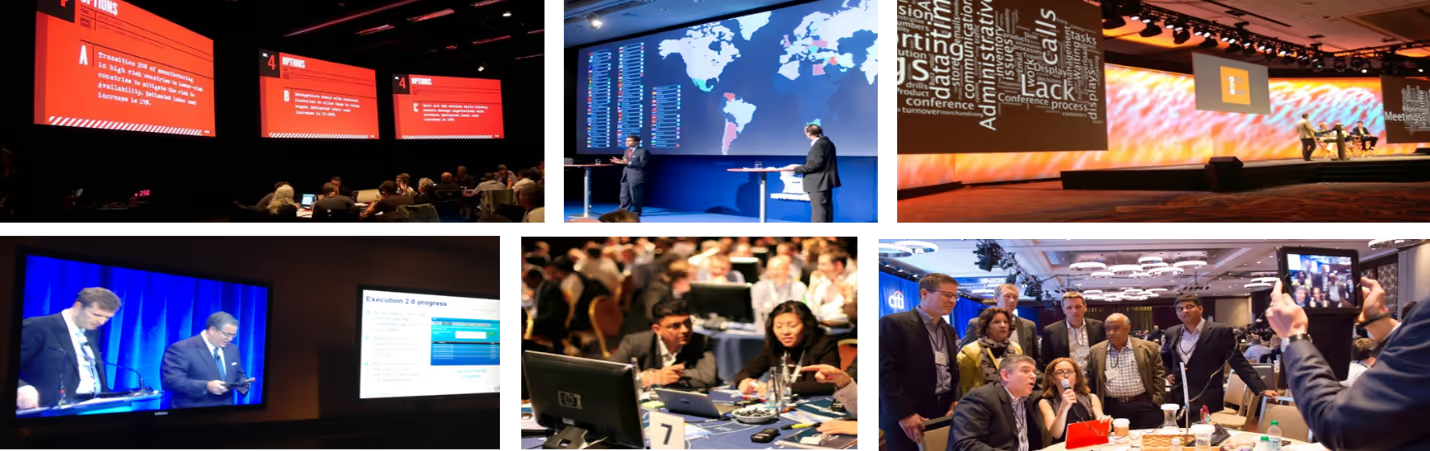
The journey would begin with a two-day live conference event for the 175 person target audience, incorporating leader-led presentations about the strategy. The event would not just be talking heads and PowerPoint slides, but rather would leverage the BTS Pulse digital event technology to increase engagement and create a two-way, interactive dialogue that captures the participants’ ideas and suggestions. Participants also would use the technology to experience a moments-based leadership simulation that develops critical communications, innovation and change leadership capabilities, among other skills.
romAfter the event, participants would return to the job to apply their new learnings. On the job, each participant would continue their journey with four one-on-one performance coaching sessions, in addition to a series of peer coaching sessions shared with four to five colleagues. They also would use 60-90 minute virtual Practice with an Expert sessions to develop specific skill areas in short learning bursts, and then practice those skills with a live virtual coach. Throughout the journey, participants would access online, self-paced modules that contain “go-do activities” to reinforce and encourage application of the innovation leadership and other skills learned during the program.
As a capstone, six months after the journey has begun, every participant would go through a live, virtual assessment conducted via the BTS Pulse platform. In three to four hours, these virtual assessments allow live assessors to evaluate each leader’s learnings from the overall journey and identify any remaining skill gaps. The individual and cohort assessment data would then lead to and govern the design of future learning interventions that would continue to ensure the leaders are capable of implementing the strategy.
As you can see, this journey design leverages a range of tools and learning methodologies to create a holistic, impactful solution. It’s not just a standalone event – each step of the journey ties into the one before, and the data gathered throughout can be used well into the future in order to shape the next initiative .
Great journeys or experiences like this can take many forms. In addition to live classroom and virtual experiences, there is an ecosystem of activities, such as performance coaching, peer coaching, practice with an expert, go-dos, self-paced learning modules, and more, that truly engage leaders and ensure that the learnings are being reinforced, built upon, practiced and implemented back on the job. We find that these types of experience rarely look the same for every client. There are many factors that determine which configuration and progression will make the most sense. There is one common theme that we have found throughout these highly contextual experiences, however – that the participant feedback is outstanding and the business impact is profound.
Related content

Related content

There’s a specific kind of strategy meeting getting scheduled right now, in nice hotels with bad coffee: the AI reset off-site.
And for good reason. In a 2026 WRITER survey, 48% of leaders described their AI rollout as, in their own words, a "massive disappointment." That's nearly half the room.
What that number really measures is the distance between what these tools can do and what people are doing with them. In our experience, that distance is almost entirely human.
Which is why the off-site is the right instinct. Making the most of that time is the harder part.
What separates an AI reset that actually changes the game from an expensive two-day conversation? In our experience, it comes down to avoiding four common design mistakes.
Mistake 1
Blaming the bots
The gap between AI investment and real adoption is almost always about people, not technology. And when adoption stalls, we usually find it's one of four things.
- They don't think it will help them
- Nobody around them is using it
- They don't feel capable
- Or they don't have real access to the tools they were promised
Four different problems, and four completely different fixes.
That's why diagnosis comes first. If you don't know which barrier you're dealing with, every intervention becomes an educated guess. And you cannot tell which one you have by staring at a dashboard. A belief gap and a skill gap look identical in a status report and need opposite interventions. Show up guessing, and you'll spend real money teaching people to use a tool they simply don't trust yet. Congratulations - you've just catered the wrong conversation.
Mistake 2
Letting leaders off the hook
One of the biggest predictors of whether change sticks is also one of the most overlooked: leadership.
If your executives show up as observers, nodding along and quietly answering email under the table, your people clock it in about four minutes.
That doesn't mean your CEO has to emcee the thing. It means they use the tools in front of everyone, participate in the conversation, and make it clear this isn't someone else's initiative.
Recently we’ve been working with a Fortune 200 global professional services firm who’s top 120 leaders were at very different points with AI. Some were redesigning entire processes. Others were using it to summarize emails, or not at all. Rather than focus on the technology, the four-hour session focused on what leaders could do with AI, applying it to a live strategic challenge and ending with a personal commitment to lead differently. The response was strong enough that the organization is now cascading the experience globally.
The lesson is simple: when leaders experience AI as a strategic capability, they're better equipped to model the behavior that makes adoption stick. Nothing you build during those two days survives without that entire chain of leadership doing its part.

Mistake 3
Chasing the wrong outcome
Without a behavioral baseline, you have no way to prove anything actually moved. No baseline, no ROI. You're just hoping the energy in the room was good, which is a wonderful feeling and a terrible metric to bring to your CFO.
But the baseline isn't just about proving the off-site worked. It's about understanding where you're starting in the first place. And you'll want that clarity, because the quiet resistance is real. In that same 2026 research, nearly a third of employees admitted to actively working around their company's AI strategy. If you don't win their belief in the room, some of them will keep politely ignoring the whole thing from their desks. You can't measure your way out of that. You have to earn your way out of it.
Which brings us to the biggest reframe of all.
Mistake 4
Leaving follow-through to chance
We've been working with a Fortune 100 medical device company on their AI strategy for three years. It started with their leadership team, a three-hour session built around what those leaders would do differently, and it landed. What became clear afterward was that the same experience needed to happen everywhere else. So, it expanded: 90-minute activations for 15,000 people, and this year intact teams redesigning their own workflows.
Three years in, that first session is the smallest part of the story.
Your event is where momentum gets created. What happens at 30, 60, and 90 days is where results get made.
If you're planning one of these and want to change what happens on Monday, not just how everyone feels on Friday, that the work we do.
We'd be glad to help you design it.

Candidates now arrive at interviews pre-coached by AI, with their resumes optimized to pass every checkpoint. Polish has stopped being a signal. The traditional hiring process was built to read exactly the cues that AI is now best at producing, and the signals hiring managers once relied on have weakened as a result. And for roles where the wrong hire carries real business consequences, losing the ability to tell who will actually perform is not a minor inconvenience. It is a material risk, and it exposes the business to unnecessary turnover, reduced performance, and heavier investment for talent growth and development.
So how do you observe the behaviors that matter most, before someone is in the role?
Not by asking better questions, but rather by putting candidates in situations designed to elicit that behavior.
The limits of predicting from paper
Credentials tell you what someone has done. Structured interviews tell you what someone says they would do. Neither lets you observe what they actually do in the moments that count.
This distinction matters most in client-facing, relationship-driven roles, where the performance gap between a strong hire and a weak one plays out in real business outcomes (revenue, retention, client growth). Organizations that hire at scale in these roles carry that gap across hundreds of decisions at a time.
The better approach is to watch candidates do the work before you hire them. Put them in simulated, role-relevant scenarios, and pair the simulation with a second, different kind of measure so no single method carries the whole decision. That combination is what lets you evaluate real performance before anyone is in the role. Organization-specific simulations provide a clear read on who is ready and capable of performing on day one. In a world of AI-supported candidate signals, the use of simulations makes the process harder to prep for. It is harder to fake. And, when designed well, it is substantially more predictive than other hiring methods.
What counts as evidence
Claims about predictive power are easy to make. Evidence for them is rarer than you would expect.
A predictive validity study, the kind that links pre-hire assessment scores to how someone actually performs once hired, is some of the hardest evidence to produce and the rarest to see. Many assessments are validated against proxies: another test, or a theoretical model of the role, rather than real results on the job. Connecting scores to concrete business outcomes and doing the statistical work to show the link holds, takes years of shared data and a level of commitment from both the assessment provider and the client that most partnerships never reach. That is precisely why it is worth asking for. A provider who can show how assessment scores track to training completion, retention, and first-year output is offering something categorically different from one who can only show a correlation with another test.
Why simulation holds up where other methods do not
When a candidate sits across from a trained assessor (someone playing the client or prospect on the other side of the conversation) and has to work through a real situation, they cannot rely on a rehearsed answer. The scenario is specific. The stakes feel real. What you see is close to what you would get on the job.
That is the value of simulation-based assessment: it does not test what candidates know about the role.
It shows how they use what they know when a real person is on the other side of the conversation, before the stakes are real.
For roles that carry significant business responsibility, this distinction is the whole game. The cost of the wrong hire in a high-stakes client-facing role is not just a missed quota for a quarter - It plays out in relationships that do not develop, clients who leave, and productivity losses that compound over time. Getting those hiring decisions right, at scale, with consistency, requires methods that are built for predictive accuracy, not just candidate experience or hiring speed.
What this means for how organizations think about hiring
Most organizations are still optimizing the wrong things in their hiring process. They invest heavily in employer branding, application flow, and interview structure, all of which matter, but less in the core question: does our hiring process actually predict who will succeed in this role?
AI has sharpened the stakes here. If every candidate can present as polished and prepared, screening based on presentation becomes less useful. What holds up is direct observation of the behaviors that the job requires.
A few principles worth building from:
- Measure what the job requires, not what is easy to measure. Cognitive tests and personality questionnaires have their place, but they do not look much like the job. The closer the assessment is to the actual work, the better it predicts performance in it.
- Ask what your assessment predicts. Training completion? Retention? First-year output? Most organizations cannot answer that question today, largely because providers have rarely been asked to prove it. It is a fair thing to ask for.
- Take the human element seriously. In a simulation, a candidate is having a real conversation, responding in real time, navigating a situation that requires judgment. Even with the help of AI, that is hard to game. And it remains one of the strongest predictors of on-the-job performance available.
The data exists to make hiring decisions more accurate, fairer, and more directly tied to business outcomes. For organizations operating in high-stakes roles at scale, there is too much on the line to rely on methods that cannot hold up to that standard.
You may be interested in BTS’ thought leadership in the five talent shifts AI is forcing now.

La IA ya forma parte del día a día de las ventas. Hoy cualquier asesor puede llegar a una reunión con datos, tendencias e insights generados en segundos. Sin embargo, disponer de más información no garantiza conversaciones de mayor valor.
A través de una experiencia real con un consultor comercial, este artículo explica por qué la inteligencia artificial funciona como un GPS: ayuda a interpretar el entorno, pero no conduce la conversación ni entiende las prioridades del cliente.
En este artículo descubrirás:
- Por qué el acceso a la información ya no supone una ventaja competitiva.
- La importancia del business acumen para interpretar los datos con criterio.
- Cómo hablar el lenguaje del cliente genera credibilidad y diferenciación.
- Por qué las relaciones B2B evolucionan hacia relaciones P2P basadas en la confianza.
- Qué capacidades consultivas seguirán siendo exclusivamente humanas incluso en la era de la IA.
La tecnología seguirá evolucionando, pero la ventaja competitiva estará en quienes sean capaces de combinar inteligencia artificial con conversaciones centradas en el cliente, pensamiento estratégico y relaciones de largo plazo.