Strategy execution
We help organizations turn strategic priorities into measurable business outcomes by aligning people, processes, and behaviors.


Enabling strategy execution at scale
Sustainable execution requires shifting the mindsets, habits, and decisions of hundreds or thousands of people simultaneously, in ways that stick.
Through immersive, scenario-based experiences and data-driven insights, we enable organizations to move beyond top-level alignment, so strategy shows up consistently in everyday decisions, behaviors, and business results.
Our approach focuses on the critical levers of execution:
- Leadership alignment
- Culture transformation
- Capability building
The BTS strategy execution formula
Why is strategy execution so difficult? In this video, BTS’s Dan Parisi introduces our Strategy Execution Formula and explains how it helps organizations turn strategy into results.
E = Alignment × Mindset × Capability
Learn how this simple but powerful framework underpins the way we work with clients to build alignment, shift mindsets, and develop the capabilities needed to execute strategy successfully.
Business acumen for leaders
According to Harvard Business Review, 67% of well-formulated strategies fail due to poor execution. One of the biggest barriers? Leaders and teams aren’t equipped to make the day-to-day decisions that strategy demands.
Our business simulations build the capabilities that drive strategy execution, developing financial, commercial, and enterprise acumen through hands-on experiences grounded in real business challenges.

What does it mean to be a Change-Ready™ organization?
Strategy execution only works if your organization can keep up with change. Priorities shift, challenges evolve, and teams are asked to adapt, often without the clarity or capability to do it well.
That’s where execution breaks down.
A Change-Ready™ organization is built to handle this - aligning quickly, adapting how work gets done, and continuing to move strategy forward. Explore our point of view to see how to build that capability in practice.
Innovation & digital transformation
Turning ideas into impact requires new ways of thinking, faster decision-making, and the ability to operate in AI- and digitally driven environments.
We help leaders and teams build those capabilities, using immersive experiences to develop the mindset and skills needed to drive innovation and execute strategy in uncertain, rapidly changing conditions.

Immersive strategy and leadership simulations
Explore some of our most popular simulation offerings, designed to improve decision-making, align teams, and drive strategy execution.
Strategy acceleration lab
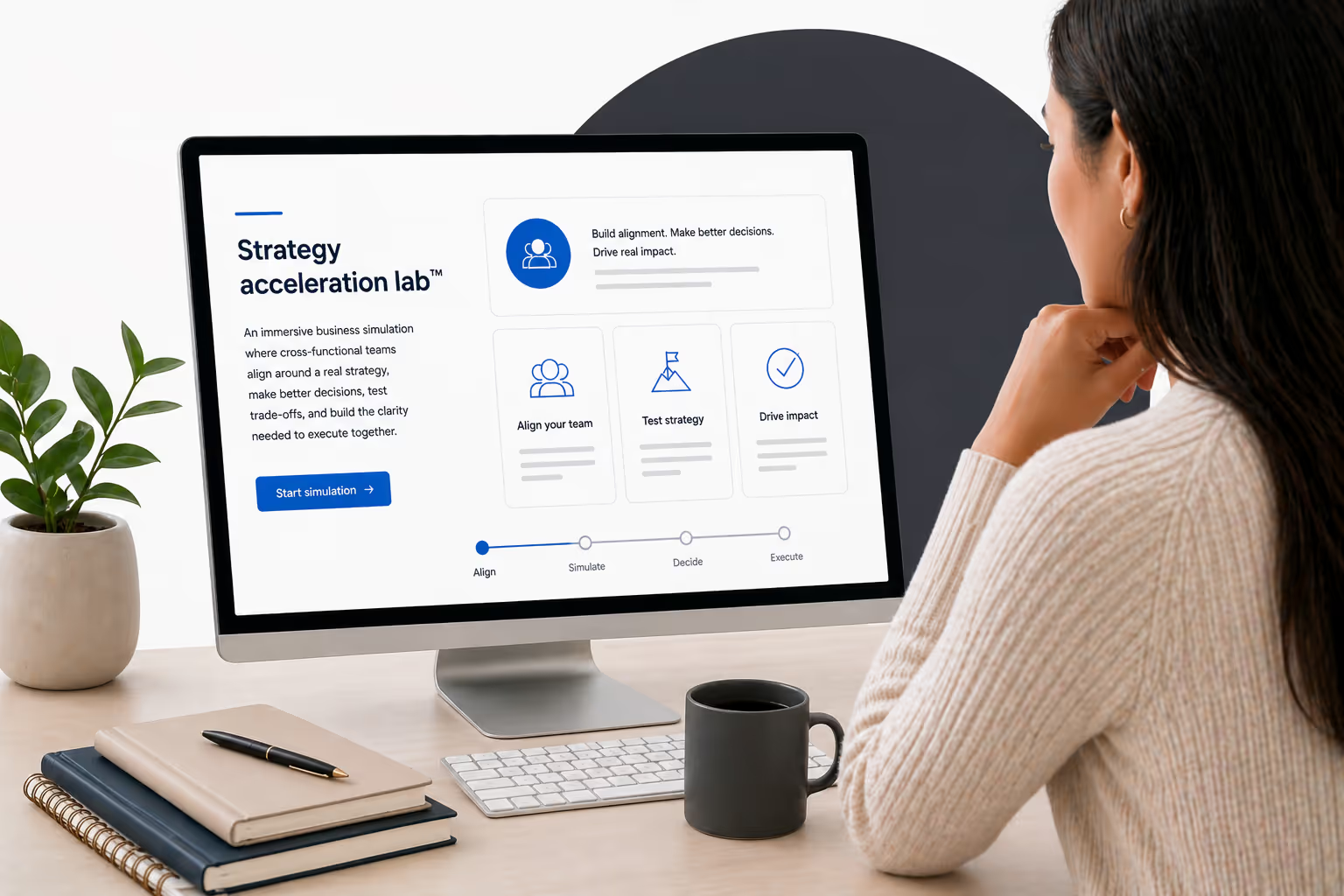
An immersive business simulation where cross-functional teams align around a real strategy, making decisions, testing trade-offs, and building the clarity needed to execute together.
Learn more
Leader lab
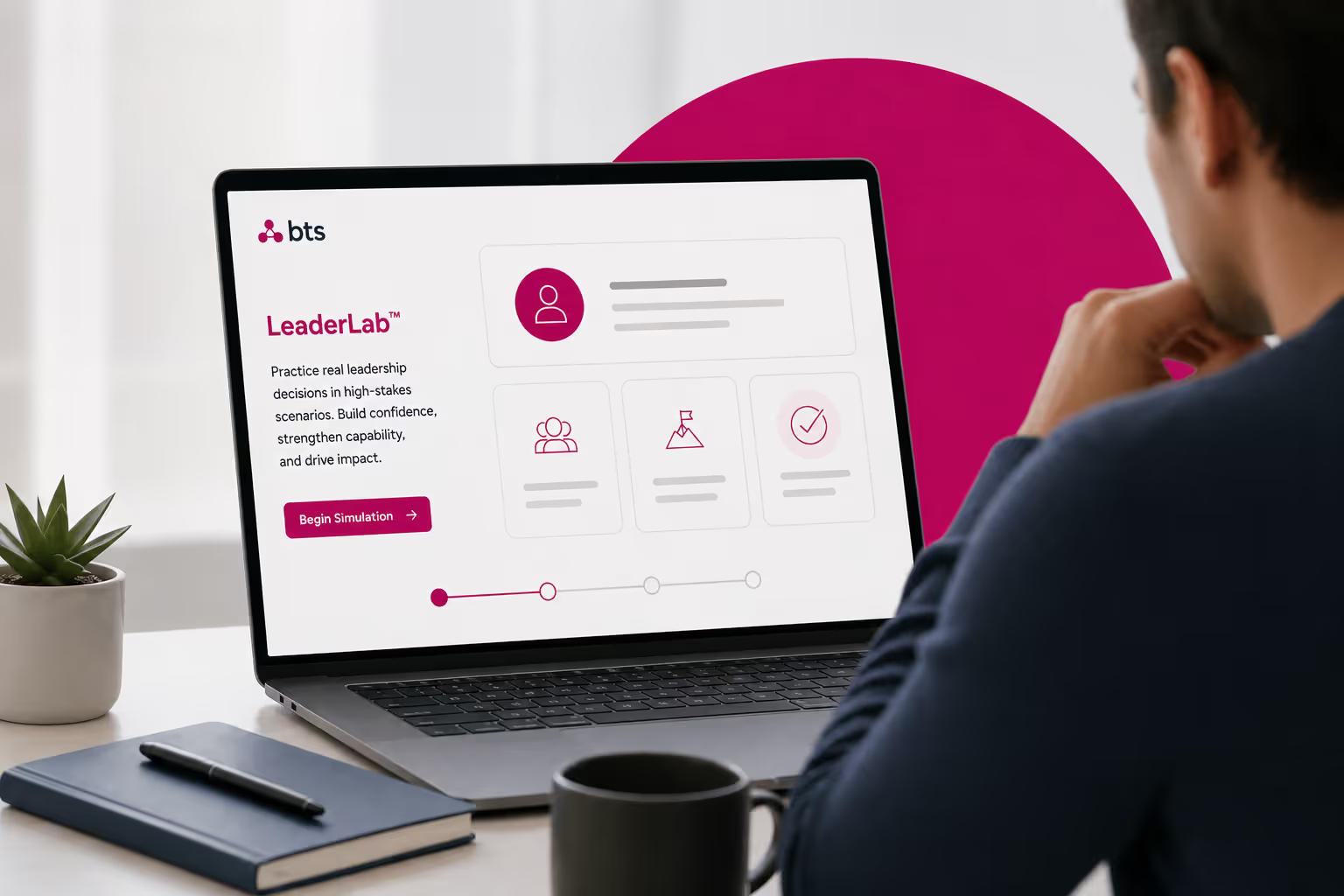
An immersive leadership simulation where frontline and mid-level leaders practice making decisions in complex, real-world scenarios to build the confidence and capability to execute strategy.

Learn moreToolkit
Learning experiences, and digital tools we use to help leaders and teams execute strategy in real-world conditions.

New on our blog

In today’s business environment, strategy no longer unfolds neatly from vision to execution. Disruption is constant, complexity is accelerating, and expectations are shifting in real time. In this context, strategy that is overly scripted becomes brittle. The organizations that thrive today are the ones that have learned to improvise. Not reactively, but with intention, agility, and confidence. To many executives, the idea of “strategy improv” might sound risky or chaotic. In truth, great improvisation is neither. It is a learned discipline rooted in presence, trust, and adaptability. It is what enables teams to respond purposefully in the face of the unexpected. And it is quickly becoming a core leadership capability for our times.
Why strategy needs to shift
For decades, the dominant model of strategy has been based on control. A select few defined the vision, cascaded goals through layers of the business, and expected execution to follow. Success was measured by fidelity to the plan. The world no longer works that way. Markets are volatile. We are in a technology super cycle. Customer needs evolve faster than product roadmaps. And the economic, geopolitical, and environmental future is increasingly uncertain. Rigid strategies struggle to survive this level of flux. They become outdated before implementation begins. Worse, they force teams into patterns of execution that ignore emerging data, evolving context, or untapped insight. What is needed now is not more precision. What is needed is more adaptability.
Strategy as intention, not prescription
In improvisational terms, a strategic plan is no longer a fixed script. It is a shared intention. It is a direction, not a destination. It is a compass, not a map. The core strategic question is no longer, “What is our five year plan?” but instead: “How do we respond wisely, quickly, and collectively to whatever emerges in service of our purpose?” This does not mean abandoning structure or discipline. In fact, it demands more of both. But the emphasis shifts from defining every move in advance to cultivating the conditions where people can make smart decisions in the moment. Here is the distinction:
- A goal says: “We will grow 17 percent in revenue.”
- An intention says: “To grow 17 percent, we will delight our clients, grow our impact, and operate with excellence to unlock long term value.”
The first is measurable. The second is both meaningful and measurable. And it is meaning that enables action when the path becomes unclear.
What improv really means
Improv in business is ripe for misunderstanding. It is not winging it or hoping for the best. Great improv is highly disciplined. It is grounded in preparation, presence, and shared principles. Here are a few improv principles that matter most for leaders and teams:
- Yes, And… Build on what is already in motion instead of shutting it down. That is how momentum grows.
- Make Your Partner Look Good. Execution is collective. Leaders who elevate others create trust and shared ownership.
- Be Present. You cannot rely on what worked yesterday or predict what comes tomorrow. Execution happens in this moment.
- Listen for What Is New. Do not just confirm your beliefs. Notice weak signals, dissenting voices, and emerging shifts.
- Commit to the Scene. Once you step in, go all in. Half-hearted execution drains energy and derails progress.
These are not stage tricks. They are everyday disciplines for how leaders and teams show up together when the path is not clear.
The boundary: What can and cannot be improvised
Not everything can or should be improvised. You cannot spin up a new factory in six weeks or redo a regulatory filing on the fly. Capital projects, infrastructure, hiring pipelines, and compliance require structure, discipline, and lead time. Within those guardrails, much of execution is improv. The actions and moves you make can and show flex with the need and the moment. Such moves might include:
- How you respond to a customer this week
- How you redeploy resources when a competitor surprises you
- How you adjust product features in response to early user feedback
The art is knowing the difference. Improv lives inside the boundaries, not outside them. And that is where the advantage lies.
We know it works
We have already seen this in action. During COVID, strategy as improv was not optional. Plans dissolved overnight. Leaders had to pivot in real time, trust their teams, and reimagine value on the fly. Many succeeded, not because they had the perfect plan, but because they had the capacity to improvise. Consider two everyday situations:
- Telecommunications company: With hardware and software tightly linked, this company faced constant tension between short-term changes in a release and the permanence of installed infrastructure. By learning to improvise in the short term with software while anchoring their long-term vision in hardware roadmaps, they delivered quick wins without derailing future value. To do so, leaders had to abandon siloed “hardware first” or “software first” thinking and live in both worlds at once.
- Global manufacturer: Preparing for volatility in regulation and transportation, this company had shifted to thinking of its manufacturing footprint as a portfolio of capabilities rather than fixed plants. When sudden shifts hit sooner than expected, they could improvise quickly, rebalancing capacity across countries, not because they were ready but because they had already rehearsed some of the moves. The adjustments were urgent, but they felt planful.
These are not exotic cases. They are reminders that when strategy execution meets reality, it is the organizations that can improvise with purpose that thrive.
From plans to response
The core strategic question has changed. It is no longer, “What is our five year plan?” but instead: “How do we respond wisely, quickly, and collectively to whatever emerges?” Capacity, creativity, and commitment to the purpose and intention of the strategy, not certainty, are now the keys to competitive advantage. Those attributes are built through people: their judgment, their alignment, and their ability to act in service of shared priorities.
How to build strategic improv into your organization
Improv is not just an individual skill. It is an organizational capacity. Here are five practical ways to embed it into how your teams work:
- Ground the organization in purpose and priorities. Make sure everyone knows the “why” behind your strategy. Not just the outcomes you are chasing, but the value you aim to create. Purpose creates the throughline that allows teams to improvise without drifting.
- Build enterprise perspective at all levels. Give people visibility into how their choices affect the whole. When teams understand upstream and downstream impacts, they act with greater confidence and coordination.
- Normalize adaptation, not perfection. Shift the narrative from flawless execution to responsive evolution. Celebrate learning, reward and highlight intelligent risk taking, and treat change as a constant, not a crisis.
- Practice collective sensemaking. Create space for cross functional conversation, reflection, and signal sensing. Encourage teams to bring forward what they are noticing, not just what they are reporting.
- Train for improvisation. Just as improv actors practice, so can your leaders. Build their capacity to navigate ambiguity, connect dots, and co-create solutions in real time. The payoff is not just agility. It is resilience.
Final thought
Strategy execution today is less about control and more about capability. It is less about knowing the answers and more about creating the conditions where your people can discover the right answers for now, together. Companies that thrive in uncertainty will not be the ones with the tightest plans. They will be the ones that can improvise with purpose, with confidence, and with each other. When the world will not wait, improv is not optional. It is the new strategic advantage.

AI is reshaping how work gets done—automating tasks, accelerating decisions, and raising expectations for speed and precision. Strategy is shifting faster than structures can adapt, leaving many leaders operating in systems that weren’t built for what’s being asked of them now. Employees are asking more of their managers—while the business is asking more of them, too. And leaders are stuck navigating it all with development priorities, operating norms, and support systems that weren’t designed for this level of speed, ambiguity, or stretch.
As expectations rise, leadership capability is under scrutiny.
But are development efforts evolving fast enough to meet the moment?
Where priorities and expectations diverge
Most leadership development programs today emphasize foundational strengths:
- Executive presence
- Personal purpose
- A growth mindset
- Empowering others
- Stretching others
In contrast, senior executives in the BTS study identified a different set of capabilities as most critical for leaders right now:
- Accountability
- Transparency
- Enterprise thinking
- Divergent thinking
The contrast reveals a disconnect between what development programs are building—and what executives believe their organizations need most from their leaders today.
How did we get here?
The expectations placed on leaders—especially at the middle—have always evolved alongside the business landscape.
In the 1990s, leadership development focused on emotional intelligence and team empowerment. The 2000s brought globalization and lean operating models, with a sharper focus on efficiency and agility. Then came digital transformation, agile ways of working, and flatter, more matrixed structures.
Each wave expanded the leadership mandate—asking leaders to become connectors, coaches, and change agents.
What’s different now is the pace and proximity of change. Strategy no longer shifts annually—it flexes monthly. And mid-level leaders are no longer simply executing someone else’s vision. They’re expected to interpret it, shape it, and deliver results through others—in real time.
At the same time, the psychological contract of work has changed. Employees want more meaning, flexibility, and support—and they often look to their managers to provide it. Add in the rise of AI and the frequency of disruption, and the expectations placed on leaders have outpaced what many development efforts were designed to support.
What’s driving the disconnect?
What we’re seeing isn’t disagreement—it’s a difference in vantage point, shaped by the distinct challenges each group is solving for. This isn’t about misaligned intent—it reflects different priorities and pressures.
Talent and learning teams often prioritize foundational capabilities because they’re proven, scalable, and critical to developing confident, human-centered leaders. These programs are designed to grow potential over time.
Executives, meanwhile, are focused on the immediacy of execution—strategy under strain, shifting priorities, and the need for alignment at speed. Their focus reflects where progress is stalling now.
Both perspectives matter. But when they remain disconnected, development risks falling out of sync with business reality—and the gap is most visible at the middle, where expectations are rising fastest.
What’s the takeaway for talent leaders now?
This moment offers more than a gap to close—it offers insight into how leadership needs are evolving.
What if the differences between these two capability lists aren’t in conflict, but in sequence? Foundational strengths help leaders show up with purpose and empathy. Enterprise capabilities help them lead across systems and ambiguity. The opportunity isn’t to choose between them—it’s to connect them more intentionally.
What’s uniquely now is the acceleration. The stretch. The pressure to reduce friction and support faster alignment. Talent leaders aren’t just being asked to build capability—they’re being asked to build momentum. That means designing development experiences that reflect complexity, enable cross-functional thinking, and help leaders decide and adapt in real time.
It also means listening more closely. The capabilities executives are calling for aren’t just wish lists—they’re signals. Signals of where transformation slows, and where leadership must evolve for strategy to move forward.
This isn’t about shifting away from what works—it’s about expanding it. To connect what leaders already do well with what the business needs next—and to do it in ways that are grounded, human, and built for today’s pace.
Shifting momentum
Leadership development isn’t just a pipeline priority. It’s a strategic lever for how your organization adapts, aligns, and accelerates through change.
This research doesn’t just reveal a skills gap—it surfaces a systems opportunity. The disconnect between talent priorities and executive expectations highlights where momentum gets lost, and how leadership development can close the space between vision and execution.
Talent leaders are uniquely positioned to reconnect the dots—between individual growth and enterprise outcomes, between what leaders learn and how they lead, between what the business says it needs and how that shows up in behavior.
So the next question isn’t just: What should we build?
It’s: How do we enable leaders to build it into the business—faster?
Every organization is navigating this differently. If you’re revisiting your development priorities or rethinking what leadership looks like in your context, let’s connect. We’re happy to share what we’re seeing—and learning—with others facing the same questions.

lorem ipsum

Get in touch
Fill out the form below and a BTS team member will get back to you as soon as possible.