Level up your leadership with BTS
Great leaders create inclusive communities and empower their team to advance to a higher level of motivation, lifting individuals, teams, and organizational results.
To be a great leader today, one must adapt quickly in a rapidly changing world while maintaining the compassion and humility needed to relate to your teams on a human level.
BTS understands leadership coaching and development better than anyone in our market. With our diverse set of tools and methods, we’ll give your leaders the tools they need to succeed.

Creating a coaching culture
Agile, people-centered organizations need their leaders to create a feedback and coaching culture. Based on the book “Four Greatest Coaching Conversations,” our award-winning approach focuses on how to spot and change mindsets in the moments that matter.

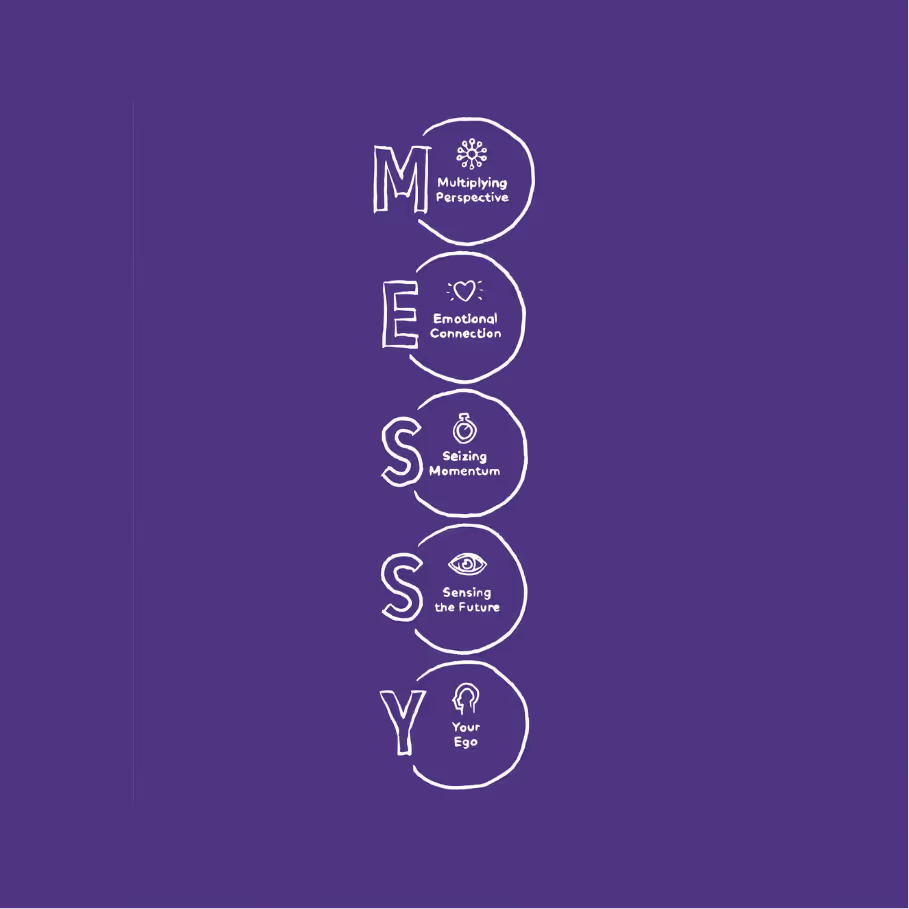
The uncommon sense of MESSY leadership
Things aren’t going back to ‘normal.’ Today’s leaders face unpredictable times, fast-changing markets, and a wide variety of new expectations. These range from their businesses’ role in creating inclusive and diverse cultures, to the speed of change, shifting work norms, and changes in the way content is consumed. Our team spoke to more than 40 of the world’s top companies to establish the kind of leadership that companies feel will best serve them in tomorrow’s world.What we’ve learned is that it’s high time that leaders get MESSY.

Developing transformational leaders at every level
Evolve your system for developing your leaders. BTS partners with clients to create curriculums for all levels of leaders that are practical, anchored in strategy, and go beyond behaviors to change mindsets. We leverage digital platforms to create a dynamic and personal learner experience all in service of helping your people do the best work of their lives.

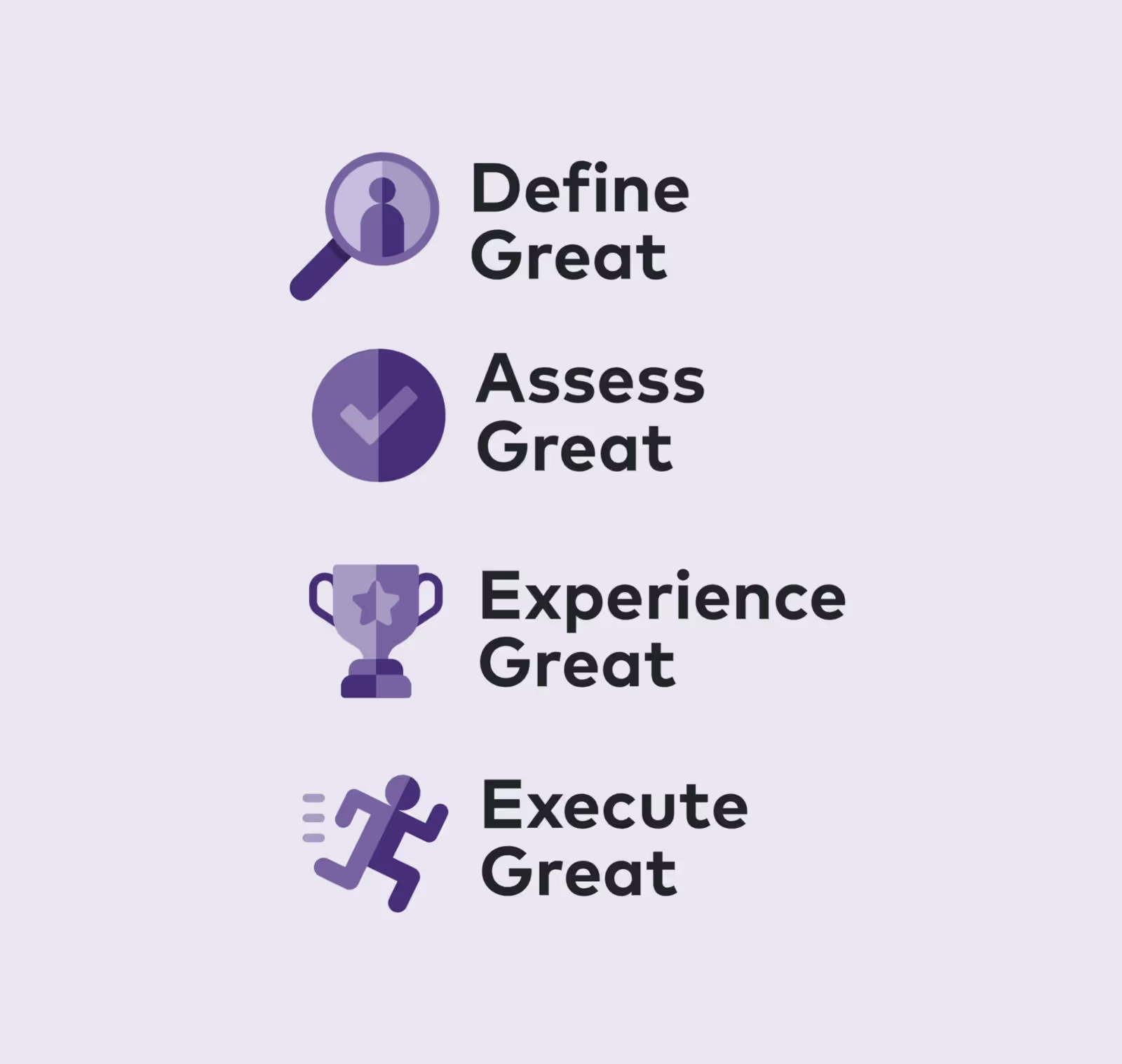
Defining GREAT for your people
Defining and bringing leadership expectations to life. Leadership is contextual and GREAT leadership is not the same from one business to another. We’ll help you define this, and execute at scale across your organization.
Executive development
Conventional development approaches separate out strategy alignment, talent assessment, and executive development. BTS brings all of these together in one experience in the same experience while leveraging the research and data from Suzanne Bates’ book “Speak like a CEO.”

School leadership
School leaders worldwide can access our award-winning leadership development through our not-for-profit initiative, BTS Spark. Flexible programs allow education leaders to strengthen their practice through workshops, coaching and online learning.

Toolkit
We believe meaningful results are achieved through a journey of learning, development, and execution. These insights allow us to create industry-leading products and experiences that can revolutionize your leadership.
The lastest in Leadership

This article was originally publish on Rotman Management
IN OUR CONSULTING WORK with teams at all levels—especially senior leadership—my colleagues and I have noticed teams grappling with an insidious challenge: a lack of effective prioritization. When everything is labeled a priority, nothing truly is. Employees feel crushed under the weight of competing demands and the relentless urgency to deliver on multiple fronts. Requests for prioritization stem from both a lack of focused direction and the challenge of efficiently fulfilling an overwhelming volume of work. Over time, this creates a toxic cycle of burnout, inefficiency and dissatisfaction.
The instinctive response to this issue is to streamline, reduce the number of initiatives, and focus. While this is a step in the right direction, it doesn’t fully address the problem. Prioritization isn’t just about whittling down a to-do list or ranking activities by importance and urgency on an Eisenhower Decision Matrix; it also requires reshaping how we approach work more productively.
In our work, we have found that three critical factors lie at the heart of solving prioritization challenges: tasks, tracking and trust. Addressing these dimensions holistically can start to address the root causes of feeling overwhelmed and lay the foundation for sustainable productivity. Let’s take a closer look at each.

Across industries, leaders agree: critical roles, those with outsized impact on organizational success on business success, deserve focused attention. And yet, most organizations still struggle to define them clearly, identify the right talent, and build the readiness needed to execute when it matters most. Despite years of investment in succession planning and high-potential pipelines, most organizations still lack the clarity and consistency needed to execute critical role strategy with confidence.
What are critical roles, really?
We define critical roles as those that disproportionately impact business outcomes and are hard to fill, often cross-functional, and deeply tied to strategic execution. They aren’t always the most senior roles, but they’re the ones that, if left vacant or poorly filled, slow down growth, innovation, or transformation. These roles often require capabilities that go beyond technical expertise like influence across silos, decision-making without full control, and the ability to navigate ambiguity.
Many organizations assume they know their critical roles, but often these definitions are inherited, outdated, or driven by hierarchy, not business value. We encourage clients to pressure-test role criticality by asking: How does the law of supply and demand apply when the demand for this critical role is high, but the supply is limited due to how difficult it is to find, train, and develop ready leaders?
The maturity challenge: what the data shows
Despite prioritizing critical roles, most organizations are not where they want to be:
- Only 21% say successors for critical roles are truly ready1
- Just 25% have clear development plans for people in these roles2
- 50% are starting to expand beyond executive roles, but definitions are still narrow3
This results in a rise of business risk. Transitions stall. Significant business moments like product launches, market expansions, or leadership shifts get delayed or derailed. Even when roles are named and successors are listed, too often it’s the same few people rotating through stretch assignments without real role-level clarity or successor variety.
Three distinct talent needs we see
At BTS, we see three pivotal talent needs organizations must design for:
- The role has evolved, but the leader hasn’t. The strategy has shifted, but expectations haven’t been redefined.
- The pipeline is unclear. It hasn’t been clearly identified who belongs on the bench or whether the right people are even in it. Without visibility and targeted development, readiness remains more of a guess than a strategy.
- A decision needs to be made now, and it must be right. The risk of getting it wrong is high, and factual, objective evidence is needed.
Readiness isn’t a one-time conversation; instead, it’s a continuous discipline. The most advanced organizations are building systems, not just lists.
Seven enablers of a critical role strategy
In our work across industries, the most effective organizations are building discipline around critical roles, not just process. We’ve identified seven drivers that consistently separate high-performing strategies from reactive ones. These show up in different ways depending on where an organization is at on their journey:
- Strategic alignment: Roles are clearly tied to business goals and future priorities.
- Role definition: Roles are defined by impact, not hierarchy.
- Building profiles: The definition of success in role is based on the future, not the past.
- Wide-ranging talent pipelines: Bench strength reflects diversity of experience, geography, background, and perspective.
- Immersive development: Successors build real readiness through stretch roles, simulations, and job previews. Coaching enhances these experiences by helping leaders process feedback, build self-awareness, and apply learning to their context.
- Retention strategy: Incumbents are supported with personalized development and visible investment.
- Continuity planning: Institutional knowledge is captured and transitioned before it walks out the door.
What great looks like in practice
Most organizations rely on role titles, tenure, and intuition. But that’s not enough for roles that carry real risk. Organizations that are closing the readiness gap are doing more than refreshing succession charts. They’re investing in: custom success profiles, assessment-backed talent decisions, and development experiences that reflect the real demands of the role. Great organizations don’t just offer development; they also create role-specific experiences that build the judgment, fluency, and resilience required for the real pressures of the job. It’s not just about knowledge; it’s about role conditioning.
How future-ready is your approach? A quick checklist
Use this checklist to pressure-test the strength of your critical role strategy:
- Have you defined critical roles based on future business impact, not just titles?
- Are success profiles aligned with what the business will require tomorrow?
- Do you know who’s in your bench and how ready they are?
- Are your placement decisions based on structured assessment, not gut feel?
- Are your successors learning through stretch experiences and role previews?
- Are incumbents receiving targeted support that drives their retention and growth?
- Do you have a plan for knowledge transfer if someone in a critical role left today?
What you can do now
- Clarify what roles are truly critical by future impact, not just past precedent
- Be honest about readiness and measure it before placing someone in role
- Invest intentionally and build immersive, real-world development to match role demands
- Don’t confuse visibility with readiness; make decisions based on data, not familiarity
- Prepare leaders before they transition into a critical role so they’re ready to thrive from day one
Critical roles don’t just need names next to them. They need clarity, intention, and investment. Organizations that treat critical role strategy as a leadership capability, not just a process, are the ones driving growth and resilience in today’s market. This isn’t just about building a bench. It’s about building belief, from the front line to the C-suite, that the right people are leading in the moments that matter most.
1Gartner, 2023 report
2The Talent Strategy Group, Critical Roles Report, Apr 2025
3Korn Ferry, Revamping Succession Planning, Nov2023 report

Each business revolution has reshaped not only how businesses operate, but how they organize themselves and empower their people. From the industrial age to the information era, and now into the age of artificial intelligence, technology has always brought with it a reconfiguration of authority, capability, and judgment.
In the 19th century, industrialization centralized work and knowledge. The factory system required hierarchical structures where strategy, information, and decision-making were concentrated at the top. Managers at the apex made tradeoffs for the greater good of the enterprise because they were the only ones with access to the full picture.
Then came the information economy. With it came the distribution of information and a need for more agile, team-based structures. Cross-functional collaboration and customer proximity became competitive necessities. Organizations flattened, experimented with matrix models, and pushed decision-making closer to where problems were being solved. What had once been the purview of a select few, judgment, strategic tradeoffs, and insight became expected competencies for managers and team leads across the enterprise.
Now, AI is changing the game again. But this time, it’s not just about access to data. It’s about access to intelligence.
Generative AI democratizes access not only to information, but to intelligent output. That shifts the burden for humans from producing insights to evaluating them. Judgment, which was long the domain of a few executives, must now become a baseline competency for the many across the organization.
But here’s the paradox: while AI extends our capacity for intelligence, discernment, the human ability to weigh context, values, and consequence, is still best left in the hands of human leaders. As organizations begin to automate early-career work, they may inadvertently erase the very pathways and opportunities by which judgment was built.
Why judgment matters more than ever
Deloitte’s 2023 Human Capital Trends survey found that 85% of leaders believe independent decision-making is more important than ever, but only 26% say they’re ready to support it. That shortfall threatens to neutralize the very productivity gains AI promises.
If employees can’t question, challenge, or contextualize AI’s output, then intelligent tools become dangerous shortcuts. The organization stalls, not from a lack of answers, but from a lack of sense-making.
What organizations must do
To stay competitive, organizations must shift from simply adopting AI to designing AI-aware ways of working:
- Build new learning paths for judgment development. As AI replaces easily systematized tasks, companies must replace lost learning experiences with mentorship, simulations, and intentional development planning.
- Design workflows that require human input. Treat AI as a co-pilot, not an autopilot. Embed review checkpoints and tradeoff discussions. Just as innovation processes have stage gates, so should AI analyses.
- Make judgment measurable. Assess and develop decision-making under ambiguity from entry-level roles onward. Research shows the best learning strategy for this is high-fidelity simulations.
- Start earlier. Leadership development must begin far earlier in career paths, because judgment, not just knowledge, is the new differentiator.
What’s emerging is not just a flatter hierarchy, but a more distributed sense of judgment responsibility. To thrive, organizations must prepare their people not to outthink AI, but to out-judge it.
Building an inclusive Multiplier culture
BTS partnered with a tech and manufacturing company to create a program that equips leaders with cross-cultural and organizational skills.

Leading during uncertainty
A leading consumer goods business partnered with BTS to equip leaders with the skills to manage through and out of a period of uncertainty.

The Change-Ready Leader
A global manufacturing company partnered with BTS to align its leaders to a new strategy and go-to market approach.

The people side of agile transformation…
A leading American financial services corporation partnered with BTS to become more agile and customer-centric.


Ready to start a conversation?
Every successful transformation begins with a meaningful conversation. Connect with us to explore how BTS can partner with you to make the shift.

.avif)