Services

The world’s most business-centric talent insights partner

Powerful experiences immerse participants in key elements of the business and leadership challenges of the role.

Real-world experiences drive real-world results.

Real-world experiences drive real-world results.

We believe context matters. Our assessments are about leading your business, not any business, and mirror the dynamics of your business and culture. We build our assessments with real people in mind and create experiences optimized for engagement, scientific and practical, that create value at all levels of talent and through all stages of their career.

We strive to go beyond the traditional client-vendor relationship to be your total people partner.

How we help

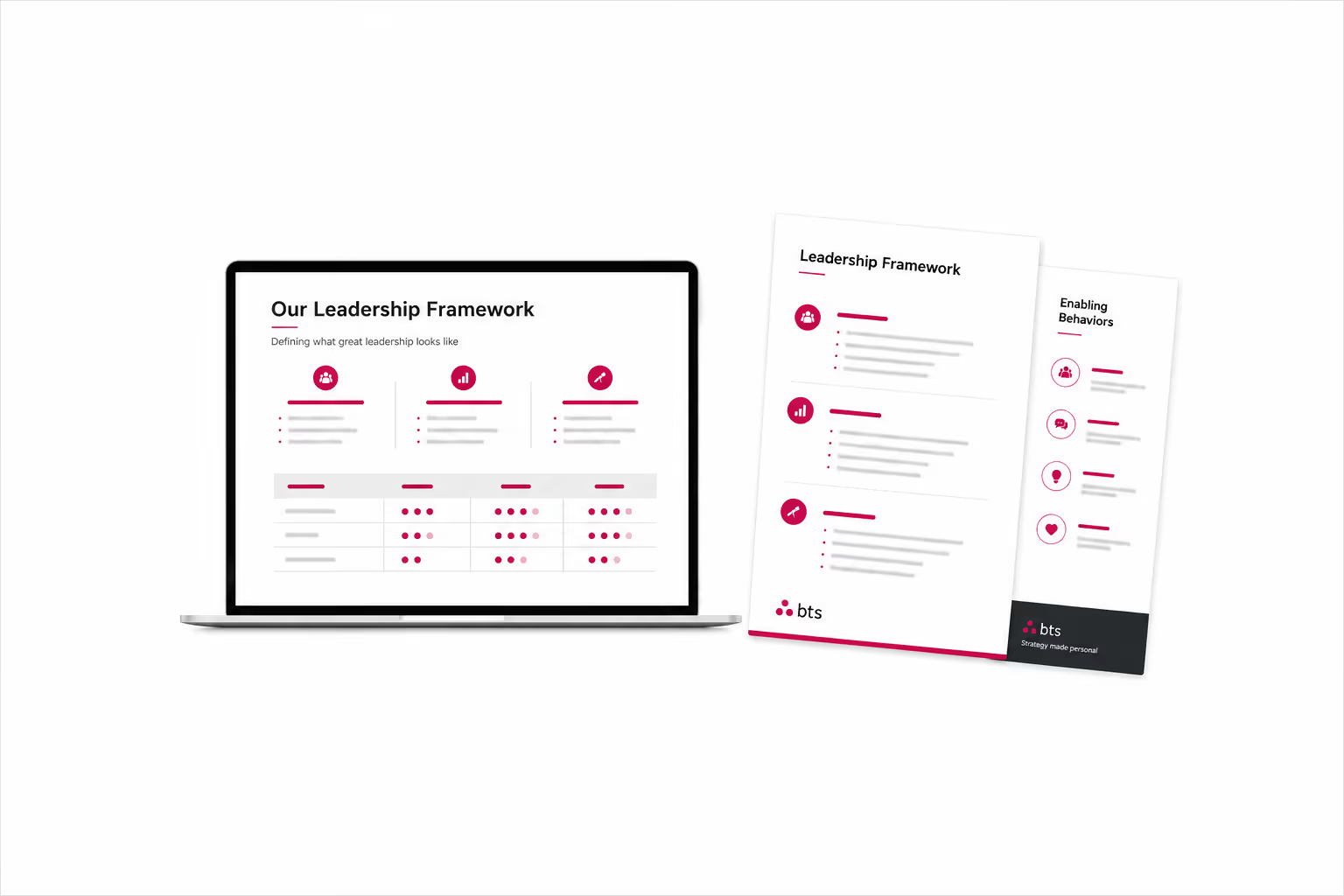
Talent frameworks

Define what great leadership looks like in your organization.

Talk to an expert
How we help

Talent acquisition

Select the best new talent in a way that promotes diversity and accelerates business success

Talk to an expert
How we help

Talent and leadership development

Accelerate the development of new capabilities and values needed to shape your future

Talk to an expert
How we help

High potential identification

Identify and develop rising leaders who will have a profound impact on the future.

Talk to an expert
How we help

Succession

Create a leadership bench for strategically important roles

Talk to an expert
How we help

Talent analytics

Inform talent planning and decision-making with data-driven insights.

Talk to an expert

Toolkit

BTS believes that meaningful results are achieved through a journey of learning, development, and execution. Because we sit at the intersection of consulting and training, we have a front-row seat in this journey. These insights allow us to create industry-leading products and experiences that can revolutionize your talent.

01

Business Simulations

Simulations enable participants to experience a new strategy personally in a highly realistic environment, allowing them to see its value and experience great execution.

02

BTS Coach

By combining our robust technology stack, our global footprint, and our innovative, research-driven approach, BTS has made leadership coaching more accessible than ever at a scale previously unimaginable.

03

Leadership Assessments

In these highly competitive markets and changing times, having an accurate understanding of a person’s capabilities has never been more critical. BTS offers assessments that evaluate a candidate’s fit within your company as well as the development areas of existing talent.

04

Great Framework

Every organization has leaders who perform better than others. We codify what these leaders do differently and build Great Profiles and Great Playbooks to create experiences that improve performance. We then follow up with fully integrated tools to ensure these lessons are applied on the job.

05

Digital Services

From mobile apps to connected portals, BTS creates immersive, interactive digital experiences that enable participants to build skills, align with organizational strategies, and drive results.

06

Culture of Innovation

We believe that openness is key to making innovation a part of your culture. This requires that your company embrace uncertainty, experimentation, and a willingness to challenge the assumptions that made it successful in the first place.

What's trending

Blogposts
November 14, 2025
5
min read
From top-down to judgment all around: The AI imperative for organizations
Discover why AI makes human judgment the new competitive edge and how organizations can develop leaders ready to out-judge, not out-think, AI.

Each business revolution has reshaped not only how businesses operate, but how they organize themselves and empower their people. From the industrial age to the information era, and now into the age of artificial intelligence, technology has always brought with it a reconfiguration of authority, capability, and judgment.

In the 19th century, industrialization centralized work and knowledge. The factory system required hierarchical structures where strategy, information, and decision-making were concentrated at the top. Managers at the apex made tradeoffs for the greater good of the enterprise because they were the only ones with access to the full picture.

Then came the information economy. With it came the distribution of information and a need for more agile, team-based structures. Cross-functional collaboration and customer proximity became competitive necessities. Organizations flattened, experimented with matrix models, and pushed decision-making closer to where problems were being solved. What had once been the purview of a select few, judgment, strategic tradeoffs, and insight became expected competencies for managers and team leads across the enterprise.

Now, AI is changing the game again. But this time, it’s not just about access to data. It’s about access to intelligence.

Generative AI democratizes access not only to information, but to intelligent output. That shifts the burden for humans from producing insights to evaluating them. Judgment, which was long the domain of a few executives, must now become a baseline competency for the many across the organization.

But here’s the paradox: while AI extends our capacity for intelligence, discernment, the human ability to weigh context, values, and consequence, is still best left in the hands of human leaders. As organizations begin to automate early-career work, they may inadvertently erase the very pathways and opportunities by which judgment was built.

Why judgment matters more than ever

Deloitte’s 2023 Human Capital Trends survey found that 85% of leaders believe independent decision-making is more important than ever, but only 26% say they’re ready to support it. That shortfall threatens to neutralize the very productivity gains AI promises.

If employees can’t question, challenge, or contextualize AI’s output, then intelligent tools become dangerous shortcuts. The organization stalls, not from a lack of answers, but from a lack of sense-making.

What organizations must do

To stay competitive, organizations must shift from simply adopting AI to designing AI-aware ways of working:

  • Build new learning paths for judgment development. As AI replaces easily systematized tasks, companies must replace lost learning experiences with mentorship, simulations, and intentional development planning.
  • Design workflows that require human input. Treat AI as a co-pilot, not an autopilot. Embed review checkpoints and tradeoff discussions. Just as innovation processes have stage gates, so should AI analyses.
  • Make judgment measurable. Assess and develop decision-making under ambiguity from entry-level roles onward. Research shows the best learning strategy for this is high-fidelity simulations.
  • Start earlier. Leadership development must begin far earlier in career paths, because judgment, not just knowledge, is the new differentiator.

What’s emerging is not just a flatter hierarchy, but a more distributed sense of judgment responsibility. To thrive, organizations must prepare their people not to outthink AI, but to out-judge it.

Blogposts
October 17, 2025
5
min read
High-performing teaming
New BTS research reveals a gap between what leaders are working hardest on in their teams and what actually sets the highest performers apart.

Work today is too complex for individuals to succeed in isolation, and almost every critical decision, innovation, or transformation depends on teams working effectively together. To understand what actually makes those teams work, BTS analyzed 6,702 leader coaching goals and 3,211 leadership team survey responses using our High-Performing Team Assessment model, comparing what leaders say they are working on with what teams say is getting in their way.

Blogposts
October 17, 2025
5
min read
A brave new world: What AI means for leadership and culture
Discover how AI is reshaping leadership and culture. Why jazz leadership, simulation, and re-skilling are essential to unlock the full value of AI across teams.

At BTS, we’re constantly challenging ourselves to innovate at speed. And right now, it feels like we’re standing at the edge of something massive. The energy? Electric. The velocity? Unprecedented. For many of us, the current pace feels a lot like the early days of the pandemic: disorienting, high-stakes, and somehow exhilarating. And honestly—it should feel that way. Our teams have been tinkering with AI, specifically LLMs, for the past 2.5 years and it has really been in the last eight months that I can see the profound impact it is going to have for our clients, for our services and our operating model.

The opportunity isn’t about the technology. The world has it and it’s getting better by the minute. The issue is people and people’s readiness to adopt it and be re-tooled and re-skilled. It’s about leadership. AI is deeply personal, it’s surgical. In fact, that’s its genius. So, getting full scale adoption of AI, re-tooling everyone in the company by workflow, so that they can invent new services, unlock new customer value, unlock new levels of productivity, even use it for a better life, is the current race. The central question I’ve been wrestling with, alongside our clients and our own teams, is this:

What does AI actually mean for leadership and culture?

And the answer is clearer by the day: AI isn’t just a new toolset. It’s a new mindset. It demands that we rethink how we lead, how we learn, and how we build thriving organizations that can compete, adapt, and grow.

The productivity paradox revisited

Let’s start with the elephant in the boardroom. There’s been a lot of buzz around AI and its promises. But many leaders have quietly wondered: Will any of this actually move the needle? A year ago, we were asking the same thing. We had licenses. We had curiosity. We had early experiments. But the results were modest, a 1% productivity gain here or there. But by April, we were seeing:

  • 30–80% productivity gains in software engineering
  • 9–12% gains in consulting teams
  • 5%-20% improvements in client success and operations

Just as importantly, the innovation unlock and creativity across our platforms due to vibe coding along with new simulation layers, is leading to new value streams for our clients. This isn’t theoretical. It’s not hype. It’s real. The difference? Adoption, ownership, and a shift in how we lead in order to energize the AI innovation within our teams. The challenge now isn’t whether AI creates value. It’s how to unlock and scale that value across teams, geographies, and business units—and do it fast.

Two Superpowers of the Agentic AI Era

In working with leaders across industries, I’ve come to believe in two superpowers (there are more as well) that will unlock the potential of this AI era: Jazz Leadership and a Simulation Culture.

1. Jazz Leadership

Forget the orchestra (although personally I am a big fan.) The successful team cultures that are innovating with AI feel more like jazz. In jazz, there’s no conductor. There’s no fixed sheet music. There are core bars and then musicians make up music on the spot based on each other’s creativity, building off of each other’s trials, riffs and mistakes, build something extraordinary together. This is how experimenting with AI today, in the flow of work, feels like.

For each activity across a workflow, how can new AI prompts, agents, and GPTs make it better, codify high performance, drive speed and quality simultaneously? How can we try something totally different and still get the job done? How might we re-invent how we work? That’s how high-performing teams operate in the AI era. The world is moving too fast for command-and-control leadership, a perfect sheet of music with one leader who is interpreting the sheet music and directing. What we need instead is improvisation, trust, shared authorship, courage and a playful spirit because there are just as many fails as breakthroughs.Jazz leadership is about creating the conditions where:

  • Ideas can come from anywhere
  • People see tinkering and testing as key to survival and AI failures mean your team is at the edge of what’s possible for your services and ways of working
  • Leaders say, “I don’t have all the answers, but I’ll go first, with you”
  • People feel “I’m behind relative to my peers in the company” and the company sees this as a good sign because the pace of learning with AI means higher chance of success in the new era

At BTS, we recently promoted five new partners who embody this mindset. They weren’t the most traditional leaders. But they were the most generative. They coached others. They experimented and are constantly re-tooling themselves and others. They inspired movement. They are keeping us ahead, keeping our clients ahead and driving our re-invention. Jazz leaders make teams better, not by directing every note—but by setting the stage for breakthroughs. It is similar to the agile movement, similar to how it felt in Covid as companies had to reinvent themselves. It’s entrepreneurial, chaotic and fun.

2. Simulation Culture

The ability to simulate is a super-power in this next agentic, AI era. Simulation has always been part of creating organizational agility, high performance and leadership excellence. But AI and high-performance computing have transformed it into something bigger, faster, and infinitely more powerful. It means that building a simulation culture is within all of our grasp, if we tap its power.Today, companies simulate:

  • Strategic alternatives - from market impact all they way to detailed frontline execution
  • New business, new markets and operating models
  • Major capital deployment e.g. build a digital twin of a factory before breaking ground
  • Initiative implementation
  • Workflows current and future
  • Jobs to assess for talent and critical role readiness
  • Customer conversations and sales enablement motions

With a simulation culture, where you regularly engage in scenario planning and expect preparation and practice as a way of working, billions in capital is saved, cross-functional teams are strengthened, high performance gets institutionalized, win rates increase, earnings and cash flow improves.

Where to get started

Below are a few examples of what leading organizations are doing. Consider testing these in your own organization:

  • Conversational AI bot platforms used to scale performance expectations and the company’s unique culture.
  • Agentic simulations built into tools so people can prepare and practice with 100% perfect context and not a wasted moment.
  • Digital twins of the job created so that certifications and hiring decisions are valid.
  • Micro-simulations spun up in hours to align 50,000 people to a shift in the market or a new operational practice.

Final Thoughts

  • Lead like a jazz musician. Embrace improvisation, courage and shared creativity.
  • Build a simulation culture. Because in a world that’s moving this fast, practice isn’t optional—it’s how we win.

This is a brave new world. Not five years from now. Right now.Let’s shape it—together.

Client stories

AstraZeneca’s Liz Moran talks about their need for global succession processes


Learn more
Client Stories

Pfizer’s Connie Bustamonte talks about their need to level up their leadership

Learn more
Client Stories

A new strategy needs different talent

A global utility company with diverse, internationally distributed business units in a variety of functional areas, was experiencing a shift in strategy following a major change in leadership. The organization partnered with BTS to identify the right people who had the potential to develop into the next generation of C-suite leaders.

Learn more
Client stories

Talent selection in Financial Services

Ready to start a conversation?

Every successful transformation begins with a meaningful conversation. Connect with us to explore how BTS can partner with you to make the shift.