
Henrik Ekelund Selected as One of Five Finalists
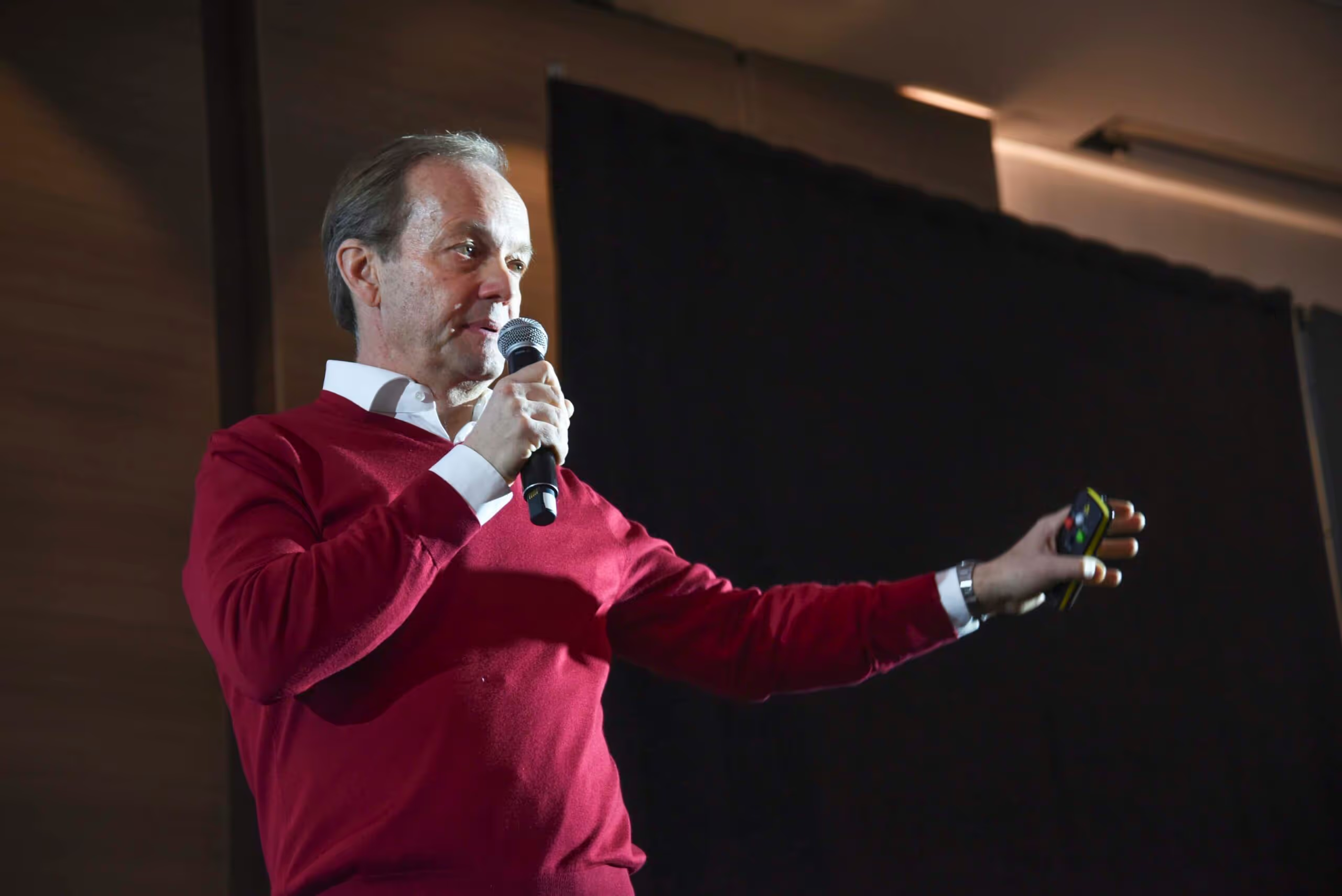
STOCKHOLM & SAN FRANCISCO--(BUSINESS WIRE)--Henrik Ekelund, founder and CEO of BTS GROUP AB (publ), a world-leading strategy implementation firm, was recently recognized by SvD, a leading Swedish daily newspaper, as one of five finalists in its “2021 Business Achievement of the Year” Awards.
Henrik Ekelund, Founder and CEO of BTS Group AB, Selected as One of Five Finalists in SvD’s “2021 Business Achievement of the Year” Awards due to BTS’s Transformation to Virtual Solutions
Tweet this
“It is an honor to be selected,” said Ekelund. “We are grateful to be recognized among many of Sweden’s leading organizations for our entrepreneurial efforts, specifically the rapid expansion of our virtual capabilities and products to deliver our solutions to anyone, anywhere.”
SvD’s “Business Achievement of the Year” award highlights business leaders who inspire growth, endure struggle, and dare to dream that their organization will become the next global leader. The competition, instituted in 2014, is held in collaboration between SvD and the Swedish investment bank Carnegie. Previous winners include leading organizations such as Spotify.
In the 2021 competition, Ekelund and BTS were selected as a finalist by popular vote. A jury will select a winner among the five finalists and the award will be presented in a virtual ceremony by Prince Daniel, the Spouse of Princess Victoria, the Crown Princess of Sweden, on May 11th, 2021 in connection with the Swedish Young Entrepreneurship Champions.
About BTS Group AB
BTS is a global professional services firm that partners with clients to enable strategy execution. We provide the skills, tools, and knowledge so people understand how their daily work impacts business results. We are experts in behavior change, care deeply about delivering results, and inspire people do the best work of their lives. It’s strategy made personal.
BTS is a public company trading on the Nasdaq Stockholm under the symbol BTS B.
About SvD
Svenska Dagbladet (SvD), founded in 1884, is a national subscription newspaper with head offices in Stockholm. SvD is a daily publication which focuses on in-depth coverage in its weekend editions in the form of supplements and magazines. In 2005 and 2010, the newspaper was voted the Newspaper of the Year in Sweden. Its circulation figures have risen dramatically in recent years.
Contacts
Rick Cheatham
CMO
rick.cheatham@bts.com
+1 (512) 897-9594
Related content
Something has been breaking in sales for years. Alexander Group's 2024 sales compensation study found that only 49% of core sellers hit or exceeded quota in 2023, across nine industries. In software sales specifically, where the erosion tends to be sharpest, several long-running benchmarks, compiled across Salesforce, Bridge Group, RepVue, and Pavilion Revenue Collective, put median account executive quota attainment at roughly 52%, essentially a coin flip.
But here's the kicker: in that same Alexander Group study, the average seller still reached 89% of target.
Those two numbers only square one way. If a meaningful share of sellers were falling far short of target, the average would sit well below 89%. It doesn't, which means the misses across that other 51% are mostly narrow, not collapses.
49% of core sellers hit or exceeded quota in 2023, across nine industries
89% average percent of target still reached by the average seller in that same study
52% median attainment in software sales specifically, an even sharper version of the same trend
Across industries and benchmarks, attainment has been drifting down, but this isn't a story about a handful of great sellers carrying the number while everyone else is falling dramatically behind. The typical seller is getting close to quota.
Sellers aren't suddenly incapable of selling. The context around selling has changed.
Buyers still need sellers, they just need them differently
1. Sellers aren't guiding a single buyer anymore
Complex sales now involve 6 to 10 stakeholders, and the biggest enterprise purchases can involve well into the double digits. About 77% of buyers describe their last purchase as complex or difficult, a dynamic that shows up anywhere a purchase has real consideration behind it, not only in enterprise software. The seller's job is increasingly to help a group reach a decision, not simply help one person make one.
2. The seller's information advantage is shrinking
Buyers now use about 10 interaction channels during a purchase, roughly twice as many as in 2016. AI is accelerating that shift, giving buyers more ways to research, compare, and pressure-test options before they ever engage a seller. The value of simply knowing more than the buyer is disappearing.
3. Buyers can avoid seller friction for longer
A recent B2B buyer behavior study found that about two-thirds of buyers would rather not engage a salesperson until later in their process. Separately, Gartner found a smaller but still meaningful share, about a third of buyers overall and 44% of millennial buyers, who want no sales contact at all. The same pattern shows up anywhere a purchase has real consideration behind it, from enterprise software to a major purchase a family researches for weeks before ever talking to a salesperson. It's easier than ever to research a category, build a shortlist, and develop a point of view without talking to sales. That means sellers have to earn their way into the conversation by adding value, not just showing up.
4. Sellers are becoming sense-makers
Buyers aren't necessarily struggling to find information.They're struggling to determine what to trust, what matters, and what to do with it. In fact, 69% say they turn to sales reps to validate AI-generated insights.
How this changes the kickoff
All of this has big implications for the one moment each year when we bring the entire commercial organization together to prepare for the year ahead: the kickoff.
Put those four shifts together and the implication is direct. If sellers now have to facilitate a group decision instead of a single conversation, earn their way in with value instead of information, and help buyers make sense of what they've already found on their own, then two days of strategy decks, product updates, and a motivational keynote will not build any of those muscles. Most kickoffs are still designed for a seller with an information advantage. Very few are designed for a seller who must do all four of the things above.
The good news? You don't need to scrap the kickoff, you just need to redesign it.
That's work we do with clients all the time, across sales kickoffs and other high-stakes moments where strategy needs to become action.
And, in the spirit of not gatekeeping the good stuff, here's what a kickoff designed to change behavior needs to get right at each stage: before it happens, during the event itself, and in the months after everyone goes home.
Before
Start with the change, not the agenda
This is where many sales kickoffs go wrong. They start with the event: strategy update, product roadmap, messaging, breakouts, keynote. The agenda becomes the organizing principle.
Flip it. Start with the behavior you need to change, then design the kickoff around it.
That means thinking beyond the room itself: what needs to happen before people arrive, what they need to experience and practice during the event, and what needs to happen after they get back to work.
THE TEST
Can you name one behavior this kickoff needs to change, in a single sentence, before a single agenda item gets picked?
Find the real constraint
Most revenue leaders have a hypothesis about what's holding their teams back. Few have enough data to know.
We ran a readiness diagnostic, what we call a Commercial Velocity Diagnostic, for a financial services client preparing for an AI leadership event. The leadership team came in expecting the biggest barrier to be skepticism: would sellers believe AI could help them sell differently?
They were wrong.
Sellers and leaders already believed in the value of AI. The real gap was much more practical: confidence and ability. People understood the promise but weren't yet sure how to use it in their day-to-day work or bring it into a client conversation.
That changed the intervention completely. Instead of spending the event convincing people that AI mattered, we could spend the time helping them use it.
SO WHAT?
That's what a good diagnostic buys you: permission to change the plan.
A useful diagnostic doesn't need to be complicated. The version we typically run takes 15 to 20 minutes per person and, when deployed across the full population, gives leaders a ranked view of the constraints by region, function, or level, assessing everything from strategy clarity to manager effectiveness to whether the right tools are actually being used in the field.
It also gives you a baseline for the behavior you're trying to change. Without a clear starting point, there's no way to know whether the kickoff moved the needle.
Get leaders ready before the room
Leader preparation shouldn't be a briefing the night before.If leaders aren't aligned on the change, the room won't be either.
Before the wider team arrives, leaders need to understand the data, the capability gap, and, most importantly, what they need to do differently to close it.
The strongest version we've run gives leaders a dedicated session ahead of the main event. They arrive aligned on what needs to change, why it matters, and how they'll reinforce it with their teams.
THE TEST
Can every leader explain what their team needs to change, how the kickoff will help, and what they'll do differently afterward? If not, you're asking the organization to change before its leaders are ready to lead the change.
During
Get people working, not watching
Most events fail for an unglamorous reason: people sit and watch.
If you want behavior change, the room needs to feel more like the work and less like a conference.
A simple experiential architecture works:
Start with the real work. Put people into a live or simulated situation before explaining the framework.
- Let them see the gap. Pause and reflect before introducing the solution. Let the insight come from the room.
- Give them something to try. Introduce the model, tool, or methodology when people have a reason to use it.
- Practice before they leave. Don't assume understanding will translate into behavior. Let people try the new behavior while they're still in the room.
Skip the practice and you have awareness. Practice it and you have a shot at behavior change.
This isn't a small-scale idea. One global technology company runs its entire annual kickoff this way: every year, tens of thousands of sellers work through a live simulation of the coming fiscal year's go-to-market strategy before it becomes real, built with BTS. Reps are inside the situation before anyone explains the framework, they see where their own instincts fail, and they practice the year's strategy before the year starts for real. The client's own enablement leadership has pointed to an unexpected side effect: running kickoff as a shared simulation built genuine community across a large, remote, global workforce, not just skill.
Put your leaders to work too
Leaders should facilitate, participate, join teams at the tables, and model the behaviors they're asking others to adopt.
If executives are on stage for 20 minutes and gone by lunch, you've designed a broadcast.
People notice the gap between what leaders say matters and what they spend their time doing.
THE TEST
Did leaders do the same work they're asking their teams to do?
After
Build reinforcement into the work
This is where a lot of the investment quietly disappears.
Managers today are carrying more people and more work than ever before. Gallup reports that the average number of direct reports per manager rose from 10.9 in 2024 to 12.1 in 2025. Yet managers remain one of the biggest variables in whether new behaviors stick: Gallup estimates they account for at least 70% of the variance in team engagement.
So don't give managers another program to administer.
Make the first 90 days part of the design:
- Weeks 1–2: Translate the kickoff into 90-day commitments with clear owners and dates. Give leaders an executive synthesis they can use with their teams.
- Days 30–60: Bring managers together in peer groups of 6 to 8 to compare what's working. Give them simple guides they can use in one-on-ones and pipeline reviews.
- Day 90 and beyond: Connect the new behaviors to business-led check-ins and actual performance.
This isn't a theoretical sequence. In one engagement, we ran a 12-week, AI-embedded capability journey alongside a live product launch, reaching more than 100 commercial team members across 6 languages.
The results?
45% improvement in year-one launch revenue attainment vs. the prior launch cohort
63% increase in assessed manager coaching capability
SO WHAT?
That second number is worth pausing on. It measures exactly what this section argues for: managers coaching the new behavior, not just attending a workshop about it.
Make leaders accountable for what happens next
Leaders set the expectation, managers coach it, executives model it, and the organization measures it.
No platform substitutes for a manager asking about the behavior in a one-on-one.
THE TEST
90 days out, can a participant remember the last time their manager asked about the behavior? If they can't, the kickoff probably didn't stick.
The opportunity is bigger
The best kickoffs don't just get everyone aligned on the year ahead. They create a shared understanding of what selling requires now, give people a chance to practice it, and make it easier to carry that behavior back into the work.
If you remember nothing else from this piece, take this question into the planning process for your next event:
When your sellers walk back into the field on Monday, what will they be able to do that they couldn't do before?
If you have a good answer, you're probably on the right track.
Ready to redesign your next kickoff?
Let's talk about what your sellers need to walk back into the field able to do differently.
Get in touch with BTS

There’s a specific kind of strategy meeting getting scheduled right now, in nice hotels with bad coffee: the AI reset off-site.
And for good reason. In a 2026 WRITER survey, 48% of leaders described their AI rollout as, in their own words, a "massive disappointment." That's nearly half the room.
What that number really measures is the distance between what these tools can do and what people are doing with them. In our experience, that distance is almost entirely human.
Which is why the off-site is the right instinct. Making the most of that time is the harder part.
What separates an AI reset that actually changes the game from an expensive two-day conversation? In our experience, it comes down to avoiding four common design mistakes.
Mistake 1
Blaming the bots
The gap between AI investment and real adoption is almost always about people, not technology. And when adoption stalls, we usually find it's one of four things.
- They don't think it will help them
- Nobody around them is using it
- They don't feel capable
- Or they don't have real access to the tools they were promised
Four different problems, and four completely different fixes.
That's why diagnosis comes first. If you don't know which barrier you're dealing with, every intervention becomes an educated guess. And you cannot tell which one you have by staring at a dashboard. A belief gap and a skill gap look identical in a status report and need opposite interventions. Show up guessing, and you'll spend real money teaching people to use a tool they simply don't trust yet. Congratulations - you've just catered the wrong conversation.
Mistake 2
Letting leaders off the hook
One of the biggest predictors of whether change sticks is also one of the most overlooked: leadership.
If your executives show up as observers, nodding along and quietly answering email under the table, your people clock it in about four minutes.
That doesn't mean your CEO has to emcee the thing. It means they use the tools in front of everyone, participate in the conversation, and make it clear this isn't someone else's initiative.
Recently we’ve been working with a Fortune 200 global professional services firm who’s top 120 leaders were at very different points with AI. Some were redesigning entire processes. Others were using it to summarize emails, or not at all. Rather than focus on the technology, the four-hour session focused on what leaders could do with AI, applying it to a live strategic challenge and ending with a personal commitment to lead differently. The response was strong enough that the organization is now cascading the experience globally.
The lesson is simple: when leaders experience AI as a strategic capability, they're better equipped to model the behavior that makes adoption stick. Nothing you build during those two days survives without that entire chain of leadership doing its part.

Mistake 3
Chasing the wrong outcome
Without a behavioral baseline, you have no way to prove anything actually moved. No baseline, no ROI. You're just hoping the energy in the room was good, which is a wonderful feeling and a terrible metric to bring to your CFO.
But the baseline isn't just about proving the off-site worked. It's about understanding where you're starting in the first place. And you'll want that clarity, because the quiet resistance is real. In that same 2026 research, nearly a third of employees admitted to actively working around their company's AI strategy. If you don't win their belief in the room, some of them will keep politely ignoring the whole thing from their desks. You can't measure your way out of that. You have to earn your way out of it.
Which brings us to the biggest reframe of all.
Mistake 4
Leaving follow-through to chance
We've been working with a Fortune 100 medical device company on their AI strategy for three years. It started with their leadership team, a three-hour session built around what those leaders would do differently, and it landed. What became clear afterward was that the same experience needed to happen everywhere else. So, it expanded: 90-minute activations for 15,000 people, and this year intact teams redesigning their own workflows.
Three years in, that first session is the smallest part of the story.
Your event is where momentum gets created. What happens at 30, 60, and 90 days is where results get made.
If you're planning one of these and want to change what happens on Monday, not just how everyone feels on Friday, that the work we do.
We'd be glad to help you design it.

Candidates now arrive at interviews pre-coached by AI, with their resumes optimized to pass every checkpoint. Polish has stopped being a signal. The traditional hiring process was built to read exactly the cues that AI is now best at producing, and the signals hiring managers once relied on have weakened as a result. And for roles where the wrong hire carries real business consequences, losing the ability to tell who will actually perform is not a minor inconvenience. It is a material risk, and it exposes the business to unnecessary turnover, reduced performance, and heavier investment for talent growth and development.
So how do you observe the behaviors that matter most, before someone is in the role?
Not by asking better questions, but rather by putting candidates in situations designed to elicit that behavior.
The limits of predicting from paper
Credentials tell you what someone has done. Structured interviews tell you what someone says they would do. Neither lets you observe what they actually do in the moments that count.
This distinction matters most in client-facing, relationship-driven roles, where the performance gap between a strong hire and a weak one plays out in real business outcomes (revenue, retention, client growth). Organizations that hire at scale in these roles carry that gap across hundreds of decisions at a time.
The better approach is to watch candidates do the work before you hire them. Put them in simulated, role-relevant scenarios, and pair the simulation with a second, different kind of measure so no single method carries the whole decision. That combination is what lets you evaluate real performance before anyone is in the role. Organization-specific simulations provide a clear read on who is ready and capable of performing on day one. In a world of AI-supported candidate signals, the use of simulations makes the process harder to prep for. It is harder to fake. And, when designed well, it is substantially more predictive than other hiring methods.
What counts as evidence
Claims about predictive power are easy to make. Evidence for them is rarer than you would expect.
A predictive validity study, the kind that links pre-hire assessment scores to how someone actually performs once hired, is some of the hardest evidence to produce and the rarest to see. Many assessments are validated against proxies: another test, or a theoretical model of the role, rather than real results on the job. Connecting scores to concrete business outcomes and doing the statistical work to show the link holds, takes years of shared data and a level of commitment from both the assessment provider and the client that most partnerships never reach. That is precisely why it is worth asking for. A provider who can show how assessment scores track to training completion, retention, and first-year output is offering something categorically different from one who can only show a correlation with another test.
Why simulation holds up where other methods do not
When a candidate sits across from a trained assessor (someone playing the client or prospect on the other side of the conversation) and has to work through a real situation, they cannot rely on a rehearsed answer. The scenario is specific. The stakes feel real. What you see is close to what you would get on the job.
That is the value of simulation-based assessment: it does not test what candidates know about the role.
It shows how they use what they know when a real person is on the other side of the conversation, before the stakes are real.
For roles that carry significant business responsibility, this distinction is the whole game. The cost of the wrong hire in a high-stakes client-facing role is not just a missed quota for a quarter - It plays out in relationships that do not develop, clients who leave, and productivity losses that compound over time. Getting those hiring decisions right, at scale, with consistency, requires methods that are built for predictive accuracy, not just candidate experience or hiring speed.
What this means for how organizations think about hiring
Most organizations are still optimizing the wrong things in their hiring process. They invest heavily in employer branding, application flow, and interview structure, all of which matter, but less in the core question: does our hiring process actually predict who will succeed in this role?
AI has sharpened the stakes here. If every candidate can present as polished and prepared, screening based on presentation becomes less useful. What holds up is direct observation of the behaviors that the job requires.
A few principles worth building from:
- Measure what the job requires, not what is easy to measure. Cognitive tests and personality questionnaires have their place, but they do not look much like the job. The closer the assessment is to the actual work, the better it predicts performance in it.
- Ask what your assessment predicts. Training completion? Retention? First-year output? Most organizations cannot answer that question today, largely because providers have rarely been asked to prove it. It is a fair thing to ask for.
- Take the human element seriously. In a simulation, a candidate is having a real conversation, responding in real time, navigating a situation that requires judgment. Even with the help of AI, that is hard to game. And it remains one of the strongest predictors of on-the-job performance available.
The data exists to make hiring decisions more accurate, fairer, and more directly tied to business outcomes. For organizations operating in high-stakes roles at scale, there is too much on the line to rely on methods that cannot hold up to that standard.
You may be interested in BTS’ thought leadership in the five talent shifts AI is forcing now.