Scaled coaching
Everything you need to scale coaching - powerful software, world-class leadership coaches, and expert program design, all in one flexible platform.












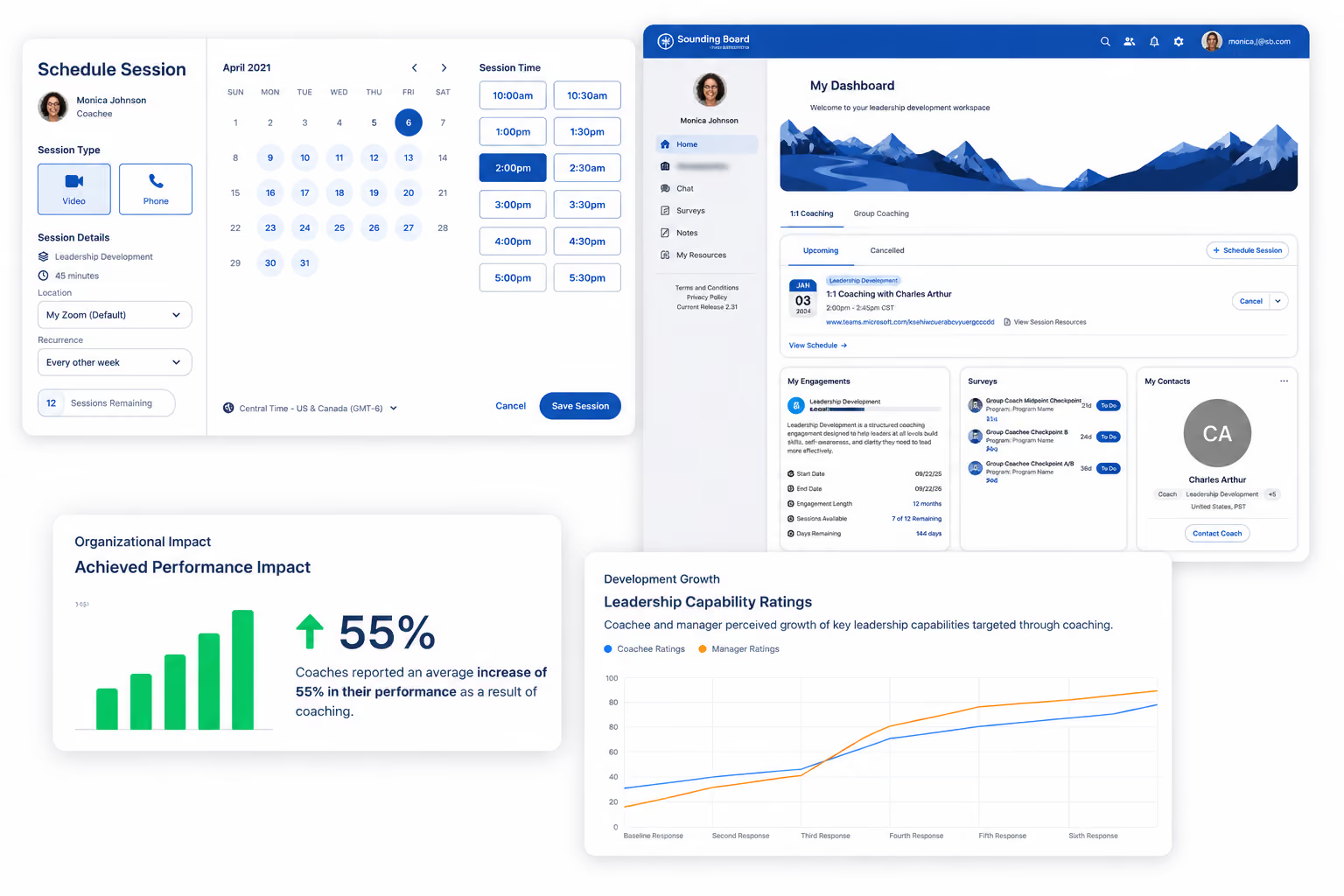
See, shape, and scale coaching across your organization
Sounding Board helps organizations scale coaching with greater consistency and visibility, combining a global network of accredited coaches with a platform to manage programs, track progress, and measure outcomes. As part of BTS’s end-to-end coaching approach, it enables high quality coaching to reach leaders at every level, aligned to your business context.
Benefits and features
Automated coach matching
Our proprietary matching algorithm matches your leaders with the right coach from the start. Our 97% first match rate ensures fit and engagement from the start.
Track progress and measure impact
Monitor coaching activity, capability development, and progress toward goals with built-in analytics, giving you a clear view of the impact of coaching on your business.
Configured to your business and leadership expectations
Coaching is aligned with your organization's business strategy, culture and leadership expectations, ensuring that the development has organizational impact.
Scale consistently across the enterprise
Align experiences across teams and regions while connecting development to real business outcomes, so you can clearly see what’s working and prove the value of your investment.
1:1 Coaching
Personalized coaching designed to help leaders navigate challenges, strengthen self-awareness, and accelerate professional growth. Each session is tailored to individual goals, opportunities, and development needs.
Group Coaching
A collaborative coaching experience that brings peers together to learn, reflect, and grow. Participants gain new perspectives, build stronger connections, and develop leadership capabilities through shared dialogue and guided discussion.
360 Debriefs
A structured feedback process that provides leaders with valuable insights from colleagues, direct reports, and stakeholders. Debrief sessions help identify strengths, uncover development opportunities, and create actionable growth plans.
Bring scaled coaching to your organization
Request a demo

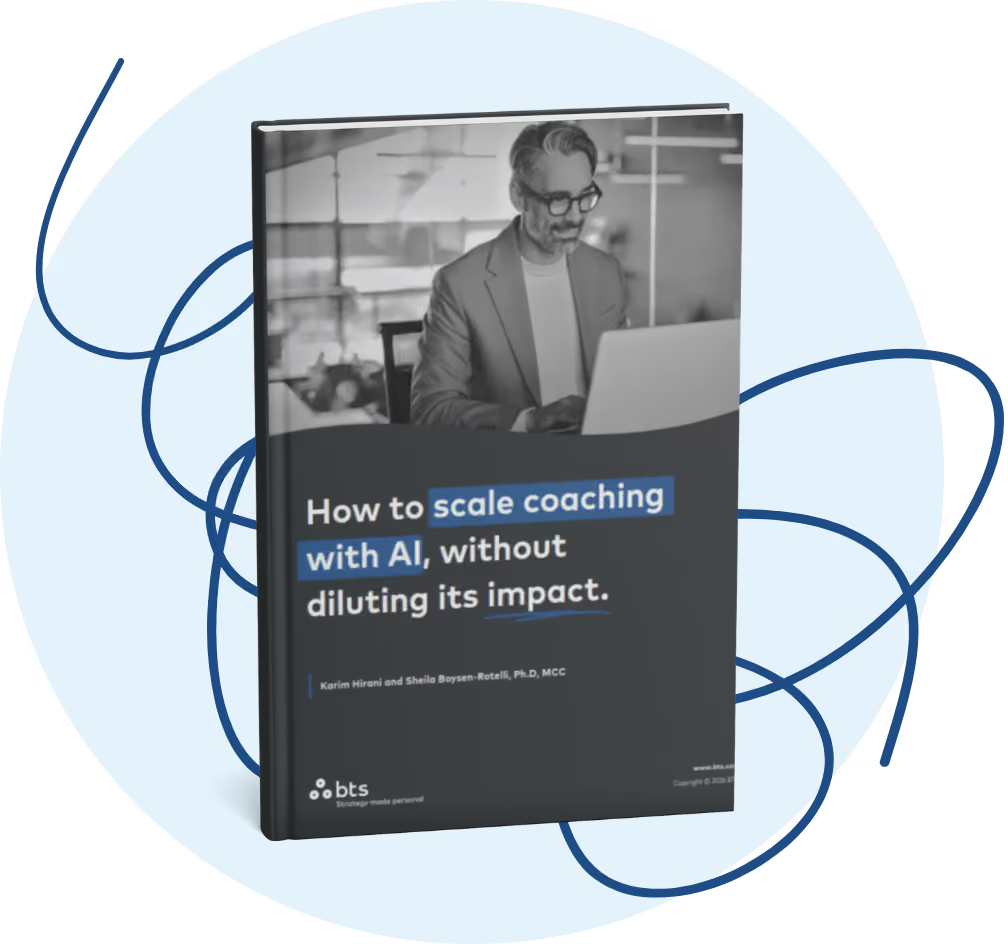
How to scale coaching with AI, without diluting its impact
How do you scale leadership coaching with AI without losing its impact? We break down the design principles, ethics, and human-AI balance that make it work.
Designed for leaders at every level




New managers
Secure the future of your organization with a strong leadership pipeline. Help new managers thrive by fostering their development from the start.

Emerging leaders
Unlock the potential of emerging leaders by building foundational capabilities, increasing retention, and accelerating their transition into strategic leadership roles.

Change-ready leaders
Accelerate the evolution of your organization. Support your agents of change by developing the key capabilities needed to initiate and influence.

Mid level leaders
Equip mid-level leaders to translate strategy into action, lead high-performing teams, and drive consistent business results.

New on the blog


Organizations have long wanted to scale coaching, but have been limited by cost and capacity. With AI, that's beginning to change as new platforms make coaching more accessible, flexible, and available on demand, extending support beyond a select group of leaders to entire populations.
For talent leaders, this shift creates both opportunity and complexity. With greater reach comes a new set of trade-offs: how to balance access with depth, flexibility with accountability, and efficiency with meaningful development.
The limits of unlimited (coaching).
Unlimited coaching sounds like the obvious answer. Remove the barriers, give everyone access, let people engage on their own terms. What's not to like?
In practice, quite a bit.
When coaching has no defined structure or cadence, engagement tends to become episodic - people show up when something feels urgent and step back when it doesn't. The coaching relationship never quite deepens. Conversations cover ground but don't build on it. And the development that was supposed to happen keeps getting pushed to the next session, and the next.
Three patterns emerge:
- Sporadic engagement over sustained development. Without a rhythm to anchor the work, coaching becomes reactive. Clients bring whatever is most pressing that week rather than working toward something larger. Progress happens in bursts, if at all.
- Insights that don't compound. Great coaching reveals patterns over time - things a client can't see in one session but can't unsee after several. Without continuity, and without a consistent coaching relationship to hold the thread, each conversation starts close to zero.
- Outcomes that are hard to measure. No milestones. No defined endpoint. No clear way for the organization, or the client, to know whether it's working. Activity fills the gap where impact should be.
The result is a model that's easy to scale and hard to defend. Which is exactly the problem talent leaders are navigating right now.
The relationship is the lever.
Decades of research into what makes coaching work keeps arriving at the same answer: it's the relationship. Not the platform, not the methodology. The relationship.
When a coach and client build trust over time, developing shared language, and returning to the same themes with increasing depth, something shifts. Conversations get more honest. Insights stick. The client starts doing the work between sessions, not just during them. That's when coaching becomes genuinely transformative, and it can't be rushed or replicated in a one-off session.
The ICF and EMCC are clear on this: continuity is what dives outcomes. The coaching engagements that produce lasting change are the ones where each session builds on the last, not the ones that simply offer more access.
Three principles make that possible: Consistency, Continuity, and Completion.
1. Consistency
The foundation everything else is built on.
The temptation when designing a coaching program is to treat flexibility as a feature - let people book when they want, swap coaches freely, engage on their own schedule. But frequent coach changes reset the clock. Every new coach has to earn trust, learn context, and find their footing with the client. That's time spent getting started, not getting somewhere.
A stable coaching relationship works differently:
- The coach starts to see around corners, uncovering patterns the client can't see on their own
- The client stops performing and starts being honest
- The relationship itself becomes a source of accountability, not just the sessions
Consistency doesn't constrain the work. It's what makes the deeper work possible.
2. Continuity
What turns a series of sessions into genuine development.
Without continuity, coaching tends to be additive at best- each session offers something useful, but nothing compounds. With it, the work builds on itself in ways that can't happen in isolated conversations.
What continuity makes possible:
- A limiting belief surfaced in session three becomes a thread that runs through the rest of the engagement
- A behavioral pattern the client couldn't see at the start becomes impossible to ignore by the end
- Space opens up for the harder work - the kind that requires sitting with discomfort across multiple sessions, not resolving it quickly and moving on
That slower, deeper work is where lasting change actually happens. It doesn't come from more sessions. It comes from the right sessions, in the right order, with the same person.
3. Completion
The most underrated principle of the three.
In a world of unlimited access, there's no finish line, and without one, it's surprisingly hard to know what you're working toward, or whether you've gotten there. A defined endpoint changes the entire shape of an engagement.
A clear endpoint creates urgency and focuses every session on what matters most.
- Shifts the question from "what should we talk about this week?" to "what do we need to accomplish before we're done?"
- Gives both coach and client a body of work to look back on, not just a log of conversations
For talent leaders, this is also what makes coaching legible as an investment. Sessions logged is an activity metric. A cohort of leaders who completed a structured engagement and can articulate what changed, that's a result.
Don't just scale it, design it (here’s how)
The opportunity in front of talent leaders right now is significant. The organizations that will get the most from this moment are the ones that treat coaching design as seriously as coaching delivery.
Practical design decisions:
- Define the arc before you launch: set the number of sessions, the cadence, and the goals upfront, not after people have already started booking
- Protect the coaching relationship: Make coach switching the exception, not the default, and design your program to discourage unnecessary re-matches
- Build in milestones: create structured check-ins at the midpoint and end of each engagement so progress is visible to both the coach and the organization
- Separate on-demand support from developmental coaching: Use AI-enabled tools for in-the-moment guidance, and reserve structured engagements for the deeper work
- Measure completion, not just activation: Track how many people finish an engagement, not just how many start one
Questions to pressure-test your design:
- Does every participant know what they're working toward before their first session?
- Can your coaches see enough context about a client's journey to pick up where they left off?
- Would you be able to show, at the end of a cohort, what changed, and for whom?
Access opened the door. Intention is what makes it worth walking through.

If you want to understand where the pressure is building in your organization, look at your middle managers. They sit at the center of it all—and that center is under strain.
They’re expected to lead strategic change, drive culture, retain talent, and hit performance goals—all while translating executive vision into everyday action. But they’re often doing it without clear direction, real-time feedback, or consistent development support.
And now the data confirms it: the squeeze is real—and getting tighter. In 2025, 45% of middle managers report burnout—higher than any other group. Only 21% say they’re thriving. (Future Forum, Gallup) That’s not just a warning sign. It’s a leadership risk.
The rising cost of holding the middle
Middle managers aren’t just task owners—they’re the force that connects vision to execution. And we’re asking them to do more than ever:
- Lead through ambiguity
- Coach and develop teams
- Champion DEI and hybrid culture
- Balance employee expectations and business constraints
- Prepare for next-level leadership roles
They’re expected to model the organization’s values while delivering results. But the systems designed to support them haven’t evolved at the same pace. They rely on outdated perspectives on learning and capability building, and are often informal at best.
The result? Too many managers are being asked to grow faster than the organization is growing its capacity to support them.
Burnout isn’t a side effect—it’s a signal
When middle managers burn out, business performance suffers.
- Middle managers are 3 times more likely to leave (Future Forum, 2025)
- Their teams underperform or disengage
- Innovation, development, and inclusion efforts lose momentum
Burnout isn’t just about wellbeing—it’s about organizational readiness.
It’s not just about removing pressure. It’s about reinforcing strength.
The most common response to manager burnout is to “lighten the load.” But that doesn’t address the structural issue. You can remove a few books from the shelf. But if the structure was never designed to hold the weight, it still bends under pressure.
Managers don’t just need less work. They need better support systems.
What effective support looks like in 2025
The most forward-looking organizations are shifting away from ad hoc fixes and leaning into investing in structured, measurable capability-building. It’s not about more content. It’s about developing real, sustained leadership capacity. The organizations who are embedding development into the flow of work are developing managers who don’t just cope, they grow.
What’s working:
- Co-created goals between managers and senior leaders
- Ongoing reflection and feedback loops that build self-awareness
- Development experiences that stretch leadership capability in real time
- Targeted support that improves coaching, communication, and decision-making
When support is consistent and measurable, managers build the adaptability, clarity, and presence needed to lead through complexity—not just react to it.
Coaching interventions
Managers who are truly effective aren’t just trained—they’re supported by coaching that strengthens behavior change over time, connects individual development to real business goals, and builds a sustainable leadership pipeline. It’s massive part of how organizations move from check-the-box training to actual transformation. For years most organizations have understood the value of coaching their senior executives. It’s those enterprises who have figured out the power that coaching unlocks at the manager level are ahead of the game now.
Building stronger foundations, not just lighter loads
The middle manager squeeze isn’t going away, but it can be addressed.
That shift starts when organizations move beyond burnout mitigation toward embedding strategic development systems that build real leadership capacity—and track progress along the way.
Because when you strengthen the center, you strengthen the whole organization.
Want to see how leading companies are building manager capability at scale?
Now part of BTS, Sounding Board brings a clearer, data-backed view of what’s working—and where high-performers need to grow next via:
- Goal alignment – See progress tied to your strategy
- Behavioral growth – Track real shifts in how leaders show up
- Self-awareness – Build reflection through feedback and assessments
- Cohort insights – Spot trends, surface gaps, and scale what works

lorem ipsum

lorem ipsum

Get in touch
Want to know how BTS can help your business? Fill out the form, and someone from our team will follow up with you.