Why we didn't wait: A CEO's field notes from two years of applied AI
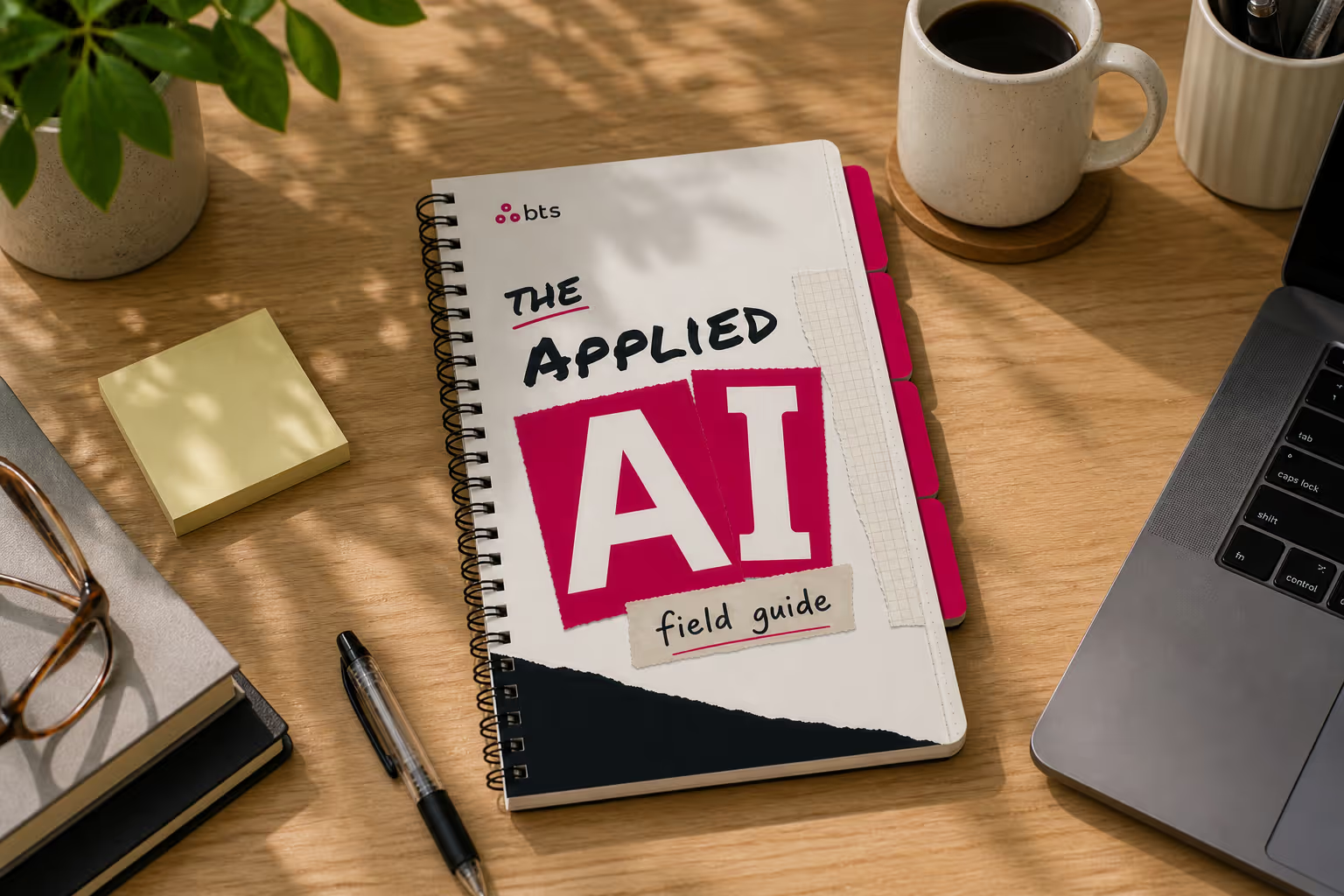
AI value is compounding, not linear. BTS CEO Jessica Skon shares how experimentation fuels flywheels, and how breakthrough “AI diamonds” emerge and scale.
April 29, 2026
5
min read
Subscribe to the BTS newsletter
Follow us on Linkedin
Follow BTS on Linkedin
Share

Three decisions that changed everything.

Two years ago, we made three deliberate decisions about how BTS would move with Applied AI.

We would become our own Customer Zero.

While others were building strategies, defining governance, and waiting for clarity, we made a different call: we decided not to wait. Not because the stakes were low, but because they were high. And because in a space evolving this quickly, clarity wouldn’t come from planning. It would come from movement.

So instead of starting with a roadmap, we started with three principles:

  1. No top-down mandate. The people closest to the work figure it out.
  2. IT must evolve from gatekeeper to enabler - leading AI trials and fast experimentation.
  3. Don’t wait for certainty.

We set the organization in motion, and once we did, things started to move quickly.

What if we started this company today?

Waiting for certainty is itself a choice, and it’s costing companies more than they realize.

We started where we knew the work best: our simulations. No perfect plan, just teams moving, trying, and iterating.

Simulations are core to who we are at BTS. Companies that simulate don’t just make better decisions they execute faster and build more engaged cultures.

The team asked a simple question:

"What if we were to start our company today?”

That question started the flywheel.

They asked IT for a few licenses and started building - vibe-coding, writing agents, and testing tools - moving at a pace that would makeany VC-backed start-up smile.

The messy middle.

At first, the team was underwhelmed.

The early reports were blunt:

“Not good with math.”

“Poor graph capabilities.”

The team wasn't discouraged.

They kept tinkering - jumping between tools, staying on top of new releases, experimenting constantly.

This was a small team, across 24 countries, building off each other’s ideas. Laughing at crazy creations. Breaking things. Iterating in a sandbox alongside real clientwork.

Each cycle produced something:

  • A sharper scenario
  • A faster build
  • A more powerful simulation

The flywheel was turning, and it was generating something real.

When the diamond appeared.

Then something shifted.

The team moved into client trials across five countries. They figured out ISO compliance and built the architecture to handle the complexity, the “spaghetti.”

And what emerged wasn’t incremental:

  • What used to take weeks started happening in days.
  • Limited creativity started to feel like unlimited innovation.
  • Clients became self-serving.
  • Agentic simulations were built directly into client systems for real-time updates and preparation.

This was our first AI diamond - a high-impact outcome created by many cycles of experimentation compounding into real value.

It only appeared because we kept the flywheel turning, each cycle increasing the odds that something would break through.

95% adoption in eight weeks.

Then it was time to take the AI diamond global.

BTS is decentralized and highly entrepreneurial. We operate across 24 countries and 38 offices, where local teams have real autonomy.

And historically? That’s meant a low appetite for adopting something built somewhere else and pushed from the center.

So we expected resistance.

Instead, something surprising happened.

In the first eight weeks, we saw 95% adoption across our global footprint.

It felt completely different from our own digital initiatives, ERP implementations, top-down rollouts of the past.

This moved on its own. Why? 

We realized it didn’t start with a framework or a model, it started with a feeling.

The feeling of being at the leading edge of one’s craft and profession.

  • Joy
  • Excitement
  • Pride

As we watched this play out across teams it stopped feeling like isolated wins.

There was a pattern to it. A repeatable, organic, innovation motion.

And the flywheel didn’t stop with simulations.

It spread across finance, sales enablement, legal, operations, and client delivery. Some cycles led to small improvements, and others revealed new diamonds.

Not becausewe planned for them, but because we built the conditions for people to find them.

The question I'd ask any CEO right now: Is your flywheel turning, or are you still waiting for the perfect plan?

In part 2, I’ll share the key success factors behind the breakthrough, and what we’re now seeing across more than 120 global clients.

Frequently Asked Questions

Get the report
Download the report

Related content

Blog Posts
March 17, 2026
5
min read
AI-Enabled Customer Centered Conversations
Why most sales meetings fail to create value, and how to intentionally build urgency, trust, and momentum into every conversation.

Most sales meetings don’t fail.
They just don’t lead to a decision.

And that’s where value is lost.

Today’s customers are more informed, more selective, and more time-poor.

They don’t need more product pitches.
They need conversations that help them prioritize, decide, and move forward.

And yet, 58% of sales meetings fail to create real value.

Not because sellers lack capability, but because conversations are not designed to move decisions forward.

“Customers don’t act on every need they recognize.

They act when something becomes a priority.”

 In this short executive brief, you’ll discover:

  • Why most conversations inform… but don’t drive action
  • What actually makes customers prioritize and move
  • How to create urgency without damaging trust
  • The shift from presenting solutions to enabling decisions
  • What separates conversations that stall from those that accelerate momentum

If your teams are experiencing stalled deals, delayed decisions, or slow pipeline movement, this brief will help you understand why, and what to do differently.

Download the Executive Brief and learn how to design conversations that actually move decisions forward

Blog Posts
March 13, 2026
5
min read
Enterprise Transformation: Five Levers to Deliver Value in the Age of AI
Agile was only the beginning. Discover the five structural levers organizations must activate to build Enterprise Agility and sustain value creation in the age of AI.

For more than a decade, Agile has played a central role in modernizing organizations. It improved collaboration, accelerated delivery cycles, and reshaped how teams build products and services.

However, Agile was never the final destination.

Scaling ceremonies does not redesign an organization. Implementing frameworks does not guarantee strategic adaptability. And in a world defined by exponential technological acceleration and artificial intelligence, improving execution alone is no longer sufficient.

Today, competitive advantage depends on something deeper: the ability to continuously adapt while still delivering value to customers.

This capability is known as Enterprise Agility.

Enterprise Agility as an organizational capability

Enterprise Agility is often misunderstood as a methodology or framework. In reality, it represents something far more fundamental.

It is the capability of an organization to generate sustainable value in uncertain environments through continuous adaptation of strategy, operating models, and culture.

Organizations with this capability are able to:

  • Continuously prioritize the initiatives that generate the greatest impact
  • Make faster and better-aligned decisions
  • Reconfigure structures without major disruption
  • Learn systematically from customers and market signals
  • Integrate strategy and execution into a unified operating flow

When this capability becomes embedded within the organization rather than dependent on isolated initiatives, companies evolve into Adaptive Organizations.

But this evolution does not happen automatically. It requires activating structural change mechanisms across the enterprise.

The five levers that enable Enterprise Transformation

Enterprise Transformation is not about implementing Agile practices across teams. It is about building the capabilities required to sustain continuous adaptation.

Five structural levers play a critical role in enabling this transformation.

1. From methods to organizational design

For years, the conversation around agility focused on which framework to implement: Scrum, SAFe, LeSS, or Kanban.

Today, the more relevant question is different:

Is the organization designed to generate a continuous flow of value?

This shift requires moving beyond project-based structures toward operating models built around products, capabilities, and value streams.

Organizations must reduce structural friction and integrate strategy, execution, and learning into a single system.

Without this redesign, agility often remains superficial.

2. From rigid planning to continuous prioritization

Traditional annual planning cycles were designed for stable environments.

In today’s context, adaptive organizations manage dynamic portfolios and adjust priorities continuously based on real-time information.

Planning becomes an ongoing process rather than a yearly event.

Competitive advantage no longer comes from predicting the future better, it comes from the ability to adjust when the future changes.

3. From misaligned autonomy to distributed strategic coherence

Decentralization without alignment creates chaos. Excessive centralization creates slow decision-making.

Adaptive organizations balance these forces by enabling distributed decision-making within clear strategic guardrails.

Transparency, alignment, and shared accountability ensure that teams operate autonomously while remaining connected to the broader strategic direction.

4. From operational efficiency to accelerated learning

In the age of artificial intelligence, the speed of learning becomes more important than the speed of execution.

Organizations must build the ability to:

  • Detect market signals early
  • Understand strategic implications
  • Experiment at low cost
  • Learn systematically
  • Adjust quickly

Artificial intelligence acts as a cognitive amplifier within this cycle, improving decision quality and enabling faster experimentation.

The objective is not simply to automate work, but to accelerate the organization’s adaptive capacity.

5. From change as a project to permanent adaptation

Many transformation initiatives fail because they are treated as temporary programs.

But adaptation is not a project, it is a strategic capability.

Organizations must integrate change into their daily operations by developing leadership capabilities, building adaptive cultures, and measuring real impact rather than superficial adoption metrics.

Transformation becomes a structural characteristic of the organization rather than an extraordinary initiative.

The real meaning of Enterprise Transformation

Agile was the first step, but it was never the destination.

Enterprise Transformation exists to build Enterprise Agility. And Enterprise Agility enables organizations to become truly adaptive.

In an environment where artificial intelligence accelerates innovation and lowers barriers to entry, stability is no longer a protection. Rigidity becomes a liability.

The critical question for organizations today is not whether they execute their plans efficiently.

It is whether they can change those plans faster than their competitors.

To understand how Enterprise Transformation can help your organization build this capability, discover more at Netmind a BTS company

Blog Posts
March 17, 2026
5
min read
IT Workforce Transformation in the Age of AI
Technology talent management is undergoing a structural transformation in the age of AI. Learn how organizations must rethink leadership, operating models, and developer experience.

Global organizations are facing a profound shift in how technology work is structured, managed, and experienced. In the age of artificial intelligence, the challenge of managing technology talent is no longer simply a question of supply and demand — it is a structural transformation of cognitive work itself.

Traditional narratives about the “war for talent” fail to capture the complexity of what organizations are experiencing today. What we are witnessing is not merely a competition for higher salaries, but a systemic reaction to organizational friction, outdated operating models, and the increasing complexity introduced by AI-driven development environments.

Recent data from the Spanish technology market provides a clear signal of this transformation. Nearly 70% of IT professionals report either active job searching or openness to new opportunities, a figure significantly higher than the global average. This trend reflects a growing disconnect between organizational expectations of productivity — often driven by rapid AI adoption and return-to-office mandates — and the everyday experience of engineers, developers, and technical specialists.

Rather than simply seeking better compensation, many professionals are responding to deeper structural challenges within organizations. These include bureaucratic processes, constant interruptions, fragmented information systems, and management practices that are poorly adapted to modern technology environments.

A changing talent ecosystem

Over the past decade, Spain has evolved from a nearshore services hub into a major European technology center. Global corporations have established innovation hubs in cities such as Madrid, Barcelona, Málaga, and Zaragoza, bringing new investment and opportunities.

However, this transformation has also created a dual labor market. On one side are traditional enterprises and consultancies operating within conventional management models. On the other are global technology companies and well-funded startups introducing international work practices and more competitive compensation structures.

This competition has intensified talent mobility. In cities like Madrid and Barcelona — which account for the majority of technology job movement in the country — switching employers has become increasingly frictionless for experienced professionals.

The hidden crisis of engagement

Beyond job mobility, a deeper issue is emerging: declining engagement among technology professionals.

Employee experience data shows a growing gap between how organizations perceive their culture and how employees actually experience their work. A significant share of employees would not recommend their company as a place to work, and overall engagement metrics have declined.

This erosion of engagement is particularly dangerous in technology environments where specialized talent is constantly approached by recruiters and global employers. Many professionals live in a state of what could be described as permanent passive job searching, where they remain open to opportunities even if they are not actively looking.

When professional pride declines and trust in leadership weakens, the barriers to leaving an organization disappear.

The rise of autonomy and project-based work

Another important shift is the growing appeal of contracting and project-based work models.

Historically, Spain has been a highly salaried technology labor market. However, an increasing number of senior professionals are exploring freelance or contracting models, not only for financial reasons but as a deliberate choice for greater autonomy.

These professionals prefer to manage their careers as independent service providers, selecting projects based on technical challenge, innovation potential, and learning opportunities.

For organizations, this creates a new form of competition. The challenge is no longer only competing with other companies for talent — it is also competing with the appeal of professional independence.

The AI productivity paradox

Artificial intelligence has rapidly become a central part of software development workflows. Tools such as generative coding assistants promise dramatic productivity gains.

However, emerging research suggests a more nuanced reality.

While AI tools can accelerate code generation, they do not eliminate the complexity of engineering work. Developers must still understand system architecture, interpret business context, design solutions, and debug subtle logic errors.

In many cases, AI-generated code introduces new challenges, including hidden bugs or inconsistencies that require additional validation. As a result, developers are increasingly shifting from writing code to reviewing, editing, and validating AI-generated outputs.

The productivity gains promised by AI therefore depend not only on technology itself but on how work is organized around it.

Developer experience: the overlooked productivity lever

One of the most revealing insights from engineering productivity research is how developers actually spend their time.

Studies suggest that developers spend less than 20% of their time writing code. The majority of their workday is consumed by coordination, meetings, searching for documentation, managing dependencies, and navigating internal systems.

These interruptions fragment attention and disrupt deep focus. Recovering from a single interruption can take more than twenty minutes, making sustained concentration difficult.

For this reason, leading organizations are increasingly focusing on Developer Experience (DevEx) as a strategic priority. Improving internal tools, reducing bureaucratic processes, and creating better workflows can unlock productivity gains far greater than technology adoption alone.

Leadership as the real bottleneck

As AI reshapes work processes, leadership practices must evolve as well.

In many organizations, middle managers find themselves under growing pressure. They are expected to accelerate innovation, adopt new technologies, and maintain productivity — while simultaneously managing uncertainty and organizational complexity.

Without new capabilities, the typical response is to increase control mechanisms: more reporting, more supervision, and more process.

Ironically, these responses often produce the opposite of their intended effect. Instead of increasing productivity, they generate additional friction and reduce team autonomy.

Effective leadership in the age of AI requires a fundamental shift in mindset. Managers must transition from task supervisors to architects of context — designing the conditions that enable teams to make effective decisions in complex environments.

This includes setting clear priorities, defining guardrails for AI usage, fostering psychological safety, and enabling distributed decision-making.

Rethinking the future of technology work

The transformation of technology work is not simply a technological shift — it is an organizational one.

AI does not eliminate complex cognitive work. Instead, it reconfigures it. The true constraints on productivity and innovation are increasingly found in operating models, leadership capabilities, and organizational design.

Organizations that succeed in this new environment will be those that create conditions where technology professionals can operate with clarity, autonomy, and trust.

Future competitive advantage will depend less on controlling work and more on enabling flow, learning, and collaboration.

In the age of artificial intelligence, the organizations that thrive will not be those trying to recreate the structures of the past, but those capable of building environments where people and technology evolve together.

Get to know how IT Workforce Transformation can help your organization build this capability, discover more at Netmind a BTS company

Related content

Insights
April 20, 2026
5
min read
The myth of more: why coaching needs structure
This blog explores why intentional design, built on consistency, continuity, and completion, is what turns scalable coaching into lasting leadership development.

Organizations have long wanted to scale coaching, but have been limited by cost and capacity. With AI, that's beginning to change —new platforms are making coaching more accessible, flexible, and available on demand, extending support beyond a select group of leaders to entire populations.

For talent leaders, this shift creates both opportunity and complexity. With greater reach comes a new set of trade-offs: how to balance access with depth, flexibility with accountability, and efficiency with meaningful development.

The limits of unlimited (coaching)

Unlimited coaching sounds like the obvious answer. Remove the barriers, give everyone access, let people engage on their own terms. What's not to like?

In practice, quite a bit.

When coaching has no defined structure or cadence, engagement tends to become episodic - people show up when something feels urgent and step back when it doesn't. The coaching relationship never quite deepens. Conversations cover ground but don't build on it. And the development that was supposed to happen keeps getting pushed to the next session, and the next.

Three patterns emerge:

  1.  Sporadic engagement over sustained development. Without a rhythm to anchor the work, coaching becomes reactive. Clients bring whatever is most pressing that week rather than working toward something larger. Progress happens in bursts, if at all.
  2. Insights that don't compound. Great coaching reveals patterns over time - things a client can't see in one session but can't unsee after several. Without continuity, and without a consistent coaching relationship to hold the thread, each conversation starts close to zero.
  3. Outcomes that are hard to measure. No milestones. No defined endpoint. No clear way for the organization, or the client, to know whether it's working. Activity fills the gap where impact should be.

The result is a model that's easy to scale and hard to defend. Which is exactly the problem talent leaders are navigating right now.

The relationship is the lever

Decades of research into what makes coaching work keeps arriving at the same answer: it's the relationship. Not the platform, not the methodology. The relationship.

When a coach and client build trust over time — developing shared language, returning to the same themes with increasing depth — something shifts. Conversations get more honest. Insights stick. The client starts doing the work between sessions, not just during them. That's when coaching becomes genuinely transformative, and it can't be rushed or replicated in a one-off session.

The ICF and EMCC are clear on this: continuity is what dives outcomes. The coaching engagements that produce lasting change are the ones where each session builds on the last, not the ones that simply offer more access.

Three principles make that possible: Consistency, Continuity, and Completion.

1. Consistency

The foundation everything else is built on.

The temptation when designing a coaching program is to treat flexibility as a feature — let people book when they want, swap coaches freely, engage on their own schedule. But frequent coach changes reset the clock. Every new coach has to earn trust, learn context, and find their footing with the client. That's time spent getting started, not getting somewhere.

A stable coaching relationship works differently:

  • The coach starts to see around corners — patterns the client can't see themselves
  • The client stops performing and starts being honest
  • The relationship itself becomes a source of accountability, not just the sessions

Consistency doesn't constrain the work. It's what makes the deeper work possible.

2. Continuity

What turns a series of sessions into genuine development.

Without continuity, coaching tends to be additive at best- each session offers something useful, but nothing compounds. With it, the work builds on itself in ways that can't happen in isolated conversations.

What continuity makes possible

  • A limiting belief surfaced in session three becomes a thread that runs through the rest of the engagement
  • A behavioral pattern the client couldn't see at the start becomes impossible to ignore by the end
  • Space opens up for the harder work - the kind that requires sitting with discomfort across multiple sessions, not resolving it quickly and moving on

That slower, deeper work is where lasting change actually happens. It doesn't come from more sessions. It comes from the right sessions, in the right order, with the same person.

3. Completion

The most underrated principle of the three.

In a world of unlimited access, there's no finish line, and without one, it's surprisingly hard to know what you're working toward, or whether you've gotten there. A defined endpoint changes the entire shape of an engagement.

A clear endpoint

Creates urgency and focuses every session on what matters most

  • Shifts the question from "what should we talk about this week?" to "what do we need to accomplish before we're done?"
  • Gives both coach and client a body of work to look back on, not just a log of conversations

For talent leaders, this is also what makes coaching legible as an investment. Sessions logged is an activity metric. A cohort of leaders who completed a structured engagement and can articulate what changed, that's a result.

Don't just scale it, design it (here’s how) 

The opportunity in front of talent leaders right now is significant. The organizations that will get the most from this moment are the ones that treat coaching design as seriously as coaching delivery.

Practical design decisions

  • Define the arc before you launch: set the number of sessions, the cadence, and the goals upfront, not after people have already started booking
  • Protect the coaching relationship: Make coach switching the exception, not the default, and design your program to discourage unnecessary re-matches
  • Build in milestones: create structured check-ins at the midpoint and end of each engagement so progress is visible to both the coach and the organization
  • Separate on-demand support from developmental coaching: Use AI-enabled tools for in-the-moment guidance, and reserve structured engagements for the deeper work
  • Measure completion, not just activation: Track how many people finish an engagement, not just how many start one

Questions to pressure-test your design

  • Does every participant know what they're working toward before their first session?
  • Can your coaches see enough context about a client's journey to pick up where they left off?
  • Would you be able to show, at the end of a cohort, what changed, and for whom?

Access opened the door. Intention is what makes it worth walking through.

Insights
March 17, 2026
5
min read
Conversazioni incentrate sul cliente abilitate dall’IA
Perché la maggior parte delle riunioni di vendita non riesce a creare valore e come costruire intenzionalmente urgenza, fiducia e slancio in ogni conversazione.

La maggior parte delle riunioni di vendita non fallisce.
Semplicemente non porta a una decisione.

Ed è lì che si perde valore.

I clienti di oggi sono più informati, più selettivi e hanno meno tempo.
Non hanno bisogno di altre presentazioni di prodotto.

Hanno bisogno di conversazioni che li aiutino a stabilire le priorità, decidere e andare avanti.

Eppure, il 58% delle riunioni di vendita non riesce a creare valore reale.
Non perché i venditori manchino di capacità, ma perché le conversazioni non sono progettate per far avanzare le decisioni.

“I clienti non agiscono su ogni esigenza che riconoscono.
Agiscono quando qualcosa diventa una priorità.”

In questo breve executive brief scoprirai:

  • Perché la maggior parte delle conversazioni informa… ma non porta all’azione
  • Cosa spinge davvero i clienti a stabilire priorità e muoversi
  • Come creare urgenza senza compromettere la fiducia
  • Il passaggio dal presentare soluzioni al facilitare decisioni
  • Cosa distingue le conversazioni che si bloccano da quelle che accelerano il progresso

Se i tuoi team stanno affrontando trattative bloccate, decisioni ritardate o un pipeline lento, questo brief ti aiuterà a capire il perché e cosa fare in modo diverso.

Scarica l’executive brief e scopri come progettare conversazioni che portano davvero a decisioni.

Insights
March 17, 2026
5
min read
Conversas centradas no cliente impulsionadas por IA
Por que a maioria das reuniões de vendas não consegue gerar valor e como construir intencionalmente urgência, confiança e momentum em cada conversa.

A maioria das reuniões de vendas não fracassa.
Elas simplesmente não levam a uma decisão.

E é aí que o valor se perde.

Os clientes de hoje estão mais informados, mais seletivos e com menos tempo.

Eles não precisam de mais apresentações de produto.
Precisam de conversas que os ajudem a priorizar, decidir e avançar.

Ainda assim, 58% das reuniões de vendas não conseguem gerar valor real.

Não porque os vendedores não tenham capacidade, mas porque as conversas não são desenhadas para impulsionar decisões.

“Os clientes não agem sobre todas as necessidades que reconhecem.
Eles agem quando algo se torna prioridade.”

Neste breve material executivo, você vai descobrir:

  • Por que a maioria das conversas informa… mas não gera ação
  • O que realmente faz os clientes priorizarem e avançarem
  • Como criar urgência sem prejudicar a confiança
  • A mudança de apresentar soluções para viabilizar decisões
  • O que diferencia conversas que estagnam daquelas que aceleram o progresso

Se suas equipes estão enfrentando negócios estagnados, decisões atrasadas ou um pipeline lento, este material vai ajudar você a entender o porquê — e o que fazer de diferente.

Baixe o material executivo e aprenda como desenhar conversas que realmente impulsionam decisões.