Getting stuff done with AI: Time to jump in and experiment

Still wondering whether now is the time to take advantage of all that AI has to offer? The answer is yes! And here is why.
Believe the hype
If you have people you care about (clients, friends, family) who are stuck with the idea that “AI is just hype” or “Tech theater,” today is a good day to help them get unstuck. Before they fall behind. The first half of this year has seen a huge rise in AI adoption around the world. According to at least one survey, corporate adoption will reach 72% in 2024 which is a significant increase from the previous year. AI usage has doubled, with 65% of companies—our clients among them--now integrating it into their operations. Key sectors like energy, technology, and media are leading the way. Custom AI solutions are becoming more common as they address specific business needs.
Interestingly, while concerns about AI inaccuracies (“hallucinations”) persist, these concerns are not stopping organizations from leaning in and using it. Nor should they, if you have well defined and communicated “Golden Rules” in place to create guard rails, outline protocols, and set expectations. Fear is giving way to excitement and curiosity. Moreover, firms embedding AI report legitimate revenue boosts, especially in supply chain management. Is this my confirmation bias kicking in? This closely tracks what we’re hearing from our own BTS clients, directly.
Use AI to get stuff done
A lot of people are busy and feeling burned out. And if they (you?) are not using Generative AI, then they (you?) are missing an opportunity to improve things. It’s just a fact. The teams and leaders that we see leaning in and experimenting together are seeing real benefits from their collaborations. By way of example, see a recent feed from our own “AI for Admins” Slack Feed.
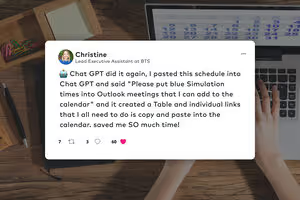
The tools are out there and easy to find
There are many tools available to use AI to do serious work with AI. Many companies – like ours – have set up a portfolio of resources – some proprietary, some not—for their internal teams to use, and also to share with clients. That is a great place to start. You will find there are an abundance of articles out there now with functional or industry-specific ways to tap into the available technologies like ChatGT, to provide you with even more insights to get started. It’s easy to ramp up quickly to do serious work - get advice, discover insights, generate ideas, write, produce reports, fill out forms, discuss strategy, craft proposals, etc.….and the resources are available to you 24x7. The bottom line is that whatever you do at work, you can ask AI. Follow the Golden Rules, and you will do this safely.
The resources keep getting better
If you are among those people tinkering, then you will have noticed AI can do a lot more today than the last time you looked. Like what? IT can connect to the internet, make images. do data analysis, watch video, read files, and work with documents. You can also create your own bespoke GPTs. The point is you can do it all on your own. You don’t need contractors. You don’t need digital experts. You can do it yourself, or with your team, today. Of note…so can your competitors. They already are and getting great benefits. So consider that when you are next faced with the option to try it – or not—to help you get more work done, better, and more quickly.
Your AI is already obsolete
It’s worth noting that by the time you read this, the list of capabilities above might already be outdated. For sure the version of AI you are using today is the weakest version you will ever use in your lifetime. As good as AI is today, today is as bad as it will ever get. You are working today with the “Shoe Phone” of AI. And that’s being generous. The next round of AI models will be way more capable. And those with the mindset and skillset to use them will benefit exponentially more from those new capabilities. Those who don’t, won’t.
So believe the hype. Help others get unstuck. And use your tools to learn, practice and master working with AI. For those who do, things will only get better, and more exciting, from here.
Want more inspiration about using AI in your business? Check out this post.
Related content


P R E S S R E L E A S E
Stockholm, May 5, 2025
STOCKHOLM, SWEDEN – BTS Group AB (publ), a leading global consultancy specializing in strategy execution, change, and people development, has agreed to acquire Nexo Pesquisa e Consultoria Ltda., Nexo, a boutique consulting firm headquartered in São Paulo, Brazil.
Nexo has been growing continuously since it was founded in 2017. With revenues of approximately 12 million Brazilian Reales (approx. 2.1 million USD) in 2024, and a highly capable team of 21 members, Nexo has built a strong reputation for delivering transformative projects in strategy, innovation, leadership, and culture.
Nexo collaborates with a great portfolio of clients across sectors such as financial services, consumer goods, and technology, assisting both local and global companies in navigating uncertainty, unlocking creativity, and activating strategy through people. Their work encompasses culture transformation, leadership development, employer value proposition, innovation culture, and vision alignment – supported by proprietary methodologies and frameworks.
BTS currently operates in Brazil servicing both local and multinational clients with a team of 13 employees. By acquiring Nexo, BTS not only increases the Group’s footprint in Brazil but also adds significant capabilities in culture and transformation services. Nexo’s client base has limited overlap with BTS, creating strong growth potential and synergy opportunities.
“Nexo is known for helping leaders and organizations tackle some of the most complex, human-centered challenges with creativity, empathy, and strategic clarity and the Nexo team is loved by their clients,” says Philios Andreou, Deputy CEO of BTS Group and President of the Other Markets Unit. “Their products and services complement and elevate our existing offerings, especially in culture transformation, and we are thrilled to welcome the Nexo team to BTS.”
“We’re excited to join BTS. We’ve long admired BTS’s approach and unique portfolio to support large organizations and leaders in connecting strategy with culture across the organization,” says Andreas Auerbach, co founder of Nexo. “Becoming part of BTS, allows us to scale our impact and bring more value to our clients while staying true to our values and culture,” adds Mariana Lage Andrade, co-founder of Nexo.
Upon completion of the transaction, Nexo’s business and organization will merge with BTS Brazil. Nexo’s founders will assume senior management roles in the joint operation.
The acquisition includes a limited initial cash consideration. Additional purchase price considerations will be paid between 2026 and 2028, provided Nexo meets specific performance targets. A limited portion of any such additional purchase price considerations will be paid in newly issued BTS shares. The transaction is effective immediately.
BTS’s acquisition strategy continues to focus on broadening our service portfolio, expanding our geographic reach, and enhancing our capabilities to support future organic growth in a fragmented market.
For more information, please contact:
Philios Andreou
Deputy CEO
BTS Group AB
philios.andreou@bts.com
Michael Wallin
Head of investor relations
BTS Group AB
michael.wallin@bts.com
+46-8-587 070 02
+46-708-78 80 19

At BTS, we’re constantly challenging ourselves to innovate at speed. And right now, it feels like we’re standing at the edge of something massive. The energy? Electric. The velocity? Unprecedented. For many of us, the current pace feels a lot like the early days of the pandemic: disorienting, high-stakes, and somehow exhilarating. And honestly—it should feel that way. Our teams have been tinkering with AI, specifically LLMs, for the past 2.5 years and it has really been in the last eight months that I can see the profound impact it is going to have for our clients, for our services and our operating model.
The opportunity isn’t about the technology. The world has it and it’s getting better by the minute. The issue is people and people’s readiness to adopt it and be re-tooled and re-skilled. It’s about leadership. AI is deeply personal, it’s surgical. In fact, that’s its genius. So, getting full scale adoption of AI, re-tooling everyone in the company by workflow, so that they can invent new services, unlock new customer value, unlock new levels of productivity, even use it for a better life, is the current race. The central question I’ve been wrestling with, alongside our clients and our own teams, is this:
What does AI actually mean for leadership and culture?
And the answer is clearer by the day: AI isn’t just a new toolset. It’s a new mindset. It demands that we rethink how we lead, how we learn, and how we build thriving organizations that can compete, adapt, and grow.
The productivity paradox revisited
Let’s start with the elephant in the boardroom. There’s been a lot of buzz around AI and its promises. But many leaders have quietly wondered: Will any of this actually move the needle? A year ago, we were asking the same thing. We had licenses. We had curiosity. We had early experiments. But the results were modest, a 1% productivity gain here or there. But by April, we were seeing:
- 30–80% productivity gains in software engineering
- 9–12% gains in consulting teams
- 5%-20% improvements in client success and operations
Just as importantly, the innovation unlock and creativity across our platforms due to vibe coding along with new simulation layers, is leading to new value streams for our clients. This isn’t theoretical. It’s not hype. It’s real. The difference? Adoption, ownership, and a shift in how we lead in order to energize the AI innovation within our teams. The challenge now isn’t whether AI creates value. It’s how to unlock and scale that value across teams, geographies, and business units—and do it fast.
Two Superpowers of the Agentic AI Era
In working with leaders across industries, I’ve come to believe in two superpowers (there are more as well) that will unlock the potential of this AI era: Jazz Leadership and a Simulation Culture.
1. Jazz Leadership
Forget the orchestra (although personally I am a big fan.) The successful team cultures that are innovating with AI feel more like jazz. In jazz, there’s no conductor. There’s no fixed sheet music. There are core bars and then musicians make up music on the spot based on each other’s creativity, building off of each other’s trials, riffs and mistakes, build something extraordinary together. This is how experimenting with AI today, in the flow of work, feels like.
For each activity across a workflow, how can new AI prompts, agents, and GPTs make it better, codify high performance, drive speed and quality simultaneously? How can we try something totally different and still get the job done? How might we re-invent how we work? That’s how high-performing teams operate in the AI era. The world is moving too fast for command-and-control leadership, a perfect sheet of music with one leader who is interpreting the sheet music and directing. What we need instead is improvisation, trust, shared authorship, courage and a playful spirit because there are just as many fails as breakthroughs.Jazz leadership is about creating the conditions where:
- Ideas can come from anywhere
- People see tinkering and testing as key to survival and AI failures mean your team is at the edge of what’s possible for your services and ways of working
- Leaders say, “I don’t have all the answers, but I’ll go first, with you”
- People feel “I’m behind relative to my peers in the company” and the company sees this as a good sign because the pace of learning with AI means higher chance of success in the new era
At BTS, we recently promoted five new partners who embody this mindset. They weren’t the most traditional leaders. But they were the most generative. They coached others. They experimented and are constantly re-tooling themselves and others. They inspired movement. They are keeping us ahead, keeping our clients ahead and driving our re-invention. Jazz leaders make teams better, not by directing every note—but by setting the stage for breakthroughs. It is similar to the agile movement, similar to how it felt in Covid as companies had to reinvent themselves. It’s entrepreneurial, chaotic and fun.
2. Simulation Culture
The ability to simulate is a super-power in this next agentic, AI era. Simulation has always been part of creating organizational agility, high performance and leadership excellence. But AI and high-performance computing have transformed it into something bigger, faster, and infinitely more powerful. It means that building a simulation culture is within all of our grasp, if we tap its power.Today, companies simulate:
- Strategic alternatives - from market impact all they way to detailed frontline execution
- New business, new markets and operating models
- Major capital deployment e.g. build a digital twin of a factory before breaking ground
- Initiative implementation
- Workflows current and future
- Jobs to assess for talent and critical role readiness
- Customer conversations and sales enablement motions
With a simulation culture, where you regularly engage in scenario planning and expect preparation and practice as a way of working, billions in capital is saved, cross-functional teams are strengthened, high performance gets institutionalized, win rates increase, earnings and cash flow improves.
Where to get started
Below are a few examples of what leading organizations are doing. Consider testing these in your own organization:
- Conversational AI bot platforms used to scale performance expectations and the company’s unique culture.
- Agentic simulations built into tools so people can prepare and practice with 100% perfect context and not a wasted moment.
- Digital twins of the job created so that certifications and hiring decisions are valid.
- Micro-simulations spun up in hours to align 50,000 people to a shift in the market or a new operational practice.
Final Thoughts
- Lead like a jazz musician. Embrace improvisation, courage and shared creativity.
- Build a simulation culture. Because in a world that’s moving this fast, practice isn’t optional—it’s how we win.
This is a brave new world. Not five years from now. Right now.Let’s shape it—together.

PRESS RELEASE
Stockholm, May 5, 2025
STOCKHOLM, SWEDEN — BTS Group AB (publ), a leading global consultancy specializing in strategy execution, change, and people development, has agreed to acquire Nexo Pesquisa e Consultoria Ltda. (Nexo), a boutique consulting firm headquartered in São Paulo, Brazil.
Nexo has been growing continuously since it was founded in 2017. With revenues of approximately 12 million Brazilian Reales (about 2.1 million USD) in 2024, and a highly capable team of 21 members, Nexo has built a strong reputation for delivering transformative projects in strategy, innovation, leadership, and culture.
Nexo collaborates with a diverse portfolio of clients across sectors such as financial services, consumer goods, and technology, assisting both local and global companies in navigating uncertainty, unlocking creativity, and activating strategy through people. Their work encompasses culture transformation, leadership development, employer value proposition, innovation culture, and vision alignment—supported by proprietary methodologies and frameworks.
BTS currently operates in Brazil, servicing both local and multinational clients with a team of 13 employees. By acquiring Nexo, BTS not only increases the Group’s footprint in Brazil but also adds significant capabilities in culture and transformation services. Nexo’s client base has limited overlap with BTS, creating strong growth potential and synergy opportunities.
“Nexo is known for helping leaders and organizations tackle some of the most complex, human-centered challenges with creativity, empathy, and strategic clarity, and the Nexo team is loved by their clients,” says Philios Andreou, Deputy CEO of BTS Group and President of the Other Markets Unit. “Their products and services complement and elevate our existing offerings, especially in culture transformation, and we are thrilled to welcome the Nexo team to BTS.”
“We’re excited to join BTS. We’ve long admired BTS’s approach and unique portfolio to support large organizations and leaders in connecting strategy with culture across the organization,” says Andreas Auerbach, co-founder of Nexo. “Becoming part of BTS allows us to scale our impact and bring more value to our clients while staying true to our values and culture,” adds Mariana Lage Andrade, co-founder of Nexo.
Upon completion of the transaction, Nexo’s business and organization will merge with BTS Brazil. Nexo’s founders will assume senior management roles in the joint operation.
The acquisition includes a limited initial cash consideration. Additional purchase-price considerations will be paid between 2026 and 2028, provided Nexo meets specific performance targets. A limited portion of any such additional considerations will be paid in newly issued BTS shares. The transaction is effective immediately.
BTS’s acquisition strategy continues to focus on broadening its service portfolio, expanding geographic reach, and enhancing capabilities to support future organic growth in a fragmented market.
For more information, please contact:
Philios Andreou
Deputy CEO
BTS Group AB
philios.andreou@bts.com
Michael Wallin
Head of Investor Relations
BTS Group AB
michael.wallin@bts.com
+46-8-587 070 02
+46-708-78 80 19
Related content

Hace unos meses terminé una sesión con un equipo de ejecutivos comerciales de una institución financiera mediana. Dos días intensos: cómo prospectar, cómo estructurar conversaciones centradas en el cliente, cómo crear valor en cada interacción. El grupo salió inspirado del taller.
Tres semanas después le pregunté a uno de los mejores participantes sobre cómo le había ido aplicando las nuevas herramientas. Me miró un segundo y me dijo, con total honestidad:
“La verdad... la semana siguiente fue igual que siempre, volví al viejo sistema”
El entrenamiento de capacidades es necesario. Pero sin una cultura comercial que lo sostenga, es un esfuerzo poco rentable para las empresas.
1. Las capacidades sin contexto no sobreviven al día a día
Un ejecutivo de ventas puede salir de un taller sabiendo exactamente qué preguntar, cómo estructurar una conversación de valor, cómo posicionarse como asesor estratégico en lugar de vendedor de productos. La semana siguiente, el peso de las métricas de corto plazo, la presión por resultados y las urgencias del día a día terminan arrastrándolos de vuelta a la rutina de siempre.
McKinsey (2024) encontró que más del 70% de las iniciativas de transformación comercial no logran sus objetivos — y la principal causa no es el diseño del programa, sino la falta de condiciones organizacionales para sostener los nuevos comportamientos.
El problema no es el taller. Es lo que existe o no existe en la realidad de la estructura comercial.
2. El cambio requiere alinear seis pilares
Lo que diferencia a las empresas que realmente transforman su modelo comercial de las que solo capacitan, está relacionado con seis pilares que operan simultáneamente.
1. Patrocinio de la alta dirección que empodera en lugar de solo exigir
2. Disciplina en gestión de cuentas/clientes estratégicos, con metodología y seguimiento
3. Conversaciones centradas en el cliente, no en el portafolio de productos
4. Cada interacción con relevancia estratégica, preparadapara crear valor medible
5. Nuevos comportamientos integrados al ritmo operativodiario y la cadencia del negocio
6. Líderes comerciales presentes que sostienen la cultura, no solo la expresan
Cuando falta uno, los demás no escalan y terminan provocando un círculo vicioso.
3. El liderazgo que sostiene vale más que el que exige
El patrocinio de la alta dirección y la presencia de los líderes comerciales sonlos pilares que más frecuentemente fallan. No porque los líderes no crean en el cambio, sino porque el día a día los jala de vuelta a revisar resultados, no a construir comportamientos.
Gartner (2024) señala que los equipos comerciales cuyos líderes hacen coaching activo y visible tienen hasta un 28% mayor probabilidad de adoptar nuevos comportamientos de manera sostenida.
El entrenamiento define el rumbo y entrega el mapa; el liderazgo es lo que realmente ayuda a navegar y sostener el cambio.
Conclusión
Si tu empresa está invirtiendo en transformar la forma en que sus equipos comerciales se relacionan con los clientes, la pregunta ya no es si el entrenamiento funciona. La verdadera pregunta es: ¿qué tan preparada está la organización para sostener el cambio?
Porque el talento existe. Las habilidades se desarrollan. Pero la cultura no se improvisa; se construye todos los días, con liderazgo, alineación y consistencia.
¿Cuál de estos seis pilares es hoy el más débil en tu organización?

É possível mudar a cultura de uma organização?
Hoje em dia, poucas organizações não estão envolvidas em um (ou vários) processos de transformação cultural. Novas formas de trabalhar em organizações mais horizontais e adaptativas, melhorias na cultura de segurança, orientação ao cliente, transformações nas áreas comerciais e excelência operacional, entre outros.
E é aqui que surge uma das grandes perguntas:
É possível mudar a cultura de uma organização? E, se sim, como fazer isso?
Para ajudar a responder a essas perguntas—frequentes entre nossos clientes e amplamente discutidas—gostaria de compartilhar o que aprendemos na BTS ao longo dos últimos 38 anos sobre o que funciona e o que não funciona (até agora, pois em transformação cultural estamos sempre aprendendo).
A boa notícia é que a resposta é sim.
A dificuldade está na segunda pergunta: como fazer isso?
Um projeto? Uma iniciativa?
Um ponto importante é que a transformação cultural não é um projeto com início e fim, mas sim um processo contínuo e em evolução. Isso muitas vezes gera tensão em organizações acostumadas a uma lógica de projetos.
O que é crítico e frequentemente ignorado?
Existem elementos que, quando considerados e aplicados corretamente, tornam a transformação muito mais eficaz. No entanto, muitas vezes são ignorados.
Esses elementos são:
- Envolver as pessoas. Quanto maior o envolvimento em todos os níveis, maior a probabilidade de implementação das mudanças.
- Tornar a mudança tangível e vivida no dia a dia, conectando teoria e prática. Transparência é fundamental.
- Toda mudança tem impactos positivos e negativos — ambos devem ser comunicados com clareza.
- Mudança cultural exige tempo e transformação de mindsets e estruturas organizacionais.
- A cultura deve estar conectada à estratégia.
Como estruturamos a transformação cultural?
Nosso modelo se baseia em quatro etapas: definir resultados, criar líderes de mudança, incorporar mudanças e sustentar novas formas de trabalho.
1. Definir resultados
O primeiro passo é estabelecer resultados claros e alinhamento executivo. É necessário conectar propósito, visão e objetivos organizacionais.
Ações:
- Coleta de dados (entrevistas, focus groups, visitas)
- Diagnósticos culturais
- Definição de expectativas (Leadership Profiles
2. Criar líderes de mudança
Todos os líderes devem atuar como agentes de mudança. É fundamental engajá-los emocional e racionalmente.
Ações:
- Programas de liderança
- Playbooks
- Feedback contínuo
3. Incorporar mudanças
É essencial transformar mentalidades e sistemas organizacionais.
Ações:
- Coaching
- Sprints culturais
- Cascata organizacional
- Avaliações comportamentais
4. Sustentar o novo modelo
Garantir continuidade através de redes, dados e suporte contínuo.
Ações:
- Integração com processos de talento
- Uso de IA no dia a dia
- Monitoramento da transformação
- Comunidades de prática
A importância de ser paciente e impaciente ao mesmo tempo
Transformações culturais são complexas e não têm fórmula única.
Ser estrategicamente paciente e taticamente ágil é essencial para ajustar e evoluir continuamente.
Esse equilíbrio permite transformar a jornada em algo positivo e sustentável.
Este é apenas um resumo.
Se quiser aprofundar com exemplos e práticas:
Baixe o PDF completo e acesse todo o conteúdo.

Si può cambiare la cultura di un’organizzazione?
Oggi, poche organizzazioni non sono immerse in uno (o più) processi di trasformazione culturale. Nuovi modi di lavorare in organizzazioni più piatte e adattive, miglioramenti nella cultura della sicurezza, orientamento al cliente, trasformazioni delle aree commerciali e miglioramento dell’eccellenza operativa, per citarne alcuni.
Ed è qui che nasce una delle grandi domande:
Si può cambiare la cultura di un’organizzazione? E, se sì, come si fa?
Per aiutare a rispondere a queste domande—che i nostri clienti ci pongono spesso e su cui esiste molta letteratura—vorrei condividere ciò che in BTS abbiamo imparato negli ultimi 38 anni su ciò che funziona e ciò che non funziona (finora, perché nel cambiamento culturale non si smette mai di imparare).
La buona notizia è che la risposta alla domanda se si possa cambiare la cultura di un’organizzazione è sì.
La difficoltà sta nel rispondere alla seconda: come si fa?
Un progetto? Un’iniziativa?
Un aspetto importante da considerare è che i processi di cambiamento o trasformazione culturale non sono progetti con un inizio e una fine; sono processi in continua evoluzione. Questo spesso genera tensione nelle organizzazioni abituate a un approccio basato sui progetti.
Cosa è critico e spesso viene ignorato?
Esistono diversi elementi che, se considerati e utilizzati correttamente, rendono gli sforzi di trasformazione molto più efficaci. Purtroppo, spesso vengono ignorati.
Questi elementi critici sono:
- Coinvolgere le persone. Più le persone (a tutti i livelli) sono coinvolte nella trasformazione, maggiori sono le probabilità che implementino i cambiamenti richiesti.
- Per comprendere il cambiamento, bisogna renderlo tangibile e sperimentarlo. Ciò significa collegare il quadro teorico alle azioni quotidiane. Spiegare il quadro completo con trasparenza è fondamentale.
- Tutti i cambiamenti portano aspetti positivi, ma anche impatti negativi. Spiegare il quadro completo con trasparenza è fondamentale.
- Cambiare la cultura richiede tempo e implica identificare e modificare i “mindset” e le strutture quotidiane (simboli) che definiscono come si fanno le cose nell’organizzazione.
- La cultura deve essere fortemente connessa alla strategia.
Come consigliamo di strutturare i processi di cambiamento culturale?
Il nostro approccio si compone di quattro fasi: definire i risultati, creare leader del cambiamento, incorporare i cambiamenti chiave e sostenere i nuovi modi di lavorare.
1. Definire i risultati
Il primo passo in qualsiasi processo di trasformazione è stabilire risultati chiari. È fondamentale identificare i driver della trasformazione e definire i risultati desiderati in modo da ottenere un vero allineamento a livello esecutivo. Man mano che si procede, è necessario collegare lo scopo e la visione, comprendendo da dove si viene, dove si è e dove si vuole andare. Inoltre, è essenziale collegare la trasformazione agli obiettivi organizzativi.
Alcune azioni rilevanti in questa fase sono:
- Raccolta di informazioni (interviste, focus group, visite operative, …)
- Diagnosi culturali
- Definizione delle aspettative (Leadership Profiles
2. Creare leader del cambiamento
In BTS crediamo che tutti i leader siano anche leader del cambiamento. Adottare una mentalità da “leader del cambiamento” richiede che i leader sperimentino e vedano ciò che ci si aspetta da loro. Fin dall’inizio è fondamentale promuovere l’azione attraverso il “lavoro reale”, come stabilire nuove priorità e comunicare in modo trasparente ed efficace.
I leader devono essere coinvolti (emotivamente e razionalmente) nel cambiamento e devono capire come possono influenzare la cultura attraverso azioni concrete quotidiane.
Infine, è necessario fornire supporto continuo per i cambiamenti più difficili di mentalità e comportamento e raccogliere feedback su ciò che funziona e ciò che non funziona in questa fase.
Alcune azioni rilevanti in questa fase sono:
- Sviluppo di playbook per ruoli critici
- Implementazione di programmi di leadership e cambiamento
- Feedback loops con i livelli esecutivi
3. Incorporare i cambiamenti chiave
Per ottenere un cambiamento significativo, è essenziale identificare i modelli mentali attuali e introdurne di nuovi che supportino lo stato desiderato. Creare routine e simboli che rafforzino il cambiamento, così come identificare processi, pratiche, eventi o norme ancorate ai vecchi modi di lavorare, è fondamentale.
Co-creare nuovi modi di lavorare per un’attivazione immediata aiuta a consolidare questi cambiamenti. Con il progresso, modificare sistemi e processi che supportano e rafforzano i cambiamenti è essenziale per il successo a lungo termine.
Alcune azioni rilevanti in questa fase sono:
- Coaching per leader
- Cultural sprints
- Cascading del cambiamento nell’organizzazione
- Assessment per misurare i cambiamenti comportamentali
4. Sostenere i nuovi modi di lavorare
Il cambiamento non è solo uno sforzo individuale, ma anche un fenomeno sociale. Per questo è necessario creare reti sociali che supportino i cambiamenti di mentalità e comportamento. Interventi con supporto individuale per ruoli critici e momenti specifici, così come l’integrazione dei nuovi modi di lavorare, garantiscono la continuità del cambiamento.
Infine, è necessario utilizzare i dati per analizzare ciò che funziona e ciò che non funziona, permettendo di definire nuove azioni e interventi.
Alcune azioni rilevanti in questa fase sono:
- Integrazione dei playbook nel ciclo di talent management
- Pratica dei nuovi comportamenti con bot basati su IA
- Creazione di un ufficio per monitorare il cambiamento e definire nuove azioni
- Creazione e lancio di Comunità di Pratica (CoP)
L’importanza di essere pazienti e impazienti allo stesso tempo
I processi di trasformazione culturale sono tra i più complessi, poiché non esiste una ricetta unica.
Essere strategicamente pazienti (con risultati chiari ed evitando cambiamenti erratici), ma tatticamente impazienti (agendo nelle fasi descritte e adattando in base a ciò che funziona e ciò che non funziona) è fondamentale.
Questo approccio permette di trasformare questi percorsi in esperienze arricchenti per l’organizzazione, e non in processi dolorosi che lasciano cicatrici nella memoria collettiva.
Questo è solo un riassunto.
Se vuoi approfondire l’approccio completo, esempi e chiavi pratiche:
Scarica il PDF completo e accedi a tutti i contenuti.