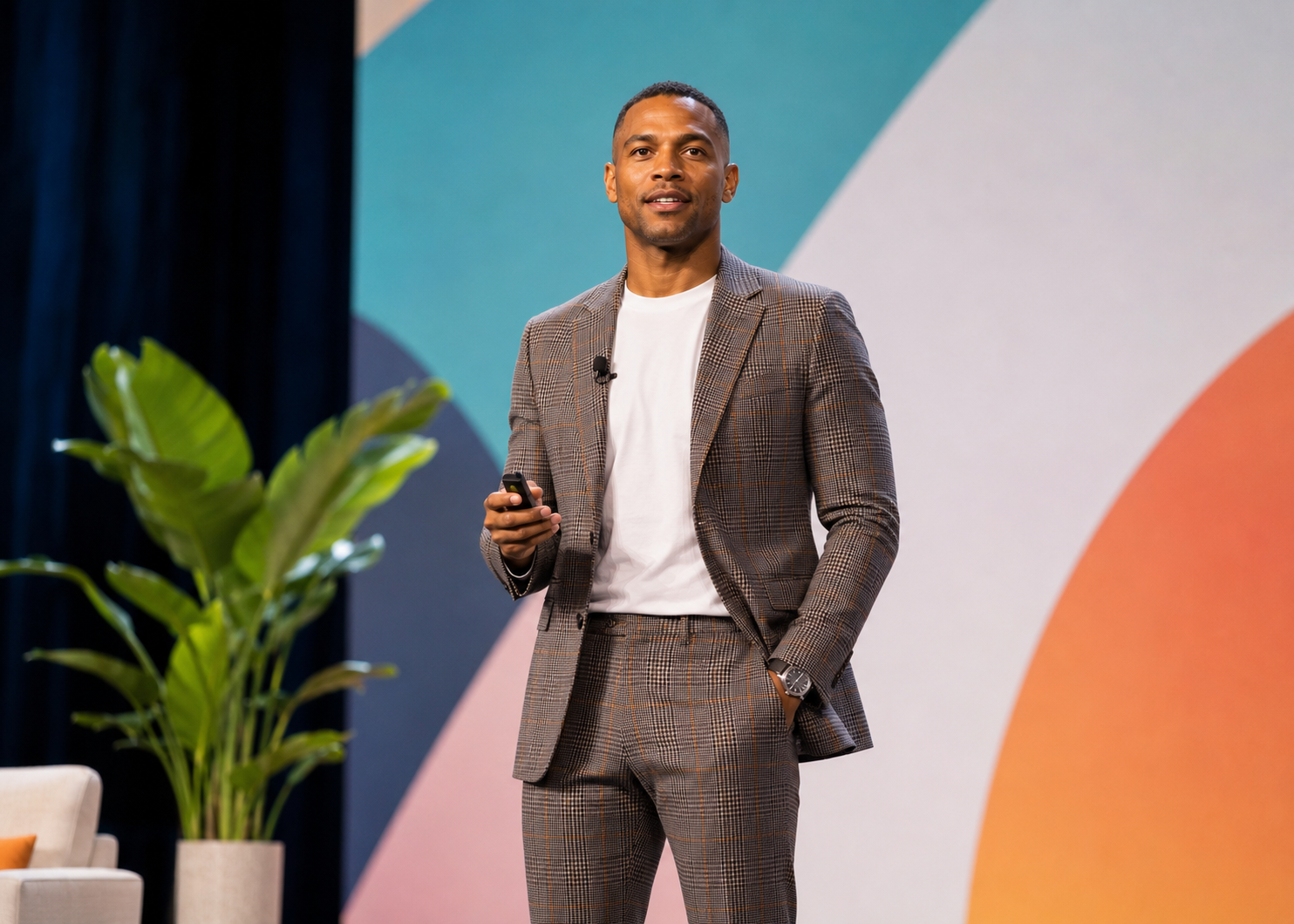
Great Leaders Understand the Power of Storytelling

Every few months, we hold a Speak Like a CEO Boot Camp—a two-day event geared to helping leaders improve their powerful presentation skills. It’s always satisfying to hear how much people enjoy learning to use our tools, but I’ve found that our segment on Storytelling for Leaders is often the area that executives find to be transformational.
At one recent boot camp, a compliance executive shared a riveting personal story with his small group. During the first Gulf War, he had to drive from one base to another on a desert road in the middle of the night. Unfortunately, he managed to get off the road… and he kept going. “If I keep going, maybe I’ll recognize something,” he thought. But he soon realized that one sand dune looked pretty much like the next one.He stopped his truck and pulled over… and freaked out. He imagined all of the ways in which he might die. Maybe a sniper would spot him, or he would stumble on a mine. Or perhaps he would die in a less dramatic way: He had no food or water, and the temperatures would skyrocket the next morning. Maybe he just wouldn’t find his way back.
It was a beautiful, starlit desert night. He had an idea. Maybe he could navigate his way back by the stars! But then he realized he had no clue as to how to do that. It was comically absurd.
In great dismay, he sat down on his back bumper and lowered his head. And there he saw his answer. Do you know what it was? His own tire tracks! He turned around and followed his tracks for several miles and finally found the road. He was saved.
As soon as the story ended, his fellow Boot Camp attendees raved about his storytelling skills. He was stunned. Amazingly, he had never told anyone the story—hadn’t thought about it until Suzanne, our CEO, read a list of memory prompts that brought this remarkable story to mind.
Then someone shouted out, “Hey! That’s a great compliance story!” That was even more of a revelation. The story could be used as a metaphor for what happens when things go wrong with compliance: You go off of a path, and you get in trouble… and the farther off you are, the deeper the trouble… but retracing your steps can save you.
Compliance executives have a tough job. They often see no way around citing rules and regulations in a dry presentation, while their audience suffers through it. On that day, this executive suddenly could see how he could tell a story to engage the emotions of his audience while making a powerful, relevant point that they would remember for a long time.
Great leaders have learned somewhere along the way that they need to be storytellers. Your annual report is a story. Your business successes are a story. Lessons about failure are also stories that help your important audiences understand why they must do more than just show up. The best stories touch people's hearts and ignite their energy to act. I urge you to go down that road and learn how to tell powerful stories.
The irony of taking the time to look back is that what you remember will drive you forward more quickly. Like the soldier who veered off that road, the tracks from your history can ultimately lead you where you want to go.
Related content

Related content

Organizations have long wanted to scale coaching, but have been limited by cost and capacity. With AI, that's beginning to change —new platforms are making coaching more accessible, flexible, and available on demand, extending support beyond a select group of leaders to entire populations.
For talent leaders, this shift creates both opportunity and complexity. With greater reach comes a new set of trade-offs: how to balance access with depth, flexibility with accountability, and efficiency with meaningful development.
The limits of unlimited (coaching)
Unlimited coaching sounds like the obvious answer. Remove the barriers, give everyone access, let people engage on their own terms. What's not to like?
In practice, quite a bit.
When coaching has no defined structure or cadence, engagement tends to become episodic - people show up when something feels urgent and step back when it doesn't. The coaching relationship never quite deepens. Conversations cover ground but don't build on it. And the development that was supposed to happen keeps getting pushed to the next session, and the next.
Three patterns emerge:
- Sporadic engagement over sustained development. Without a rhythm to anchor the work, coaching becomes reactive. Clients bring whatever is most pressing that week rather than working toward something larger. Progress happens in bursts, if at all.
- Insights that don't compound. Great coaching reveals patterns over time - things a client can't see in one session but can't unsee after several. Without continuity, and without a consistent coaching relationship to hold the thread, each conversation starts close to zero.
- Outcomes that are hard to measure. No milestones. No defined endpoint. No clear way for the organization, or the client, to know whether it's working. Activity fills the gap where impact should be.
The result is a model that's easy to scale and hard to defend. Which is exactly the problem talent leaders are navigating right now.
The relationship is the lever
Decades of research into what makes coaching work keeps arriving at the same answer: it's the relationship. Not the platform, not the methodology. The relationship.
When a coach and client build trust over time — developing shared language, returning to the same themes with increasing depth — something shifts. Conversations get more honest. Insights stick. The client starts doing the work between sessions, not just during them. That's when coaching becomes genuinely transformative, and it can't be rushed or replicated in a one-off session.
The ICF and EMCC are clear on this: continuity is what dives outcomes. The coaching engagements that produce lasting change are the ones where each session builds on the last, not the ones that simply offer more access.
Three principles make that possible: Consistency, Continuity, and Completion.
1. Consistency
The foundation everything else is built on.
The temptation when designing a coaching program is to treat flexibility as a feature — let people book when they want, swap coaches freely, engage on their own schedule. But frequent coach changes reset the clock. Every new coach has to earn trust, learn context, and find their footing with the client. That's time spent getting started, not getting somewhere.
A stable coaching relationship works differently:
- The coach starts to see around corners — patterns the client can't see themselves
- The client stops performing and starts being honest
- The relationship itself becomes a source of accountability, not just the sessions
Consistency doesn't constrain the work. It's what makes the deeper work possible.
2. Continuity
What turns a series of sessions into genuine development.
Without continuity, coaching tends to be additive at best- each session offers something useful, but nothing compounds. With it, the work builds on itself in ways that can't happen in isolated conversations.
What continuity makes possible
- A limiting belief surfaced in session three becomes a thread that runs through the rest of the engagement
- A behavioral pattern the client couldn't see at the start becomes impossible to ignore by the end
- Space opens up for the harder work - the kind that requires sitting with discomfort across multiple sessions, not resolving it quickly and moving on
That slower, deeper work is where lasting change actually happens. It doesn't come from more sessions. It comes from the right sessions, in the right order, with the same person.
3. Completion
The most underrated principle of the three.
In a world of unlimited access, there's no finish line, and without one, it's surprisingly hard to know what you're working toward, or whether you've gotten there. A defined endpoint changes the entire shape of an engagement.
A clear endpoint
Creates urgency and focuses every session on what matters most
- Shifts the question from "what should we talk about this week?" to "what do we need to accomplish before we're done?"
- Gives both coach and client a body of work to look back on, not just a log of conversations
For talent leaders, this is also what makes coaching legible as an investment. Sessions logged is an activity metric. A cohort of leaders who completed a structured engagement and can articulate what changed, that's a result.
Don't just scale it, design it (here’s how)
The opportunity in front of talent leaders right now is significant. The organizations that will get the most from this moment are the ones that treat coaching design as seriously as coaching delivery.
Practical design decisions
- Define the arc before you launch: set the number of sessions, the cadence, and the goals upfront, not after people have already started booking
- Protect the coaching relationship: Make coach switching the exception, not the default, and design your program to discourage unnecessary re-matches
- Build in milestones: create structured check-ins at the midpoint and end of each engagement so progress is visible to both the coach and the organization
- Separate on-demand support from developmental coaching: Use AI-enabled tools for in-the-moment guidance, and reserve structured engagements for the deeper work
- Measure completion, not just activation: Track how many people finish an engagement, not just how many start one
Questions to pressure-test your design
- Does every participant know what they're working toward before their first session?
- Can your coaches see enough context about a client's journey to pick up where they left off?
- Would you be able to show, at the end of a cohort, what changed, and for whom?
Access opened the door. Intention is what makes it worth walking through.

Three decisions that changed everything.
Two years ago, we made three deliberate decisions about how BTS would move with Applied AI.
We would become our own Customer Zero.
While others were building strategies, defining governance, and waiting for clarity, we made a different call: we decided not to wait. Not because the stakes were low, but because they were high. And because in a space evolving this quickly, clarity wouldn’t come from planning. It would come from movement.
So instead of starting with a roadmap, we started with three principles:
- No top-down mandate. The people closest to the work figure it out.
- IT must evolve from gatekeeper to enabler - leading AI trials and fast experimentation.
- Don’t wait for certainty.
We set the organization in motion, and once we did, things started to move quickly.
What if we started this company today?
Waiting for certainty is itself a choice, and it’s costing companies more than they realize.
We started where we knew the work best: our simulations. No perfect plan, just teams moving, trying, and iterating.
Simulations are core to who we are at BTS. Companies that simulate don’t just make better decisions; they execute faster and build more engaged cultures.
The team asked a simple question:
"What if we were to start our company today?”
That question started the flywheel.
They asked IT for a few licenses and started building - vibe-coding, writing agents, and testing tools - moving at a pace that would make any VC-backed start-up smile.
The messy middle.
At first, the team was underwhelmed.
The early reports were blunt:
“Not good with math.”
“Poor graph capabilities.”
The team wasn't discouraged. They kept tinkering - jumping between tools, staying on top of new releases, experimenting constantly.
This was a small team, across 24 countries, building off each other’s ideas. Laughing at crazy creations. Breaking things. Iterating in a sandbox alongside real clientwork.
Each cycle produced something:
- A sharper scenario
- A faster build
- A more powerful simulation
The flywheel was turning, and it was generating something real.
When the diamond appeared.
Then something shifted.
The team moved into client trials across five countries. They figured out ISO compliance and built the architecture to handle the complexity, the “spaghetti.”
And what emerged wasn’t incremental:
- What used to take weeks started happening in days.
- Limited creativity started to feel like unlimited innovation.
- Clients became self-serving.
- Agentic simulations were built directly into client systems for real-time updates and preparation.
This was our first AI diamond - a high-impact outcome created by many cycles of experimentation compounding into real value.
It only appeared because we kept the flywheel turning, each cycle increasing the odds that something would break through.
95% adoption in eight weeks.
Then it was time to take the AI diamond global.
BTS is decentralized and highly entrepreneurial. We operate across 24 countries and 38 offices, where local teams have real autonomy.
And historically? That’s meant a low appetite for adopting something built somewhere else and pushed from the center.
So we expected resistance.
Instead, something surprising happened.
In the first eight weeks, we saw 95% adoption across our global footprint.
It felt completely different from our own digital initiatives, ERP implementations, top-down rollouts of the past.
This moved on its own. Why?
We realized it didn’t start with a framework or a model, it started with a feeling.
The feeling of being at the leading edge of one’s craft and profession.
- Joy
- Excitement
- Pride
As we watched this play out across teams it stopped feeling like isolated wins.
There was a pattern to it. A repeatable, organic, innovation motion.
And the flywheel didn’t stop with simulations.
It spread across finance, sales enablement, legal, operations, and client delivery. Some cycles led to small improvements, and others revealed new diamonds.
Not becausewe planned for them, but because we built the conditions for people to find them.
The question I'd ask any CEO right now: Is your flywheel turning, or are you still waiting for the perfect plan?
In part 2, I’ll share the key success factors behind the breakthrough, and what we’re now seeing across more than 120 global clients.

La maggior parte delle riunioni di vendita non fallisce.
Semplicemente non porta a una decisione.
Ed è lì che si perde valore.
I clienti di oggi sono più informati, più selettivi e hanno meno tempo.
Non hanno bisogno di altre presentazioni di prodotto.
Hanno bisogno di conversazioni che li aiutino a stabilire le priorità, decidere e andare avanti.
Eppure, il 58% delle riunioni di vendita non riesce a creare valore reale.
Non perché i venditori manchino di capacità, ma perché le conversazioni non sono progettate per far avanzare le decisioni.
“I clienti non agiscono su ogni esigenza che riconoscono.
Agiscono quando qualcosa diventa una priorità.”
In questo breve executive brief scoprirai:
- Perché la maggior parte delle conversazioni informa… ma non porta all’azione
- Cosa spinge davvero i clienti a stabilire priorità e muoversi
- Come creare urgenza senza compromettere la fiducia
- Il passaggio dal presentare soluzioni al facilitare decisioni
- Cosa distingue le conversazioni che si bloccano da quelle che accelerano il progresso
Se i tuoi team stanno affrontando trattative bloccate, decisioni ritardate o un pipeline lento, questo brief ti aiuterà a capire il perché e cosa fare in modo diverso.
Scarica l’executive brief e scopri come progettare conversazioni che portano davvero a decisioni.