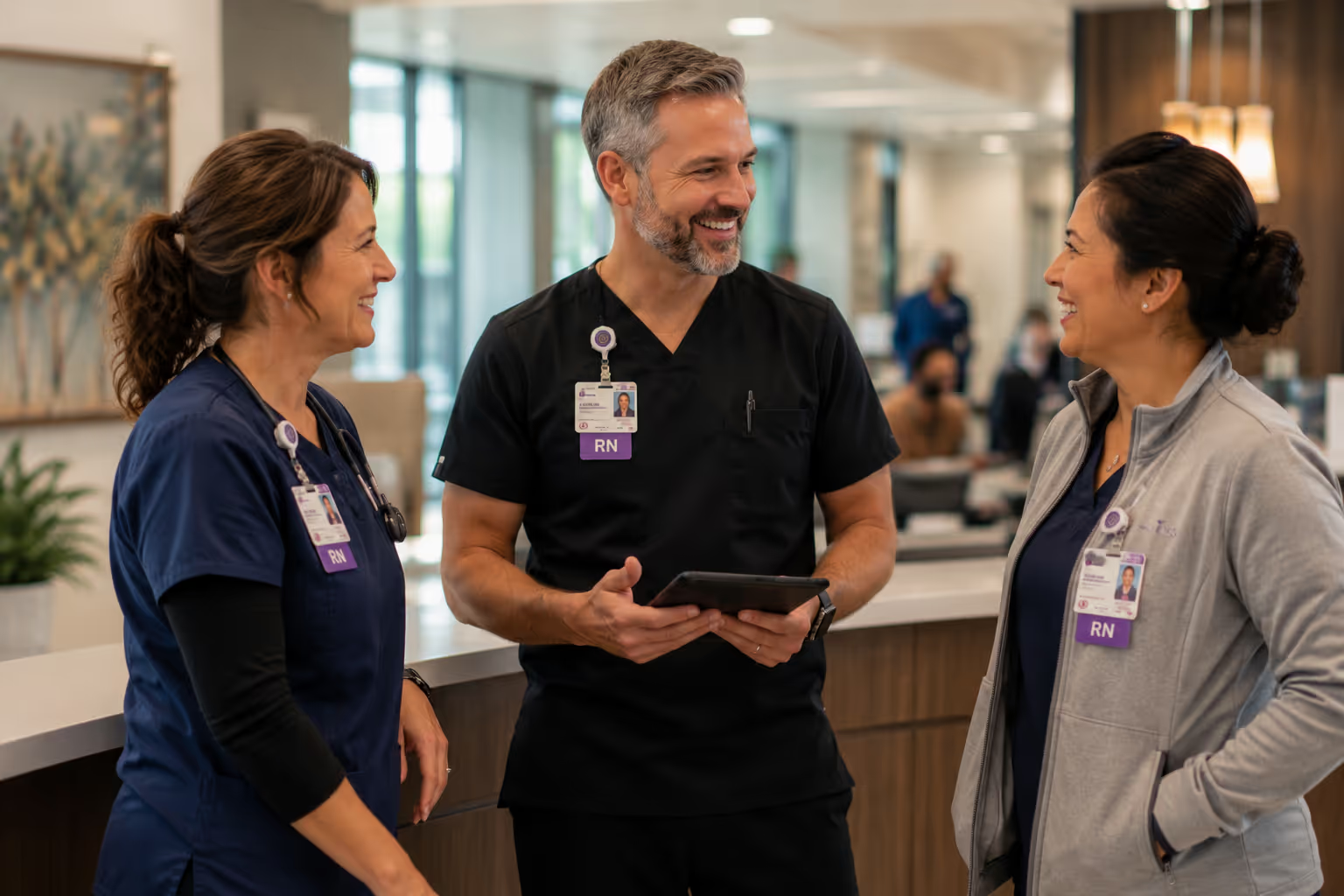
Delivering great care while driving the business

To prepare their best caregivers to become care center business leaders, a leading provider of home and hospice care partnered with BTS to provide a customized simulation and Multipliers program to develop leadership and business skills.
July 2, 2021
5
min read
Follow us on Linkedin
Follow BTS on Linkedin
Share

Leadership development at a leading provider of home health and hospice care

A leading provider of home health and hospice care in the United States consistently delivers high quality care but strives to be the premiere solution for patients across the country to age in place.

To meet this ambitious goal, the organization identified the need to develop their people, providing them with the leadership and business skills necessary to drive results and continue providing top-of-the-line care.

At the company, often the best physical therapists, nurses, and occupational therapists are selected to lead care centers, shifting roles from a caregiver to a business leader. Care center leaders report to regional heads and are responsible for managing their care centers’ P&L, holding other caregivers accountable, and growing the business. These major responsibilities can be challenging for many new care center leaders. While they have excelled as caregivers, their background is not in business.

Embarking on a transformative leadership journey

To mediate this issue, the organization engaged with BTS to help care center leaders gain the skills required for their role and familiarize themselves with the tools that will enable their success. Through a series of intensive interviews, BTS created a customized program to fit the healthcare company’s specific needs.

The program is a two-day offsite, during which participants embark on an experiential learning journey to practice their business acumen and leadership skills. In addition to the 25 care center leaders in attendance, there are also a handful of regional heads who participate, making a total of 30 participants, with several senior observers overseeing the program. The goal of the program is to reach all care center leaders within the organization, equipping them with the skills and tools to successfully lead and grow the business.

Being a Multiplier, developing business acumen, and honing leadership skills

Before the program kicks off, participants are asked to read a short article on Liz Wiseman’s Multipliers, which prepares them for their leadership learning journey.

On the first day of the program, leaders immediately jump into a customized business simulation, running a care center in a simulated environment. Both new and tenured leaders test the behaviors and skills required for the job in a risk-free environment where their mistakes will not affect the business. In this first round of the simulation, leaders focus on optimizing their caregiver mix and utilization levels, ensuring resources are adequately meeting patient needs and providing the best care profitably. This round takes half of a day, but simulates an entire quarter of running a care center. Participants will later receive feedback on their performance in the simulation, learning how their decisions impacted their simulated business. All of the results are contextualized in the company’s service-value chain so that participants can understand how both their business and leadership choices make a measurable difference.

In the afternoon, leaders are exposed to the BTS Multipliers Framework, based on the concepts from Liz Wiseman’s Multipliers, which describes how leaders can encourage those around them to reach their full potential by tapping into their teams’ natural talents and “multiplying” their impact. Leaders are also exposed to “accidental diminishers,” which describe well-intentioned behaviors that accidentally inhibit people’s ability to make mistakes and subsequently learn and grow. Participants engage with these concepts through a moments-based playbook, learning What Great Looks Like and What Not So Great Looks Like in the most pivotal moments they encounter in their role.In the afternoon, leaders are exposed to the BTS Multipliers Framework, based on the concepts from Liz Wiseman’s Multipliers, which describes how leaders can encourage those around them to reach their full potential by tapping into their teams’ natural talents and “multiplying” their impact. Leaders are also exposed to “accidental diminishers,” which describe well-intentioned behaviors that accidentally inhibit people’s ability to make mistakes and subsequently learn and grow. Participants engage with these concepts through a moments-based playbook, learning What Great Looks Like and What Not So Great Looks Like in the most pivotal moments they encounter in their role.

For the remainder of the day and in the following morning, leaders are divided into two cohorts, one of care center leaders and the other of regional heads, to respectively practice giving feedback and coaching skills. The division of these two cohorts allows for more candid conversations and targeted learning opportunities as they discuss existing challenges they face in their role and potential ways forward.For the remainder of the day and in the following morning, leaders are divided into two cohorts, one of care center leaders and the other of regional heads, to respectively practice giving feedback and coaching skills. The division of these two cohorts allows for more candid conversations and targeted learning opportunities as they discuss existing challenges they face in their role and potential ways forward.

In the second round of the simulation, participants have the opportunity to run their care center again, and this time are better equipped for success. The results of this round allow participants to see how applying their learnings can enhance business performance, and what mistakes to avoid when applying their skills to their care center in the real world.

At the close of the two-day program, the company’s Chief Operating Officer and President present the company’s future outlook, inspiring participants to apply their learnings in support of the company’s ambitious growth goals.

The learning does not stop after participants leave. After the program, cohorts continue to peer-coach in three subsequent, virtual coaching sessions. These coaching sessions sustain the learning by addressing obstacles faced in the field, providing a platform for success stories, and giving further opportunities to practice in a safe space.

Sustained momentum: impressive results

Since the program’s inception, net income from operations (NIFO) has improved by roughly $10M, fostering a business-focused, feedback and coaching culture through improved alignment. Based on post-program interviews, the organization estimates that at least 30% of the $10M in additional NIFO was due to the training initiative.

In addition, the program received world-class results with an average NPS of 9.2. Over 350 care center leaders and regional heads have been through the program, with more than half (63%) reporting knowledge transfer and nearly all (97%) participants reporting behavior change.

The healthcare provider is still on its leadership journey, but the results so far prove the program provides significant impact on the skill level and tool application for leaders, giving them the capabilities they need to successfully run the business while continuing to provide the care that their patients deserve.

NPS comments cite the program as a “game changer” and “eye-opening.”

“I would definitely recommend this experience to my colleagues. Information shared on giving feedback both positive and negative will be a game changer for this organization.”
“I learned more about my leadership abilities and ways to improve it or correct it than any other meeting I have attended.”
“This conference brought to light more of what I have been doing ‘wrong’ but certainly opened my eyes to what I can do better to assist my care center in future growth. Thank you.”
Get the report
Download report
About the company

Related content

Client Stories
May 13, 2026
5
min read
Driving engagement and retention with scaled coaching
Discover how Wellstar Health System scaled leadership coaching to boost engagement, retention, and measurable business impact with Sounding Board, BTS’ scaled coaching solution.

Client challenge

Wellstar Health System, one of Georgia’s largest healthcare systems, had already invested heavily in leadership development for senior leaders. But as the organization navigated rapid growth, a major acquisition, and the demands of a shifting healthcare landscape, it became clear that the greatest leadership challenges were happening at the front and midline.

“Some of the greatest leader challenges are really at the front and midline levels… we’ve invested heavily in leadership development, putting more emphasis on our front line and mid-level leadership in terms of outcomes, said Laura Dannels, Chief Talent Officer at the time.
We’re not an organization who believes in just investing in high performers… you’ve got to invest in your entire workforce.”

Wellstar partnered with Sounding Board to bring a more scalable, flexible coaching solution to leaders across the organization.

The solution

Partnering with Sounding Board, Wellstar designed a scalable, personalized coaching program to extend leadership development across the organization while maintaining the quality of one-on-one coaching.

A proprietary 360 assessment, aligned to Wellstar’s leadership behaviors, served as the foundation for each coaching engagement. This ensured development was directly tied to how leaders show up and lead in practice.

“We really wanted to ground the coaching to a framework that matters to our organization,” said Garry Gross, Executive Director of Leadership Development.
“Helping our leaders create an environment where our mission, vision, and values come to life was paramount.”

Program goals:

  • Develop leadership capabilities aligned to Wellstar’s mission, vision, and values
  • Deliver personalized, relevant development for leaders at all levels
  • Strengthen the leadership bench and support succession planning
  • Foster a culture of innovation, learning, and engagement

Program overview:

  • Personalized, one-on-one coaching for leaders at all levels
  • Capability development aligned to Wellstar’s values
    • Serve with Compassion → Builds relationships
    • Pursue Excellence → Drives results, leads teams, and plans strategically
    • Honor Every Voice → Fosters inclusion and respect for differences
  • Scalable delivery across frontline, mid-level, and clinical leaders
  • Digital tools to track goals, capture insights, and measure progress

This approach made it possible to deliver consistent, high-quality coaching across roles and locations while keeping development relevant to each leader’s day-to-day work.

Results

As the program unfolded, Wellstar began to see a shift in how frontline and mid-level leaders showed up across the organization. Leaders in these critical roles had more consistent support navigating day-to-day challenges, and managers gained better visibility into how their teams were developing. Coaching became a more practical, embedded part of how Wellstar supports leaders in a complex healthcare environment.

Higher engagement and satisfaction

  • 96% of participants said the coaching experience was worth the investment
  • 99% said they could immediately apply what they learned to their day-to-day work

Measurable leadership growth

Participants reported double-digit growth across leadership capabilities including:

  • Executive presence (+16%)
  • Organizational collaboration (+14%)
  • Strategic thinking (+13%)
  • Time management and prioritization (+13%)
  • Communication (+11%)

Stronger retention and mobility

  • Coached leaders achieved a 90% one-year retention rate
  • Retention for coached leaders was 31% higher than non-coached peers
  • 3% of participants were promoted into new roles, exceeding organizational goals and industry benchmarks

Learn more about Wellstar’s leadership coaching journey with Sounding Board in this feature in Becker’s Hospital Review.

Client Stories
May 1, 2026
5
min read
Reimagining frontline leadership at scale in global manufacturing
How a manufacturing leader scaled frontline leadership development to 1,600+ leaders, driving measurable quality improvements and business impact through behavior-based coaching programs.

Client need

For a 175-year-old technology company, competitive advantage isn’t just built on technical innovation: it’s built on leaders who know how to get the best thinking from every person around them. That culture of drawing out ideas, developing people, and driving innovation through engaged teams had been a defining feature of the organization for generations. And it depended on having the right infrastructure to keep developing frontline leaders at scale.

In 2020, that infrastructure was disrupted. The COVID-19 pandemic forced the organization to pivot its in-person development to virtual almost overnight, risking the erosion of frontline leadership capability while simultaneously needing to navigate the broader shocks of the pandemic: supply chain volatility, shifting materials costs, and a workforce managing profound uncertainty.  

Stalling frontline leadership development meant risking productivity, employee engagement, talent retention, job performance, and downstream impacts on quality and operating margin, at a moment when the organization could least afford it.

The question now was how to reimagine frontline leader development to equip thousands of global leaders to continue supporting their teams through disruption, and to ensure the next generation of managers could help their people do their best work under any conditions.

Solution

The client partnered with BTS to reimagine frontline leader development from the ground up, equipping leaders globally with the practical skills, tools, and mindset shifts needed to support their teams in doing great, innovative work.

The partnership began in 2019, and over five years has reached over 1,600 frontline leaders capturing 700+ documented behavior change actions. In 2022, BTS collaborated with the organization to refresh the program to reflect their evolving strategy and develop a sharper focus on supporting a culture of continuous improvement and innovation with coaching and feedback.  

The blended program experience combined the following elements:

  • Immersive leadership simulations: Scenario-based experiences placing leaders in realistic situations, surfacing Multiplier and Diminisher tendencies in real time and making the learning immediately personal and actionable
  • Multipliers and Diminishers framework: A structured exploration of how leaders either amplify or diminish the intelligence of those around them, including specific “experiments” leaders could use to better understand their own leadership approaches
  • Custom leadership frameworks: Including a structured, step-by-step process for having significant feedback conversations, a tool to understand and flex to communication preferences, and a coaching approach designed to help leaders guide team members toward their own solutions, building capability and long-term ownership.
  • Structured application sessions — on-the-job practice components designed to bridge the gap between the program experience and day-to-day behavior, giving participants specific frameworks to apply immediately with their teams
  • Peer networking and breakout groups — cohort-based learning that participants identified as a standout feature, both for deepening the learning and for building cross-functional relationships that extended beyond the program
  • A commitment-capture platform integrated into the program to log participant actions and reinforce behavior change after the program ended; over 670 participant actions were captured across the program’s delivery

Throughout the program, leaders examined the impact of their own behaviors, recognizing where they were unintentionally diminishing their teams, and built new habits around challenging, creating space for mistakes and learning, listening, questioning, giving developmental feedback, and creating ownership. The feedback model gave participants a practical process for the positive and constructive conversations that actually change performance.

Results

More than 1,600 frontline leaders and individual contributors have participated in the program—the population closest to daily execution, quality, and operations. A recent impact study told a clear story about the effects of the program across participants:  

100% of participants reported actively applying what they learned. 59% reported producing significant, measurable business impact, with concrete evidence to describe it.

The results weren’t theoretical. One engineering leader restructured how his team developed project plans, creating space for debate and ownership instead of coming in with the answer. His team exceeded their quality target by 10 percentage points and accelerated the project timeline by +4 months.

One production leader used the feedback model to coach a struggling supervisor and cascade the process across his entire leadership layer. His unit reached #1 performance in its division, improving a key quality KPI by more than 18% year-over-year. A department head with over a decade in leadership set new production records after learning to flex his communication style and draw out quieter team members. And a development lab supervisor used the program to clarify her leadership identity, earn a promotion, and coach her direct report to one as well.

The study also confirmed that when managers actively supported participants post-program, the likelihood of significant business impact increased substantially, shaping the organization’s next phase of reinforcement and cohort follow-up.

For an organization whose competitive advantage rests on the innovation and intelligence of its people, the program gave its leaders something technical training rarely delivers: the confidence, the tools, and the self-awareness to make everyone around them better.

Testimonials

“The program gave me greater confidence to try new things as a leader. It helped me realize what I do and what I don’t do.”  - HR Leader
“The skills I learned in the training helped me be more efficient. It helped me do the right thing, right away.” - Production Manager
“Feedback is very important to create a positive environment; and how to [give] feedback is a specific skill I learned from this training and how to share constructive feedback.” - Production Leader
Financial advisor showing a tablet to a middle-aged couple discussing documents and a calculator on a table.
Client Stories
March 18, 2026
5
min read
Redesigning work with AI: Moving from access to impact at scale
What happens when teams stop experimenting and start applying AI to their most critical workflows? See how BTS partnered with a large U.S. health insurance organization to bring teams together in focused design sprints and shift from incremental efficiency gains to meaningful, scalable impact.

Client need

A large U.S.-based health insurance organization operating at the center of a complex national ecosystem had already made a serious investment in enterprise AI. Leadership was not experimenting at the edges. They were leaning in.

Capability and commitment existed across the organization, but unevenly. Some teams were already pushing boundaries. Others hadn't yet found their footing. Most of the gains had come in personal productivity. Valuable, but the core work itself had not yet fundamentally changed. The opportunity was to go deeper, to move from AI-assisted individuals to AI-reinvented workflows.

Across the health insurance landscape, pressure was intensifying. Medicaid and government program contracts were becoming more competitive. Decision cycles were faster and more analytics-driven. Clinical evidence was evolving rapidly. Regulatory scrutiny was high. Security risks were constant. AI was no longer a future conversation. It was a present expectation.

Inside the organization, world-class experts were still constrained by manual processes.

Specialized teams were synthesizing large volumes of complex, fast-moving information, working to keep pace with an environment where the inputs never stopped changing. The work required deep expertise and judgment, and it also demanded repetitive processing that consumed days when it needed to take hours.

Other teams faced pressure where speed and precision directly influenced competitive outcomes. Manual approaches were creating lag at exactly the moments when faster insight mattered most.

Across functions, the pattern was consistent. Highly trained professionals were spending valuable time on low-leverage tasks, stitching together data, transforming files, and correlating inputs that AI could handle.

Leadership understood that AI licenses alone would not create advantage. To compete in an increasingly analytics-driven insurance environment, expertise had to scale. Insight had to move faster. Teams needed to reinvent how core work happened.

Solution

BTS partnered with the organization to move from AI access to AI application.

Through a series of focused design sprints, intact teams worked on their highest-value workflows using our GROUNDING → EXPERIMENT → BUILD → AMPLIFY methodology. The structure was simple and disciplined. Set context. Experiment quickly. Build against real work. Create a path to scale.

Participants brought their actual work into the room. Analytical frameworks. Competitive and operational documents. Risk and intelligence inputs. Data pipelines.

No generic demos. No abstract hypotheticals.

The turning point came when AI began working on their actual content.

Research syntheses that previously took days began structuring themselves in minutes. Competitive analysis that once required manual review surfaced patterns instantly. Data transformation workflows streamlined in real time.

Skepticism shifted to possibility.

We positioned AI as augmentation, not replacement. In a sector defined by professional expertise and accountability, that framing was critical. The goal was to elevate expert judgment, not automate it away.

Some teams left with working prototypes. Others left with detailed blueprints aligned to enterprise privacy and security requirements. Another team took away a re-prioritized set of additional tools to incorporate into a HIPAA-compliant environment. Every team left with a redesigned workflow.

Results

In five days, more than 100 leaders advanced 30 priority use cases tied directly to operational performance and competitive growth.

Early outcomes included:

  • Significant reduction in manual research synthesis and data preparation
  • Faster, more structured competitive intelligence to support high-stakes decisions
  • Clear implementation pathways aligned to security and regulatory constraints
  • A scalable model for continued AI-enabled workflow reinvention

Just as important was the mindset shift.

Participants stopped viewing AI as a tool sitting outside their work and began treating it as embedded infrastructure for how work gets done.

“This showed immediate relevance to our work.”
“Now I understand what’s actually possible for my team.”
“We just accomplished in two hours what used to take us two months.”

In a U.S. health insurance market where insight, speed, and precision directly influence who wins and who grows, the organization moved decisively from AI access to AI advantage.

Related content

Client Stories
May 13, 2026
5
min read
Driving engagement and retention with scaled coaching
Discover how Wellstar Health System scaled leadership coaching to boost engagement, retention, and measurable business impact with Sounding Board, BTS’ scaled coaching solution.

Client challenge

Wellstar Health System, one of Georgia’s largest healthcare systems, had already invested heavily in leadership development for senior leaders. But as the organization navigated rapid growth, a major acquisition, and the demands of a shifting healthcare landscape, it became clear that the greatest leadership challenges were happening at the front and midline.

“Some of the greatest leader challenges are really at the front and midline levels… we’ve invested heavily in leadership development, putting more emphasis on our front line and mid-level leadership in terms of outcomes, said Laura Dannels, Chief Talent Officer at the time.
We’re not an organization who believes in just investing in high performers… you’ve got to invest in your entire workforce.”

Wellstar partnered with Sounding Board to bring a more scalable, flexible coaching solution to leaders across the organization.

The solution

Partnering with Sounding Board, Wellstar designed a scalable, personalized coaching program to extend leadership development across the organization while maintaining the quality of one-on-one coaching.

A proprietary 360 assessment, aligned to Wellstar’s leadership behaviors, served as the foundation for each coaching engagement. This ensured development was directly tied to how leaders show up and lead in practice.

“We really wanted to ground the coaching to a framework that matters to our organization,” said Garry Gross, Executive Director of Leadership Development.
“Helping our leaders create an environment where our mission, vision, and values come to life was paramount.”

Program goals:

  • Develop leadership capabilities aligned to Wellstar’s mission, vision, and values
  • Deliver personalized, relevant development for leaders at all levels
  • Strengthen the leadership bench and support succession planning
  • Foster a culture of innovation, learning, and engagement

Program overview:

  • Personalized, one-on-one coaching for leaders at all levels
  • Capability development aligned to Wellstar’s values
    • Serve with Compassion → Builds relationships
    • Pursue Excellence → Drives results, leads teams, and plans strategically
    • Honor Every Voice → Fosters inclusion and respect for differences
  • Scalable delivery across frontline, mid-level, and clinical leaders
  • Digital tools to track goals, capture insights, and measure progress

This approach made it possible to deliver consistent, high-quality coaching across roles and locations while keeping development relevant to each leader’s day-to-day work.

Results

As the program unfolded, Wellstar began to see a shift in how frontline and mid-level leaders showed up across the organization. Leaders in these critical roles had more consistent support navigating day-to-day challenges, and managers gained better visibility into how their teams were developing. Coaching became a more practical, embedded part of how Wellstar supports leaders in a complex healthcare environment.

Higher engagement and satisfaction

  • 96% of participants said the coaching experience was worth the investment
  • 99% said they could immediately apply what they learned to their day-to-day work

Measurable leadership growth

Participants reported double-digit growth across leadership capabilities including:

  • Executive presence (+16%)
  • Organizational collaboration (+14%)
  • Strategic thinking (+13%)
  • Time management and prioritization (+13%)
  • Communication (+11%)

Stronger retention and mobility

  • Coached leaders achieved a 90% one-year retention rate
  • Retention for coached leaders was 31% higher than non-coached peers
  • 3% of participants were promoted into new roles, exceeding organizational goals and industry benchmarks

Learn more about Wellstar’s leadership coaching journey with Sounding Board in this feature in Becker’s Hospital Review.

Client Stories
May 1, 2026
5
min read
Reimagining frontline leadership at scale in global manufacturing
How a manufacturing leader scaled frontline leadership development to 1,600+ leaders, driving measurable quality improvements and business impact through behavior-based coaching programs.

Client need

For a 175-year-old technology company, competitive advantage isn’t just built on technical innovation: it’s built on leaders who know how to get the best thinking from every person around them. That culture of drawing out ideas, developing people, and driving innovation through engaged teams had been a defining feature of the organization for generations. And it depended on having the right infrastructure to keep developing frontline leaders at scale.

In 2020, that infrastructure was disrupted. The COVID-19 pandemic forced the organization to pivot its in-person development to virtual almost overnight, risking the erosion of frontline leadership capability while simultaneously needing to navigate the broader shocks of the pandemic: supply chain volatility, shifting materials costs, and a workforce managing profound uncertainty.  

Stalling frontline leadership development meant risking productivity, employee engagement, talent retention, job performance, and downstream impacts on quality and operating margin, at a moment when the organization could least afford it.

The question now was how to reimagine frontline leader development to equip thousands of global leaders to continue supporting their teams through disruption, and to ensure the next generation of managers could help their people do their best work under any conditions.

Solution

The client partnered with BTS to reimagine frontline leader development from the ground up, equipping leaders globally with the practical skills, tools, and mindset shifts needed to support their teams in doing great, innovative work.

The partnership began in 2019, and over five years has reached over 1,600 frontline leaders capturing 700+ documented behavior change actions. In 2022, BTS collaborated with the organization to refresh the program to reflect their evolving strategy and develop a sharper focus on supporting a culture of continuous improvement and innovation with coaching and feedback.  

The blended program experience combined the following elements:

  • Immersive leadership simulations: Scenario-based experiences placing leaders in realistic situations, surfacing Multiplier and Diminisher tendencies in real time and making the learning immediately personal and actionable
  • Multipliers and Diminishers framework: A structured exploration of how leaders either amplify or diminish the intelligence of those around them, including specific “experiments” leaders could use to better understand their own leadership approaches
  • Custom leadership frameworks: Including a structured, step-by-step process for having significant feedback conversations, a tool to understand and flex to communication preferences, and a coaching approach designed to help leaders guide team members toward their own solutions, building capability and long-term ownership.
  • Structured application sessions — on-the-job practice components designed to bridge the gap between the program experience and day-to-day behavior, giving participants specific frameworks to apply immediately with their teams
  • Peer networking and breakout groups — cohort-based learning that participants identified as a standout feature, both for deepening the learning and for building cross-functional relationships that extended beyond the program
  • A commitment-capture platform integrated into the program to log participant actions and reinforce behavior change after the program ended; over 670 participant actions were captured across the program’s delivery

Throughout the program, leaders examined the impact of their own behaviors, recognizing where they were unintentionally diminishing their teams, and built new habits around challenging, creating space for mistakes and learning, listening, questioning, giving developmental feedback, and creating ownership. The feedback model gave participants a practical process for the positive and constructive conversations that actually change performance.

Results

More than 1,600 frontline leaders and individual contributors have participated in the program—the population closest to daily execution, quality, and operations. A recent impact study told a clear story about the effects of the program across participants:  

100% of participants reported actively applying what they learned. 59% reported producing significant, measurable business impact, with concrete evidence to describe it.

The results weren’t theoretical. One engineering leader restructured how his team developed project plans, creating space for debate and ownership instead of coming in with the answer. His team exceeded their quality target by 10 percentage points and accelerated the project timeline by +4 months.

One production leader used the feedback model to coach a struggling supervisor and cascade the process across his entire leadership layer. His unit reached #1 performance in its division, improving a key quality KPI by more than 18% year-over-year. A department head with over a decade in leadership set new production records after learning to flex his communication style and draw out quieter team members. And a development lab supervisor used the program to clarify her leadership identity, earn a promotion, and coach her direct report to one as well.

The study also confirmed that when managers actively supported participants post-program, the likelihood of significant business impact increased substantially, shaping the organization’s next phase of reinforcement and cohort follow-up.

For an organization whose competitive advantage rests on the innovation and intelligence of its people, the program gave its leaders something technical training rarely delivers: the confidence, the tools, and the self-awareness to make everyone around them better.

Testimonials

“The program gave me greater confidence to try new things as a leader. It helped me realize what I do and what I don’t do.”  - HR Leader
“The skills I learned in the training helped me be more efficient. It helped me do the right thing, right away.” - Production Manager
“Feedback is very important to create a positive environment; and how to [give] feedback is a specific skill I learned from this training and how to share constructive feedback.” - Production Leader
Financial advisor showing a tablet to a middle-aged couple discussing documents and a calculator on a table.
Client Stories
March 18, 2026
5
min read
Redesigning work with AI: Moving from access to impact at scale
What happens when teams stop experimenting and start applying AI to their most critical workflows? See how BTS partnered with a large U.S. health insurance organization to bring teams together in focused design sprints and shift from incremental efficiency gains to meaningful, scalable impact.

Client need

A large U.S.-based health insurance organization operating at the center of a complex national ecosystem had already made a serious investment in enterprise AI. Leadership was not experimenting at the edges. They were leaning in.

Capability and commitment existed across the organization, but unevenly. Some teams were already pushing boundaries. Others hadn't yet found their footing. Most of the gains had come in personal productivity. Valuable, but the core work itself had not yet fundamentally changed. The opportunity was to go deeper, to move from AI-assisted individuals to AI-reinvented workflows.

Across the health insurance landscape, pressure was intensifying. Medicaid and government program contracts were becoming more competitive. Decision cycles were faster and more analytics-driven. Clinical evidence was evolving rapidly. Regulatory scrutiny was high. Security risks were constant. AI was no longer a future conversation. It was a present expectation.

Inside the organization, world-class experts were still constrained by manual processes.

Specialized teams were synthesizing large volumes of complex, fast-moving information, working to keep pace with an environment where the inputs never stopped changing. The work required deep expertise and judgment, and it also demanded repetitive processing that consumed days when it needed to take hours.

Other teams faced pressure where speed and precision directly influenced competitive outcomes. Manual approaches were creating lag at exactly the moments when faster insight mattered most.

Across functions, the pattern was consistent. Highly trained professionals were spending valuable time on low-leverage tasks, stitching together data, transforming files, and correlating inputs that AI could handle.

Leadership understood that AI licenses alone would not create advantage. To compete in an increasingly analytics-driven insurance environment, expertise had to scale. Insight had to move faster. Teams needed to reinvent how core work happened.

Solution

BTS partnered with the organization to move from AI access to AI application.

Through a series of focused design sprints, intact teams worked on their highest-value workflows using our GROUNDING → EXPERIMENT → BUILD → AMPLIFY methodology. The structure was simple and disciplined. Set context. Experiment quickly. Build against real work. Create a path to scale.

Participants brought their actual work into the room. Analytical frameworks. Competitive and operational documents. Risk and intelligence inputs. Data pipelines.

No generic demos. No abstract hypotheticals.

The turning point came when AI began working on their actual content.

Research syntheses that previously took days began structuring themselves in minutes. Competitive analysis that once required manual review surfaced patterns instantly. Data transformation workflows streamlined in real time.

Skepticism shifted to possibility.

We positioned AI as augmentation, not replacement. In a sector defined by professional expertise and accountability, that framing was critical. The goal was to elevate expert judgment, not automate it away.

Some teams left with working prototypes. Others left with detailed blueprints aligned to enterprise privacy and security requirements. Another team took away a re-prioritized set of additional tools to incorporate into a HIPAA-compliant environment. Every team left with a redesigned workflow.

Results

In five days, more than 100 leaders advanced 30 priority use cases tied directly to operational performance and competitive growth.

Early outcomes included:

  • Significant reduction in manual research synthesis and data preparation
  • Faster, more structured competitive intelligence to support high-stakes decisions
  • Clear implementation pathways aligned to security and regulatory constraints
  • A scalable model for continued AI-enabled workflow reinvention

Just as important was the mindset shift.

Participants stopped viewing AI as a tool sitting outside their work and began treating it as embedded infrastructure for how work gets done.

“This showed immediate relevance to our work.”
“Now I understand what’s actually possible for my team.”
“We just accomplished in two hours what used to take us two months.”

In a U.S. health insurance market where insight, speed, and precision directly influence who wins and who grows, the organization moved decisively from AI access to AI advantage.