
Delivering great care while driving the business


Related content
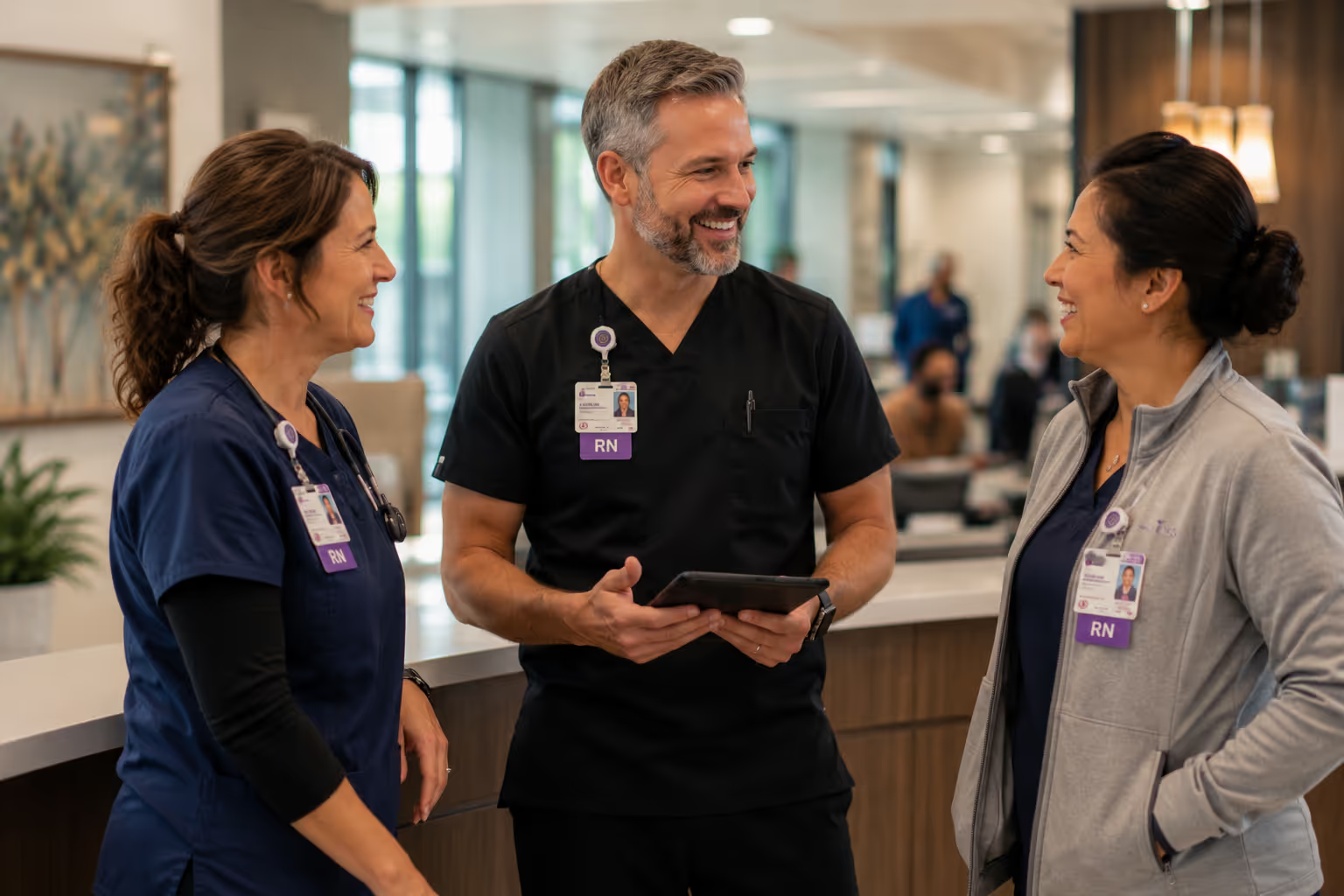
Client challenge
Wellstar Health System, one of Georgia’s largest healthcare systems, had already invested heavily in leadership development for senior leaders. But as the organization navigated rapid growth, a major acquisition, and the demands of a shifting healthcare landscape, it became clear that the greatest leadership challenges were happening at the front and midline.
“Some of the greatest leader challenges are really at the front and midline levels… we’ve invested heavily in leadership development, putting more emphasis on our front line and mid-level leadership in terms of outcomes, said Laura Dannels, Chief Talent Officer at the time.
We’re not an organization who believes in just investing in high performers… you’ve got to invest in your entire workforce.”
Wellstar partnered with Sounding Board to bring a more scalable, flexible coaching solution to leaders across the organization.
The solution
Partnering with Sounding Board, Wellstar designed a scalable, personalized coaching program to extend leadership development across the organization while maintaining the quality of one-on-one coaching.
A proprietary 360 assessment, aligned to Wellstar’s leadership behaviors, served as the foundation for each coaching engagement. This ensured development was directly tied to how leaders show up and lead in practice.
“We really wanted to ground the coaching to a framework that matters to our organization,” said Garry Gross, Executive Director of Leadership Development.
“Helping our leaders create an environment where our mission, vision, and values come to life was paramount.”
Program goals:
- Develop leadership capabilities aligned to Wellstar’s mission, vision, and values
- Deliver personalized, relevant development for leaders at all levels
- Strengthen the leadership bench and support succession planning
- Foster a culture of innovation, learning, and engagement
Program overview:
- Personalized, one-on-one coaching for leaders at all levels
- Capability development aligned to Wellstar’s values
- Serve with Compassion → Builds relationships
- Pursue Excellence → Drives results, leads teams, and plans strategically
- Honor Every Voice → Fosters inclusion and respect for differences
- Scalable delivery across frontline, mid-level, and clinical leaders
- Digital tools to track goals, capture insights, and measure progress
This approach made it possible to deliver consistent, high-quality coaching across roles and locations while keeping development relevant to each leader’s day-to-day work.
Results
As the program unfolded, Wellstar began to see a shift in how frontline and mid-level leaders showed up across the organization. Leaders in these critical roles had more consistent support navigating day-to-day challenges, and managers gained better visibility into how their teams were developing. Coaching became a more practical, embedded part of how Wellstar supports leaders in a complex healthcare environment.
Higher engagement and satisfaction
- 96% of participants said the coaching experience was worth the investment
- 99% said they could immediately apply what they learned to their day-to-day work
Measurable leadership growth
Participants reported double-digit growth across leadership capabilities including:
- Executive presence (+16%)
- Organizational collaboration (+14%)
- Strategic thinking (+13%)
- Time management and prioritization (+13%)
- Communication (+11%)
Stronger retention and mobility
- Coached leaders achieved a 90% one-year retention rate
- Retention for coached leaders was 31% higher than non-coached peers
- 3% of participants were promoted into new roles, exceeding organizational goals and industry benchmarks
Learn more about Wellstar’s leadership coaching journey with Sounding Board in this feature in Becker’s Hospital Review.
.jpg)
Client need
For a 175-year-old technology company, competitive advantage isn’t just built on technical innovation: it’s built on leaders who know how to get the best thinking from every person around them. That culture of drawing out ideas, developing people, and driving innovation through engaged teams had been a defining feature of the organization for generations. And it depended on having the right infrastructure to keep developing frontline leaders at scale.
In 2020, that infrastructure was disrupted. The COVID-19 pandemic forced the organization to pivot its in-person development to virtual almost overnight, risking the erosion of frontline leadership capability while simultaneously needing to navigate the broader shocks of the pandemic: supply chain volatility, shifting materials costs, and a workforce managing profound uncertainty.
Stalling frontline leadership development meant risking productivity, employee engagement, talent retention, job performance, and downstream impacts on quality and operating margin, at a moment when the organization could least afford it.
The question now was how to reimagine frontline leader development to equip thousands of global leaders to continue supporting their teams through disruption, and to ensure the next generation of managers could help their people do their best work under any conditions.
Solution
The client partnered with BTS to reimagine frontline leader development from the ground up, equipping leaders globally with the practical skills, tools, and mindset shifts needed to support their teams in doing great, innovative work.
The partnership began in 2019, and over five years has reached over 1,600 frontline leaders capturing 700+ documented behavior change actions. In 2022, BTS collaborated with the organization to refresh the program to reflect their evolving strategy and develop a sharper focus on supporting a culture of continuous improvement and innovation with coaching and feedback.
The blended program experience combined the following elements:
- Immersive leadership simulations: Scenario-based experiences placing leaders in realistic situations, surfacing Multiplier and Diminisher tendencies in real time and making the learning immediately personal and actionable
- Multipliers and Diminishers framework: A structured exploration of how leaders either amplify or diminish the intelligence of those around them, including specific “experiments” leaders could use to better understand their own leadership approaches
- Custom leadership frameworks: Including a structured, step-by-step process for having significant feedback conversations, a tool to understand and flex to communication preferences, and a coaching approach designed to help leaders guide team members toward their own solutions, building capability and long-term ownership.
- Structured application sessions — on-the-job practice components designed to bridge the gap between the program experience and day-to-day behavior, giving participants specific frameworks to apply immediately with their teams
- Peer networking and breakout groups — cohort-based learning that participants identified as a standout feature, both for deepening the learning and for building cross-functional relationships that extended beyond the program
- A commitment-capture platform integrated into the program to log participant actions and reinforce behavior change after the program ended; over 670 participant actions were captured across the program’s delivery
Throughout the program, leaders examined the impact of their own behaviors, recognizing where they were unintentionally diminishing their teams, and built new habits around challenging, creating space for mistakes and learning, listening, questioning, giving developmental feedback, and creating ownership. The feedback model gave participants a practical process for the positive and constructive conversations that actually change performance.
Results
More than 1,600 frontline leaders and individual contributors have participated in the program—the population closest to daily execution, quality, and operations. A recent impact study told a clear story about the effects of the program across participants:
100% of participants reported actively applying what they learned. 59% reported producing significant, measurable business impact, with concrete evidence to describe it.
The results weren’t theoretical. One engineering leader restructured how his team developed project plans, creating space for debate and ownership instead of coming in with the answer. His team exceeded their quality target by 10 percentage points and accelerated the project timeline by +4 months.
One production leader used the feedback model to coach a struggling supervisor and cascade the process across his entire leadership layer. His unit reached #1 performance in its division, improving a key quality KPI by more than 18% year-over-year. A department head with over a decade in leadership set new production records after learning to flex his communication style and draw out quieter team members. And a development lab supervisor used the program to clarify her leadership identity, earn a promotion, and coach her direct report to one as well.
The study also confirmed that when managers actively supported participants post-program, the likelihood of significant business impact increased substantially, shaping the organization’s next phase of reinforcement and cohort follow-up.
For an organization whose competitive advantage rests on the innovation and intelligence of its people, the program gave its leaders something technical training rarely delivers: the confidence, the tools, and the self-awareness to make everyone around them better.
Testimonials
“The program gave me greater confidence to try new things as a leader. It helped me realize what I do and what I don’t do.” - HR Leader
“The skills I learned in the training helped me be more efficient. It helped me do the right thing, right away.” - Production Manager
“Feedback is very important to create a positive environment; and how to [give] feedback is a specific skill I learned from this training and how to share constructive feedback.” - Production Leader

Client need
A large U.S.-based health insurance organization operating at the center of a complex national ecosystem had already made a serious investment in enterprise AI. Leadership was not experimenting at the edges. They were leaning in.
Capability and commitment existed across the organization, but unevenly. Some teams were already pushing boundaries. Others hadn't yet found their footing. Most of the gains had come in personal productivity. Valuable, but the core work itself had not yet fundamentally changed. The opportunity was to go deeper, to move from AI-assisted individuals to AI-reinvented workflows.
Across the health insurance landscape, pressure was intensifying. Medicaid and government program contracts were becoming more competitive. Decision cycles were faster and more analytics-driven. Clinical evidence was evolving rapidly. Regulatory scrutiny was high. Security risks were constant. AI was no longer a future conversation. It was a present expectation.
Inside the organization, world-class experts were still constrained by manual processes.
Specialized teams were synthesizing large volumes of complex, fast-moving information, working to keep pace with an environment where the inputs never stopped changing. The work required deep expertise and judgment, and it also demanded repetitive processing that consumed days when it needed to take hours.
Other teams faced pressure where speed and precision directly influenced competitive outcomes. Manual approaches were creating lag at exactly the moments when faster insight mattered most.
Across functions, the pattern was consistent. Highly trained professionals were spending valuable time on low-leverage tasks, stitching together data, transforming files, and correlating inputs that AI could handle.
Leadership understood that AI licenses alone would not create advantage. To compete in an increasingly analytics-driven insurance environment, expertise had to scale. Insight had to move faster. Teams needed to reinvent how core work happened.
Solution
BTS partnered with the organization to move from AI access to AI application.
Through a series of focused design sprints, intact teams worked on their highest-value workflows using our GROUNDING → EXPERIMENT → BUILD → AMPLIFY methodology. The structure was simple and disciplined. Set context. Experiment quickly. Build against real work. Create a path to scale.
Participants brought their actual work into the room. Analytical frameworks. Competitive and operational documents. Risk and intelligence inputs. Data pipelines.
No generic demos. No abstract hypotheticals.
The turning point came when AI began working on their actual content.
Research syntheses that previously took days began structuring themselves in minutes. Competitive analysis that once required manual review surfaced patterns instantly. Data transformation workflows streamlined in real time.
Skepticism shifted to possibility.
We positioned AI as augmentation, not replacement. In a sector defined by professional expertise and accountability, that framing was critical. The goal was to elevate expert judgment, not automate it away.
Some teams left with working prototypes. Others left with detailed blueprints aligned to enterprise privacy and security requirements. Another team took away a re-prioritized set of additional tools to incorporate into a HIPAA-compliant environment. Every team left with a redesigned workflow.
Results
In five days, more than 100 leaders advanced 30 priority use cases tied directly to operational performance and competitive growth.
Early outcomes included:
- Significant reduction in manual research synthesis and data preparation
- Faster, more structured competitive intelligence to support high-stakes decisions
- Clear implementation pathways aligned to security and regulatory constraints
- A scalable model for continued AI-enabled workflow reinvention
Just as important was the mindset shift.
Participants stopped viewing AI as a tool sitting outside their work and began treating it as embedded infrastructure for how work gets done.
“This showed immediate relevance to our work.”
“Now I understand what’s actually possible for my team.”
“We just accomplished in two hours what used to take us two months.”
In a U.S. health insurance market where insight, speed, and precision directly influence who wins and who grows, the organization moved decisively from AI access to AI advantage.
Related content

Client need
A leading global wholesale bank needed to increase its market competitiveness by re-defining and implementing a differentiated growth strategy. This required significant leadership alignment, increased collaboration across regions, products, and functions, and faster execution. To increase competitiveness, leadership needed to rewire old mindsets, lack of clarity and siloed ways of working that were limiting their edge in the market, and build a performance culture grounded in enterprise value, feedback, and accountability.
Solution
BTS partnered with the head of the bank and the leadership team to design and deliver a structured engagement through a series of leadership off-sites, strategy definition sessions, and high-performance team experiences across EMEA, APAC, and the Americas to rapidly align, commit to, and execute the new strategy.
The work focused on:
- Co-creating the wholesale bank’s must-win battles and driving their activation and translation to the country, product, and function level.
- Resetting performance culture through a growth mindset, "brave spaces," and a sharper competitive edge.
- Creating a blueprint for high-performing teaming, with a consistent approach and language across the organization.
- Systematically removing key silos by tangibly strengthening collaboration and co-creation across the organization.
Through a series of assessments, practical tools, and focused application, leaders created joint ownership and commitment to the organization’s strategy, a culture of constructive conflict, stronger stakeholder engagement, and enterprise thinking, while defining new operating principles, ways of working, and must-win battles to accelerate execution.
Results
The partnership engaged more than 320 senior leaders globally and helped align teams around shared priorities, new ways of working, and enterprise-wide collaboration.
Key outcomes included:
- Joint ownership of defined regional strategies and cross-functional workstreams across EMEA, APAC, and the Americas.
- Year-on-year improvement in the EMEA Leadership Team's High-Performing Team Assessment (HPTA) scores across every facet .
- Increased alignment between country, product, and functional leaders .
- Leadership team meetings were redesigned for greater focus on collaboration, co-creation, and feedback; "corridors of cooperation" were established to share best practice across WB regions .
- A shift from "safe spaces" to "brave spaces" that encouraged constructive challenge and accountability, driving breakthrough client solutions and competitive wins
Testimonial
"This group has never come together in one room to align on an EMEA set of priorities, tradeoffs, or commitments."

Client need
A global fintech organization was navigating rapid growth amid increasing business and talent market volatility. As the company scaled, senior leadership recognized the need to strengthen leadership effectiveness and cultural alignment at the top of the organization.
The goals were to:
- Accelerate the effectiveness of critical C‑1/C‑2 leaders.
- Rebuild confidence and alignment around the company’s values.
- Gain deeper, actionable insights into the culture and leadership realities.
- Inform future senior‑talent decisions (selection, fit, succession).
The organization partnered with BTS to design a scalable approach that would both develop senior leaders in role while simultaneously generating insight to shape the future of the enterprise culture.
Solution
The result was a multi-year, integrated leadership partnership combining executive advisory and cohort-based simulations.
Together, BTS and the organization built a multi-year leadership partnership designed to accelerate senior leader performance while generating enterprise-wide insight.
The solution combined two core components:
- Executive advisory - targeted 1:1 engagements to shift behavior in real time
- Leadership simulations - cohort-based experiences to align leaders around operating principles and surface patterns at scale
By strengthening leaders in role while creating visibility into cross-organizational themes, the partnership supported both immediate performance and longer-term talent strategy.
Executive advisory
The work began with a six-month engagement for the top 7–8 senior leaders and expanded globally toC1/C2 roles critical to future success.
Each engagement:
- Followed a structured BTS advisory protocol
- Anchored development in the company’s values
- Focused on live enterprise challenges, stakeholder alignment, and decision-making
Because the work was grounded in real business priorities, impact was immediate. Themes across engagements provided leadership and HR with clear insight into strengths and friction points across the senior population.
Leadership simulations
Annual simulations reinforced enterprise priorities at scale.
These immersive experiences:
- Translated leadership expectations into applied decision-making
- Built a shared language across regions and functions
- Generated cultural and behavioral insight
Findings from both workstreams informed decisions related to selection, succession, and senior talent planning.
Results
During a period of growth and market pressure, the partnership strengthened critical leaders and clarified the future of the leadership bench.
Leader impact
Senior executives demonstrated stronger enterprise decision-making, clearer stakeholder alignment, and greater confidence navigating complexity. Leaders described the experience as one of the most valuable investments of their careers.
100% of participating leaders:
- Would recommend working with BTS
- Left with a clear development plan
- Valued their advisor as a thought partner on live business challenges
Cultural insight and talent strategy
As the work progressed, patterns emerged across leaders, revealing cultural strengths and previously unnamed friction points. HR and executive stakeholders gained across-organizational view of how leadership behaviors were shaping performance.
Expanding the work together
What began with a small senior cohort grew into
- Ongoing annual simulations
- Expanded advisory across global C1/C2 roles
- A pilot to scale coaching capacity and flexibility
Today, the work is embedded in how the organization strengthens and advances its senior leaders, a core component of its leadership strategy.
Testimonials
“My coach was instrumental in helping me to align with my manager on where and how to create more focus in my role. They held me accountable for results and follow-through. They helped me think through how to work the system with all of its’ big personalities and ever-changing dynamics.”
“My coach helped me to learn and claim my superpowers and stay focused on spending my time and energy in that space and to let others do that same thing.”

Client need
A leading global life sciences company was operating at the forefront of scientific innovation, delivering therapies to millions of patients around the world.
The organization's strategy called for Medical to play an increasingly visible and influential role across the enterprise, not as a scientific function operating in parallel with the business, but as a core contributor to strategic decisions spanning pipeline priorities, governance forums, and commercial direction. The ability of medical leaders to operate at that level had become a strategic imperative.
These leaders were not generalists. Many had built careers in academic and research settings, developing deep expertise in science and medicine. In their roles, they operated at the intersection of R&D and commercial, translating scientific insights into strategy, influencing governance forums, and shaping both pipeline and brand decisions. These were among the most complex and high-stakes leadership roles in the organization.
As these leaders took on broader, enterprise-facing responsibilities, the nature of their work shifted. They were expected to work across functions, influence diverse stakeholders, and contribute to decisions that balanced patient, scientific, and commercial priorities in increasingly complex, cross-functional environments.
While highly capable, many had not yet had the opportunity to develop these enterprise leadership skills. With strong competition for talent, the organization recognized the need to accelerate development from within and ensure its leaders could operate as true enterprise contributors.
Solution
BTS partnered with the organization to design and deliver a four-month immersive leadership journey focused on building enterprise leadership capability in some of its most critical roles.
The program engaged 165 leaders across six cohorts, primarily senior leaders in medical affairs, market access, and health economics. Designing an experience that would genuinely resonate with this audience required more than adapting a traditional leadership curriculum. These leaders operated in highly specialized roles, navigating governance forums, balancing scientific and commercial trade-offs, and influencing cross-functional stakeholders without formal authority.
To reflect that complexity, BTS co-created the experience with senior stakeholders across the business, grounding the journey in the actual decisions, stakeholder dynamics, and enterprise challenges participants faced in their day-to-day work. That specificity was essential to making the experience credible, relevant, and immediately applicable.
The program focused on strengthening three capabilities critical to enterprise leadership:
- Enterprise mindset
- Influencing across the organization
- Communication and storytelling
To build these capabilities, the journey combined assessment, practice, and application through a set of integrated experiences:
Enterprise simulation and assessment (in-person)
The journey began with a simulation based on real governance forums and asset-level decisions. Leaders worked through role-based scenarios with assessor-coaches, navigating trade-offs and stakeholder dynamics in a realistic enterprise setting.
Each session included immediate feedback supported by:
- Simulation observations
- 360 executive presence assessment
- Personality insights assessment
This established clear, evidence-based development priorities tied directly to each leader's role and business context.
Experiential workshops (2 x 1.5 days)
Leaders then participated in two immersive workshops focused on decision-making and influence in cross-functional environments.
Using real business scenarios, participants practiced aligning stakeholders, navigating ambiguity, and communicating complex scientific insights with clarity and impact. The workshops emphasized active practice and real-time feedback.
Individual coaching (throughout the journey)
Each participant worked with a dedicated assessor-coach to translate insight into action.
Coaching centered on upcoming business decisions and stakeholder interactions, with manager involvement helping reinforce alignment with enterprise priorities and day-to-day application.
Peer learning and application (ongoing)
Leaders participated in small peer groups that met throughout the journey to reinforce learning and accountability.
These sessions created space to reflect, share experiences, and apply new approaches in real time, helping build consistency across the organization.
Across every element of the journey, the work remained grounded in real business challenges. Leaders built capability by practicing the same decisions, conversations, and trade-offs they faced every day.
Results
The program's success led to continued investment, with new cohorts of more than 200 critical role leaders now underway. Overall, the program strengthened how leaders think, decide, and influence, improving both decision quality and cross-functional execution.
Impact was assessed through:
- Post-program surveys
- End-of-journey evaluations
- 49 structured interviews with participants and their managers
Every manager interviewed reported sustained positive behavior change. The most significant shift was in how leaders approached decision-making. Participants engaged stakeholders earlier, clarified trade-offs more effectively, and showed up with greater confidence in governance discussions. As a result, decisions moved faster and with less friction.
The impact extended beyond the Medical function itself. Colleagues across commercial, R&D, and other functions began noticing a tangible difference. Medical leaders showed up differently in joint forums, communicating complex scientific trade-offs more clearly and building alignment more effectively across competing priorities. Conversations that once required multiple rounds of clarification increasingly moved to alignment more quickly.
Leaders consistently improved in several key areas:
- Earlier alignment before formal decision forums
- Greater confidence navigating ambiguity and enterprise trade-offs
- Stronger influence across cross-functional groups
- Clearer, more concise communication of complex scientific insights
Collectively, these shifts improved cross-functional decision-making and execution across the organization. Leaders were better able to prioritize enterprise value, align diverse perspectives, and ensure medical insights were clearly understood and acted upon.
The impact extended beyond individual participants. Leaders applied these approaches within their own teams, reinforcing more consistent ways of working across the organization and helping position Medical as a strategic enterprise partner rather than solely a scientific function.