Leadership is relentlessly contextual
Proven leaders don't always deliver
You've seen the pattern. A leader with a strong record joins from a respected company and results stall. Your board asks why and you need an answer built on evidence.
BTS first published this argument in 2017. Nine years of new research make the case stronger. Talent is portable, but success isn't. Whether a leader delivers depends on the match between what they know how to do and what a specific business, in a specific market, at a specific moment, needs.
Two GE alumni, opposite results
For 20 years, companies paid premiums for GE veterans. Larry Bossidy left GE for Allied Signal and grew the stock roughly tenfold. Robert Nardelli left GE for Home Depot in 2000, and the announcement alone added close to $10 billion in market value. Over his six years, Home Depot’s stock fell about 8% while Lowe’s rose about 180%. He was out in 2007.
What the research shows
- 20: GE executives who became chairman, CEO or CEO-designate elsewhere between 1989 and 2001. Markets rewarded every hire on announcement. Results then diverged based on whether the new company needed each leader’s particular mix of skills.
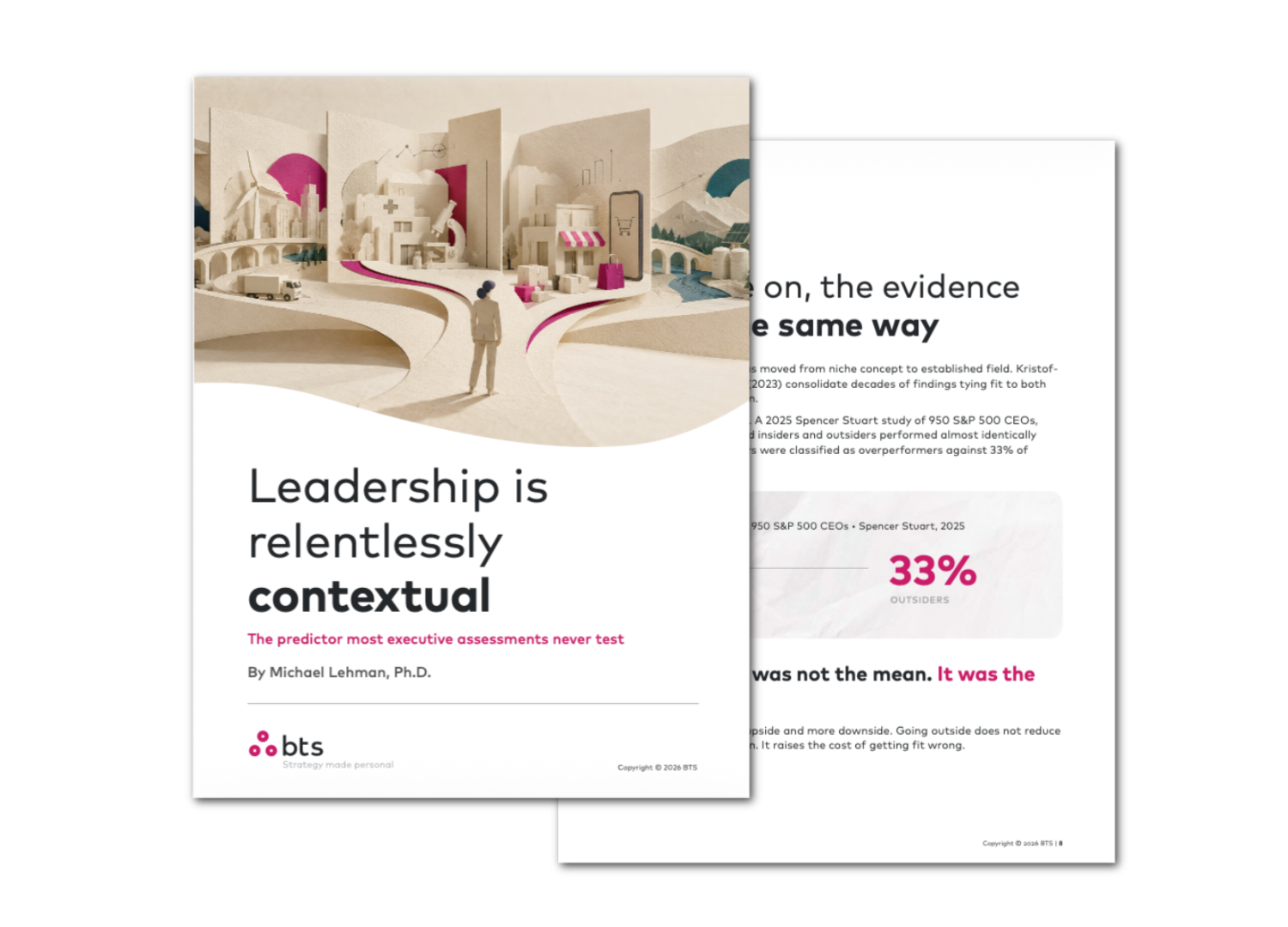
- 34% and 33%: the share of insider and outsider CEOs classed as overperformers in a 2025 Spencer Stuart study of 950 S&P 500 CEOs. Outside hires carry more upside and more downside.
- 46%: the share of star Wall Street analysts whose performance declined after they changed firms.
Same training, same era, opposite results.
Five kinds of executive human capital
The research found five kinds of executive capital. Only two of them travel from one company to the next. The other three stay behind, and they decide whether a leader delivers in a new setting. Success comes from matching the blend to the setting, not from holding more total capital.
Why most assessments miss fit
Most assessments apply context after the measurement, as a weighting against a role profile. This approach captures only 2 of the 5 capitals. The other three show up only as behavior inside a real setting.
What’s inside
- Which two of the five capitals travel, and which three don't
- Why insider and outsider CEOs perform alike on average and differ in spread
- What an investment bank learned when it paid a premium for outside hires
- What the latest CEO picks at Walmart, Target, Disney and Kroger tell you about fit
- How to test all five capitals before your next succession call
Get the full white paper
Michael Lehman, Ph.D., Senior Director at BTS, wrote this for HR leaders who own succession, assessment and the leadership bench. Download the whitepaper to see the research, the five capitals and how to build fit into your next talent decision.
Test for fit before you bet on a leader.
Sources: Groysberg, McLean and Nohria, Harvard Business Review (2006). Groysberg, Nanda and Nohria, Harvard Business Review (2004). Spencer Stuart (2025).

Related Content

Related Content