Expertise

Digital Transformation

We help your people drive, promote, and lead the transformation required for the digital age through training and consultative solutions.

Light bulb shattering with red and blue particles against a dark background.

We are so excited to introduce the newest member of the BTS family -Netmind.

With its deep expertise in Digital Transformation Netmind opens up a world of possibilities in the agile and digital space for our clients. These offerings bring important complementary capabilities to BTS, and I could not be more thrilled to share them with you. I hope you are inspired to embrace digital transformation.


Grid of diverse people in a video conference, smiling and engaging, with a woman in a blue polka-dot shirt centered and gesturing.
Henrik Ekelund
Founder, President & CEO BTS Group

People-based transformations. We believe that an organization’s people, from the front-line to the C-suite, are the catalyst for transformation.

To drive digital transformation, leaders must optimize processes to improve organizational efficiency and maximize customer value.

Teams need the right culture and skills to reimagine how they are organized and how they work. We help you develop your talent, adapt new ways of working, and drive the powerful culture changes necessary for transformation.

Your people will be empowered to successfully implement your digital strategy, leveraging new technology to enable innovation, inspire continuous learning, and deliver amazing value to your customers.

How we help

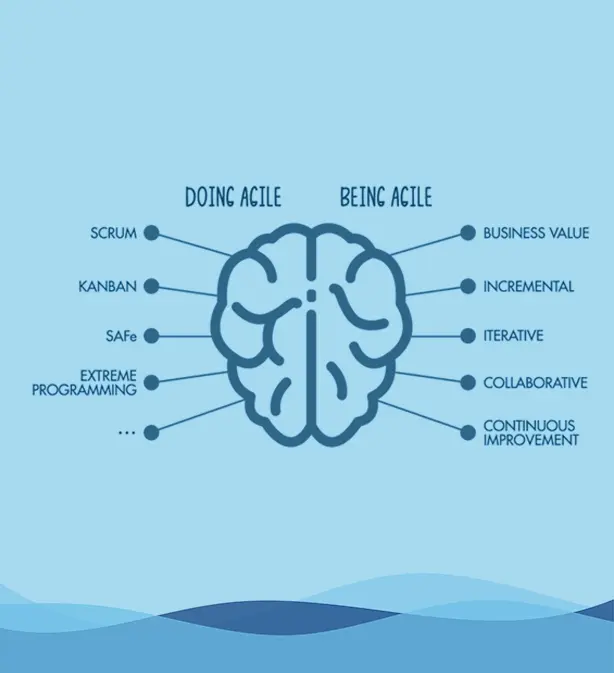
Do Agile. Be Agile.

Adopting new Lean-Agile management methodologies is not easy. The process not only involves adopting new ways of working, but also new ways of thinking and acting. True transformation happens when people start focusing on delivering value to customers. This can only happen if people go beyond “Doing Agile” and also start “Being Agile”.
How we help

Digital talent

Adopting a digital transformation strategy should be an essential priority for any organization that not only wants to survive in today’s accelerated pace of change, but also to thrive in it. However, most organizations are not sufficiently prepared to design, implement, or apply digital technology to various aspects of their business.

Common roadblocks in digital transformations include a lack of knowledge within teams, organizational culture, and the effectiveness of IT teams. A digital transformation requires a new way of thinking and approach to management, as well as having professionals with the necessary skills to promote and lead it.
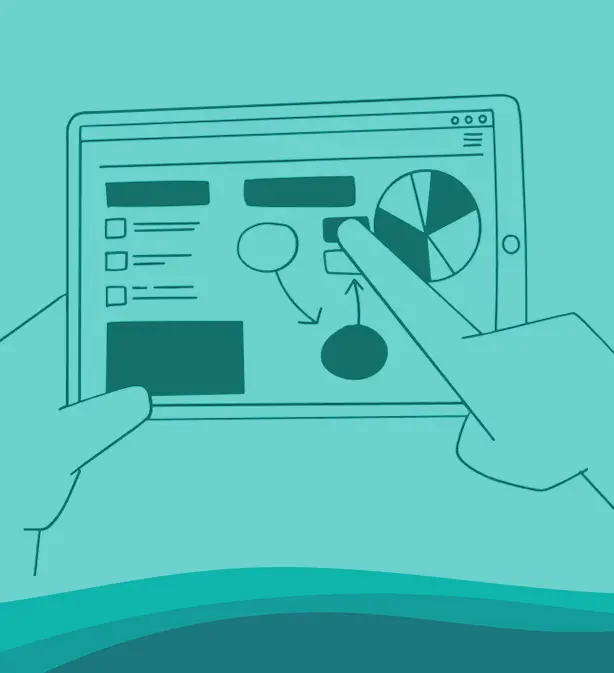
Illustration of two hands holding a tablet displaying charts, a pie graph, and flow diagrams on the screen.
How we help

Always learning

In an environment where changes occur rapidly, training and learning needs grow exponentially. In this context, traditional training models are no longer effective. Modern organizations need to have an agile and decentralized learning culture, in which their collaborators take an active role by leading their own development and participating in the development of others by sharing their knowledge with the rest of the organization.

Illustration of two people placing sticky notes on a wall for brainstorming or planning.
Client stories

Shifting to a digital, agile paradigm at BBVA

In a constantly changing environment and with high complexity, BBVA, a multinational financial services company, faced the challenge of improving to meet customer expectations, and began to promote a new model that was digital, agile, and flexible.To help BBVA respond to this challenge, Netmind, a BTS company, undertook a co-creation process with the team, sponsoring the management of this change initiative.

Night view of the illuminated Metropolis building in Madrid with long exposure light trails of passing traffic.
Client stories

Enterprise transformation at a technology organization

A non-profit technology organization specializing in compliance and licensing for insurance professionals needed to make the shift to agile to achieve its growth plans. After attempting and failing to make the shift in the past, employees were left with a negative perception of agile, incomplete training, and a feeling of disconnectedness.

Man wearing glasses typing on a laptop in a dimly lit room with several people working on laptops around him.
Client stories

Digital transformation at Red Eléctrica de España

Red Eléctrica de España (REE), a Spanish utilities company, needed to increase its flexibility and efficiency to comply with an international treaty on climate change. Its newly unified IT department (DTI) spearheaded a digital transformation with the following components: assess current employees’ competence, anticipate talent development needs, and promote a cultural shift towards active, continuous learning.

Client stories

Increasing agility for a healthcare organization’s HR department

The world’s leading children’s hospital sought to improve its HR department’s ability to develop and retain top medical talent. To counter frustrations caused by the hospital’s recent exponential growth, HR recognized the need for a clear service strategy, as well as greater flexibility in the interpretation of policy.

Latest Content

Blog
August 14, 2026
5
min read
Every candidate looks like a great hire now. AI made sure of it.
Polish is no longer a hiring signal. See how organizations use role-relevant simulations and predictive validity data to hire for high-stakes roles.

Candidates now arrive at interviews pre-coached by AI, with their resumes optimized to pass every checkpoint. Polish has stopped being a signal. The traditional hiring process was built to read exactly the cues that AI is now best at producing, and the signals hiring managers once relied on have weakened as a result. And for roles where the wrong hire carries real business consequences, losing the ability to tell who will actually perform is not a minor inconvenience. It is a material risk, and it exposes the business to unnecessary turnover, reduced performance, and heavier investment for talent growth and development.

So how do you observe the behaviors that matter most, before someone is in the role?

Not by asking better questions, but rather by putting candidates in situations designed to elicit that behavior.

The limits of predicting from paper

Credentials tell you what someone has done. Structured interviews tell you what someone says they would do. Neither lets you observe what they actually do in the moments that count.

This distinction matters most in client-facing, relationship-driven roles, where the performance gap between a strong hire and a weak one plays out in real business outcomes (revenue, retention, client growth). Organizations that hire at scale in these roles carry that gap across hundreds of decisions at a time.

The better approach is to watch candidates do the work before you hire them. Put them in simulated, role-relevant scenarios, and pair the simulation with a second, different kind of measure so no single method carries the whole decision. That combination is what lets you evaluate real performance before anyone is in the role. Organization-specific simulations provide a clear read on who is ready and capable of performing on day one. In a world of AI-supported candidate signals, the use of simulations makes the process harder to prep for. It is harder to fake. And, when designed well, it is substantially more predictive than other hiring methods.  

What counts as evidence

Claims about predictive power are easy to make. Evidence for them is rarer than you would expect.

A predictive validity study, the kind that links pre-hire assessment scores to how someone actually performs once hired, is some of the hardest evidence to produce and the rarest to see. Many assessments are validated against proxies: another test, or a theoretical model of the role, rather than real results on the job. Connecting scores to concrete business outcomes and doing the statistical work to show the link holds, takes years of shared data and a level of commitment from both the assessment provider and the client that most partnerships never reach. That is precisely why it is worth asking for. A provider who can show how assessment scores track to training completion, retention, and first-year output is offering something categorically different from one who can only show a correlation with another test.

Why simulation holds up where other methods do not

When a candidate sits across from a trained assessor (someone playing the client or prospect on the other side of the conversation) and has to work through a real situation, they cannot rely on a rehearsed answer. The scenario is specific. The stakes feel real. What you see is close to what you would get on the job.

That is the value of simulation-based assessment: it does not test what candidates know about the role.

It shows how they use what they know when a real person is on the other side of the conversation, before the stakes are real.

For roles that carry significant business responsibility, this distinction is the whole game. The cost of the wrong hire in a high-stakes client-facing role is not just a missed quota for a quarter - It plays out in relationships that do not develop, clients who leave, and productivity losses that compound over time. Getting those hiring decisions right, at scale, with consistency, requires methods that are built for predictive accuracy, not just candidate experience or hiring speed.

What this means for how organizations think about hiring

Most organizations are still optimizing the wrong things in their hiring process. They invest heavily in employer branding, application flow, and interview structure, all of which matter, but less in the core question: does our hiring process actually predict who will succeed in this role?

AI has sharpened the stakes here. If every candidate can present as polished and prepared, screening based on presentation becomes less useful. What holds up is direct observation of the behaviors that the job requires.

A few principles worth building from:

  • Measure what the job requires, not what is easy to measure. Cognitive tests and personality questionnaires have their place, but they do not look much like the job. The closer the assessment is to the actual work, the better it predicts performance in it.
  • Ask what your assessment predicts. Training completion? Retention? First-year output? Most organizations cannot answer that question today, largely because providers have rarely been asked to prove it. It is a fair thing to ask for.
  • Take the human element seriously. In a simulation, a candidate is having a real conversation, responding in real time, navigating a situation that requires judgment. Even with the help of AI, that is hard to game. And it remains one of the strongest predictors of on-the-job performance available.

The data exists to make hiring decisions more accurate, fairer, and more directly tied to business outcomes. For organizations operating in high-stakes roles at scale, there is too much on the line to rely on methods that cannot hold up to that standard.

You may be interested in BTS’ thought leadership in the five talent shifts AI is forcing now.  

Blog
July 15, 2026
5
min read
Why leadership needs less jargon
Why do leaders rely on business jargon? The answer may surprise you. This article explores the hidden ways leadership language shapes how others understand, trust, and respond to leaders.

Leadership is the work of creating shared understanding, and language is the primary tool for doing it. Yet we spend remarkably little time examining our words. Every decision, expectation, priority, and piece of feedback reaches another person through words. If those words aren't doing the job, neither is the leadership.

The lighthouse

Some years ago, a large company hired a strategy consulting firm to rethink its leadership model. The firm came back with a beautifully produced framework built around a central metaphor: the lighthouse.

Leaders, the model declared, should be lighthouses.

The metaphor quickly found its way into playbooks, performance reviews, onboarding decks, and town halls. People repeated it with the confidence of those who had paid a lot of money for it.

There was just one problem: nobody could agree on what a lighthouse was supposed to do.

Was it warning people away from danger? Guiding them toward a destination? Standing firm while everything else changed?

Eventually, the company hired another team to translate the metaphor into specific, observable leadership behaviors.

It was an expensive way to discover that a word everyone confidently repeated wasn't creating nearly as much shared understanding asthey thought.

Why jargon prevails

  • Parking lot that
  • Double-click
  • Close the loop

Business jargon survives because it’s largely designed to manage social risk. Using it signals, I know how this world works. It demonstrates membership, competence, and credibility.

Business is messy, and leaders don't always have complete information. Abstract language lets us project confidence while preserving flexibility.

Altitude without traction

Specific language creates accountability. The more specific you are, the easier it is for people to disagree, question your thinking, orhold you accountable. That's part of the appeal of jargon. It creates distance between the speaker and the detail. The more abstract and elevated your language, the more strategic you sound.

A 2020 study by Harvard Business School professors Laura Huang and Andy Wu, published in the Academy ofManagement Journal, analyzed over 1,000 early-stage startup pitches and found that founders who spoke in abstract, visionary terms were significantly more likely to advance in the funding process.

A separate study, published in Applied Cognitive Psychology in 2025, found the other side: jargon raises how credible a speaker appears and lowers how much the audience retains.

The very language that helps people see you as a leader can make you less effective once you're leading.

The most trusted leaders tend to be the ones who resist impressive-sounding language and say the plainest version of what they mean.

In fact, four words probably do more for a leader's standing than any carefully crafted message: I made a mistake. Not "we encountered some headwinds," not "there were learnings from this experience," but the plain version.

The cost of comfort

When a conversation gets uncomfortable at work, it almost always feels easier to soften your message than to say exactly what you mean. You hedge, add qualifiers, cushion the point with extra reassurance, or leave the hardest part unsaid. Most of the time, you mean well. You don't want to discourage someone, damage the relationship, or create unnecessary conflict. The conversation becomes less uncomfortable for a moment, but the work often becomes harder afterward.

Amy Edmondson, Novartis Professor of Leadership and Management at Harvard Business School and author of The Fearless Organization, found that the fear of making a negative impression pushes people to stay silent exactly when clarity is most needed. According to her research, silence is one of the most consistent predictors of teams that miss problems early and never learn from them. The friction avoided in the meeting resurfaces later, at greater cost.

KimScott, former executive at Google and Apple and author of Radical Candor, calls this ruinous empathy: softening your message to protect someone's short-term feelings comes at the cost of the clarity they need. Her argument is simple and uncomfortable: clear, direct communication, even when it is hard, is an act of care.

The quiet power of saying what you mean

None of this is an argument for bland, colorless language.Vivid, precise writing does the opposite of jargon: it sharpens meaning instead of hiding it. Before reaching for a word, pause on two questions:

  • What do I mean by it? 
  • What will my audience hear? 

A surprising amount of corporate language wouldn't survive those two questions.

Leaders have more influence over language than they often realize. Whatever tone, vocabulary, and level of directness they model becomes the standard everyone else copies. Word choice is one of the quietest ways leaders shape culture.

This matters even more as we hand our language to AI. These tools can already learn to write in our voice. The question now is whether we've been deliberate enough about that voice in the first place to like what we see.

Blog
June 9, 2026
5
min read
Built for a different world: Five talent shifts AI is forcing now
AI is changing work fast, but many organizations are still using talent practices built for a different era. Here are five emerging shifts every talent leader should have on their radar.

You can't predict the future. You can be disciplined about how you face it.

That's where Future Storming comes in. Future Storming is a process for looking at the trends and signals already visible in the market, understanding how those forces connect, and thinking more clearly about where they may lead.

Recently, we've been applying that lens to talent strategy, running Future Storming sessions with talent leaders across industries to understand which forces are already reshaping how organizations find, develop, and retain the people they need. When you look across those conversations, one thing is hard to miss: AI runs through almost all of the most significant trends, and not as a future scenario. It's already reworking the talent systems most organizations have leaned on for years, often quietly, and often faster than leadership teams have had time to respond.

From these sessions, five high-likelihood, high-impact shifts have emerged as the ones every talent leader needs to be watching right now. What follows is what each of them may mean for your organization.

1. The frameworks most organizations use to define great leadership were built for a different era

Skills and competency models describe work that no longer exists in many roles or that AI now performs alongside, or instead of, humans. The gap between what organizations say they're selecting and developing for, and what the work actually requires, is widening quietly.

This creates a real problem. Organizations that don't redefine what great looks like now will be developing the wrong people for the wrong future optimizing for capabilities that are becoming less predictive while under-investing in the ones that matter most.

  • Rebuild leadership profiles from a future-back perspective, starting with where the business is heading, not where it has been.
  • Focus on the distinctly human capabilities AI cannot replicate judgment in ambiguous conditions, relational intelligence, ethical reasoning, the ability to set direction when there is no precedent.
  • Increase the use of behavioral observation in selection and development. It's the only methodology that shows how someone actually thinks and decides under real pressure.

The signal worth chasing isn't on a resume, it's in the room in how someone handles a real situation, under genuine pressure. It's the only place where someone can't prepare their way out of being themselves.

2. Human differentiators are the last mile AI cannot close

Judgment. Empathy. Creativity. The ability to navigate genuine ambiguity. These are increasingly what separates human contribution from AI output and they're precisely the things most talent systems have always found hardest to measure.

For a long time, organizations could afford to treat these as qualities that would emerge naturally with experience. That's no longer an option. The human differentiators are becoming the job. And most organizations still aren't measuring them well.

The methods exist behavioral assessment, simulation, structured observation. And AI is now making them accessible at scale in ways that simply weren't possible before. The question isn't whether to use them. It's how to deploy them thoughtfully, with the governance and transparency that -stakes talent decisions require.

  • AI-powered behavioral observation that surfaces how people actually perform in the flow of work, (i.e. judgement, decision-making, adaptability) not self-report
  • Assessment that evaluated how people work with AI, not just without it because that's increasingly what the role looks like
  • Simulation-based approaches that reveal thinking in action - the kind of evidence no credential or output can provide

3. The talent pipeline is broken

AI is displacing the early-career work that has traditionally served as the on-ramp into organizational life. Those tasks once gave emerging employees something more valuable than work product. They gave them foundational experiences, relationships, and judgment. The kind of judgment that eventually grows into leadership.

The impact won't show up immediately. That's exactly what makes it worth paying attention to now. Within three to six years, benches will thin and succession pipelines will require far more intentional investment. Organizations will find themselves asking why their internal talent isn't developing the way it used to.

The organizations that get ahead of this have a real opportunity to build something more deliberate, more equitable, and better suited to the capabilities the future actually requires.

  • Invest in real, simulation-based experiences, putting emerging leaders into the decisions and pressures that build genuine organizational judgment, not just task exposure.
  • Redefine what early-career development is, building toward the capabilities the future requires, not the ones the old job description described.
  • Build feedback into the flow of work. AI behavioral observation and practice AI role plays make continuous development possible at scale. The experience that used to happen informally has to be designed now.

4. People need to re-skill faster than any development model was built to support

People need to reskill faster than any development model was built to support.  Most organizational development infrastructure was built around a longer, more stable arc of skill acquisition. AI is compressing that arc significantly.

The implication isn't just that training needs to be faster. It's that the whole architecture of how organizations identify, develop, and deploy talent needs to be built for continuous recalibration not periodic refresh.

  • Prioritize adaptability and learning agility over static expertise. The ability to acquire new capabilities quickly matters more than the specific capabilities someone holds today.
  • Treat reskilling as a continuous organizational process, not an episodic program.

5. AI is absorbing leadership work and culture is losing it's anchor

This is the shift that's easiest to underestimate, and hardest to recover from once it arrives.

Culture is what people see leaders do. The behaviors leaders model how they make decisions, how they show up in hard moments, what they choose to reward and what they let go are how organizational culture gets transmitted. It doesn't travel through stated values. It travels through visible human behavior.

AI is absorbing the work that used to make leaders visible as humans making choices. Performance reviews written by AI. Communications drafted by AI. Coaching conversations mediated by AI. When the distinctly human work disappears, so does the signal. People don't know what to watch anymore. And culture which depends on that watching starts to fray.

The organizations that navigate this well won't be the ones that use less AI, they'll be the ones most intentional about which leadership behaviors remain visibly human, and why.

The behaviors that held culture together need to be rebuilt around what humans uniquely contribute now and that starts with getting the success profile right. That's exactly what the Future Ready Profile is built for.

Strengthen empathy-centered leadership capabilities. The human dimensions of leadership matter more, not less, as AI takes on more of the technical work.

  • Strengthen empathy-centered leadership capabilities. The human dimensions of leadership matter more, not less, as AI takes on more of the technical work.
  • Reinforce organizational purpose and human-centered culture as anchors.
  • Treat culture as something you design, not something you inherit.

What this means

The organizations that navigate this well won't be the ones that adopted AI fastest, they'll be the ones that invested just as deliberately in the human systems around it.

These five shifts aren't warnings. They're design problems, and design problems have answers. The talent systems that come out of this moment can be more intentional, more equitable, and more fit for purpose than anything we've built before.

At BTS, this is the work we're doing every day. If you'd like to think through what any of it means for your organization, we’d love to talk.

The thinking in this article was shapped by Future Storming sessions, including a SIOP 2026 workshop, and by ongoing conversations with talent leaders navigating these shifts in real time.
Client Stories
July 16, 2026
5
min read
Wholesale bank strategy re-alignment for growth
See how BTS helped a global wholesale bank align 320+ leaders, break down silos, and execute a differentiated growth strategy across regions.

lorem ipsum

Client Stories
May 27, 2026
5
min read
Building a future-ready leadership bench in global fintech
A global fintech company partnered with BTS to strengthen senior leadership effectiveness and cultural alignment during rapid growth.

lorem ipsum

Client Stories
May 14, 2026
5
min read
Building enterprise leadership in medical affairs
Learn how BTS helped a global life sciences company strengthen enterprise leadership in critical medical affairs roles through simulations, leadership assessment, coaching, and cross-functional leader development.

lorem ipsum

BTS whitepaper cover: The Leadership Shift — mindset coaching research
Whitepapers
July 24, 2026
5
min read
The leadership shift: what two years of coaching data are telling us.
Two years of anonymized coaching data reveal the mindset patterns holding leaders back.

lorem ipsum

Whitepapers
July 24, 2026
5
min read
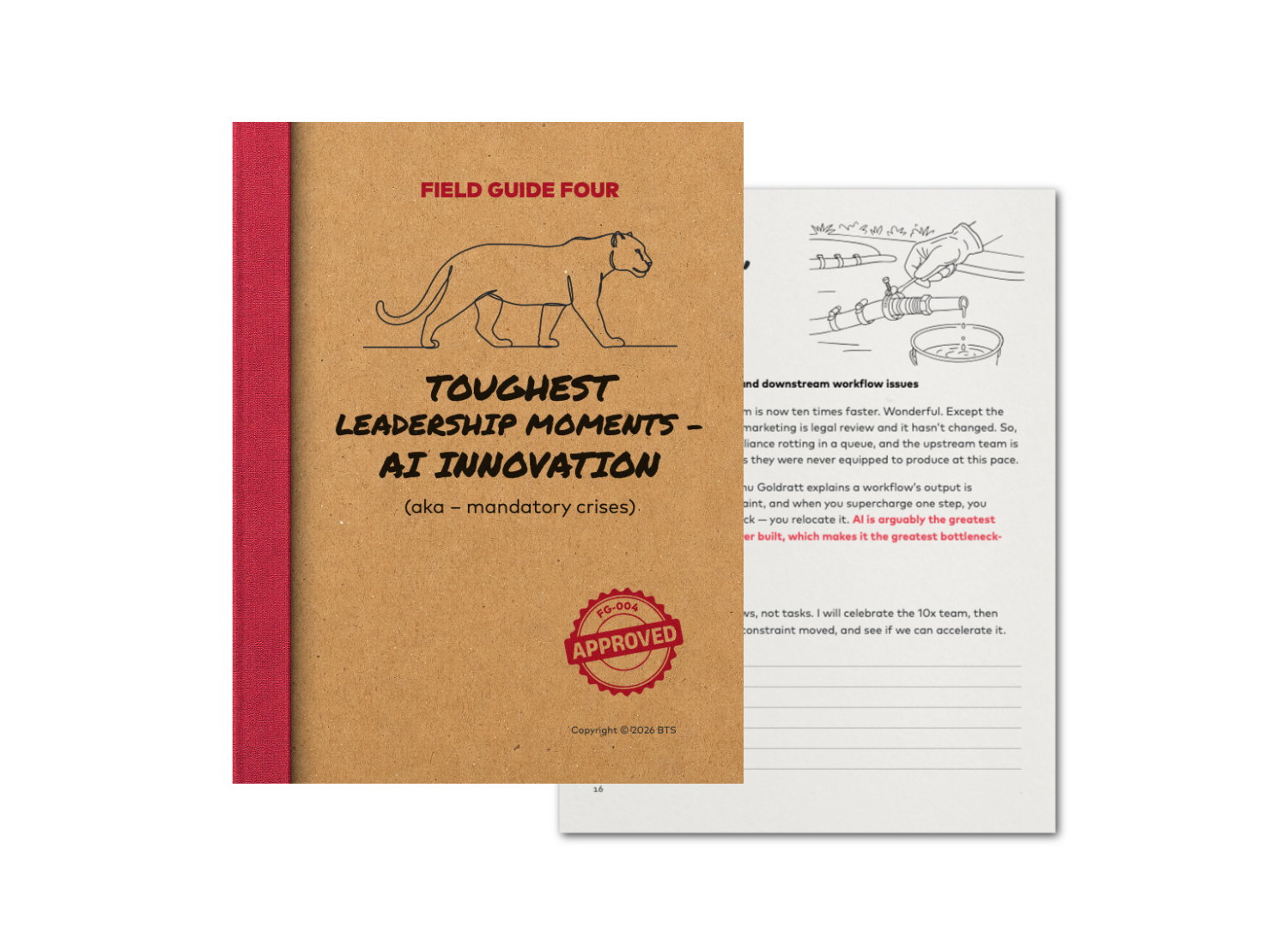
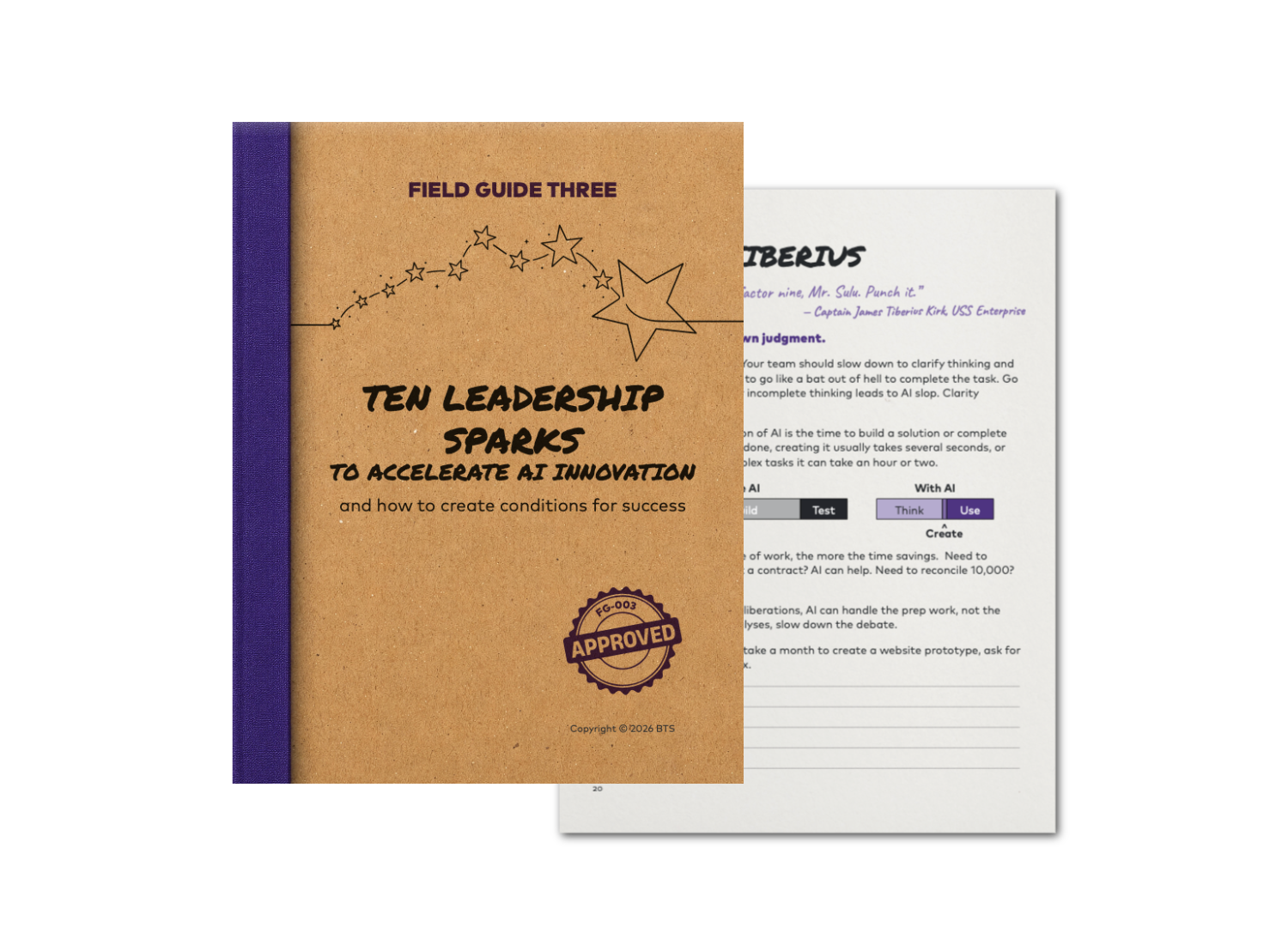
Applied AI field guides
Four practical guides for building AI capability, mobilizing leaders, and navigating the moments when AI innovation gets difficult.

lorem ipsum

Whitepapers
June 25, 2026
5
min read
BTS 2026 AI pulse survey
Read the original BTS research from nearly 400 leaders on AI adoption, workforce readiness, training gaps, and governance.

lorem ipsum

Neon sign with pink circular symbols and white text 'bts' mounted on a wall covered in rows of vintage cassette tape images.

Ready to start a conversation?

Every successful transformation begins with a meaningful conversation. Connect with us to explore how BTS can partner with you to make the shift.