Welcome to BTS Southeast Asia
Transforming strategy into action — through people

At BTS, we believe people are the driving force behind every successful strategy. We help organizations turn ambitious visions into meaningful action and measurable results - by engaging, equipping, and inspiring their people.
BTS Southeast Asia, with offices in Singapore, Malaysia, Indonesia, and Thailand, brings over 60 years of combined experience partnering with leading organizations across both the private and public sectors, spanning industries such as banking, manufacturing, healthcare, and technology.
We work alongside our clients to align their people with their vision of success, shift mindsets, and build the confidence and capabilities to embrace change and deliver lasting impact.
When people grow, organizations transform. That’s why at BTS, we’re focused on the people side of strategy - turning vision into action, and action into results.
Latest insights, news, and events


Three decisions that changed everything.
Two years ago, we made three deliberate decisions about how BTS would move with Applied AI.
We would become our own Customer Zero.
While others were building strategies, defining governance, and waiting for clarity, we made a different call: we decided not to wait. Not because the stakes were low, but because they were high. And because in a space evolving this quickly, clarity wouldn’t come from planning. It would come from movement.
So instead of starting with a roadmap, we started with three principles:
- No top-down mandate. The people closest to the work figure it out.
- IT must evolve from gatekeeper to enabler - leading AI trials and fast experimentation.
- Don’t wait for certainty.
We set the organization in motion, and once we did, things started to move quickly.
What if we started this company today?
Waiting for certainty is itself a choice, and it’s costing companies more than they realize.
We started where we knew the work best: our simulations. No perfect plan, just teams moving, trying, and iterating.
Simulations are core to who we are at BTS. Companies that simulate don’t just make better decisions; they execute faster and build more engaged cultures.
The team asked a simple question:
"What if we were to start our company today?”
That question started the flywheel.
They asked IT for a few licenses and started building - vibe-coding, writing agents, and testing tools - moving at a pace that would make any VC-backed start-up smile.
The messy middle.
At first, the team was underwhelmed.
The early reports were blunt:
“Not good with math.”
“Poor graph capabilities.”
The team wasn't discouraged. They kept tinkering - jumping between tools, staying on top of new releases, experimenting constantly.
This was a small team, across 24 countries, building off each other’s ideas. Laughing at crazy creations. Breaking things. Iterating in a sandbox alongside real clientwork.
Each cycle produced something:
- A sharper scenario
- A faster build
- A more powerful simulation
The flywheel was turning, and it was generating something real.
When the diamond appeared.
Then something shifted.
The team moved into client trials across five countries. They figured out ISO compliance and built the architecture to handle the complexity, the “spaghetti.”
And what emerged wasn’t incremental:
- What used to take weeks started happening in days.
- Limited creativity started to feel like unlimited innovation.
- Clients became self-serving.
- Agentic simulations were built directly into client systems for real-time updates and preparation.
This was our first AI diamond - a high-impact outcome created by many cycles of experimentation compounding into real value.
It only appeared because we kept the flywheel turning, each cycle increasing the odds that something would break through.
95% adoption in eight weeks.
Then it was time to take the AI diamond global.
BTS is decentralized and highly entrepreneurial. We operate across 24 countries and 38 offices, where local teams have real autonomy.
And historically? That’s meant a low appetite for adopting something built somewhere else and pushed from the center.
So we expected resistance.
Instead, something surprising happened.
In the first eight weeks, we saw 95% adoption across our global footprint.
It felt completely different from our own digital initiatives, ERP implementations, top-down rollouts of the past.
This moved on its own. Why?
We realized it didn’t start with a framework or a model, it started with a feeling.
The feeling of being at the leading edge of one’s craft and profession.
- Joy
- Excitement
- Pride
As we watched this play out across teams it stopped feeling like isolated wins.
There was a pattern to it. A repeatable, organic, innovation motion.
And the flywheel didn’t stop with simulations.
It spread across finance, sales enablement, legal, operations, and client delivery. Some cycles led to small improvements, and others revealed new diamonds.
Not becausewe planned for them, but because we built the conditions for people to find them.
The question I'd ask any CEO right now: Is your flywheel turning, or are you still waiting for the perfect plan?
In part 2, I’ll share the key success factors behind the breakthrough, and what we’re now seeing across more than 120 global clients.

Organizations have long wanted to scale coaching, but have been limited by cost and capacity. With AI, that's beginning to change as new platforms make coaching more accessible, flexible, and available on demand, extending support beyond a select group of leaders to entire populations.
For talent leaders, this shift creates both opportunity and complexity. With greater reach comes a new set of trade-offs: how to balance access with depth, flexibility with accountability, and efficiency with meaningful development.
The limits of unlimited (coaching).
Unlimited coaching sounds like the obvious answer. Remove the barriers, give everyone access, let people engage on their own terms. What's not to like?
In practice, quite a bit.
When coaching has no defined structure or cadence, engagement tends to become episodic - people show up when something feels urgent and step back when it doesn't. The coaching relationship never quite deepens. Conversations cover ground but don't build on it. And the development that was supposed to happen keeps getting pushed to the next session, and the next.
Three patterns emerge:
- Sporadic engagement over sustained development. Without a rhythm to anchor the work, coaching becomes reactive. Clients bring whatever is most pressing that week rather than working toward something larger. Progress happens in bursts, if at all.
- Insights that don't compound. Great coaching reveals patterns over time - things a client can't see in one session but can't unsee after several. Without continuity, and without a consistent coaching relationship to hold the thread, each conversation starts close to zero.
- Outcomes that are hard to measure. No milestones. No defined endpoint. No clear way for the organization, or the client, to know whether it's working. Activity fills the gap where impact should be.
The result is a model that's easy to scale and hard to defend. Which is exactly the problem talent leaders are navigating right now.
The relationship is the lever.
Decades of research into what makes coaching work keeps arriving at the same answer: it's the relationship. Not the platform, not the methodology. The relationship.
When a coach and client build trust over time, developing shared language, and returning to the same themes with increasing depth, something shifts. Conversations get more honest. Insights stick. The client starts doing the work between sessions, not just during them. That's when coaching becomes genuinely transformative, and it can't be rushed or replicated in a one-off session.
The ICF and EMCC are clear on this: continuity is what dives outcomes. The coaching engagements that produce lasting change are the ones where each session builds on the last, not the ones that simply offer more access.
Three principles make that possible: Consistency, Continuity, and Completion.
1. Consistency
The foundation everything else is built on.
The temptation when designing a coaching program is to treat flexibility as a feature - let people book when they want, swap coaches freely, engage on their own schedule. But frequent coach changes reset the clock. Every new coach has to earn trust, learn context, and find their footing with the client. That's time spent getting started, not getting somewhere.
A stable coaching relationship works differently:
- The coach starts to see around corners, uncovering patterns the client can't see on their own
- The client stops performing and starts being honest
- The relationship itself becomes a source of accountability, not just the sessions
Consistency doesn't constrain the work. It's what makes the deeper work possible.
2. Continuity
What turns a series of sessions into genuine development.
Without continuity, coaching tends to be additive at best- each session offers something useful, but nothing compounds. With it, the work builds on itself in ways that can't happen in isolated conversations.
What continuity makes possible:
- A limiting belief surfaced in session three becomes a thread that runs through the rest of the engagement
- A behavioral pattern the client couldn't see at the start becomes impossible to ignore by the end
- Space opens up for the harder work - the kind that requires sitting with discomfort across multiple sessions, not resolving it quickly and moving on
That slower, deeper work is where lasting change actually happens. It doesn't come from more sessions. It comes from the right sessions, in the right order, with the same person.
3. Completion
The most underrated principle of the three.
In a world of unlimited access, there's no finish line, and without one, it's surprisingly hard to know what you're working toward, or whether you've gotten there. A defined endpoint changes the entire shape of an engagement.
A clear endpoint creates urgency and focuses every session on what matters most.
- Shifts the question from "what should we talk about this week?" to "what do we need to accomplish before we're done?"
- Gives both coach and client a body of work to look back on, not just a log of conversations
For talent leaders, this is also what makes coaching legible as an investment. Sessions logged is an activity metric. A cohort of leaders who completed a structured engagement and can articulate what changed, that's a result.
Don't just scale it, design it (here’s how)
The opportunity in front of talent leaders right now is significant. The organizations that will get the most from this moment are the ones that treat coaching design as seriously as coaching delivery.
Practical design decisions:
- Define the arc before you launch: set the number of sessions, the cadence, and the goals upfront, not after people have already started booking
- Protect the coaching relationship: Make coach switching the exception, not the default, and design your program to discourage unnecessary re-matches
- Build in milestones: create structured check-ins at the midpoint and end of each engagement so progress is visible to both the coach and the organization
- Separate on-demand support from developmental coaching: Use AI-enabled tools for in-the-moment guidance, and reserve structured engagements for the deeper work
- Measure completion, not just activation: Track how many people finish an engagement, not just how many start one
Questions to pressure-test your design:
- Does every participant know what they're working toward before their first session?
- Can your coaches see enough context about a client's journey to pick up where they left off?
- Would you be able to show, at the end of a cohort, what changed, and for whom?
Access opened the door. Intention is what makes it worth walking through.

Across industries, safety is undergoing a structural shift. What was once managed primarily as a compliance function or performance metricis increasingly understood as a reflection of how organizations are designed, led and continuously improved.
In complex and high-risk environments, safety is notachieved through stronger enforcement or additional programs alone. It emerges from the interaction between leadership behavior, operational design, decision environments and the organization’s capacity to learn and adapt.
Drawing on global safety science, Human & Organizational Performance (HOP), research on psychological safety, and our cross-industry transformation experience, eight key shifts are shaping the next evolution of safety culture.
1. Safety as a Core Organizational Value
Safety is moving beyond being treated as a shifting priority. Priorities compete. Values guide.
When safety becomes a core organizational value, it shapes decision-making, trade-offs under pressure, operational planning and resourceallocation. Safety becomes the natural consequence of how the system operates,rather than a campaign layered on top of production.
This shift also redefines the role of safety functions, from compliance policing to enabling safe and sustainable performance.
2. Learning as an Operating Discipline
Organizations are embedding continuous learning into everyday operations. Rather than focusing only on what failed, they exploreweak signals, near misses, operational friction and successful adaptations.
Learning becomes a core capability, accelerating insight, strengthening resilience and improving decision quality.
3. Leadership Ownership at All Levels
Safety culture is increasingly recognized as a leadership capability, not solely an HSE responsibility.
Executives define direction and tone.
Middle managers translate expectations into operational decisions.
Supervisors shape the daily decision environment.
Successful organizations translate safety expectations into concrete leadership behaviors and daily routines, creating clarity and alignment across levels.
4. Psychological Safety as Infrastructure
A strong safety culture depends on speaking-up environments.
When employees feel psychologically safe, weak signals surface earlier, risk trade-offs are openly discussed and learning accelerates.
Psychological safety is operational infrastructure , not a soft topic.
5. Amplifying What Works
There is growing recognition that most work is completed safely, often under variable conditions.
Studying success reveals adaptive capacity and strengthens resilience. This complements traditional incident analysis by reinforcing expertise and confidence.
6. Aligning Work-as-Imagined and Work-as-Done
Procedures and plans rarely capture operational complexity perfectly.
Leading organizations reduce the gap between policies and operational reality by inviting front line input and empowering stop-work authority.
The goal is better alignment between design and execution.
7. Designing for Human Decision-Making
Incidents often stem from predictable cognitive biases such as normalization of deviance, production bias, overconfidence and hindsight bias.
Recognizing these decision traps shifts focus from blaming individuals to strengthening decision environments.
8. Cultural Evolution as a Long-Term Capability
Sustainable safety culture requires integration rather than reinvention, structured capability journeys rather than one-off programs, and measurable behavioral impact rather than activity metrics.
Organizations that succeed:
- Integrate safety into existing leadership and operational systems
- Design earning journeys that support day-to-day application
- Measure behavioral change and operational outcomes
- Reinforce progress consistently over time
Cultural evolution is a sustained commitment to system alignment and capability building.
Conclusion
The evolution of safety culture is less about adding controls and more about strengthening systems.
Safety is something organizations produce — through leadership clarity, operational design, psychological safety and continuous learning.
Those who embed these capabilities consistently will not only reduce risk. They will build more resilient, sustainable and high-performing organizations.
Sources & references:
- WorldSteel Association. Safety Culture & Leadership Fundamentals.
- Norsk Industri (2025). Safety Leadership and Learning: A Practical Guide to HOP.
- D. Parker et al. / Safety Science 44 (2006). Development of Organisational Safety Culture
- Hollnagel, E. (2014). Safety-I and Safety-II: The Past and Future of Safety Management.
- Hollnagel, E. (2018). Safety-II in Practice: Developing the Resilience Potentials.
- Conklin, T. (2012). Pre-Accident Investigations: An Introduction to Organizational Safety.
- Edmondson, A. (2018). The Fearless Organizations
- Reason, J. (1997). Managing the Risks of Organizational Accidents.
- Resilience Engineering research (Hollnagel,Woods, Leveson and others).

What makes us different
Global and Local
With 38 offices worldwide, BTS combines global expertise with deep local understanding. Our Southeast Asia team, based in Singapore, Malaysia, Indonesia, and Thailand, works seamlessly across borders to help organizations translate global strategies into results that work locally. We leverage decades of experience partnering with leading companies around the world to bring the same level of excellence, insight, and impact to every client in our region.
Turning strategy into action
We partner with organizations across both the private and public sectors to turn strategic ambition into measurable execution. Through personalized learning and execution journeys, we help leaders and teams build the mindsets, habits, and capabilities needed to align around strategy, act decisively, and deliver results that last.
Turning culture into strength
Culture is the invisible force that drives performance. We help organizations shape and strengthen their culture to support business goals — aligning values, leadership behaviors, and everyday decisions so that transformation becomes embedded and sustainable.
Unrivaled simulations
For over 30 years, BTS has led the world in business simulations that mirror real roles, strategies, and decisions. These immersive experiences allow leaders and teams to practice before it matters, creating alignment, confidence, and ownership that accelerate transformation.
Empowering Your Organization with Strategy Execution, Leadership, Talent and Succession Solutions
In today’s fast-paced business environment, organizations face numerous challenges in executing strategies, ensuring continuity, preparing for future needs, and cultivating a culture of excellence. At BTS, we understand these challenges and have developed comprehensive solutions that bridge strategy with leadership and talent capabilities to deliver impactful results.
.webp)
Leadership Development
Great leaders create inclusive communities, empower individuals and teams with higher levels of motivation, and lift organizational results.
Today’s leaders must adapt to the rapidly changing world while maintaining the compassion and humility needed to relate to teams on a human level.
BTS has deep understanding and expertise in leadership coaching and development, leveraging diverse methods to equip leaders with the tools to succeed.
Sales & Marketing Strategy
Integrating marketing and sales is transformational.
In today’s market, your sales, marketing, product, and service teams face accelerating buying cycles, fragmented markets, and demanding buyers.
BTS has spent years conducting extensive research and working with the world’s best sales and marketing organizations to gain a deep understanding of the critical moments in a buyer’s journey. Leveraging this understanding, we equip your customer-facing teams with the skills and mindsets needed to accelerate results, close sales quickly, and provide elevated service that will keep your clients coming back.


Strategy Execution & Business Transformation
Going from strategy to execution can be a challenging process. To effectively execute
new business and culture strategies in today’s constantly changing business environment, leaders must inspire teams to shift their mindsets and behaviors as well as initiatives and ways of working.
We also know that change has changed. Traditional change management approaches can’t keep up with today’s business evolution.
BTS can help your team understand, adapt, and thrive in new competitive landscapes and cultures, providing you with the alignment and mindset necessary to execute your strategies at scale.
Assessment
Real-world experiences drive real-world results. We believe context matters. Our assessments are about leading your business, not any business, and mirror the dynamics of your business and culture.
We build our assessments with real people in mind and create experiences optimized for engagement, scientific and practical, that create value at all levels of talent and through all stages of their career.
We strive to go beyond the traditional client-vendor relationship to be your total people partner.

.avif)
Innovation & Digital Transformation
The discipline of discovering and solving problems in new ways under conditions of uncertainty. All companies want to innovate, and some leaders and organizations already have an idea of what they want to be doing, but only a handful are doing it successfully.
We believe there are five key capabilities every organization needs to create a culture of innovation. BTS can partner with you to build the capability of your team in:
- Thinking from the future back
- Customer centricity
- Divergent thinking & applied creativity
- Disciplined experimentation (Agile)
- Applied digital acumen and literacy

Get to know BTS
Our Smart Learning Methodology

Weaving 4 distinct ways of learning that serves the 70-20-10 development model, creating community and momentum to deliver maximum learning impact.

Process that engages learners to effectively acquire, retain, and apply new mindsets, skillsets, and toolsets in their life and work.
6 targeted application boosters focusing on developing action (application) in real-world scenarios for impact.
Promoting safety in transportation through cultural transformation
BTS partnered with a Spanish railway embed safety into its culture through a leadership program reaching 1,500 people.

Translating at scale: Building a better client experience with AI on the team
See how BTS uses AI to transform translation and localization to deliver faster, smarter, and more personal client experiences worldwide.

AI-first business simulations: A BTS innovation story
BTS is redefining experiential learning with AI-first business simulations that accelerate strategy, scale leadership impact, and drive real transformation.

Developing global leadership through tech-enabled coaching
Discover how a global media company partnered with Sounding Board to scale leadership development worldwide through personalized, tech-enabled coaching.
Join BTS Southeast Asia
Southeast Asia is fast emerging as a global economic powerhouse, with a combined GDP nearing USD 4 trillion and projected to surpass USD 5 trillion by the end of the decade. As global attention shifts toward this vibrant region, BTS Southeast Asia is at the forefront — helping leaders and organizations shape the future of business across Singapore, Malaysia, Indonesia, and Thailand.
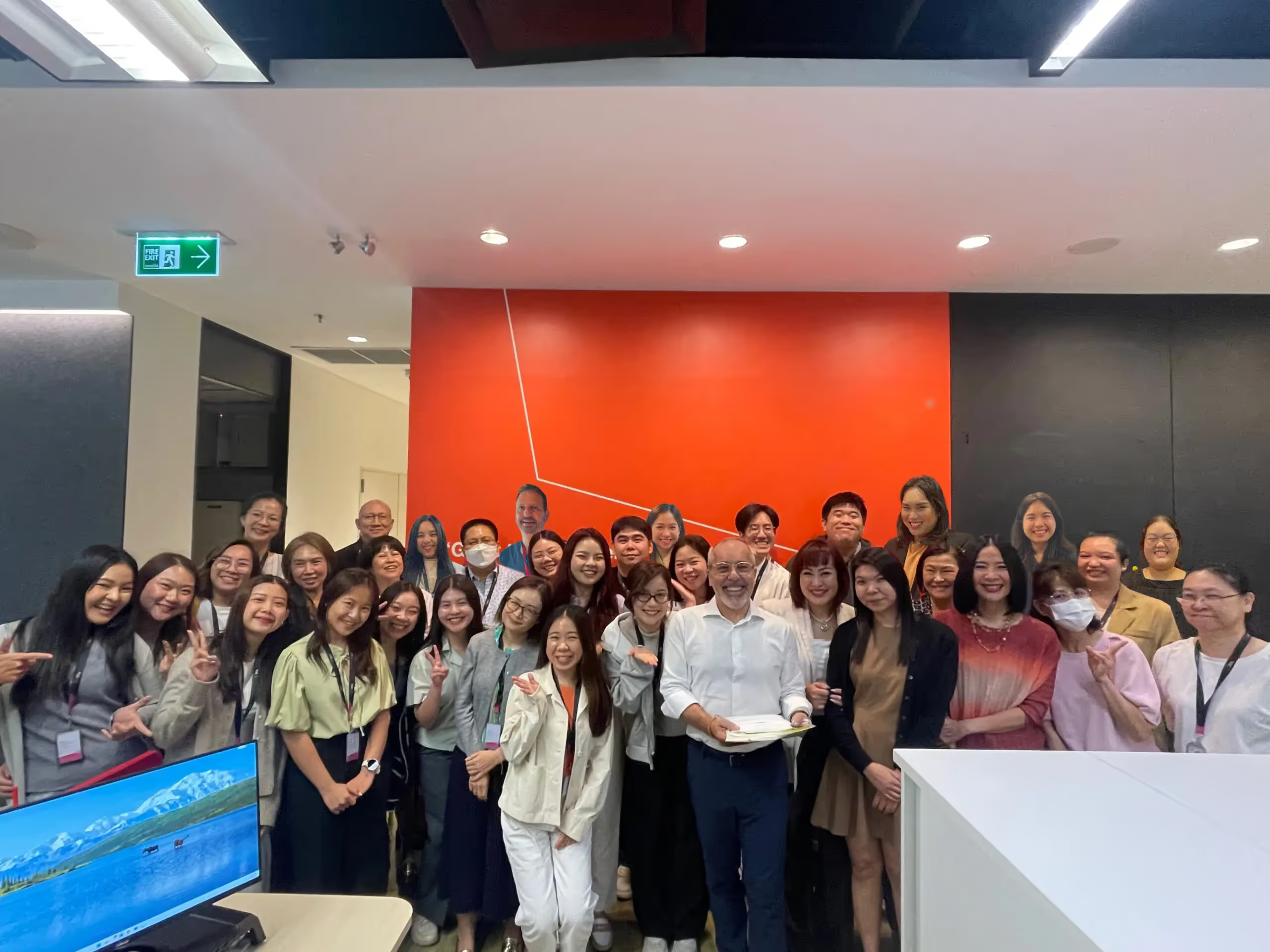
Here, you’ll work in a diverse, people-first environment that’s both meritocratic and fun. From day one, you’ll gain real exposure to top organizations, collaborate with talented teammates across borders, and accelerate your growth in a region that never stops evolving.
Be part of the momentum. Be part of BTS Southeast Asia.
Meet our team


Locations & Contact Info


.avif)