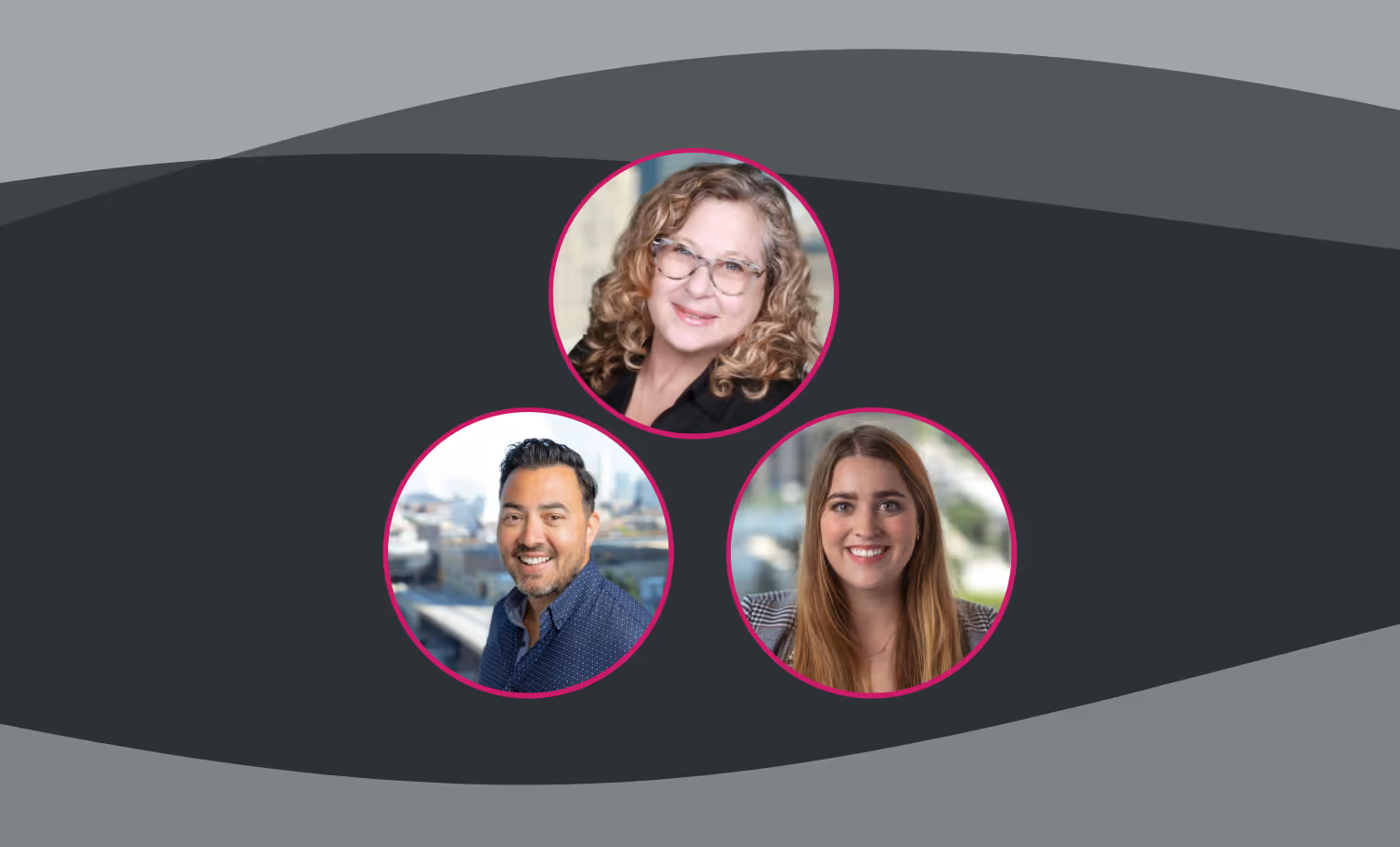
In light of current events,

and after careful consideration, we’ve made the decision to postpone our upcoming Suhoor.

TBC
TBC
HuQQa Garden, U Walk, Riyadh

The wellbeing and safety of our guests, partners, and team is always our priority.

While we were truly looking forward to gathering and sharing the evening together, this feels like the most responsible step at this time.

Community remains at the heart of this event, and we are committed to bringing everyone together when it feels both appropriate and safe to do so.

We will share a new date soon.

Thank you for your understanding and continued support.

As we take this pause, we extend our sincere wishes to you and your loved ones for a peaceful and safe remainder of Ramadan.

May this sacred month continue to bring reflection, strength, and togetherness.

We look forward to gathering with you soon.

From Chris and the BTS team

Questions about this event?

Related Content

On-demand
5
min read
Cultivate The Talent to Power What’s Next
In this webinar, we’ll explore what it means to future-proof your organization through your critical roles, and how leading companies are accelerating the readiness of this critical talent and aligning their talent strategy with business transformation.

lorem ipsum

Inisights
October 2, 2025
5
min read
A brave new world: What AI means for leadership and culture
Discover how AI is reshaping leadership and culture. Why jazz leadership, simulation, and re-skilling are essential to unlock the full value of AI across teams.

At BTS, we’re constantly challenging ourselves to innovate at speed. And right now, it feels like we’re standing at the edge of something massive. The energy? Electric. The velocity? Unprecedented. For many of us, the current pace feels a lot like the early days of the pandemic: disorienting, high-stakes, and somehow exhilarating. And honestly—it should feel that way. Our teams have been tinkering with AI, specifically LLMs, for the past 2.5 years and it has really been in the last eight months that I can see the profound impact it is going to have for our clients, for our services and our operating model.

The opportunity isn’t about the technology. The world has it and it’s getting better by the minute. The issue is people and people’s readiness to adopt it and be re-tooled and re-skilled. It’s about leadership. AI is deeply personal, it’s surgical. In fact, that’s its genius. So, getting full scale adoption of AI, re-tooling everyone in the company by workflow, so that they can invent new services, unlock new customer value, unlock new levels of productivity, even use it for a better life, is the current race. The central question I’ve been wrestling with, alongside our clients and our own teams, is this:

What does AI actually mean for leadership and culture?

And the answer is clearer by the day: AI isn’t just a new toolset. It’s a new mindset. It demands that we rethink how we lead, how we learn, and how we build thriving organizations that can compete, adapt, and grow.

The productivity paradox revisited

Let’s start with the elephant in the boardroom. There’s been a lot of buzz around AI and its promises. But many leaders have quietly wondered: Will any of this actually move the needle? A year ago, we were asking the same thing. We had licenses. We had curiosity. We had early experiments. But the results were modest, a 1% productivity gain here or there. But by April, we were seeing:

  • 30–80% productivity gains in software engineering
  • 9–12% gains in consulting teams
  • 5%-20% improvements in client success and operations

Just as importantly, the innovation unlock and creativity across our platforms due to vibe coding along with new simulation layers, is leading to new value streams for our clients. This isn’t theoretical. It’s not hype. It’s real. The difference? Adoption, ownership, and a shift in how we lead in order to energize the AI innovation within our teams. The challenge now isn’t whether AI creates value. It’s how to unlock and scale that value across teams, geographies, and business units—and do it fast.

Two Superpowers of the Agentic AI Era

In working with leaders across industries, I’ve come to believe in two superpowers (there are more as well) that will unlock the potential of this AI era: Jazz Leadership and a Simulation Culture.

1. Jazz Leadership

Forget the orchestra (although personally I am a big fan.) The successful team cultures that are innovating with AI feel more like jazz. In jazz, there’s no conductor. There’s no fixed sheet music. There are core bars and then musicians make up music on the spot based on each other’s creativity, building off of each other’s trials, riffs and mistakes, build something extraordinary together. This is how experimenting with AI today, in the flow of work, feels like.

For each activity across a workflow, how can new AI prompts, agents, and GPTs make it better, codify high performance, drive speed and quality simultaneously? How can we try something totally different and still get the job done? How might we re-invent how we work? That’s how high-performing teams operate in the AI era. The world is moving too fast for command-and-control leadership, a perfect sheet of music with one leader who is interpreting the sheet music and directing. What we need instead is improvisation, trust, shared authorship, courage and a playful spirit because there are just as many fails as breakthroughs.Jazz leadership is about creating the conditions where:

  • Ideas can come from anywhere
  • People see tinkering and testing as key to survival and AI failures mean your team is at the edge of what’s possible for your services and ways of working
  • Leaders say, “I don’t have all the answers, but I’ll go first, with you”
  • People feel “I’m behind relative to my peers in the company” and the company sees this as a good sign because the pace of learning with AI means higher chance of success in the new era

At BTS, we recently promoted five new partners who embody this mindset. They weren’t the most traditional leaders. But they were the most generative. They coached others. They experimented and are constantly re-tooling themselves and others. They inspired movement. They are keeping us ahead, keeping our clients ahead and driving our re-invention. Jazz leaders make teams better, not by directing every note—but by setting the stage for breakthroughs. It is similar to the agile movement, similar to how it felt in Covid as companies had to reinvent themselves. It’s entrepreneurial, chaotic and fun.

2. Simulation Culture

The ability to simulate is a super-power in this next agentic, AI era. Simulation has always been part of creating organizational agility, high performance and leadership excellence. But AI and high-performance computing have transformed it into something bigger, faster, and infinitely more powerful. It means that building a simulation culture is within all of our grasp, if we tap its power.Today, companies simulate:

  • Strategic alternatives - from market impact all they way to detailed frontline execution
  • New business, new markets and operating models
  • Major capital deployment e.g. build a digital twin of a factory before breaking ground
  • Initiative implementation
  • Workflows current and future
  • Jobs to assess for talent and critical role readiness
  • Customer conversations and sales enablement motions

With a simulation culture, where you regularly engage in scenario planning and expect preparation and practice as a way of working, billions in capital is saved, cross-functional teams are strengthened, high performance gets institutionalized, win rates increase, earnings and cash flow improves.

Where to get started

Below are a few examples of what leading organizations are doing. Consider testing these in your own organization:

  • Conversational AI bot platforms used to scale performance expectations and the company’s unique culture.
  • Agentic simulations built into tools so people can prepare and practice with 100% perfect context and not a wasted moment.
  • Digital twins of the job created so that certifications and hiring decisions are valid.
  • Micro-simulations spun up in hours to align 50,000 people to a shift in the market or a new operational practice.

Final Thoughts

  • Lead like a jazz musician. Embrace improvisation, courage and shared creativity.
  • Build a simulation culture. Because in a world that’s moving this fast, practice isn’t optional—it’s how we win.

This is a brave new world. Not five years from now. Right now.Let’s shape it—together.

Inisights
August 1, 2025
5
min read
Does safety matter in your workplace? Learn the common mind traps in safety and how to overcome them
Safety in the workplace today is different from the past. Today, process improvements, safer designs, systems, and protective equipment are not enough.

Safety in the workplace today is different from the past. Today, process improvements, safer designs, systems, and protective equipment are not enough. To create workspaces that are truly safe, companies must cultivate organizational cultures that prioritize safety by focusing on the behaviors and mindsets that enable lasting change.

Part of developing a culture of safety is determining the obstacles that prevent people from moving towards advancement. Beyond the proper physical tools or processes, ‘mind traps,’ or inherent subconscious ideas and beliefs that prevent people from achieving an ideal state, are one of the major barriers preventing organizations from improving their safety levels. Mind traps are difficult to identify and overcome because most people have a logical and rational basis for believing them.

Why is it important to identify mind traps in safety?

It is important to identify mind traps in safety because they have an impact on the way people communicate and behave in their day-to-day lives. If you believe accidents will still happen, no matter how much you try to communicate otherwise, your team will notice this belief and you will be passing on your mind traps to them. For example, if you believe that by sub-contracting an activity, it is normal for the number of incidents to increase, you will lower your guard and your team will do the same and thus increase the likelihood of an accident. In the end, mindsets impact and shape your behaviors and those of the people around you. The sum of these behaviors creates the company's safety culture.

To help you identify mind traps in safety in your organization, this list provides some of the most common mind traps people in safety experience.

Common mind traps in safety

Skepticism: This is usually one of the most difficult mind traps to overcome because people can use data to justify their beliefs. For example, if history shows that on average, one accident happens every year, it is reasonable to expect that it will continue, right? However, it is actually possible to eliminate accidents, but before this is possible, people must overcome their skepticism. Skepticism can sound like: "it is impossible not to expect any accidents over time – the data backs me up."

Complacency: This mind trap typically occurs when companies have experienced periods of significant progress, with indicators showing an absence of serious accidents and therefore improvements in safety. When indicators begin to reach a plateau, it often serves as a justification to make leaders believe statements like: “we have improved a lot in recent years, further progress is going to be very difficult.”

Criticism: This mind trap happens when people focus more on their surroundings rather than on how to actually improve themselves. This is normal when there are many things to improve and people don’t know where to start, when the job relies largely on third parties (collaborating companies, contractors), or when superiors do not always show coherence between what they do and say. Statements exhibiting criticism look like: “how do you expect me to set an example if my bosses don’t?”

Short-Termism: One of the main dilemmas in productive and industrial environments is the perceived tension between results and safety. The tension is only perceived because in more mature and advanced safety cultures, the two terms (results and safety) are not separated, nor do they contradict each other. This mind trap becomes accentuated in market environments that negatively affect income and margins, where naturally, the pressure for results makes the rest of the elements take a back seat. This thinking impacts what kinds of decisions are made, how they are communicated, and how they are executed. An example of the verbalization of this trap is: “safety is important, but sometimes it goes against efficiency.”

It is important to recognize that mind traps vary over time and are highly dependent on the environment in which you find yourself. There may be times when you think you have no mind traps, and then suddenly when facing a change of job or pressure for results, some are automatically activated. The nature of your day-to-day life greatly impacts your mind traps.

So, how do you face and overcome mind traps?

How to face and overcome mind traps

Identify them: Identifying the main safety mind traps and knowing which ones you are more likely to fall into is the first step to overcoming them. Leverage evaluations to easily identify individual mind traps.

Understand their impact: It is important to know the impact safety mind traps have on your behaviors and on the people around you – your team, your peers, your superiors, etc. Explore the impact your safety mindsets could have on the team.

Challenge them: Finally, define mechanisms to challenge yourself, your colleagues, bosses, and teams to break free from the safety mind traps. Become the devil’s advocate who questions the logical reasons behind the mind traps. For example, to combat skepticism, you might reference specific examples of long periods of time without accidents: “if we managed to spend a week, month, or year without any accidents in such an asset, we should be able to do the same with the rest of our assets, and for a much longer time, right?”

The ultimate goal of any business is to make money and therefore efficiency is key. However, to achieve such results in a sustainable way, safety must be integrated into your organization’s culture and way of working. This means identifying the mind traps in your organization and working as a collective to overcome them.

In an ideal state, at the more advanced levels of safety culture, there is a sense of community where everyone cares about each other. While the goal is still safely achieving business results (efficiency, income, margins), safety is not sacrificed.

In summary, to achieve significant improvements in organizational safety and wellbeing, it is fundamental that companies focus on developing a culture of safety. Key to any organization sustainably achieving their goals, a safety culture not only enables success but also ensures that everyone gets home to their loved ones safe and sound. To achieve this goal, it is critical to understand the mind traps within your organization and learn the mechanisms to challenge and overcome them.

Inisights
May 20, 2025
5
min read
Demystifying culture change to unleash your momentum in the market
Is culture accelerating your strategy—or slowing it down? Learn how leaders turn invisible habits into momentum in this guide to culture change.

You already know strategy matters. You’ve likely spent months—maybe years—crafting one that’s bold, clear, and built to win. But when progress stalls, the issue often isn’t the strategy itself—it’s whether the organization can move with it.

That’s where culture comes in.

The culture that once fueled your success may no longer be fit for what’s next. And even if things look fine on the surface, early signals might be telling a different story—signs your culture isn’t accelerating your strategy the way it used to.

Culture is what turns intent into impact. It’s not the values on the wall or the message at a town hall—it’s the unwritten rules that shape how people decide, collaborate, and lead. It’s how things really get done.

When those patterns align with your direction, momentum builds. When they don’t, even the best strategy struggles to stick.

→ Let’s chat about leveraging culture to manage change fatigue at your organization.

You see it in:

  • The stories people tell about what gets rewarded
  • The choices teams make under pressure
  • The habits that show up when no one’s watching

And in the everyday:

  • How decisions get made
  • How people collaborate
  • How accountability is managed
  • How change is received

If your strategy has shifted but progress still feels stuck—or strained—it’s worth asking:

Is your culture still serving your business, or is it starting to slow you down?

A case in point

Two years ago, BTS partnered with a global organization that had just launched an ambitious growth strategy. Excitement was high—but results didn’t follow.

Leaders were frustrated by a lack of speed and ownership. Employees said they didn’t feel empowered. The word that kept surfacing? Bureaucracy.

That term became a catch-all for inefficiency, but no one could quite define it. So we helped them unpack what was really going on:

  • Unclear decision rights
  • Too many committees for too many decisions
  • Outdated knowledge-sharing systems
  • Manual processes slowing everything down

We visualized the findings in a “bureaucracy tree” to connect the dots. That clarity helped leaders prioritize where to focus first. And that’s when momentum returned.

The power of pivotal moments

The breakthrough didn’t start with a bold new initiative. It started with a shift in focus—from broad ideas to specific moments.

We worked with leaders to identify the everyday situations where culture is shaped and signaled: subtle, unscripted moments that reflect what’s truly expected and rewarded.

  • A decision point with no obvious answer: do we act, or wait for perfection?
  • A team member hesitates: do we jump in to solve, or create space for them to step up?

When leaders could name these moments, they could begin to shape them—making small, deliberate choices that sent a different signal. These weren’t one-time actions. They were repeatable patterns, practiced consistently.

And they’re just as available to you. Start by asking: where are the moments I tend to default to safety, silence, or control? And how could I begin to respond differently to shift the story?

Breaking old habits and building new ones

With these pivotal moments in mind, the leadership team reflected on their own patterns. How were they showing up? What were they reinforcing?

They focused on three shifts:

  1. Stop reinforcing slow, complex decision-making
  2. Start modeling clarity, ownership, and speed
  3. Shift systems that quietly rewarded caution over empowerment

These weren’t abstract goals. They were grounded in real behaviors:

  • How many people are involved in a decision?
  • Are roles and responsibilities clear?
  • Are our tools helping—or slowing us down?

By focusing on what people could see, track, and practice, change became tangible. It gave people something to act on—and believe in.

Scaling change through experimentation

The organization didn’t treat culture change as a campaign. They treated it as a learning process.

Top leaders ran small, coordinated experiments—turning abstract values into visible behaviors.

In one experiment, leaders committed to returning authority to managers who had “delegated decisions up” to them. In another, they redefined decision rights to cut through ambiguity and accelerate action.

These weren’t pilots. They were deliberate repetitions of new behaviors, designed to build muscle memory across the organization.

The results:

  • Decisions moved faster
  • Long-stalled initiatives were shut down
  • A new product feature launched in half the usual time
  • Employees reported feeling more empowered and accountable

If you’re wondering what this could look like for your organization, start here: What’s one behavior you could test out—or let go of—for a week? What’s one decision you could delegate? One moment you could coach instead of solve?

That’s how momentum builds—quietly, visibly, and fast.

Four common patterns to surface

Now that you’ve seen how small cultural habits shape (or stall) strategy, the next step is to spot where those habits are hiding in your organization. Here are four patterns we often see when momentum is missing—along with what they may be signaling.

   Element of Culture What It Shapes What It Might Look Like Today Why It Might Be Time to Rethink     Decision making Speed, ownership, and accountability Teams slow down not because the path is unclear, but because they’re unsure who’s empowered to choose it. Decisions stall in ambiguity—or escalate unnecessarily. Legacy approval structures often reflect yesterday’s risks. Today’s pace requires alignment over consensus, and trust in judgment at every level.   Meeting norms Focus, decision velocity, and participation Meetings are packed with updates, but few decisions get made. Real conversations happen in sidebars—after the meeting ends. When meetings become status dumps, they signal that the real work happens elsewhere. Reclaim meetings for collaboration and visible decisions to shift how teams show up—and move with more speed.   Leadership modeling Credibility and cultural integrity Leaders talk about agility or empowerment—but in high-stakes moments, default to control, caution, or top-down decisions. Culture isn’t shaped by slides—it’s shaped by what leaders do when it counts. If words and actions diverge, people follow the behavior. Find misalignments and try a new tack.   Feedback Learning, adaptability, and momentum Leaders see something misaligned—but let it go to avoid discomfort or protect relationships. Feedback is delayed, diluted, or disappears. Without feedback, small misalignments calcify. Cultures that learn fast don’t wait—they normalize feedback as a lever for shared growth.    

Which one shows up most in your team? That’s your next pivotal moment.

Shining a flashlight on your invisible “monsters”

When it comes to culture, the hardest part is often what you can’t see—or don’t know how to name.

Think back to childhood. Most of us, at some point, were convinced there was a monster in the closet or under the bed. In the dark, a pile of clothes becomes something menacing. A shadow turns into something to fear.

But then the light comes on. You see clearly. The fear fades. What once felt huge and scary becomes harmless—even a little silly.

That’s what culture can feel like inside an organization. Bureaucracy. Resistance. Complexity. These forces seem big and hard to define. They slow us down and sap momentum. But more often than not, they’re just old habits and assumptions lurking in the dark.

When leaders learn to spot the subtle, pivotal moments that shape behavior, they turn the light on. What felt intangible becomes specific. What felt impossible becomes actionable.

You don’t need a total reinvention. You need clarity—a way to see what’s really happening and where to shift, simply and deliberately.

When to bring in reinforcement

Not every culture challenge needs an outside partner. But some moments call for reinforcement—especially when change needs to stick at scale.

At BTS, we help organizations turn invisible cultural friction into visible forward motion. Whether you’re shaping a new strategy, integrating after a merger, or building a leadership culture that unlocks ownership—we help leaders shift from insight to impact.

Here are a few signs it might be time to partner

  • You’ve named the strategy—but execution keeps stalling.
  • You see the issues—but can’t align on how to shift behaviors.
  • Leaders are bought in intellectually, but behavior hasn’t changed.
  • Teams say the right things—but culture feels stuck in old habits.

If you’re facing one of these moments, it’s not a failure—it’s a signal. The good news? You don’t have to tackle it alone.

Let’s talk about what it would take to move from insight to sustained culture change.

Client Stories
October 28, 2025
5
min read
Translating at scale: Building a better client experience with AI on the team
See how BTS uses AI to transform translation and localization to deliver faster, smarter, and more personal client experiences worldwide.

lorem ipsum

Client Stories
October 17, 2025
5
min read
AI-first business simulations: A BTS innovation story
BTS is redefining experiential learning with AI-first business simulations that accelerate strategy, scale leadership impact, and drive real transformation.

lorem ipsum

Client Stories
April 4, 2025
5
min read
RGM as a growth engine in the snack industry
Discover how a leading snack company turned Revenue Growth Management into a powerful tool for growth, agility, and profitability.
lorem ipsum

Podcast
September 19, 2025
5
min read
4 things nobody is telling you about the future of work
Discover 4 things no one is telling you about the future of work, and how leaders can unlock real AI adoption, culture shifts, and lasting impact.

lorem ipsum

Podcast
July 30, 2025
5
min read
What AI can’t replace: the human side of leadership
Discover how better conversations drive alignment, trust, and results—plus why communication matters more than ever in the age of AI and hybrid work.

lorem ipsum

Podcast
July 18, 2024
5
min read
Revenue Growth Management: Linking strategy and tactics for success
In this episode, Rick Cheatham is joined by Teresa Yetano, Senior Director, and Emily Steigerwald, Senior Director, to explore RGM.

lorem ipsum

Whitepapers
July 28, 2025
5
min read
Built to Shift: A playbook for downturns
Built to Shift is a playbook for navigating constant change, from how to align teams to leading with clarity in today’s fast-moving world.

lorem ipsum

Whitepapers
April 30, 2025
5
min read
Belonging by design: How organizations build thriving cultures
Discover how fostering belonging across individuals, teams, and systems can drive performance, trust, and culture in your organization.

lorem ipsum

Whitepapers
January 10, 2025
5
min read
An emerging role of coach in learning journeys
Traditional coaching focuses on individual growth and is evolving into something far more integrated and dynamic: the coach as learning partner.

lorem ipsum

News
October 10, 2025
5
min read
The New AI Driven Leadership Model Will Be More Like Jazz

Six top CEOs from varying industries discuss the future of leadership in an AI world.

lorem ipsum

News
August 20, 2025
5
min read
BTS and clients recognized with 59 Brandon Hall Group Excellence Awards in 2025

BTS has earned 59 Brandon Hall Group Excellence Awards in 2025 alongside its clients. These awards recognize some of BTS’s most innovative and effective solutions, created through close collaboration with their clients.

lorem ipsum

News
March 3, 2025
5
min read
BTS acquires Sounding Board to serve global companies end-to-end, executive to frontline coaching needs

STOCKHOLM, SWEDEN – BTS Group AB (publ), a leading global consultancy specializing in strategy execution, change, and people development, has agreed to acquire Sounding Board, a technology-based leader in scalable, high-impact coaching solutions driving transformational leadership development.

lorem ipsum