4 things nobody is telling you about the future of work

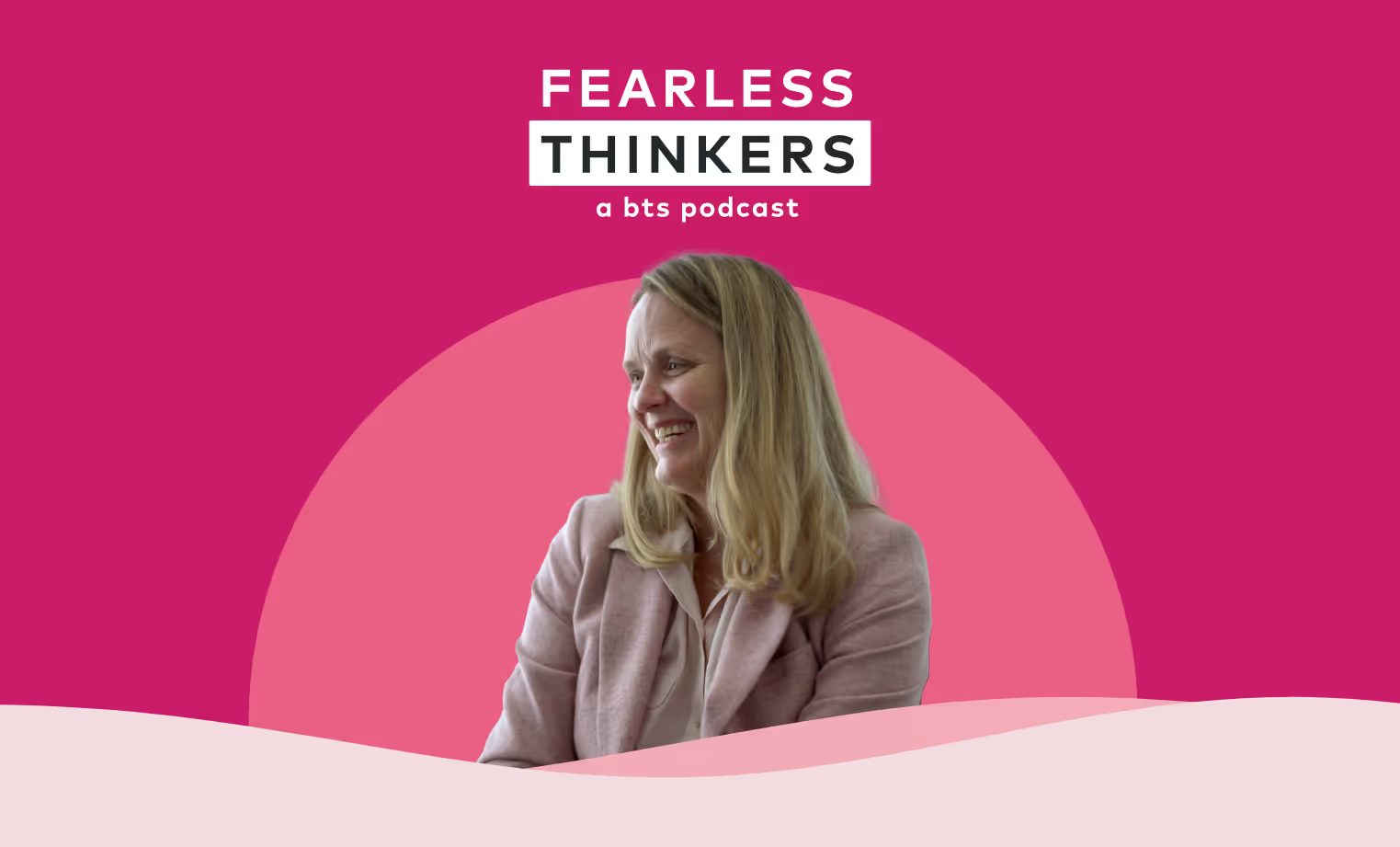
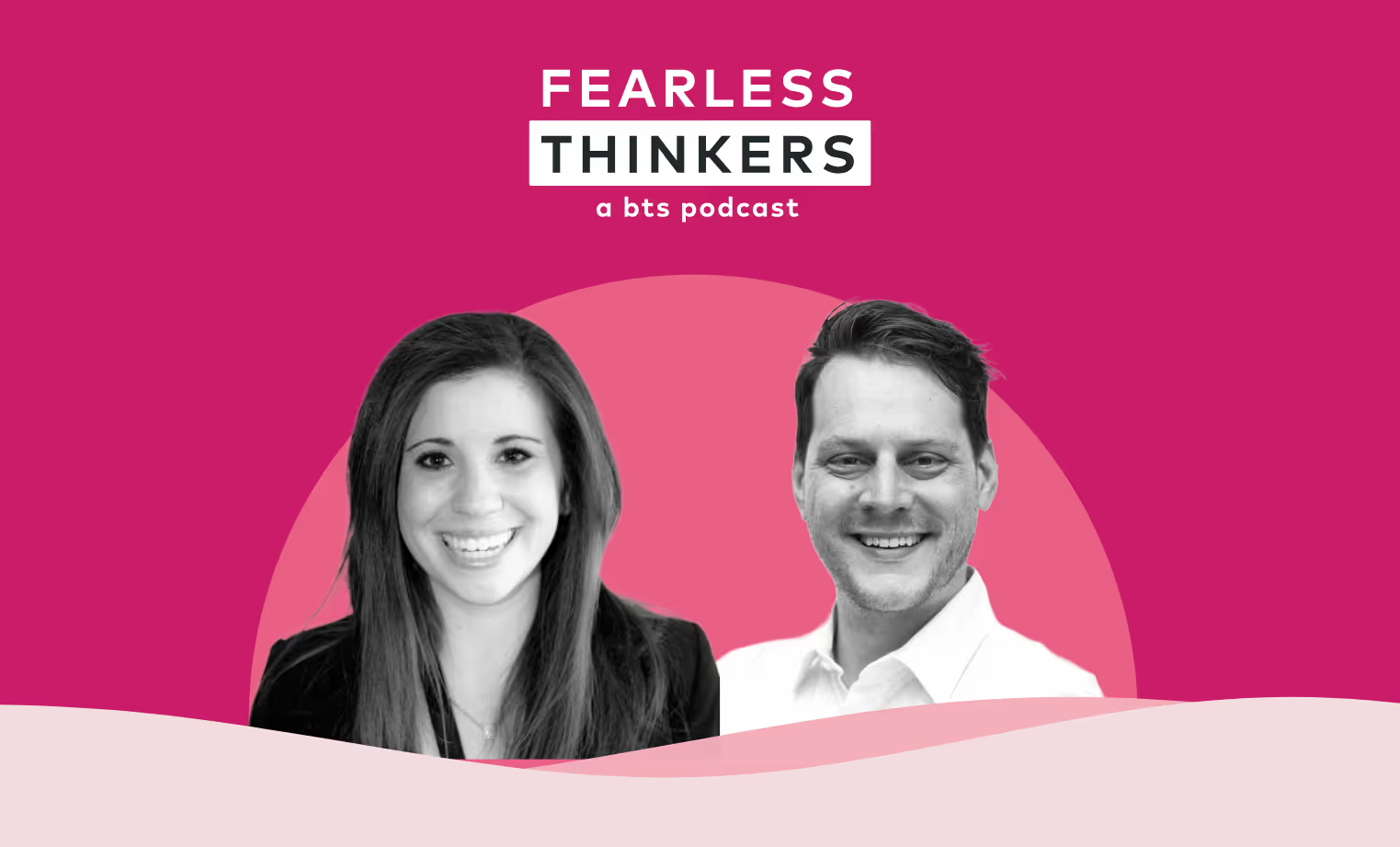
In this Fearless Thinkers episode, BTS CEO Jessica Skon unpacks the realities and possibilities of AI at work. She shares: The challenges global CEOs say will define the AI era What it will truly take to lead in the future How organizations can harness AI to spark creativity, connection, and joy at work Her take? Simulation culture will be your organization's next superpower.

Most of us want to lead in a way that matters; to lift others up and build something people want to be part of. But too often, we’re socialized (explicitly or not) to lead a certain way: play it safe, stick to what’s proven, and avoid the questions that really need asking.
This podcast is about the people and ideas changing that story. We call them fearless thinkers.
Our guests are boundary-pushers, system challengers, and curious minds who look at today’s challenges and ask, “What if there is a better way?” If that’s the energy you’re looking for, you’ve come to the right place.
Find this episode on:

.svg)
Rick Cheatham: What’s your best advice at this moment?
Jessica Skon: I think it’s time to rethink the function. The best in class stuff we all used to do together that was reserved for the elite because it was so expensive. I think now can be done at scale, right? Ongoing and at scale. I’ll share four things that I see kind of at the edge.
Rick Cheatham: So Jess, welcome back to the show.
Jessica Skon: Thank you, Rick. Fun to be with you.
Rick Cheatham: It’s always fun for us to get to hear about your adventures as you travel and get to speak to some of the most brilliant, interesting people on the planet. For today’s discussion, I’m hoping that we can narrow our focus to AI adoption because it’s such a hot topic right now. And I know that you’ve not only been focused on it in your conversations with clients, but you’ve also been focused on it for our own firm. So I think it might be good for us to potentially explore both of those things a little bit.
Jessica Skon: Wonderful.
Rick Cheatham: Well, so huge open-ended question when it comes to AI adoption, what are you seeing right now?
Jessica Skon: You know what? It’s early days. It’s early days for the world. I think on AI adoption there’s the whole productivity paradox that’s been looming for decades and we’re seeing such an increase in spend in the world right now, both in the companies that are giving AI to the world and in all of our increased software licenses in terms of driving our own internal adoption.
But I don’t buy it. I don’t buy that the productivity paradox is gonna be at a reality for this AI era. We’re seeing too much rapid advancement internally in BTS in terms of the evolution of our services and the value we can provide to clients and too much very real productivity gains and even the joy that comes for our teams and their doing the work.
For me to believe that we’re not gonna see the lift and to have this, I think this is gonna be an era of enormous value creation. At least, at least over the next 2, 3, 4, 5 years. So I see it as historic. The last data I read said only about 1% of companies consider themselves an AI maturity.
I was just at a conference in Singapore with a good number of Southeast Asian CEOs and all of them unanimously agreed, this is not a tech problem. This is a people problem. So the whole issue right now is to drive the adoption of AI through teams and through people in ways that they can be more creative about how they do their work.
So I think we are seeing some productivity gains. I think we’re on the verge of breakthrough gains in different parts of the companies or different parts of the business. An interesting thing is I remember saying at the Wall Street Journal event two and a half years ago that for the first time in my life.
I’m seeing software adoption that puts smiles on the faces of our people and that’s refreshingly wonderful. And a new thing that I’m seeing our teams at least start to subscribe to is, you know, rather than looking at the AI tools outta fear, right? In terms of will I still have a job, will I be relevant?
Look at it as a way to have better work-life balance. Look at it, you know, make that AI assistant do the things for you that aren’t that fun and they can do much more quickly. So you can spend your time on better things and have a better week, right, and a better month. So that would be maybe the first point is, I guess I’m not buying all the articles right now, questioning if we’re in another productivity paradox.
And I think the breakthroughs are yet to come.
Rick Cheatham: I was in a meeting with one of our colleagues earlier today and we finished what we had to do earlier and then we went playing in ChatGPT and trading prompt ideas and learning what each other’s doing. So I get and totally agree with this is the first time a software shift has put a smile on my face and that it, I would choose to actually spend a little extra time with a colleague just playing with it.
But I wanna rewind to what you started with, and I’m curious in these conversations that you’re having with leaders both at conferences and one-on-one, what are you seeing from a leadership or culture perspective when it comes to when AI implementations or AI adoption that actually works?
Jessica Skon: Yeah. There’s two things. One I’m gonna say is a practice that I also think is a bad practice, and the other one is going to be what I think is the magical unlock where we’re seeing high adoption. So first in terms of a poor practice right now is we’re seeing a lot of companies give everybody an AI license and then they do a hiring freeze.
That tells me that they don’t actually know where the value is that’s being created. That means that the tinkering, the playing around the adoption techniques that are, that some of their teams must be doing, they don’t have enough confidence or visibility into what the real gains are, either in value creation, new services, or in the productivity gains in the ways of working.
And if we unpack that a minute, I think one of the things that we actually did well, started two and a half years ago is when the BTSers either individuals or teams asked for the license. We ask them, what’s the hypothesis that you’re gonna try to solve for? Right? And that muscle, just the muscle of like, tinker, tinker, what’s the problem?
Be okay with it not working. Try again, try again. And then until you get breakthrough, I think is important. Right? Versus like two and a half years ago, just giving everybody the license. I think the game right now is what are companies, including BTS’, time to 100% AI adoption. So how fast can you get it across every task in every workflow?
I’m not saying every task is perfect for AI, but you’re at least the teams doing the work are trying it for every little task so that they can understand what the potential is. I think that’s the work, right? That needs to be done. And that’s not an ERP implementation. You don’t need heavy handed, you know, expensive software engineers to do that.
You just need some handholding. From some advisors and a culture that unlocks that level of play. So going to your question around what are we seeing from a leadership and cultural perspective where we have pockets of high adoption? And I’ve been thinking about this and our team does a lot of research because we’re partnering with clients across many industries on this.
And we have a bunch of from twos in terms of mindset shifts and so forth. And if you take a step back and look at them. The best way I’ve been able to summarize this and hear this summarized is that it’s like jazz. So if you’re a music lover or a music fan, you know, when you think about jazz versus let’s say, going to the symphony, which I also love, right?
The musicians in a symphony are playing, they’re following along sheet music, and they’re taking their cues of passion and energy and speed from the conductor who’s interpreting the sheet music. To me, that’s the equivalent of a really good CEO who’s creating the plays for the company and telling the company to go a little bit faster, a little bit slower based on their interpretation right, of the market.
There’s nothing fundamentally wrong with that, but right now, right now when people have the chance to retool themselves or have their own personal AI assistant and rethink how they do their work every day, it is absolutely much more like a quartet, a jazz quartet, where yes, they’re aligned to, let’s say 12 bars in general, but they have the freedom to riff off of each other.
Serious. Right? And when someone tries something, someone else won’t be, might be wowed by that. And then the music changes for a while while everybody falls in line and builds off of that energy. So it’s much more like jazz. It’s much more creative. There’s a lot of funky noises that are coming out, a lot of playful spirit.
And in a way it’s almost like you’re playing jazz and someone just brought in a new instrument. Right. So if I think about the teams inside BTS, who were the fastest and furthest have the fastest and furthest adoption from an internal productivity gain, and the teams who are doing it across our simulation platforms, for example, that’s absolutely what it feels like.
I see the tone on Slack. They’re laughing, they’re failing, they’re riffing off each other. They’re trying different vibe, coatings and different sequences. They’re working on frameworks and then it crashes and they’re trying again. And there’s a ton of energy in those teams. It’s, it’s playful, it’s fun, it’s hard, right?
But they sense like they’re on the breakthrough of coming up with a new way of working. And the team that’s doing the work is the team that’s doing the tinkering.
Rick Cheatham: Love it. I love it. And I, and I really like the way that you think about that as a big unlocking of the mechanism of how things have traditionally gotten done.
I’m curious as to what else there might be when we think of these superpowers or ways to unlock what’s possible that might be a little different than we’ve traditionally done things.
Jessica Skon: As we look ahead at this, you could call it AI era or Agentic era, we also think the ability to simulate is gonna be critical to the success of companies, or you could say differently, the ability to simulate is going to be a superpower in the AI era.
That’s not just coming from a training, leadership development, learning, increasing performance perspective or driving change perspective. It’s also possible because of high performance computing, right? The Nvidia chips and other chips that are out there. I mean, if you go back and listen to Jensen Wang, even a few years ago at high Performance Computing conferences, he was talking about the power of a simulation culture.
I just heard Mari Berra, the CEO of General Motor speak at the Wall Street Journal conference and she said, look, thanks to Nvidia, we’re simulating our factory before we spend a dime on it. And by doing that we get an aligned view. Of the factory of everything we’re trying to drive in it inch by inch, piece by piece, and we’ll waste a lot less capital.
It’ll be done much more quickly with higher quality. So there’s immense shareholder value creation by taking the time to simulate before you do something. So when we’re talking about the ability to simulate as a superpower in the AI era, it’s more the ability of leadership teams to be able to imagine and even experience new strategic scenarios.
Before deciding or before setting their priorities or being able to really think through new users and the implications of those new users on the company’s operating model try out a new process design before you introduce it to your team. Simulate and look at new ways of working from every angle and bring cross-functional teams together in that thinking so that the, you know, you can have the thoughtfulness upfront in the process.
A simulation culture allows people to prepare for and practice when it’s safe. Before you waste billions in capital, or you try to get 900 different teams to work in a new way, they at least have a chance to visualize it. Experience it, try it out, fail, and then go ahead and, you know, do it for real.
Right? That’s, so I think, and what’s gonna happen and what’s already happening is we’re gonna be able to do this at the fast and at the cheap, right. And at scale. So this idea, I remember talking to one of our clients in Australia, mining company, I think it was BHP. And they were able to reduce the time to productivity for a new like heavy machine operator, right, from like three years to six months because of high fidelity simulations, right?
And certifying them through the Sims as opposed to multi-year training programs. But those were super expensive. Right. So now the ability to simulate for critical world readiness to reduce the time to adopt change, to improve the performance of a team is gonna be done quickly, right? And its scale and cheaply.
So I think that’s coming. I think it’s already starting to be here, and it will become louder and more critical to successful operating models of companies.
Rick Cheatham: Yeah, it’s funny because you know all the work that I’ve done with commercial organizations through the years, I’m always like, you do not need to press the reset button.
We, we need to be able to trial things before we completely change your customer’s experience. And I think what you are really speaking to right now is not only can we. Try different things, but we can try them before they, we try them at all externally. We can try them all before we have to spend money so that the implications of that experimentation aren’t necessarily felt outside.
You know, that decision making is that, am I getting it?
Jessica Skon: Yes, you’re, you’re totally getting it. And I would say, a simulation culture not only recognizes that you wanna simulate before you invest capital or make a change, but that you’d have a culture where the teams and individuals are constantly practicing or preparing for important conversations, right?
Whether that’s conversations with the customer or important one-on-one with the star employee, or they wanna improve or change how they run their weekly standups. I think that’s the other part of a simulation culture is it’s ongoing performance, practice preparation, and feedback and assessments, right?
Because real time you can be getting feedback in your normal flow of work.
Rick Cheatham: And now this is one of my favorite parts of our sit downs because I get to do something that most folks don’t, which is, put my own CEO in the hot seat and ask you, what are your reflections as a CEO on the things that you’ve implemented here at BTS from, even from the perspective of what are you learning and what are you the most proud of?
Jessica Skon: Hmm. It’s an amazing time to be the CEO of BTS. I’ll tell you that. It is not boring. There’s three lenses that come to mind to answer your question, right. The first one is in terms of our ability to be the world’s or our client’s, AI, implementation, and adoption partner, I’ve kind of been waiting. For tech new technology to come to the world that’s super easy and hyper-personalized in its nature to implement.
So I think it’s actually very funny and interesting right now. That’s what’s slowing down the adoption is the people and the teams. This is simple. It’s democratizing software and prompts for the world, right? I actually personally think we’re the perfect firm. I’m not just saying that on the podcast.
We’ve been on the people side of change for 40 years. We’ve never done tech implementations for lowercase AI needs, not capital letter ai, and that’s my distinction. Capital letter AI BTS is not the expert in rethinking data architecture, right? Or looking at the company stack and big, big, big capital bets, but for lowercase ai, making ai deeply personal to every employee in the organization so that workflows change, I think we’re the best partner on the planet.
So that’s lens number one is fulfilling that mission because when we work with clients, their leaders do it themselves. The teams are more proud when they’re done, and they will fundamentally figure out how to change the way they work and make their company better. And that’s been our focus for 40 years.
So that’s lens number one. Lens number two then is more internal, right? And one is, how are we rethinking our simulation platforms and our services, given what’s possible with technology right now? And I can tell you what, what makes me the happiest from that lens is we have our global strategy and business modeling simulation team, and that’s the team that builds our most complex simulations, often simulating ecosystems and countries, companies, so that our clients could do scenario planning and can make strategy personal for everyone in the organization. And those are not simple simulations. Right. And the team has been trying to figure out how to take advantage of the different LLMs and the different tech that’s been coming out for the last three years.
And I remember three years ago they’re one of the first teams to ask for the ChatGPT license. Right. So we gave them that. And within months it’s just, it’s failure. It’s not gonna work. It’s bad at math, it’s bad at visuals. The graphs don’t work like fail, fail, fail.
Anyways, they moved to another one and that was a full fail. Then they went to Windsurf and it was actually starting to look promising. Now they’re actually in love with lovable. We’re still not sure if it’s gonna be perfect, but we are trialing it. We’re going live with clients right now and there’s a lot of value creation for our clients if for, if they’re gonna be able to figure out how to do this and do it at scale and do it globally.
But for me, the high moments are not when they’re getting a breakthrough. It’s actually been that they’ve been failing, and I really legitimately mean that because that tells me that they’re at the edge of what’s possible, at least within one of our service arms, right? Once they get a breakthrough, one, that will mean that we will redesign the number of people that we need on our teams.
We’ll be able to shift value from our, for our, from our, for our clients, from the time it costs to co-design, to full usage across the enterprise, so it would be better for them. And that will have big implications that are, for the most part, very positive for BTS. The third lens is then are our people able to work in a way that brings them more joy, that’s more productive, it’s more creative.
And that’s been fun to watch and evolve as well. And like every company, we have our fast movers and our early adopters. Right. It’s a small percentage of the total leaders went first. And now, like every other company, we’re trying to move the mean right from the early adopters to a hundred percent adoption across every team and every workflow.
And we’ve been learning as fast as we can around what works and what doesn’t work, how to do this as practical as possible, as non bureaucratic as possible. We have a very high freedom culture, very kind of grassroots and oriented. So how do we take. The best of that, but then also scale across 24 countries.
What truly are the best agents, GPTs prompts, bots, across the various workflows, both our consultant groups and our functions. And honestly, as fast as we’re seeing what works and what doesn’t here, we’re sharing it with our clients and they’re sharing right back, you know, similar struggles and challenges and together we’re.
We’re evolving. I mean, just this morning we realized we have a bunch of super users across the world. They’ve been doing a great job of kicking off our consultant projects so that everybody on that team has a chance of using the most advanced prompts and at least getting exposed to them so that we can make sure they’re all using them throughout the project.
And we realized today, you know, in order to get to the next level, we need to shift the expectation across our service. Leaders, right? So if you are somebody in BTS who owns a particular product or service that we take to market, I will start to ask them, now, show me how you’re using AI across that service and that software.
So if we do kind of grassroots plus shift the expectations now to some of our key leaders, I think that would be the magic formula for the next level of adoption. But I keep track across our practices and our functional leaders and our offices. What I think the P&L and balance sheet implications will be spanning R&D capital expense and productivity gains.
For right now, I have line of sight over the next eight quarters, and I share that with the board, and it changes real time as the weeks progress. Sometimes good news, sometimes bad news, but I can’t remember a time when the possibilities to rethink our org model. The possibilities to rethink our platforms or maybe potentially add a simulation layer on top of our platforms was more possible than it is now.
So it’s an exciting time.
Rick Cheatham: It’s funny there, there are two perspectives that you just shared there that I can’t help but put an exclamation mark behind one being that whole concept of. Being excited when things fail. And I think usually when people talk about embracing failure, they talk about embracing it because now you can go find out what’s next versus embracing it because it basically keeps forefront in your mind that we’re continuing to push the edges and that we’re not being complacent.
And I think that’s a great mindset to hold. And the second one is, I. I think so many leaders, and I do my best to kind of get my out of my BTS head in these conversations and think more broadly would be saying, “Hey, this grassroots approach, this give everybody a chance to try thing. It’s gonna take too long and there’s gonna be people missing out.”
And so things just as simple is having super users join Project kickoffs, I think is something a very valuable and easy thing. To add into any sort of workflow.
Jessica Skon: Yeah. Yeah, I agree. I agree. I’ll share a moment of annoyance a couple weeks ago just so that we balance right. This, the narrative here.
I was talking to one of our leaders and they just quickly said, look, look, I know I don’t need ai, but I’ll make sure the team does it.
I think obviously leaders role model the change, right? They lead from the front, they get their hands dirty, they’re courageous enough to look messy and not know what they’re doing and to figure it out with the team.
’cause that attitude to me is an attitude of oversight and a bit bureaucracy and not willing to go deep enough to really help the team, right? So. I’ll just use that as the counterbalance struggle that we’re still on.
Rick Cheatham: Yes. And you know, there are plenty of unknowns that it’s hard to know where to go, but I also completely agree with people follow what leaders do, not necessarily what they say.
Jessica Skon: Let me share with you something else I learned. This was just last week, I think, or two weeks ago. We did an all hands. Internal meeting and I recognize to the BTSers that I get, many of us are feeling on a day to day behind. And we’re feeling behind, not in the world, but we’re feeling behind because we’re seeing what some of our peers are doing and we’re hearing about it for the first time all the time.
Like you can go two weeks and then realize, wait, what? I didn’t know we were doing that, or I didn’t realize we had that offering, or I didn’t know the team figure that out yet. Right. And so I wanted to just recognize that and call, kind of call that’s the, the zeitgeist for the moment, right. And I was talking to Lori and Christine, who are the founders of Sounding board, and that’s the scaled coaching company we bought six months ago because I think they have the best tech in the world, right, to support that service for us.
And what they pointed out is like, Jess, I we appreciate you saying that, but we think that’s a sign of a very productive culture right now. In fact, that’s what great feels like right now. You should feel like you’re behind your peers or the company’s not moving enough. We’re not moving fast enough. We’re not forming new partnerships quick enough.
We’re not trying our work on new platforms fast enough. So they helped. They helped me actually see it differently. I was actually feeling empathy for our team, and they’re like, no, no, no, no. This is gold right now. And in fact, BTS should be proud at how fast you’re willing to move and the risks that we are willing to take.
Like you’re not trying to get everything figured out before you take something to market. We’re going live with clients for the first time across multiple platforms. I agree with them. I think that’s the key right now to staying at the edge.
Rick Cheatham: Love that. Love that. So now this is the part in pretty much every conversation where I like to pivot towards our audience perspective.
You know, the majority of those listening or watching us are in that HR learning talent enablement space. What’s your best advice for them at this moment?
Jessica Skon: I think it’s time and many of our clients are doing this and I, I think it’s time to rethink the function. The best in class stuff we all used to do together that was reserved for the elite because it was so expensive.
I think now can be done at scale, right? Yeah. Ongoing and at scale. So I’ll share four things that I see at kind of at the edge right now of, where we’re co-innovating with some of the world’s best companies. One is I heard one of our clients say this learning and development is now learn and do.
Learn and do. Learn and do, learn and do, learn and do. It is fast, right? And it can be fast and still super high fidelity. And I’m not talking about the digital content libraries available to everyone. That’s the thing of the past, right? What learn and do means now it is possible for, let’s say the l and d or the enablement function to deliver ongoing behavior change at scale for 50,000, a hundred thousand, 200,000 people within the same budget. I think that’s miraculous. Right. That is possible now for the first time ever in the last 18 months, it means people’s real working moments or real one-on-one or real customer conversation are also practice and real time assessment of capability. That’s also never been possible before from our perspective.
Right. So that goes under the learning and development is now learn and do. A balance to that kind of speed and in the flow of work constant practice preparation and assessment is, I’m gonna call it IRL plus in real life-plus I heard the, CEO of the holding company, of all the dating apps. Imagine the ones you know, I’m not even gonna list them ’cause they all mean something and I’m not gonna realize what I’m saying.
But he runs all the dating apps they’ve acquired and brought them all together and he was saying that IRL is back that when people wanna date, they don’t wanna do a first virtual zoom call to meet each other however you do it. They actually wanna go on a date and they don’t wanna do it alone.
They wanna go on a double date. So they are rethinking their offering to allow IRL in real life. For states, we are seeing the same thing from our chief learning officers that in real life, meaning top 100 meetings, top 500 meetings, top 2000 meetings, sales kickoffs, top 50 meetings are back. Why are they back?
Because the chief learning officers see their role as strengthening the culture of the company and people really, really need and want to be together. The reason why I’m calling it IRL plus is because what we’re doing is we’re putting the AI tech into the offsites. And when you do that and you get people to practice the latest prompts, GPTs, bots, whatever it is, it’s driving super fast and hyper adoption the day after, the days after, the weeks after in the flow of work.
So I think I was talking to Claude from Brandon Hall, and he said, what’s interesting is that when in real life or workshops or offsites in the past were popular, you saw a decrease in tech being used. And I’m like, no, no, no, not right now. Right now, they’re all coming together in one. And when you have that captive audience that’s practicing the strategy or the most important priorities of the firm, and they’re doing it with the latest AI platforms and tools, then we’re seeing the adoption skyrocket afterwards, agentic simulations in the flow of work, they’re here.
And agentic simulations in the flow of work, meaning that they’re hyper-personalized to the person using them and they’re personalized based on how the company’s products and services are updated. So our particular offering there is the agentic simulations built right into the client’s CRM and being used currently by sellers and customer success, success people and so forth.
And then the final kind of leading edge trend right now is I’d call it digital twins. Digital twins of the job. So for every critical role in the company, one of our clients said, look, we spend millions on certifications. Wouldn’t it be nice to have certifications? We actually believed in. Oof.
And what we know at our core is that if you create a digital twin of the job, a replica of the job, and it’s hyper-personalized and on point for the user who’s in there, whether it’s an engineer or a sales person or a country leader, you’re gonna have an accurate reflection on their performance in role, and on their readiness for the next role.
So learn and do, IRL plus, agent simulations in the flow of work and digital twins of the job seem to be on the edge of what’s possible right now in enablement, L&D and talent.
Rick Cheatham: Wow. I’m sure many of our listeners would love to dig deeper into a lot of those great concepts. So it might be worth something that we explore further in the future, possibly with some of those great smart people that are doing that work within their organizations.
Jessica Skon: A hundred percent. ’cause we are innovating with clients on all of these right now. We, that’s how BTS evolves. The clients have the great ideas and we help them make them real. So I agree.
Rick Cheatham: Yes. And with that I will say thank you so much. I appreciate our time together. Every time we get these moments and as I reflect back and you know, if my two big takeaways, if nothing else are, I need to understand improv, jazz, I need to figure out how to practice before the results are on the line and we need to be open to things that we didn’t necessarily believe were possible in the past, or doors that have always been closed are now potentially opening for us as we develop our teams. That’s fair.
Jessica Skon: Fair. Fair. It’s a historic time. For sure.
Rick Cheatham: Beautiful. Well thanks so much and I’m sure we’ll talk again soon.
Jessica Skon: Thanks, Rick.
Related Content






.png)