Cascading a leadership framework

Learn how an international oil services organization propagated a new leadership framework to 5,000 of its managers.
March 1, 2020
5
min read

Follow us on Linkedin
Follow BTS on Linkedin
Share

Client need

A leading international oil and gas company wanted to align its top 5,000 managers to its new leadership framework. The company wanted to ensure that its top 400 executives became “change leaders” by facilitating sessions for their people in the flow of work.

The solution

The organization partnered with BTS to create a solution that:

  • Leveraged BTS’ Digital Cascade Tool to craft an interactive digital meeting-in-a-box.
  • Allowed senior leaders to facilitate sessions themselves easily, locally, virtually and effectively in an engaging way far more impactful than merely distributing a PDF or presenting a slide deck.
  • Included a discussion on the case for change, exploration of pivotal leadership moments, self-assessment on the framework, and commitment to actions to be implemented on-the-job.
  • Enabled the client to cascade the framework and rapidly drive behavior change while also harnessing data to gain insights from the global deployment to 5,000 managers within six months.

Results

After a successful pilot phase, the organization expects to reach the top 5,000 leaders within 6 months.Based on the pilot results, participating leaders will enact tens of thousands of “go-dos,” actions tobe implemented on-the-job, in their daily work, to live the new culture.Following the early success, the company launched a similar initiative to cascade customer centricity to an even wider audience.

Get the report
Download report
About the company

Related content

Client Stories
October 23, 2024
5
min read
Building a pipeline of high-performing general managers in aviation
An aviation service provider partnered with BTS to create a leadership framework that set clear expectations and developed GM capabilities.

Client need

An aviation services provider with over 200 fixed base operations (FBOs) across five continents recognized the need for a standardized approach to hiring, training, and assessing its general managers (GMs). Facing complex market dynamics like industry consolidation and rising customer expectations, the company found that GMs were now expected to act as mini-CEOs. They needed a diverse skill set to drive revenue, manage talent, ensure safety, and maintain customer satisfaction. However, without a clear development path, it was difficult to consistently prepare GMs for this demanding role.

Solution

The organization partnered with BTS to develop a comprehensive leadership framework that defined expectations and built the necessary capabilities for GMs to thrive.  This solution included:

  • The playbook: A foundational guide outlining:
  • GM profile: Key capabilities and behaviors for GM success.
  • GM pivotal moments: 11 critical scenarios requiring strong leadership.
  • GM experience map: Experiences that aspiring, new, and seasoned GMs should seek to ensure they excel in the role.
  • The assessment: A multifaceted tool designed to:
    • Evaluate current GMs by identifying development areas aligned with the GM profile.
    • Assess aspiring GMs to define what development is needed to prepare them for the role.
    • Screen external candidates to determine their readiness for GM responsibilities.

The assessment comprises several components, including:

  • Moments-based assessment: A simulated environment where candidates demonstrate decision-making in job-related scenarios.
  • Mindset explorer assessment: Evaluates alignment with key leadership beliefs.
  • 360-survey: Provides feedback on participants’ strengths and development areas.
  • Work preferences assessment and panorama assessment: Explore work style preferences, critical thinking, and problem-solving skills.

Results

The playbook and assessment have enabled the organization to identify and elevate high-potential leaders across its global locations. Since launching the program, numerous GMs have been promoted to leadership roles such as area director. The structured evaluation has empowered participants to uncover performance gaps and develop targeted growth plans. One GM, recently promoted to area director after following a personalized development plan, shared, “You are given the tools to succeed, and your future is in your hands. The assessments and the courses offered are outstanding and can be life-changing.”

Client Stories
May 26, 2023
5
min read
Developing future-ready executive leaders
How a multinational SaaS organization partnered with BTS to help its next generation of executive leaders to define next-chapter growth.
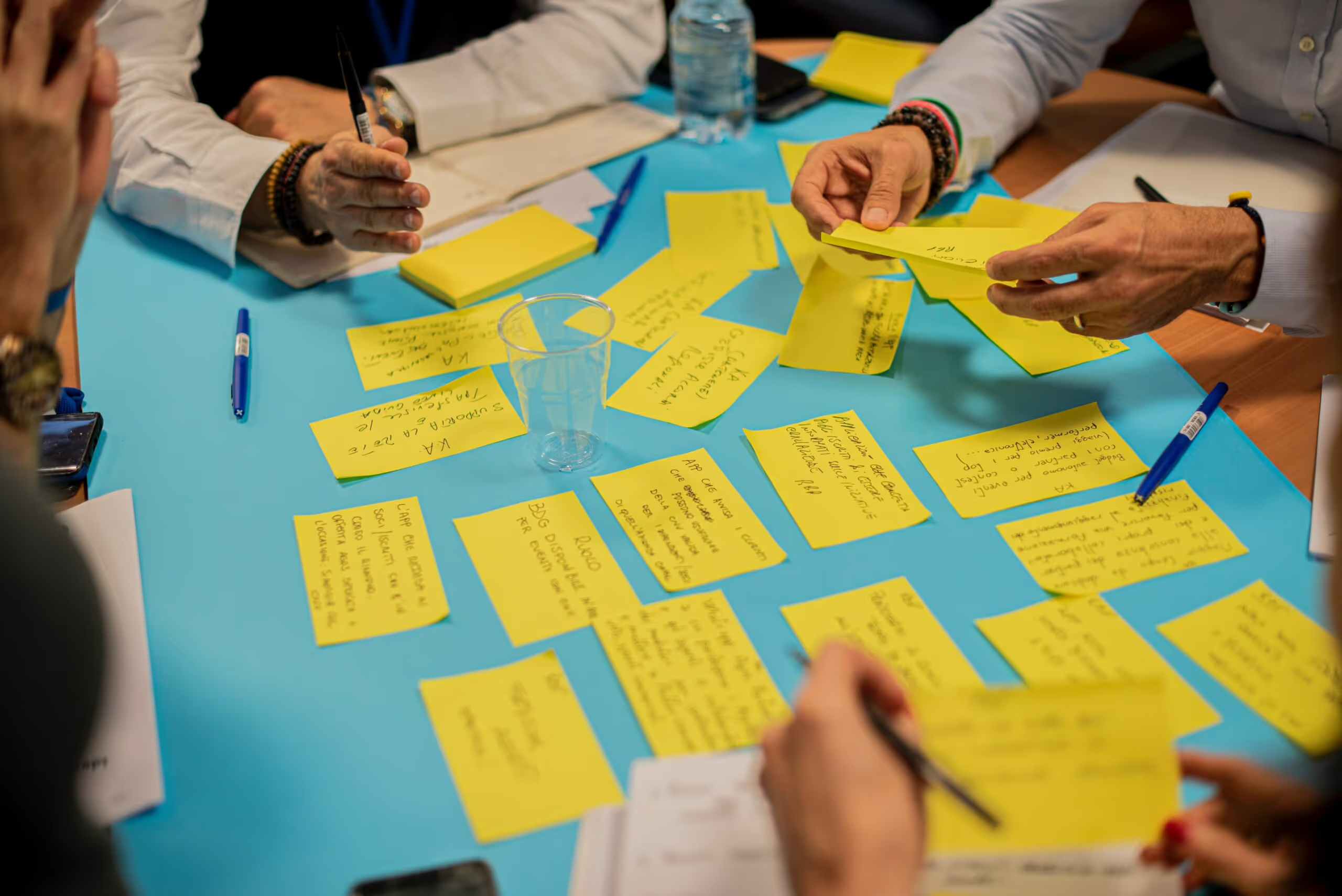
Client need

A multinational SaaS organization focused on search, observability, and security needed to scale following its initial public offering, but faced several obstacles.

The organization’s leaders needed to:

  • Scale their go-to-market strategy to determine how to reach key client decision makers, build strong relationships, articulate the impact of their solutions, and prepare for the next phase of SaaS growth.
  • Extend their product leadership by improving cloud platform accessibility, maintaining technology differentiation, and both protecting and evolving the company’s unique culture with every new hire.
  • Adapt to a rapidly changing market by prioritizing activities which would enable the organization to stay ahead of its competitors, building stronger relationships internally, a distribution model externally, and expanding to new-use cases and larger deployments.

To meet these needs, the organization partnered with BTS to design an immersive learning journey that would challenge its next generation of executive leaders to define the organization’s next-chapter growth.

Solution

BTS deployed the resulting leadership development program for the organization’s leaders both virtually and in a hybrid setting over the course of four months.

The journey was designed to address the following five core themes:

  • Being employee and customer centric: Recognize the changing needs of both employee and customer personas to drive value, while shifting to an outside-in, customer-centric mindset.
  • The organization’s “North Star”: Ensure that all leaders understand and communicate the organization’s purpose and strategy well enough to inspire and empower their teams.
  • Design for the future: Prioritize organizational growth over ten years’ time, not just two.
  • Enterprise mindset: Eliminate siloed thinking to effectively collaborate across functions.
  • Protect and evolve organizational culture: Nurture the best aspects of the existing culture while adapting to a changing context.

The development program consisted of three workshops:

  • Driving the strategy (leading the organization): A customized business simulation in which leaders practice decision-making in realistic scenarios, addressing specific organizational challenges and objectives.
  • Leading with purpose (leading self): Interactive peer coaching sessions to help leaders better appreciate their individual strengths, then leverage them while leading their teams.
  • Change-ready leader (leading others): Further interactive peer coaching sessions designed to help leaders manage the uncertainty and resistance that comes with change.

Additionally, teams selected cross-functional business challenges to explore in greater detail, conducting interviews and analysis before presenting their findings to the CEO and executive team during a capstone session.

Results

So far, two cohorts have completed the leadership development program. At the capstone session, both the CEO and CHRO appreciated the breadth and depth of team insight and initiated several immediate, large-scale changes, including an update to the company’s leadership expectations and values.

The first cohort reported the following percentage improvement in scores that measure individual agreement with the following statements:

  • +13: “I create alignment and clarity on direction among my team by connecting to our vision and strategy.”
  • +19: “I make decisions that future-proof the organization by thinking and acting with scale in mind.”
  • +20: “I drive functional interdependence between my team and those around me to collectively execute on our organizational objectives.”
  • +16: “I have open and honest dialogue both downwards and upwards in service of nurturing our Source Code and growing each other, the business, and customers.”
  • +11: “I foster a psychologically safe environment that enables experimentation, risk taking, and learning.”
  • +19: “I step into the shoes of our customers to understand and empathize with their differing needs.”
  • +13: “I lead customer centric conversations around enablers and barriers to customer success and satisfaction.”

The second cohort reported the following:

  • 100% reported that “The program’s learning objectives related to my job.”
  • 93% agreed that “My learning was enhanced by the work of the facilitator.”
  • 100% reported that “My learning was enhanced by the work of the facilitator.”
  • 88% agreed, “I will be able to immediately apply what I learned in my job.”

Participants rated the program 88 out of 100 when asked if they would recommend it.

Testimonials

“Explicit recognition of our strengths, values, and what drives us is a powerful tool I will carry forward."
“I love this concept of using the friction in change to spark debate [that enables us to] lead through the change.”
Client Stories
September 14, 2022
5
min read
Cultivating alignment in the face of large-scale change
Learn how a global social networking organization partnered with BTS to help its leaders improve their teams' collaboration.

Client need

A leading global social networking organization was implementing a new process for product development. To bring this structural change to fruition, the organization’s leaders needed to help their teams work together more cohesively. Thus, the organization partnered with BTS to help their people better understand their own roles, their teammates’ roles, and their collective goals, all to spur along the new product development process.

Solution

To achieve this goal, the company and BTS created a virtually delivered learning program that reached 260 people divided into 17 cohorts. Each cohort was comprised of both individual contributors and experienced managers across different functions.  The program, completed over the course of three months, consisted of:  

  • Two half-day workshops
  • Go-Dos, which are actionable steps to take back on the job
  • Playbooks, a tool that demonstrates how each role can live the company’s values during their day-to-day work
  • Experience maps, or self-development tools that 1) identify realistic, role-specific situations and 2) list actionable steps for building key capabilities
  • Momenta: BTS’s proprietary digital platform that allows people to explore someone else’s role by accessing their playbooks and experiencing their daily dilemmas, ultimately building cross-functional empathy

The learning program was designed to meet people where they were and was fully customized to the organization’s unique values and culture.

Results

Participating managers have improved their abilities to ideate and follow through, align teams through difficult conversations, create attainable road maps, apply organizational frameworks, and measure success. As of now, 76% of the 259 participants have completed the initial phases of the learning journey, and have mentioned learning the following:

  • “Don't be afraid to speak up, ask for help on understanding wants, needs and blockers, attend more meetings with [cross-functional teams], be bold, make assertions, [or] ask the hard-hitting questions."
  • “I need to do a better job of avoiding heroic efforts personally to fix the problem. I need to also avoid micromanaging the team as they work through a course correction.”- Technical Manager
  • “I would like to work on delegation through making better connections, [including] painting a clear picture of how my work will appeal to all stakeholders by gaining a better understanding of what is important to them.”

Related content

Client Stories
March 18, 2026
5
min read
From AI access to AI advantage
Reinventing work in U.S. health insurance

Client need

A large U.S.-based health insurance organization operating at the center of a complex national ecosystem had already made a serious investment in enterprise AI. Leadership was not experimenting at the edges. They were leaning in.

Capability and commitment existed across the organization, but unevenly. Some teams were already pushing boundaries. Others hadn't yet found their footing. Most of the gains had come in personal productivity. Valuable, but the core work itself had not yet fundamentally changed. The opportunity was to go deeper, to move from AI-assisted individuals to AI-reinvented workflows.

Across the health insurance landscape, pressure was intensifying. Medicaid and government program contracts were becoming more competitive. Decision cycles were faster and more analytics-driven. Clinical evidence was evolving rapidly. Regulatory scrutiny was high. Security risks were constant. AI was no longer a future conversation. It was a present expectation.

Inside the organization, world-class experts were still constrained by manual processes.

Specialized teams were synthesizing large volumes of complex, fast-moving information, working to keep pace with an environment where the inputs never stopped changing. The work required deep expertise and judgment, and it also demanded repetitive processing that consumed days when it needed to take hours.

Other teams faced pressure where speed and precision directly influenced competitive outcomes. Manual approaches were creating lag at exactly the moments when faster insight mattered most.

Across functions, the pattern was consistent. Highly trained professionals were spending valuable time on low-leverage tasks, stitching together data, transforming files, and correlating inputs that AI could handle.

Leadership understood that AI licenses alone would not create advantage. To compete in an increasingly analytics-driven insurance environment, expertise had to scale. Insight had to move faster. Teams needed to reinvent how core work happened.

Solution

BTS partnered with the organization to move from AI access to AI application.

Through a series of focused design sprints, intact teams worked on their highest-value workflows using our GROUNDING → EXPERIMENT → BUILD → AMPLIFY methodology. The structure was simple and disciplined. Set context. Experiment quickly. Build against real work. Create a path to scale.

Participants brought their actual work into the room. Analytical frameworks. Competitive and operational documents. Risk and intelligence inputs. Data pipelines.

No generic demos. No abstract hypotheticals.

The turning point came when AI began working on their actual content.

Research syntheses that previously took days began structuring themselves in minutes. Competitive analysis that once required manual review surfaced patterns instantly. Data transformation workflows streamlined in real time.

Skepticism shifted to possibility.

We positioned AI as augmentation, not replacement. In a sector defined by professional expertise and accountability, that framing was critical. The goal was to elevate expert judgment, not automate it away.

Some teams left with working prototypes. Others left with detailed blueprints aligned to enterprise privacy and security requirements. Another team took away a re-prioritized set of additional tools to incorporate into a HIPAA-compliant environment. Every team left with a redesigned workflow.

Results

In five days, more than 100 leaders advanced 30 priority use cases tied directly to operational performance and competitive growth.

Early outcomes included:

  • Significant reduction in manual research synthesis and data preparation
  • Faster, more structured competitive intelligence to support high-stakes decisions
  • Clear implementation pathways aligned to security and regulatory constraints
  • A scalable model for continued AI-enabled workflow reinvention

Just as important was the mindset shift.

Participants stopped viewing AI as a tool sitting outside their work and began treating it as embedded infrastructure for how work gets done.

“This showed immediate relevance to our work.”
“Now I understand what’s actually possible for my team.”
“We just accomplished in two hours what used to take us two months.”

In a U.S. health insurance market where insight, speed, and precision directly influence who wins and who grows, the organization moved decisively from AI access to AI advantage.

Client Stories
October 29, 2025
5
min read
Promoting safety in transportation through cultural transformation
BTS partnered with a Spanish railway embed safety into its culture through a leadership program reaching 1,500 people.

Client need

Safety in the transportation industry has often been treated as a set of rules to follow and boxes to check. But one Spanish railway organization saw an opportunity to redefine safety as something far greater, a core value embedded into the culture of their company at every level.

This bold vision demanded more than compliance. It required a cultural transformation to challenge outdated behaviors, inspire teams, and empower leaders to embrace and model a safety-first mindset. For years, the organization had been working to foster a culture that prioritized protection over profit, setting new behavioral standards across the industry.

To accelerate this shift, the organization partnered with BTS to design a leadership development program that dismantled old practices and equipped leaders with the tools, insights, and behaviors needed to bring their vision to life.

  • Deconstruct existing mindsets to enable cohesive change.
  • Identify barriers preventing progress.
  • Equip leaders with practical behavioral knowledge and tools.

Solution

BTS partnered with the organization to design a leadership journey that would reshape not just processes but perspectives, fostering a workplace where physical and psychological safety were paramount. Over eight months, the project team conducted interviews with leaders and focus groups to uncover critical behavioral insights and tailor the program to the organization’s unique needs.

Participants explored essential themes, including:

  • Embedding safety into daily decision-making.
  • Cultivating greater awareness of safety risks.
  • Understanding the influence of their leadership on safety outcomes.
  • Leading by example to set a cultural standard.
  • Building trust, commitment, and open communication within their teams.

The program unfolded in three distinct phases to drive lasting behavioral change:

  1. Workshop preparation
    Participants began with a self-assessment to uncover personal “safety blind spots” and mind traps. This phase, delivered through a custom online platform, helped leaders reflect on their current practices and prepare for the transformational journey ahead.
  1. Safety workshop
    The one-day, immersive workshop was designed to spark deep conversations about safety culture, challenge ingrained mindsets, and equip participants with actionable strategies for change. Leaders engaged in real-world scenarios to explore the implications of their decisions and practice new behaviors. The day concluded with collaborative debrief sessions, leaving participants with practical tools to implement their insights immediately.
  2. Implementation in action
    To sustain momentum, the post-workshop phase extended over six months, offering six targeted activities. These activities reinforced key lessons, encouraged team collaboration, and provided ongoing support for integrating safety-first behaviors into daily routines.

The leadership program was delivered to 1500 participants over 66 workshops in seven locations across Spain.

Results

To measure results, the project team created a resource map evaluating progress.  

Average completion rate of Activities One–Three: 57 percent. (One: 78.21%; Two: 53. 01%; Three: 40.57%)

A post-workshop survey was sent to participants, reporting on the following metrics:

  • Average satisfaction — 4.7/5.
  • Trainer’s evaluation — 4.9/5.
  • NPS — 82 percent.
  • “Saw improvement in safety alignment” — 93 percent.
  • “Integrated safety tools in daily roles” — 82 percent.
  • “Identified new initiatives for improving safety” — 77 percent.
  • “Mitigated team/peer mind traps” — 93 percent.
  • “More aware of risk in daily roles” — 98 percent.
  • “Identified a normalized risk to work on” — 92 percent.

Testimonials

  • “Many of the methodologies and tools not only help to improve safety but can also be used to improve operational or organizational processes.”
  • “It has put us in front of the mirror of how we are today in terms of safety culture, opening our eyes to our development areas. Very participative and practical.”

Client Stories
October 28, 2025
5
min read
Translating at scale: Building a better client experience with AI on the team
See how BTS uses AI to transform translation and localization to deliver faster, smarter, and more personal client experiences worldwide.

Over the years, BTS has expanded its global footprint through thoughtful acquisitions and collaborations, bringing new creative capabilities and local expertise into the fold. From digital design studios to leadership consultancies across Europe, Asia, and the Americas, we’ve built a community that blends shared values with local perspective. That diversity has become one of our greatest strengths, shaping how we design and deliver learning that feels deeply personal everywhere we work.

Whether someone is in a leadership journey in Singapore, a coaching program in São Paulo, or a strategy workshop in Stockholm, the goal is always the same: to make the experience feel like it was made just for them.

Many of those experiences live on Momenta, BTS’s digital experience platform, powering journeys like Coaching, Multipliers, and other core programs.

As those experiences grew, so did the need for nuance. Every journey had to feel local, not just sound translated. Tone, humor, and cultural context have always been central to the BTS approach, and as demand expanded across formats and regions, our translation model was ready for its next evolution.

In early 2024, the team began exploring how AI could help. Rather than treating technology as the destination, we saw it as a catalyst, a way to rethink translation and deliver richer, more customized client experiences at scale. That curiosity sparked one of BTS’s most ambitious AI-first experiments, led by our Global Product Enablement Function team in partnership with our global network of linguists and translators.

Shifting to AI-first

The next step was finding the right place to experiment. Enter Phrase, a cloud-based translation management platform that quickly became our test lab. Phrase brings every part of the translation process into one place, from machine translation engines to human review, terminology management, and workflow tracking. It gives our linguists, designers, and project teams a shared space to collaborate, test ideas, and learn.

Over the next few months, two key discoveries reshaped how we think about translation, and ultimately, how we work.

Key discovery 1: Making AI a teammate

We began with a clear goal: make translation faster and more consistent. Using Phrase, AI handled the first drafts while our linguists refined them. Quickly, we realized there was potential for AI-value that went far beyond speed.  

With AI completing the first 80% of the work in a fraction of the time, our linguists could focus on what matters most: nuance, tone, and cultural resonance. The relationship evolved from oversight to collaboration, AI structured and scaled, humans shaped and elevated.

The result was more than efficiency. It was better work, created by people and technology learning to amplify each other.

Key discovery 2: Turning a roadblock into a redesign

Next came a design challenge. Phrase, like most translation tools, struggled with text embedded in graphics, a hallmark of many BTS learning experiences. Instead of forcing the tool to adapt, we changed how we created.

We began designing with translation in mind: simplifying visuals, reducing text, and using modular components that could flex across languages. The constraint sparked better design, easier to scale, more consistent, and more inclusive for every audience.

Key discovery 3: Integrating systems for scale

With people, AI, and design in sync, the last barrier was process. Managing translations between Phrase and Momenta still required manual effort.

To fix that, we built an API integration linking the two platforms. Now, files move automatically, progress is tracked in real time, and everything stays connected.

That integration turned our workflow into a unified ecosystem, fast, transparent, and ready to scale globally.

Business impact

Just 18 months ago, our translation reviews lived in double-column Word docs. Today, we work in a fully connected, AI-first ecosystem. Each project feeds the next, refining prompts, tone profiles, and design patterns, so our translation process keeps getting faster, smarter, and more aligned with BTS’s voice.

Speed and quality. Translation cycles that once took months now wrap up in weeks, cutting turnaround times by over 40%. Phrase’s tools and AI-powered workflows accelerate production while maintaining quality through expert-approved reuse, glossaries, and automated quality checks. Even complex formats like videos and animations are localized faster, with AI supporting linguists at every step.

Smarter workflows. The integration between Momenta and Phrase automates project transfers and tracking, saving an estimated 2.5 hours per project. Teams across language, digital, and project management now collaborate in one streamlined environment.

Human focus. Our linguists remain the engine of quality and innovation. With AI managing repetitive tasks, they focus on nuance and meaning, and go further by creating specialized GPTs, training databases, and testing translation engines to continually raise the bar.