Global mining graduate development program

To create an integrated safety culture, a leading European energy company partnered with BTS to bring the transformation to life
December 5, 2022
5
min read
Follow us on Linkedin
Follow BTS on Linkedin
Share

Client need

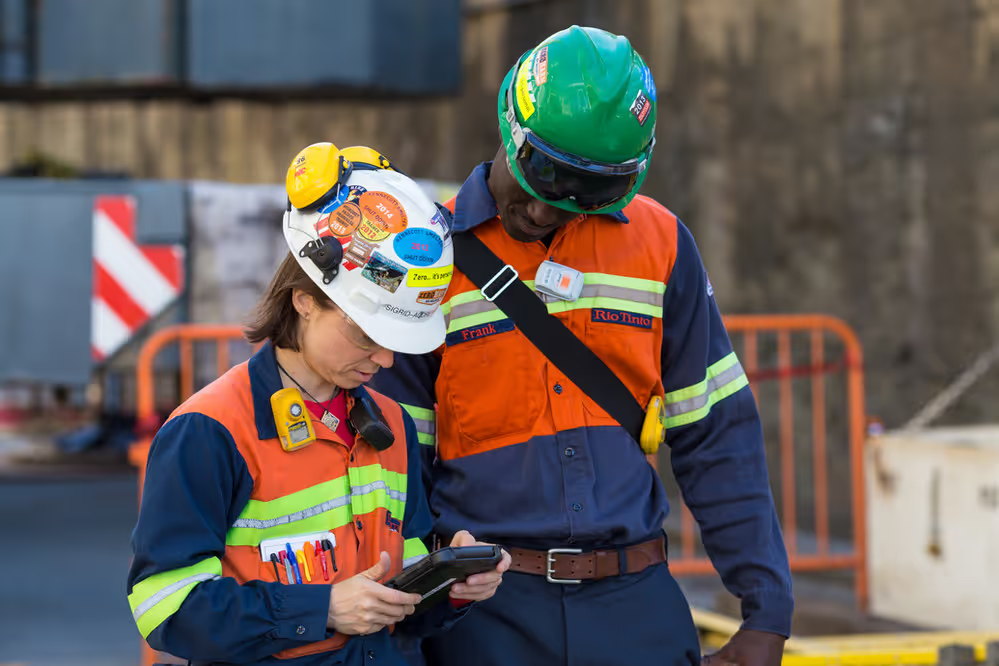
A global metals and mining organisation sought a partner in enabling new graduates successfully transition into corporate life. Such a program would help recent graduates examine the organisation’s culture, determine whether their own behaviours and values would mesh with it, and adjust accordingly.

Solution

The organisation partnered with BTS to co-create the Global Graduate Excellence Program, streamlining new graduates’ transition to and development at the organisation. Over a two-year span, the program:

  • Explored the organisation’s unspoken 'rules' which made the difference between success and failure.
  • Enabled participants to identify that which limited their potential.
  • Provided the skills and tools these new graduates needed as a foundation for a promising career.

The program contained experiences that helped disrupt and shift the graduates’ mindsets, including:

  • Virtual, personalised 1:1 coaching on topics such as employee engagement, building commitment and support, influencing, personal authority, speaking up, and challenging the status quo.
  • Virtual webinars allowing graduates to experiment, collaborate, and role-play with a small group of peers, covering topics such as transitioning into the organisation, creating a personal brand, and building the future.
  • A Graduate Summit about supporting development through personal resilience, giving and receiving feedback, and collaboration; the summit integrated the entire journey with a celebration of achievements

These experiences combined all the mindsets and behaviors that were essential to establishing the right habits for recent graduates.

Results

BTS has delivered the Graduate Development Program to 549 graduates across five summits, 110 webinars, and 2,496 coaching sessions. Following program completion, the organisation found:

  • Increases in efficiency (40%), quality (17%), and retention of leadership talent (11%).
  • That 97% of graduates reported experiencing change (51% experienced significant change), shifts in self-confidence (72%), forming productive relationships with people, action-orientation, and decision making.
  • 98% of participants felt that the program met their expectations (exceeded expectations for 60%), and 92% met the program objectives (45% exceeded their objectives set).
  • That 97% of participants would recommend the 1:1 coaching, and 94% would recommend the Summit experiences.

Participant testimonials

"I have developed deeper relationships with my peers and leaders. This has improved teamwork/ morale and lead to better efficiency for both myself, my team, and the company."
"The value that I have gained from the program has been enormous. I have been able to target development of key skills that were important to me, of which have significantly improved my personal and professional levels in the workplace."
“The value that I have gained from the program has been enormous. I have been able to target development of key skills that were important to me, of which have significantly improved my personal and professional levels in the workplace.”
Get the report
About the company

Related content

Client Stories
October 10, 2025
5
min read
Developing global leadership through tech-enabled coaching
Discover how a global media company partnered with Sounding Board to scale leadership development worldwide through personalized, tech-enabled coaching.

Client need

A leading global media company, serving audiences in 170+ countries, had built its reputation on delivering high-quality content through a vast network of regional operations. With over 20,000 employees, its business relied on leaders at every level making fast, effective decisions in their markets while staying aligned to global strategy.

The company saw an opportunity to better support new leaders joining the organization globally and seasoned leaders seeking additional development opportunities, focusing on those responsible for bringing strategy to life every day.

To bridge that gap, the company set out to pilot a scalable leadership coaching program focused on:

  • Building six leadership capabilities critical to business success
  • Creating consistency across regions while respecting cultural and language nuance
  • Measuring progress at individual, regional, and organizational levels
  • Enabling development that lasts beyond the coaching engagement

The goal: strengthen alignment and elevate leadership impact across North America, Europe, the Middle East, Africa, and the Asia–Pacific region.

Solution

The challenge wasn’t just delivering coaching, it was creating a leadership development system that could work across continents, prove its impact, and adapt to local realities without diluting global priorities.

The company partnered with Sounding Board, a BTS company, to design a pilot that blended human expertise with scaled, tech-enabled insight to meet four imperatives:

  • Activating frontline and mid-level leadership – Focused on people leaders who directly shape day-to-day execution and culture.
  • Building the capabilities that matter – Six leadership behaviors rooted in the company’s unique culture, values, and strategic operating principles, ensuring development was relevant to how leaders drive success within the organization.
  • Ensuring quality at scale – AI-driven matching connected each leader to a coach with relevant industry, regional, and cultural experience.
  • Making growth measurable and sustainable – Biweekly coaching reinforced through a digital platform for goal tracking, reflection, and feedback, plus structured manager check-ins to keep progress aligned to business needs.

Scaled coaching gave the company a consistent platform and approach to leadership development, developing leaders in every region to the same leadership expectations and behaviors. Real-time insights surfaced trends in behavior change, engagement, and alignment early enough to adjust the program midstream. The data struck the right balance between consistency and cultural relevance, showing where local adaptations strengthened leadership and where global priorities needed to hold firm.

Results

By the end of the program, leaders across continents were working from the same playbook, speaking a shared leadership language, and working in ways that respected local context and in alignment to how they wanted leaders to show up in the organization. Managers noticed stronger alignment with their direct reports, leaders felt more confident in their roles, and the data showed tangible shifts in the behaviors tied to business success.

Impact at a glance:

  • 84% completion rate demonstrated sustained engagement.
  • 92% of coachees advanced their development goals, with nearly as many showing measurable improvement in targeted leadership behaviors.
  • 84% of coachees and 64% of managers reported stronger alignment in how they approached priorities and collaboration.
  • 76% of leaders progressed toward broader career goals, signaling a stronger leadership pipeline.
  • 87% satisfaction rate with coaching, reinforced by a 95% coach match success rate.
  • 30% of coachees reported increased job satisfaction—critical in a competitive talent market.

What’s next:

The company expanded coaching to 50+ additional team leaders and began planning its rollout to mid-level managers worldwide, confident they have a model that delivers measurable growth, alignment, and cultural agility at scale.

Testimonials

“I have seen [my report] take it to another, more strategic level, particularly as she engages with her senior stakeholder. She spent time reflecting on what she wanted to get out of their first meeting, how to present herself as his new partner, what kind of questions would solicit the most meaningful responses etc.” — Senior Manager
“[My report] increased her capacity to appreciate the views of others and to work to develop them. She expanded her horizons to think outside of her comfort zones and to draw out some fine work from others. She showed improved capacity to help others develop their own ideas, rather than imposing her own on them.” — Senior Manager
“[Coaching] has helped me have a better understanding of where I enjoy working and developing most so I can continue to do so.” — Coachee

Client Stories
May 19, 2025
5
min read
Transforming commercial capabilities at Nufarm
Nufarm and BTS built a global program to boost commercial excellence and customer engagement for sales and marketing teams.

Client need

Nufarm is a global crop protection and seeds technologies company that helps farmers and businesses meet the global challenges of food, feed, fiber and fuel production. Nufarm brings their proven agility, capabilities and partnerships to help customers in a rapidly changing world. Commercial Excellence is recognized as a core lever in driving value for Nufarm’s customers and shareholders and in particular ensuring that their commercial teams develop and foster the capabilities needed today and into the future.

Nufarm partnered with BTS to create a Commercial Capability Framework—a comprehensive, global platform designed to support and foster capability development and deepened customer insights. The goal: empower teams to deliver consistent, high-impact results while driving deeper customer engagement.

Solution

The BTS-designed Commercial Capability Framework was delivered through a structured, multi-modular program that engaged approximately 500 commercial professionals across North America, Europe and APAC. Tailored to meet the needs of diverse roles, the program provided learning paths for all Commercial Excellence teams—including leaders and field teams in sales, marketing, and customer service.  

The program featured six core modules—Sales Excellence, Sales Leadership, Business Acumen, Key Account Management (KAM), Campaign Management, and Pricing—each available in multiple languages to deliver global common practices while allowing for adaptation to local market realities. Key elements included:

Key elements included:

  • Interactive business simulation:
    A custom Go-To-Market (GTM) simulation where leaders tested strategic and operational decision-making in a risk-free setting. Participants evaluated GTM strategies, analyzed financial metrics, and created actionable, market-specific plans that balanced short-term wins with long-term growth.
  • Leadership coaching program:
    Aimed at commercial leaders, this initiative developed coaching and communication skills through workshops, one-on-one, and peer learning sessions. It emphasized active listening, empathy, and strategic dialogue to foster cultural and behavioral change.
  • E-learning modules:
    Short, interactive modules reinforced a shared commercial language and provided easy, on-demand access for new and existing employees. Video scenarios and quizzes offered real-time feedback, while participant data informed continuous improvement.
  • Strategic conversations program:
    Designed for sales and account managers to elevate customer dialogue quality. Using AI-supported feedback, participants practiced balancing operational discussions with high-value strategic conversations. The program will expand to other commercial roles to increase alignment.

The program rollout was aligned with the fiscal planning cycle, enabling teams to integrate learning into yearly strategic kickoffs. Regional capability leads tailored the delivery to meet local needs, ensuring relevance and engagement at every level.

Results

Each phase of the program was evaluated using Kirkpatrick’s Four Levels of Evaluation—measuring participant satisfaction, learning outcomes, behavioral change, and business impact. Feedback enabled ongoing refinements, ensuring the program remained aligned with the organization’s strategic priorities.

The result:

  • Enhanced commercial and leadership capabilities.
  • Greater consistency in customer engagement and sales processes.
  • Actionable strategies tailored to regional market dynamics.

Through its partnership with BTS, the organization not only improved its commercial excellence but also empowered its teams to deliver on the promise of “Evolving Ag.”

Client Stories
June 15, 2020
5
min read
Creating value with the Bates ExPI for your clients
Maggie Bertrand identified often-overlooked opportunities for marketers to help their organizations shine in a downturn.

Challenge

Halvor and Line Holter run Holter Consulting, a firm based in Copenhagen renowned for its expertise in executive presence. Working with individuals, groups, and teams, they provide executive coaching services while also facilitating leadership development programs. They are always looking for ways to extend and deepen their expertise, expand their offerings and create more value for their clients.

Solution

The Holters saw the ExPITM as an exceptional tool for this purpose. They were among the first to become certified in the Bates ExPITM and are among the most active Certified Practitioners. They have deployed the Bates ExPITM with well over 100 leaders, reflecting a broad range of industries and organizations.

Experience and Outcomes

What did you see as the value of going through the ExPITM Certification program, including working with a partner to practice the process?

Line: “We think that ExPITM Certification—getting your assessment beforehand and then going through the program—gave us an in-depth understanding of the model and the background for it… the feeling that you now know what executive presence is. After Certification, you really feel you know how the process works, and you feel ready to go back and give feedback to your clients. It was a very safe learning environment. No matter how much experience you have, this is new for everyone, and the learning atmosphere was great.”

Halvor: “During Certification, having the possibility of practicing working with the tool and also being inspired by a partner was also very valuable—learning tips, tricks, and approaches—and becoming more aware of your own style versus others’ styles.”

Give me an example of a story of a leader who has gone through the ExPITM with you as their coach. What were some insights that you arrived at through use of the report and the process?

Halvor: “I'm thinking of one executive who was part of a team. Initially, he had a tendency to score himself a little higher than others did, and he didn't see the immediate need for development. He had the over-strengths of being self-driven, being a strong thinker and visionary, having an action bias, being assertive and so forth. Understanding the flipsides of those qualities helped him realized the importance of working on the development themes of Resonance and Authenticity, because people saw him as distant and hard to connect with.  So, we worked on the impact of his strengths becoming weaknesses and how that affected his ability to drive performance while being inclusive. This had a big impact for him and even more so with his organization.”

What have you seen as the business impact of the ExPITM for leaders who have undergone the process with you?

Halvor: “For the leader that I was just describing, letting go and delegating more opened up his ability to be more visionary and strategic, while empowering the people reporting to him. It helped the unit become what they were aiming for—a more strategic partner for the company. It had quite a huge impact for him and his team. For the enterprise, it decreased the distance between this unit and the rest of the company, opened up trust and created more ways for the unit to contribute to the enterprise rather than being in a silo.

”Line: “We have worked with an executive board for several years. They have been leading through a time of extensive change. We had the team go through the ExPITM twice. It wasn't exactly the same team each time, as a couple of years had passed between assessments. Still, we found that the scores had gone up on 11 of the 15 facets on average. They went up for 14 of 15 facets for one person, which was just crazy! They had taken the information and done something about their behaviors to make a positive change. In terms of business impact, it had a lot to do with communicating more effectively and being able to not come across as having all the answers… listening more. Communication was crucial in engaging people and getting the whole organization on board with the change. They also needed to come across as one team to build trust. Because of this work, now they're seen as a team. The board has been able to speed up the process of change because the rest of the organization now believes that they're all in this together. With the ExPITM, we were able to help them highlight specific areas that were crucial in how they wanted to come across. Insights from the ExPITM helped them have success in those areas.”

Halvor: “And now they have language to use with the ExPITM. They can relate facets with leadership behaviors.”

What were some insights you picked up about yourself by going through your own report with your coach on your original insights call?

Line: “What a privilege it was to get feedback as an external consultant, as you so rarely get that in the way that an internal talent development expert does. You're told that you’ve done a good job, and they pay your invoice, but it’s very interesting to learn what they really think of you. I was privileged to have the feedback twice, including last year when I participated in the Bates Executive Presence Mastery open-enrollment program. My Bates coach helped me to realize that maybe I didn't have to put so much effort into my highest-rated facets of my executive presence anymore. They're working fine, so don't put as much as energy in those--focus on other things. With my development areas, my coach gave concrete advice and tips I could use right away—advice I could use myself but also that I could pass along to the leaders I coach.”

Halvor: “It was also interesting to get insight on the intention/perception gap—how one’s own insight compared to others. In my case, I found that I was overrating myself on some facets and underrating myself in other facets. Some were a little surprising! It provided me with increased awareness about certain behaviors that led to behavioral adjustments. Becoming aware was the starting point.”

Related content

Client Stories
October 29, 2025
5
min read
Promoting safety in transportation through cultural transformation
BTS partnered with a Spanish railway embed safety into its culture through a leadership program reaching 1,500 people.

Client need

Safety in the transportation industry has often been treated as a set of rules to follow and boxes to check. But one Spanish railway organization saw an opportunity to redefine safety as something far greater, a core value embedded into the culture of their company at every level.

This bold vision demanded more than compliance. It required a cultural transformation to challenge outdated behaviors, inspire teams, and empower leaders to embrace and model a safety-first mindset. For years, the organization had been working to foster a culture that prioritized protection over profit, setting new behavioral standards across the industry.

To accelerate this shift, the organization partnered with BTS to design a leadership development program that dismantled old practices and equipped leaders with the tools, insights, and behaviors needed to bring their vision to life.

  • Deconstruct existing mindsets to enable cohesive change.
  • Identify barriers preventing progress.
  • Equip leaders with practical behavioral knowledge and tools.

Solution

BTS partnered with the organization to design a leadership journey that would reshape not just processes but perspectives, fostering a workplace where physical and psychological safety were paramount. Over eight months, the project team conducted interviews with leaders and focus groups to uncover critical behavioral insights and tailor the program to the organization’s unique needs.

Participants explored essential themes, including:

  • Embedding safety into daily decision-making.
  • Cultivating greater awareness of safety risks.
  • Understanding the influence of their leadership on safety outcomes.
  • Leading by example to set a cultural standard.
  • Building trust, commitment, and open communication within their teams.

The program unfolded in three distinct phases to drive lasting behavioral change:

  1. Workshop preparation
    Participants began with a self-assessment to uncover personal “safety blind spots” and mind traps. This phase, delivered through a custom online platform, helped leaders reflect on their current practices and prepare for the transformational journey ahead.
  1. Safety workshop
    The one-day, immersive workshop was designed to spark deep conversations about safety culture, challenge ingrained mindsets, and equip participants with actionable strategies for change. Leaders engaged in real-world scenarios to explore the implications of their decisions and practice new behaviors. The day concluded with collaborative debrief sessions, leaving participants with practical tools to implement their insights immediately.
  2. Implementation in action
    To sustain momentum, the post-workshop phase extended over six months, offering six targeted activities. These activities reinforced key lessons, encouraged team collaboration, and provided ongoing support for integrating safety-first behaviors into daily routines.

The leadership program was delivered to 1500 participants over 66 workshops in seven locations across Spain.

Results

To measure results, the project team created a resource map evaluating progress.  

Average completion rate of Activities One–Three: 57 percent. (One: 78.21%; Two: 53. 01%; Three: 40.57%)

A post-workshop survey was sent to participants, reporting on the following metrics:

  • Average satisfaction — 4.7/5.
  • Trainer’s evaluation — 4.9/5.
  • NPS — 82 percent.
  • “Saw improvement in safety alignment” — 93 percent.
  • “Integrated safety tools in daily roles” — 82 percent.
  • “Identified new initiatives for improving safety” — 77 percent.
  • “Mitigated team/peer mind traps” — 93 percent.
  • “More aware of risk in daily roles” — 98 percent.
  • “Identified a normalized risk to work on” — 92 percent.

Testimonials

  • “Many of the methodologies and tools not only help to improve safety but can also be used to improve operational or organizational processes.”
  • “It has put us in front of the mirror of how we are today in terms of safety culture, opening our eyes to our development areas. Very participative and practical.”

Client Stories
October 28, 2025
5
min read
Translating at scale: Building a better client experience with AI on the team
See how BTS uses AI to transform translation and localization to deliver faster, smarter, and more personal client experiences worldwide.

Over the years, BTS has expanded its global footprint through thoughtful acquisitions and collaborations, bringing new creative capabilities and local expertise into the fold. From digital design studios to leadership consultancies across Europe, Asia, and the Americas, we’ve built a community that blends shared values with local perspective. That diversity has become one of our greatest strengths, shaping how we design and deliver learning that feels deeply personal everywhere we work.

Whether someone is in a leadership journey in Singapore, a coaching program in São Paulo, or a strategy workshop in Stockholm, the goal is always the same: to make the experience feel like it was made just for them.

Many of those experiences live on Momenta, BTS’s digital experience platform, powering journeys like Coaching, Multipliers, and other core programs.

As those experiences grew, so did the need for nuance. Every journey had to feel local, not just sound translated. Tone, humor, and cultural context have always been central to the BTS approach, and as demand expanded across formats and regions, our translation model was ready for its next evolution.

In early 2024, the team began exploring how AI could help. Rather than treating technology as the destination, we saw it as a catalyst, a way to rethink translation and deliver richer, more customized client experiences at scale. That curiosity sparked one of BTS’s most ambitious AI-first experiments, led by our Global Product Enablement Function team in partnership with our global network of linguists and translators.

Shifting to AI-first

The next step was finding the right place to experiment. Enter Phrase, a cloud-based translation management platform that quickly became our test lab. Phrase brings every part of the translation process into one place, from machine translation engines to human review, terminology management, and workflow tracking. It gives our linguists, designers, and project teams a shared space to collaborate, test ideas, and learn.

Over the next few months, two key discoveries reshaped how we think about translation, and ultimately, how we work.

Key discovery 1: Making AI a teammate

We began with a clear goal: make translation faster and more consistent. Using Phrase, AI handled the first drafts while our linguists refined them. Quickly, we realized there was potential for AI-value that went far beyond speed.  

With AI completing the first 80% of the work in a fraction of the time, our linguists could focus on what matters most: nuance, tone, and cultural resonance. The relationship evolved from oversight to collaboration, AI structured and scaled, humans shaped and elevated.

The result was more than efficiency. It was better work, created by people and technology learning to amplify each other.

Key discovery 2: Turning a roadblock into a redesign

Next came a design challenge. Phrase, like most translation tools, struggled with text embedded in graphics, a hallmark of many BTS learning experiences. Instead of forcing the tool to adapt, we changed how we created.

We began designing with translation in mind: simplifying visuals, reducing text, and using modular components that could flex across languages. The constraint sparked better design, easier to scale, more consistent, and more inclusive for every audience.

Key discovery 3: Integrating systems for scale

With people, AI, and design in sync, the last barrier was process. Managing translations between Phrase and Momenta still required manual effort.

To fix that, we built an API integration linking the two platforms. Now, files move automatically, progress is tracked in real time, and everything stays connected.

That integration turned our workflow into a unified ecosystem, fast, transparent, and ready to scale globally.

Business impact

Just 18 months ago, our translation reviews lived in double-column Word docs. Today, we work in a fully connected, AI-first ecosystem. Each project feeds the next, refining prompts, tone profiles, and design patterns, so our translation process keeps getting faster, smarter, and more aligned with BTS’s voice.

Speed and quality. Translation cycles that once took months now wrap up in weeks, cutting turnaround times by over 40%. Phrase’s tools and AI-powered workflows accelerate production while maintaining quality through expert-approved reuse, glossaries, and automated quality checks. Even complex formats like videos and animations are localized faster, with AI supporting linguists at every step.

Smarter workflows. The integration between Momenta and Phrase automates project transfers and tracking, saving an estimated 2.5 hours per project. Teams across language, digital, and project management now collaborate in one streamlined environment.

Human focus. Our linguists remain the engine of quality and innovation. With AI managing repetitive tasks, they focus on nuance and meaning, and go further by creating specialized GPTs, training databases, and testing translation engines to continually raise the bar.

Client Stories
October 17, 2025
5
min read
AI-first business simulations. A BTS story
BTS is redefining experiential learning with AI-first business simulations that accelerate strategy, scale leadership impact, and drive real transformation.

A BTS next gen innovation story

When BTS invented business simulations in the 1980s, leadership development was mostly theoretical – case studies, lectures, and frameworks about what good decisions looked like. Simulations changed that. They let leaders learn by doing, stepping into a realistic version of their business to test strategy, make decisions, and see the impact before the stakes were real.

Since then, simulations have evolved from spreadsheets to digital platforms to immersive virtual experiences that capture the complexity of leading in today’s world. Now, large language models and agentic AI are opening a new frontier, one where simulations evolve as fast as the world they reflect and experiential learning scales with the pace of change.

Creating space for exploration

Test quickly, abandon what doesn’t work, and share what you learn.
– Jessica Skon, CEO, BTS

A handful of simulation experts were pulled out of their day-to-day work and given the freedom to set their own direction. They had the authority to shape the roadmap and the protection to explore bold ideas without fear of critique. The brief was simple: go figure out what’s possible.

They had cover to fail fast, freedom to explore, and permission to get a little messy. Early wins were interesting but small. AI could draft faster, automate a few things – helpful, sure. Transformative? Not yet.

The breakthrough came when we stopped trying to bolt AI on to what we already did. We rebuilt our simulation platforms, our processes, and tools from the ground up around AI. Suddenly it wasn’t just about micro-gains & efficiencies, the canvas of possibility was much larger.

From experimentation to acceleration

So, we tested. Some tools showed promise, others, not so much. Every experiment taught us something. Each “failure” made us sharper about where AI could actually help, and where it would just get in the way.

What began as small experiments turned into a new way of working, a process and platform working as one.

AI now accelerates the first 80% of the work, the structure, synthesis, and early drafts, freeing BTS consultants to focus on the high-impact moments that drive behavior change: dilemmas, trade-offs, and conversations that build conviction.

Our new AI simulation platform and AI-First development process operationalizes that process:

  • Enabling live co-creation and branching edits with clients
  • Applying light guardrails for quality and security
  • Integrating with enterprise systems for compliance and control

AI accelerates, people transform. That combination is what makes BTS… BTS.

Clients feel the impact in four ways

  1. Fast spin-ups for focused needs
    For targeted challenges like coaching a customer conversation, debriefing a safety incident, aligning a sales team, we can now stand up bespoke simulations in days, not weeks. Teams co-create live; scenarios adjust in the room; relevance is immediate.
  2. Enterprise simulations for strategy alignment
    For multi-round, high-fidelity simulations, AI accelerates the structure without compromising quality. BTS experts still craft the dilemmas and trade-offs that drive conviction.
  3. A broader platform portfolio
    Beyond enterprise simulations, we now support conversational practice, skill drills, workflow redesign, and company or market modeling, helping clients choose the right tool for each need.
  4. On-demand, without the risk
    Clients can use our AI platform for self-authored micro-sims, where speed and iteration matter most. Our toolchain scaffolds the flow, enforces guardrails, and keeps quality high.

The best model is flexible: enable where DIY shines, co-build for complex challenges, and experts lead end-to-end when outcomes matter most.

What clients are already seeing

  • Weeks to hours: Work that once took six weeks was delivered as a high-fidelity experience in just 13 hours, specific enough to engage a CEO on first pass.
  • Lean, agile teams: Projects that required seven consultants now take two, with no loss in quality or impact.
  • Live collaboration: Simulations are built with clients, not for them, adjusted in real time during design and delivery.

The result: faster delivery, deeper relevance, and experiences that scale across an enterprise without losing the human touch.

The bigger picture

BTS simulations have always given leaders a safe place to wrestle with real dilemmas. AI hasn’t changed that, it’s expanded the canvas. By rebuilding how we design and deliver simulations, we’ve removed the trade-off between speed and substance.

Focused needs can now be met in days. Complex transformations can move at the pace of business. Clients can engage however they choose, DIY, co-create, or end-to-end, with BTS expertise guiding every step.

We’re still early in this chapter, just like our clients. But the direction is clear: faster, smarter, more scalable experiential learning, anchored in human judgment, strategic alignment, and the craft that defines BTS.