
Tech-enabled coaching
Modern, scalable coaching and mentoring software, world-class coaching, and strategic program design, all in one flexible platform.












Everything you need to scale coaching, finally in one place.
Scaling leadership development is hard to do well, and even harder to measure. Sounding Board brings coaching, mentoring, and insights together in one place, giving you the visibility, consistency, and scale needed to support leaders and track what’s actually working.

Benefits and features.
.svg)
Automate coach matching.
Quickly match leaders with the right coach using data-driven criteria like goals, role, and preferences, improving fit, engagement, and outcomes from the start.

Track progress and measure impact.
Monitor coaching activity, capability development, and progress toward goals with built-in analytics, giving you a clear view of what’s working.

Build and manage programs with ease.
Create, launch, and manage coaching programs in just a few steps, reducing administrative burden and freeing your team to focus on impact.

Scale consistently across the enterprise.
Align experiences across teams and regions while connecting development to real business outcomes, so you can clearly see what’s working and prove the value of your investment.
Ready to bring tech-enabled coaching to your organization?
Request a demo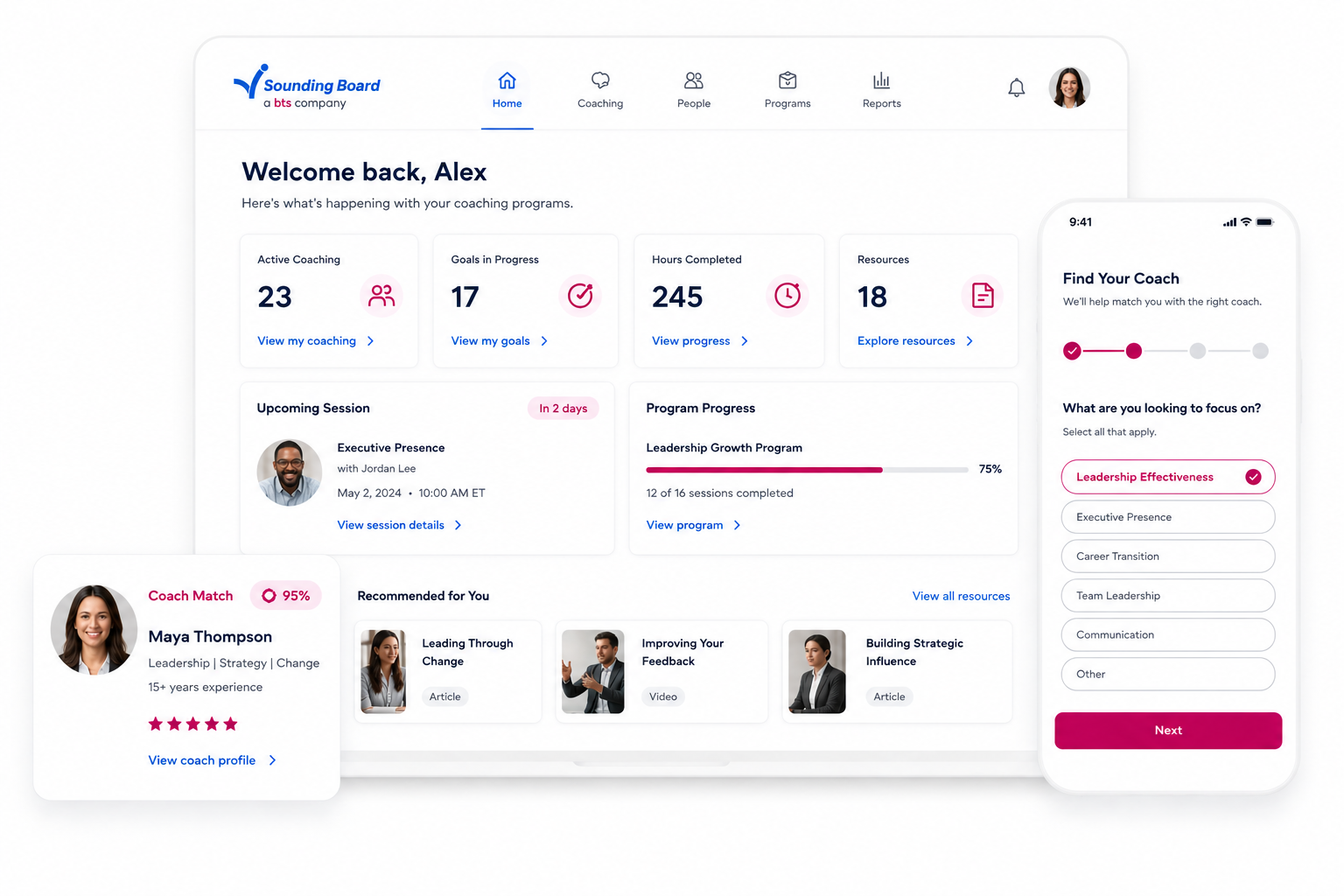
Developing global leadership through tech-enabled coaching.
Learn how a leading media company leveraged BTS tech-enabled coaching to scale leadership development across 170+ countries and better align leaders worldwide. The result was a scalable system delivering consistent, measurable leadership development impact.

Designed for leaders at every level.




New managers
Secure the future of your organization with a strong leadership pipeline. Help new managers thrive by fostering their development from the start.

High potential employees
Help retain high-potential employees while developing foundational leadership capabilities to empower them throughout their careers.

Change-ready leaders
Accelerate the evolution of your organization. Support your agents of change by developing the key capabilities needed to initiate and influence.
Innovators
Innovation happens when everyone has a seat at the table. Develop emerging leaders from underrepresented groups to leverage diverse perspectives and expertise for greater innovation.

New on the blog.

In Part 1, I told you about the three decisions we made two years ago and the simulation flywheel that produced our first Applied AI diamond.
Here’s the field-notes version.
Over 80% of our global business have now adopted a new Applied AI approach for doing simulations in the first eight weeks, across 24 countries and every practice.
The flywheel didn’t stop with simulations. It moved into finance, sales enablement, legal, operations, and client delivery. Teams started building agents and bringing them onto their own org charts. We didn’t plan for any of that. We built the conditions for people to find their own breakthroughs.

What it felt like inside the flywheel.
When the simulation team went live with their first clients on the new way of working, the lead person hit a wall. Their words:
“You’re asking too much. You’re making me be a full-stack developer. Up until this point I did a small part, and I sent it to the team, and they built off the back end, and they brought it back. And now I have to end-to-end soup to nuts, basically alone.”
There was graphic UI work nobody had been trained for, the fear of delivering quality below what BTS expects of itself, and the weight of not having a playbook. This was not the joyful adoption story most consultancies tell.
Then something shifted. Six members showed up for product testing, where the usual was two or three. The work created teamwork I hadn’t seen at BTS in years. The breakthrough was not an instantaneous change from skepticism to celebration. It was a breakdown in confidence, then rally, then bonding. If we didn’t make room for the breakdown, we would have lost the rally.
The other breakthrough was global teamwork; not yet a BTS core strength. Our culture is beautiful: high-freedom and entrepreneurial. But people’s first identities are to their countries. Almost every prior attempt we’ve made at a global initiative has failed. The one exception was Covid. So, when I say what happened next surprised me, I mean it.
I asked to join the simulation team’s Slack channel rather than pulling them into status meetings. What I got to watch in the mornings was someone in South Africa waking up, posting “I tried this and got stuck,” then London adding on, then San Francisco weighing in, then a surprise breakthrough overnight from Tokyo. We didn’t engineer that. Curious and determined BTS’ers did. The problem was interesting enough that the org chart didn’t matter. It was amazing to see and a glimpse into the next evolution of the BTS culture.

The pattern: Explore, expand, institutionalize, renew.
What we’ve now seen play out, both inside BTS and with clients, follows the same four-step pattern. Each step asks a specific decision of the leader.
Explore.
Stay stubborn on the aspiration and fluid on the path. Our breakthrough wasn’t the path we originally took. We changed tools and approaches. Nobody could have foreseen that. And if the team had taken the first six months of learnings from AI as their definitive “this is the detailed path we will follow,” we never would have gotten the disruption. Five different tool combinations were tried before we found the one that worked. Companies that lock into a single path or tool too early are betting against compounding capability that doubles roughly every seven months. That is not a bet I’d take.
Expand.
Run the old way and the new way side by side. When the simulation team’s breakthroughs got real, the instinct was to retreat into more internal testing. We did the opposite. They ran old way and new way in parallel on 6 or 8 live client projects across all three geographies. Every single one ended up going live the new way. The backup was always there. They didn’t need it.
Institutionalize.
Burn the boats. The simulation team committed that no new client work would be done the old way after January 1. The other practice leads then committed to dates within Q1, even though most of them had not yet experienced the new way themselves. They had to trust their colleagues. If you can do it for the most complex thing, you could probably do it for the less complex ones. By February 15, we had approaching 90% global adoption across 24 countries, across all practices. I was shocked and proud. We had spent years failing at exactly this kind of global rollout.
Renew.
Treat your agents as contractors. People on our diamond teams are now managing 30+ agents they built themselves. Our teams give agents performance feedback. We terminate their contracts when they don’t deliver. We expand the responsibility of agents when they outperform. The frontier question we’re wrestling with now is token budgeting. Two friends of mine running engineering-heavy companies believe that within 6 - 9 months, their token cost per engineer will exceed the cost of the engineer. Whether that’s the right framing is open. The question is real, and every CEO will be asked some version of it within the year.
What had to be true for this to scale.
Once we achieved this amazing global innovation, the leadership sat down to figure out what made it work. We named five things. None of them were about the technology.
Real pain points as the starting point. We had so many people frustrated from those ways of working, all the back and forth and all the wasted time, that this was gold for them. The old way was already painful. The new way wasn’t a forced disruption; it was relief. Find the workflow where the pain is loudest and start there.
The diamond unlocked creativity, it didn’t constrain it. This was the most differentiated insight, and the one most leaders miss. It wasn't "here's the new tasks and rules." It was, "once you learn how to do this, the sky's the limit. You can be even more creative." If your rollout feels like a new set of rules constraining your people, you’ve built the wrong thing.
Pair deep expertise with fresh eyes. The disproportionate share of our breakthroughs came from a tenured tinkerer with total command of the work, paired with someone new to the role who hadn’t yet built the muscle memory of how it had always been done. Without that pairing, you get incremental improvements to the work you already know how to do, instead of a reinvention.
Refuse the “people are too busy” reflex. When I brought the rollout to the global leadership team, the excuses came fast. “Our people are too busy. They’re burnt out. Q1 is going to be busy. No one’s going to have time.” My response: “This is a chance to eliminate the tasks you dread and expand what you love. I know it is a short push of extra work, and I think after the fact you and your team will feel joy and pride and say it was the best time we ever spent.” This is the moment most AI rollouts die.
Senior leaders must lead by example and do the work themselves. This is not middle manager’s job. This is not something you delegate. Even though you don’t build simulations anymore, you must know what this is. One of our partners proactively put time on senior leaders’ calendars and forced them to do the work. Once they started building, the excitement grew, and they could advocate for the rollout because they understood it. If your executives haven’t put their hands on the keyboard, you don’t have a rollout. You have a memo.
What we’re seeing across clients.
We’re now running this play with client organizations across industries and geographies. The companies whose flywheels are accelerating paired their A-players with their early-career talent, pulled IT and legal into the working sessions, refused the “too busy” reflex, and put their senior leaders’ hands on the keyboard. The companies whose flywheels are stuck almost always have a leadership pattern at the center of the stall. Not a tooling pattern. Not a governance pattern. A leadership pattern.
If this resonates, let’s talk.
If you read Part 1 and asked yourself whether your flywheel was turning, the question I’d add now is sharper: do you have the conditions in place for a diamond to appear? If yes, you’re already moving. If no, the technology will not save you.
Here's where we're starting with clients: a working session, half day to a full day, with a small group that owns one of your highest-friction processes. Together we map where your first diamond is most likely to land, how to set up the side-by-side trial, and what your version of "burn the boats" should look like.
The destination, if we do this right, is a self-reliant culture of applied AI inside your company. 5, 10, 15 diamonds compounding into a fundamentally different way of operating. From what I have experienced this is a once in a career opportunity for dramatic shareholder value creation if you get that muscle going. I say that because I'm watching it happen, in real time, inside our own company and across our client base.
If you want to get your flywheels spinning and map your first diamond, start here. Bring your hardest workflow. We'll bring the playbook.

Three decisions that changed everything.
Two years ago, we made three deliberate decisions about how BTS would move with Applied AI.
We would become our own Customer Zero.
While others were building strategies, defining governance, and waiting for clarity, we made a different call: we decided not to wait. Not because the stakes were low, but because they were high. And because in a space evolving this quickly, clarity wouldn’t come from planning. It would come from movement.
So instead of starting with a roadmap, we started with three principles:
- No top-down mandate. The people closest to the work figure it out.
- IT must evolve from gatekeeper to enabler - leading AI trials and fast experimentation.
- Don’t wait for certainty.
We set the organization in motion, and once we did, things started to move quickly.
What if we started this company today?
Waiting for certainty is itself a choice, and it’s costing companies more than they realize.
We started where we knew the work best: our simulations. No perfect plan, just teams moving, trying, and iterating.
Simulations are core to who we are at BTS. Companies that simulate don’t just make better decisions; they execute faster and build more engaged cultures.
The team asked a simple question:
"What if we were to start our company today?”
That question started the flywheel.
They asked IT for a few licenses and started building - vibe-coding, writing agents, and testing tools - moving at a pace that would make any VC-backed start-up smile.

The messy middle.
At first, the team was underwhelmed.
The early reports were blunt:
“Not good with math.”
“Poor graph capabilities.”
The team wasn't discouraged. They kept tinkering - jumping between tools, staying on top of new releases, experimenting constantly.
This was a small team, across 24 countries, building off each other’s ideas. Laughing at crazy creations. Breaking things. Iterating in a sandbox alongside real clientwork.
Each cycle produced something:
- A sharper scenario
- A faster build
- A more powerful simulation
The flywheel was turning, and it was generating something real.

When the diamond appeared.
Then something shifted.
The team moved into client trials across five countries. They figured out ISO compliance and built the architecture to handle the complexity, the “spaghetti.”
And what emerged wasn’t incremental:
- What used to take weeks started happening in days.
- Limited creativity started to feel like unlimited innovation.
- Clients became self-serving.
- Agentic simulations were built directly into client systems for real-time updates and preparation.
This was our first AI diamond - a high-impact outcome created by many cycles of experimentation compounding into real value.
It only appeared because we kept the flywheel turning, each cycle increasing the odds that something would break through.

95% adoption in eight weeks.
Then it was time to take the AI diamond global.
BTS is decentralized and highly entrepreneurial. We operate across 24 countries and 38 offices, where local teams have real autonomy.
And historically? That’s meant a low appetite for adopting something built somewhere else and pushed from the center.
So we expected resistance.
Instead, something surprising happened.
In the first eight weeks, we saw 95% adoption across our global footprint.
It felt completely different from our own digital initiatives, ERP implementations, top-down rollouts of the past.
This moved on its own. Why?
We realized it didn’t start with a framework or a model, it started with a feeling.
The feeling of being at the leading edge of one’s craft and profession.
- Joy
- Excitement
- Pride
As we watched this play out across teams it stopped feeling like isolated wins.
There was a pattern to it. A repeatable, organic, innovation motion.
And the flywheel didn’t stop with simulations.
It spread across finance, sales enablement, legal, operations, and client delivery. Some cycles led to small improvements, and others revealed new diamonds.
Not becausewe planned for them, but because we built the conditions for people to find them.
The question I'd ask any CEO right now: Is your flywheel turning, or are you still waiting for the perfect plan?
In part 2, I’ll share the key success factors behind the breakthrough, and what we’re now seeing across more than 120 global clients.

Today’s customers are more informed, more selective, and more time-poor. They need conversations that help them prioritize, decide, and move forward.
And yet, 58% of sales meetings fail to create real value.
Not because sellers lack capability, but because conversations are not designed to move decisions forward.
“Customers don’t act on every need they recognize.
They act when something becomes a priority.”
In this short executive brief, you’ll discover
- Why most conversations inform… but don’t drive action
- What actually makes customers prioritize and move
- How to create urgency without damaging trust
- The shift from presenting solutions to enabling decisions
- What separates conversations that stall from those that accelerate momentum
If your teams are experiencing stalled deals, delayed decisions, or slow pipeline movement, this brief will help you understand why, and what to do differently.

Get in touch
Want to know how BTS can help your business? Fill out the form, and someone from our team will follow up with you.