Why bother with feedback in a moment like this?
Stephanie Peskett, Head of Leadership and Coach MOW region, shared this article on giving feedback during COVID-19.
July 1, 2020
5
min read
Subscribe to the BTS newsletter
Follow us on Linkedin
Follow BTS on Linkedin
Share

As a manager, you may be thinking, “how can I possibly give feedback in the middle of a pandemic?” and “Why now?” Most are probably thinking, giving feedback is a huge risk. But in the current environment, doing so is more important than ever.

Checklist

Why? Employees face a myriad of challenges daily – working virtually, maybe working less, operating different shifts. The way people work has changed significantly – and so have expectations. In the past, everyday conversations would provide an opportunity for managers to communicate new expectations and give feedback to direct reports, but in today’s virtual environment, those casual yet critical interactions have largely fallen by the wayside.

During this strange time, it is your job as a manager to keep your people engaged. Doing so requires you to clearly define what success looks like and how to get there. But for the average people leader, properly evaluating an individual’s performance, the ‘what’ and ‘how,’ is fraught with danger. The below scenarios highlight why:
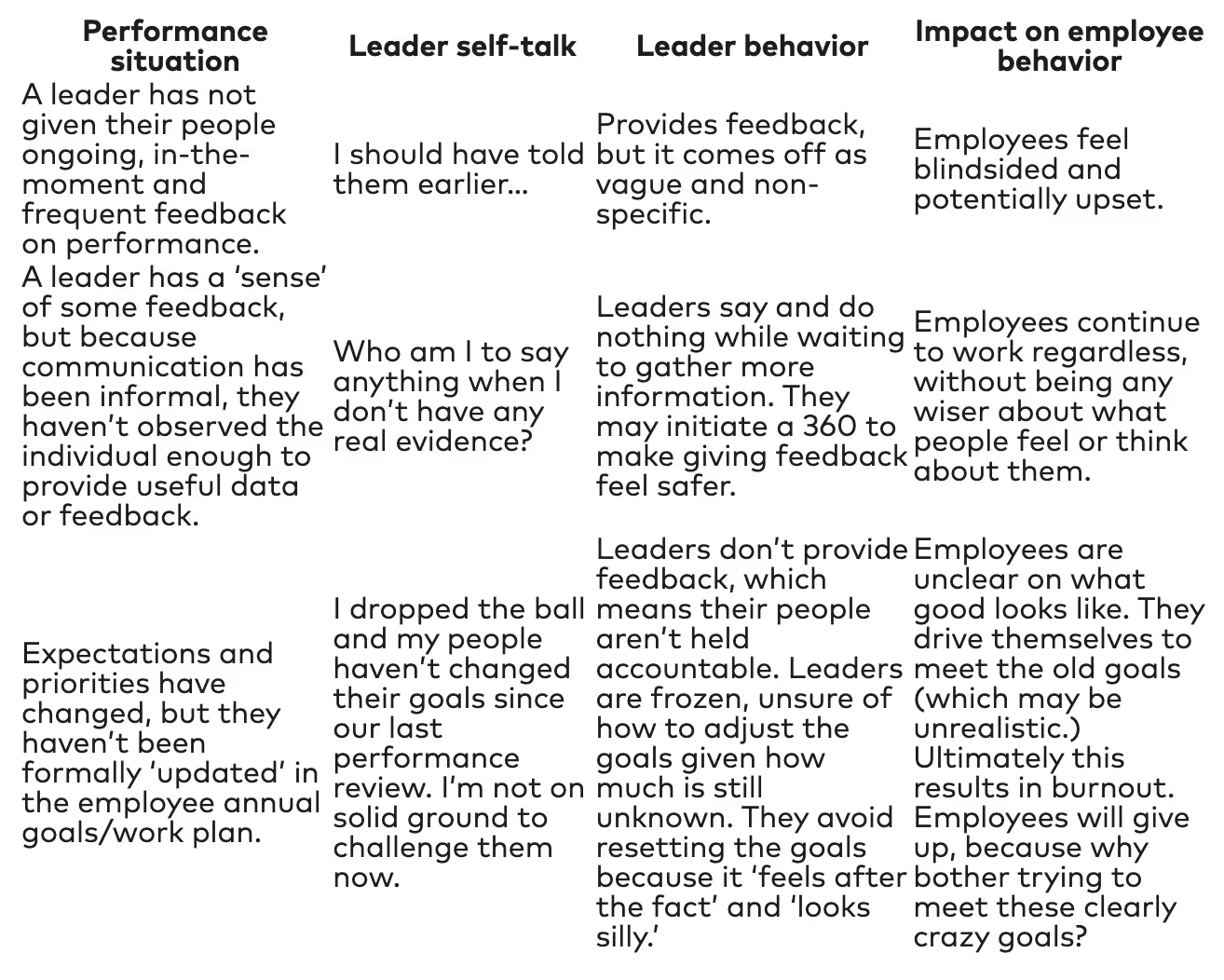

So what is the antidote? There are three key steps you can to take to make an outsized impact on your people:

1. Be Prepared

  • Take time to reflect and take some notes about each person before you have your performance conversation. Use your calendar as a prompt to remember the key moments/interactions so your feedback is more data driven.
  • If the feedback is serious and has consequence, make it very specific and direct. Write out a script if it helps you (and be willing to go off script, once well-rehearsed.)
  • If the feedback is more developmental and less serious, acknowledge specific situations and leverage them for development coaching conversations. Invite them to rise above the situation and consider it from a broader view. For example, “Do you recall when you led the team meeting last week? We didn’t get through the full agenda and ran over by 20 minutes. Let’s set that moment aside specifically and think, what went well? What could have been better? What is the learning here? If you were doing the same thing next week, what would you do now?” etc.

2. Be Safe – Bring structure to feedback conversations so that even in the virtual context there is safety while providing feedback. For example:

  • Give a frame for feedback that is positive and growth focused. In BTS we like to use “what’s working well” and “even better if…”
  • Set aside ten minutes at the end of a team meeting and ask people to share their views on what went well, and what would be “even better if…” Using the chat feature is one way to get your introverted team members to contribute to the conversation.
  • Set the expectation with your team that each one-on-one must include a moment for feedback, for both the leader and direct report.
  • When setting up the quarterly/monthly reviews, set an agenda in advance that includes an explicit call out for feedback – asking people to reach out in advance of the meeting to get input from their peers.

3. Be Real:

  • Go into every ‘tough’ feedback conversation with your head clear and your heart open. Going in with judgments, assumptions or heavy emotions could possibly make it a regretful conversation.
  • Admit your mistakes as a leader to yourself first – without blaming or judging yourself, COVID-19, the business, or the situation. Know that you’re learning how to lead in a crisis too. The next step in being real is being willing to admit these mistakes to others.
  • Adjust goals for the team as best you can, even if it’s later than you’d like. If you can’t change the goals for now, then share this with your team and decide when you will next review them.

In every organization, from top to bottom, everyone is still mastering feedback. A moment like this will expose gaps and make them look like chasms. Support your people with focused, consumable, digital and virtual development on giving (and receiving) feedback, so every leader out there can feel empowered and inspired, in every feedback conversation.

Get the report

Related content

Blog Posts
February 1, 2013
5
min read
Leadership development eliminating the obstacles
Inspired by Irvin Yalom, this blog shows that growth happens when we remove the obstacles holding leaders back, one step at a time.

Last night I started reading a book by Irvin Yalom, a psychiatrist who has written several novels that I’ve loved. But right now I’m reading something different—a book of short lessons he’s learned from many years of working with patients.

Early in his career, Yalom was inspired by something he read. The gist of it was that all people have a natural tendency to want to grow and become fulfilled—just an acorn will grow up to become an oak—as long as there are no obstacles in the way. So the job of the psychotherapist was to eliminate the obstacles to growth.

This was a eureka moment for Yalom. At the time, he was treating a young widow. Suffering through grief for a long while, she wanted help because she had a “failed heart”—an inability ever to love again.

Yalom had felt overwhelmed.  How could he possibly change someone’s inability to love?  But now he looked at it differently.  He could dedicate himself to identifying and eliminating the obstacles that kept her from loving.

So they worked on that—her feelings of disloyalty to her late husband, her sense that she was somehow responsible for his death, and the fear of loss that falling in love again would mean. Eventually they eliminated all of the obstacles. Then her natural ability to love—and grow—returned. She remarried.

Reading this story made me think of the responsibility of leaders toward the people they need to develop—and for the growth and learning that leaders themselves require to be the best that they can be.

Many leadership development challenges seem overwhelming—even impossible. The leaders that we coach usually have a list of areas where they want to get better, but how?  How do you “build better relationships with your peers and direct reports”?  How are you supposed to “get out of the weeds and demonstrate enterprise-wide thinking” or “build executive presence”?  All of these goals are as abstract as they are huge.

So the best approach is to not focus on the huge and fuzzy goal.  What we try to do is to break these goals down into concrete actions through working on real-time business problems. To put it simply, though, we do just as Yalom does: We identify the obstacles and work toward knocking them off, one at a time.

Leadership development is not usually a quick fix. You’re not going to develop executive presence through a half-day workshop or a one-time meeting.  If you’re interested in meaningful, lasting growth—whether for yourself or for those who work for you—it’s a commitment.

But don’t ever forget that we’re all capable of growth throughout life and our careers. The trick is to find the right coach or mentor who will guide you through that obstacle course.

Blog Posts
April 2, 2025
5
min read
Feedback that fuels: A framework to help leaders shift from critique to connection
Leaders can turn feedback into a powerful tool for connection and growth with this practical guide to building trust and sparking curiosity.

Feedback is one of the most powerful tools a leader has, shaping both individual and organizational culture. Yet, despite its value, it’s often met with apprehension—seen as judgment rather than an opportunity. Instead of fueling growth, it can create tension, leaving recipients feeling exposed and defensive.

This reaction is natural. Feedback touches on identity, competence, and self-worth. When framed as a verdict rather than an insight, it sparks defensiveness instead of openness. But what if feedback wasn’t about judgment? What if it was a tool for gathering better data—both for the recipient and the leader?

When leaders make feedback a habit, not a performance review, they gain sharper insights, model continuous improvement, and create a culture where learning thrives. The shift from evaluation to empowerment turns feedback into fuel for growth. And at the heart of this shift? Curiosity.

Leading in a MESSY world: Why feedback matters more than ever

Leaders today operate in constant disruption and complexity. They must move beyond assumptions and seek new perspectives. At BTS, we call this operating in a MESSY world:

  • M – Making sense of the broader ecosystem
  • E – Establishing emotional connections to build trust
  • S – Seizing momentum to stay ahead
  • S – Sensing the future amid uncertainty
  • Y – Yielding ego to create space for others to grow

Feedback is critical in helping leaders navigate these challenges. It’s not just a tool for correction but a catalyst for innovation and collaboration. But without structure, feedback can fall flat. That’s where the AFIRM Model comes in.

Reframing feedback: From evaluation to exploration

Great feedback moves beyond transaction into mutual discovery. When leaders model effective feedback, they foster deeper connections and unlock insights that drive performance.

Curiosity plays a crucial role in this transformation. When leaders approach feedback with genuine curiosity—asking open-ended questions and actively listening—they shift conversations from critique to shared learning. Curiosity also provides leaders with better data on how they show up, helping them refine their approach and model the kind of feedback culture they want to create.

Balancing feedback with efficiency is essential. The AFIRM Model provides a structured approach that makes feedback actionable and constructive while keeping curiosity at the center.

Structure feedback for impact with the AFIRM model

AFIRM enables structured yet flexible conversations—ensuring feedback drives results. It provides a roadmap for leaders to create meaningful, productive discussions that foster growth and accountability. Here’s how it works:

A – Agenda

Set clear intentions. Define the purpose and desired outcomes upfront. A prepared conversation leads to honest, productive dialogue and signals that feedback is a shared responsibility rather than a one-sided critique.

F – Facts, Observations, Evidence

Keep it objective. Base feedback on data and observations to minimize bias. Stay neutral and constructive. Providing fact-based feedback ensures conversations remain focused and prevents emotional reactions that derail progress.

Curiosity fosters deeper dialogue—ask questions, seek perspectives, and pave the way for growth. Instead of assuming why something happened, ask “What led to this?” or “What challenges were you facing?” to create space for honest reflection.

I – Impact

Clarify effects. Who was affected? What were the consequences? Centering feedback on impact builds trust and accountability. Highlighting the broader implications helps individuals understand why feedback matters and how their actions contribute to team success.

R – Request

Co-create a path forward. Define actionable, SMART next steps (Specific, Measurable, Achievable, Realistic, Time-bound). Encourage collaboration by asking “How do you think we can move forward?” or “What support do you need?” Keeping the dialogue open ensures accountability while fostering autonomy.

M – Mutuality

Feedback is a partnership. Success requires shared ownership and commitment to growth. A strong feedback culture thrives when both parties see feedback as a two-way street—leaders should also invite input on how they can better support and enable success. Take time to ask “What feedback do you have for me?” to reinforce that feedback is a mutual learning process.

Creating feedback-driven growth

Imagine an organization where feedback fuels engagement and connection. When framed as a tool for growth rather than judgment, conversations shift from evaluation to exploration. Everyone is on the same team, with the same goals.

Great leaders don’t just give feedback—they seek it, reflect on it, and use it to sharpen their approach. By modeling curiosity and making feedback a daily habit, they foster a culture where feedback is normal, constructive, and empowering.

Feedback isn’t about fixing. It’s about discovering what’s possible. By approaching it as a shared learning opportunity, we move from judgment to collaboration, growth, and transformation.

What’s one question you could ask today to spark a meaningful feedback conversation?

Blog Posts
October 16, 2024
5
min read
Leading with others: Embracing a new era of leadership
Explore how 'leading with others' redefines leadership as a collective responsibility, fostering collaboration, innovation, and resilience.

The landscape of leadership is evolving as newer generations challenge traditional hierarchies. Outdated practices, focused on a top-down power dynamic, have fostered an “us vs. them” mentality, stifling collaboration, slowing innovation, and hindering sustained growth.In response, Future Relevant Organizations are adopting "next practices" that recognize and celebrate contributions, influence, and impact of contributions at all levels of the organization. Central to this shift is the movement from “leading others” to “leading with others,” recognizing that leadership isn’t confined to those in senior positions.“Leading with others” encourages a more inclusive, collaborative approach by:

  • Encouraging employees to lead and influence across boundaries.
  • Inspiring shared purpose and accountability toward collective goals.
  • Prioritizing well-being, fostering psychological safety, and enabling open idea-sharing.
  • Viewing vulnerability as a strength, recognizing that no one has all the answers.
  • Maintaining focus and thoughtful engagement amidst uncertainty.

A biopharma company with a historically top-down leadership structure offers a clear example of the transformative power of this shift. While the company had enjoyed impressive growth, it faced competitive and pricing pressures from disruptive innovation, regulatory challenges, and supply chain vulnerabilities, all of which called for a fresh approach to leadership. Innovation and expansion were crucial to sustaining success.Recognizing the need for change, the company embraced the idea that leadership and influence aren’t confined to those at the top. Here’s how this new approach reshaped their organization:

  • Empowering all levels: Leadership became less about titles and more about fostering a culture where every employee felt valued and capable of contributing. Through well-crafted experiences, 5,000 employees enhanced their self-awareness, challenged established norms, and adopted a long-term perspective aimed at collective growth.
  • Redefining leadership: Leadership shifted from micromanagement to empowering others to make meaningful contributions. Employees were given greater agency and ownership, leading to increased adaptability in a dynamic market.
  • Building trust through vulnerability: The organization encouraged vulnerability, quickly building trust across teams in an evolving, loosely connected environment. This strengthened team dynamics and established a supportive community ready to face new challenges.

Next practices: Shared leadership responsibility

The shift toward “leading with others” is not simply a change in leadership style; it is a strategic imperative. By embracing diverse perspectives and treating leadership as a collective responsibility, organizations gain more valuable insights that drive better decision-making and innovation. Companies that adopt this approach are better prepared to adapt to change, seize new opportunities, and build a culture where everyone is engaged in shaping the future.

“Leading with”: A more inclusive path forward

Adopting a “leading with others” mindset requires more than just structural changes—it calls for a fundamental shift in how leadership is understood at all levels. Leaders must actively create environments where contributions from all employees are expected, not optional. This inclusive leadership approach fosters a deeper sense of ownership and accountability, empowering employees to align their actions with the organization’s long-term goals.As the business landscape continues to evolve, organizations that embrace this collective approach to leadership will be better positioned not only to navigate uncertainty but also to thrive in the future ensuring future relevance.

Related content

Insights
January 23, 2026
5
min read
The silent productivity problem: prioritization
Andy Atkins shares a practical and timely perspective on how leaders can address the root causes of prioritization by focusing on three essentials: tasks, tracking and trust.

This article was originally publish on Rotman Management

IN OUR CONSULTING WORK with teams at all levels—especially senior leadership—my colleagues and I have noticed teams grappling with an insidious challenge: a lack of effective prioritization. When everything is labeled a priority, nothing truly is. Employees feel crushed under the weight of competing demands and the relentless urgency to deliver on multiple fronts. Requests for prioritization stem from both a lack of focused direction and the challenge of efficiently fulfilling an overwhelming volume of work. Over time, this creates a toxic cycle of burnout, inefficiency and dissatisfaction.

The instinctive response to this issue is to streamline, reduce the number of initiatives, and focus. While this is a step in the right direction, it doesn’t fully address the problem. Prioritization isn’t just about whittling down a to-do list or ranking activities by importance and urgency on an Eisenhower Decision Matrix; it also requires reshaping how we approach work more productively.

In our work, we have found that three critical factors lie at the heart of solving prioritization challenges: tasks, tracking and trust. Addressing these dimensions holistically can start to address the root causes of feeling overwhelmed and lay the foundation for sustainable productivity. Let’s take a closer look at each.

Insights
December 2, 2015
5
min read
Business Simulations: Why Are They Effective

You’re buckling in for an overseas flight in a brand-new Boeing 777. The pilot comes on the PA: “Ah, ladies and gentlemen, our flight time today will be six and a half hours at a cruising altitude of 33,000 feet. And I should mention that this is the first time I have ever flown a 777. Wish me luck.”

Before setting foot in the real world, pilots, military personnel and disaster response teams use intense simulations to learn how to respond to high-intensity challenges.Why should we place corporate leaders and their teams in situations without first giving them a chance to try things out? The risks are huge — new strategy investments can run into the hundreds of millions of dollars. BTS offers a better way to turn strategy into action: customized business simulations.

‘Now I Know What it’s Like to be CEO’

A customized business simulation of your enterprise, business unit or process, using real-world competitive dynamics, places leaders in a context where they step out of their normal day-to-day roles and gain exposure to the big picture. Participants make decisions in a risk-free environment, allowing them to experience critical interdependencies, execution best practices and the levers they can use to optimize their company’s key performance indicators. It takes the concept of a strategy and makes it personal, giving each individual the chance to see the direct impacts of their actions and the role they play in strategy execution.

Leading corporations are increasingly turning to business simulations to help build strategic alignment and execution capability when faced with the following business challenges:

  • Key performance objective and new strategy implementation.
  • Accelerating strategy execution and innovation.
  • Improving business acumen and financial decision making.
  • Transforming sales programs into business results accelerators.
  • Leadership development focused on front-line execution.
  • Implementing culture change as tied to strategy alignment.
  • Modeling complex value chains for collaborative cost elimination.
  • Merger integration.

Within minutes of being placed in a business simulation, users are grappling with issues and decisions that they must make — now. A year gets compressed into a day or less. Competition among teams spurs engagement, invention and discovery.

The Business Simulation Continuum: Customize to Fit Your Needs

Simulations have a broad range of applications, from building deep strategic alignment to developing execution capability. The more customized the simulation, the more experience participants can bring back to the job in execution and results. Think about it: why design a learning experience around generic competency models or broad definitions of success when the point is to improve within your business context?  When you instead simulate what “great” looks like for your organization, you exponentially increase the efficacy of your program.

10 Elements of Highly Effective Business Simulations

With 30 years of experience building and implementing highly customized simulations for Fortune 500 companies, BTS has developed the 10 critical elements of an effective business simulation:

  1. Highly realistic with points of realism targeted to drive experiential learning.
  2. Dynamically competitive with decisions and results impacted by peers’ decisions in an intense, yet fun, environment.
  3. Illustrative, not prescriptive or deterministic, with a focus on new ways of thinking.
  4. Catalyzes discussion of critical issues with learning coming from discussion within teams and among individuals.
  5. Business-relevant feedback, a mechanism to relate the simulation experience directly back to the company’s business and key strategic priorities.
  6. Delivered with excellence : High levels of quality and inclusion of such design elements as group discussion, humor, coaching and competition that make the experience highly interactive, intriguing, emotional, fun, and satisfying.
  7. User driven: Progress through the business simulation experience is controlled by participants and accommodates a variety of learning and work styles.
  8. Designed for a specific target audience, level and business need.
  9. Outcome focused , so that changes in mindset lead to concrete actions.
  10. Enables and builds community: Interpersonal networks are created and extended through chat rooms, threaded discussions and issue-focused e-mail groups; participants support and share with peers.
Better Results, Faster

Well-designed business simulations are proven to significantly accelerate the time to value of corporate initiatives. A new strategy can be delivered to a global workforce and execution capability can be developed quickly, consistently and cost-effectively. It’s made personal, so that back on the job, participants own the new strategy and share their enthusiasm and commitment. This in turn yields tangible results; according to a research report conducted by the Economist Intelligence Unit and sponsored by BTS, titled “Mindsets: Gaining Buy-In to Strategy,” the majority of firms struggle to achieve buy-in to strategy, but those that personalize strategy throughout their organization significantly outperform their peers in terms of profitability, revenue growth and market share.

Business Simulations: Even More Powerful in Combination

Comprehensive deployment of business simulation and experiential learning programs combines live and online experiences. The deepest alignment, mindset shift and capability building takes place over time through a series of well-designed activities. Maximize impact by linking engagement and skill building to organizational objectives and by involving leadership throughout the process.

Putting Business Simulations to Work

Simulations drive strategic alignment, sales force transformation, and business acumen, financial acumen and leadership development, among other areas. A successful experiential learning program cements strategic alignment and builds execution capability across the entire organization, turning strategy into action. Results can be measured in team effectiveness, company alignment, revenue growth and share price.

Learn more about business simulations

Learn how BTS Business Simulations can help with your initiatives.

Fill out the form below to have a BTS representative contact you.

Insights
February 1, 2017
5
min read
The Power of Learning Journeys for Leadership Development
EVP Rommin Adl shares the success of BTS's partnership with a financial services firm in creating a 6-month comprehensive learning journey.

I recently read an HBR article discussing why the traditional approach to leadership development doesn’t always work.

It stated that instead of traditional methods, the best way to identify, grow and retain leaders to meet today’s demands is to “Let them innovate, let them improvise and let them actually lead.”

Over the past 30 years, as we’ve partnered with clients facing a vast range of challenges, we’ve seen the truth behind this – that people learn best by actually doing. That’s why business simulations are such a powerful tool: they allow people to do and lead within a risk-free environment, and condense years of on-the-job learning experience into a few days, or even hours.

We also know that learning is not just a “one and done” situation – it is a continuous experience. In many cases, a learning journey, which blends a variety of learning methodologies and tools over time, is the most powerful means of shifting mindsets, building capabilities and driving sustained, effective results.What a learning journey looks like depends entirely on the context of your organization. What challenges are you addressing? What results are you driving for? What does great leadership look like for your organization?

Learning Journey Program

To bring this to life, imagine the following approach to a blended learning journey for aligning and developing leaders – in this scenario, within a financial services firm: Financial technology has “transformed the way money is managed. It affects almost every financial activity, from banking to payments to wealth management. Startups are re-imagining financial services processes, while incumbent financial services firms are following suit with new products of their own.”

For a leading financial services company, this disruption has led to a massive technology transformation. With tens of thousands of employees in the current technology and operations group, the company will be making massive reductions to headcount over the next five years as a result of automation, robotics and other technology advances.

This personnel reduction and increased use of technology is both a massive shift for the business as well as a huge change in the scope of responsibility that the remaining leaders are being asked to take on moving forward. As such, the CEO of the business unit recognizes the need to align 175 senior leaders in the unit to the strategy and the future direction of the business, and give them the capabilities that they need to effectively execute moving forward.

To achieve these goals, BTS would build an innovative design for this initiative: a six-month blended experience, incorporating in-person events, individual and cohort-based coaching sessions, virtual assessments and more. Throughout the journey, data would be captured and analyzed to provide top leadership with information about the participants’ progress – and skill gaps – on both an individual and cohort level, thus setting up future development initiatives for optimal success.

The journey would begin with a two-day live conference event for the 175 person target audience, incorporating leader-led presentations about the strategy. The event would not just be talking heads and PowerPoint slides, but rather would leverage the BTS Pulse digital event technology to increase engagement and create a two-way, interactive dialogue that captures the participants’ ideas and suggestions. Participants also would use the technology to experience a moments-based leadership simulation that develops critical communications, innovation and change leadership capabilities, among other skills.

romAfter the event, participants would return to the job to apply their new learnings. On the job, each participant would continue their journey with four one-on-one performance coaching sessions, in addition to a series of peer coaching sessions shared with four to five colleagues. They also would use 60-90 minute virtual Practice with an Expert sessions to develop specific skill areas in short learning bursts, and then practice those skills with a live virtual coach. Throughout the journey, participants would access online, self-paced modules that contain “go-do activities” to reinforce and encourage application of the innovation leadership and other skills learned during the program.

As a capstone, six months after the journey has begun, every participant would go through a live, virtual assessment conducted via the BTS Pulse platform. In three to four hours, these virtual assessments allow live assessors to evaluate each leader’s learnings from the overall journey and identify any remaining skill gaps. The individual and cohort assessment data would then lead to and govern the design of future learning interventions that would continue to ensure the leaders are capable of implementing the strategy.

As you can see, this journey design leverages a range of tools and learning methodologies to create a holistic, impactful solution. It’s not just a standalone event – each step of the journey ties into the one before, and the data gathered throughout can be used well into the future in order to shape the next initiative .

Great journeys or experiences like this can take many forms. In addition to live classroom and virtual experiences, there is an ecosystem of activities, such as performance coaching, peer coaching, practice with an expert, go-dos, self-paced learning modules, and more, that truly engage leaders and ensure that the learnings are being reinforced, built upon, practiced and implemented back on the job. We find that these types of experience rarely look the same for every client. There are many factors that determine which configuration and progression will make the most sense. There is one common theme that we have found throughout these highly contextual experiences, however – that the participant feedback is outstanding and the business impact is profound.