Marketing made personal
Alignment, mindsets, and capabilities for marketers to better lead marketing transformations, implement marketing initiatives, and drive customer-centric collaboration

Experience the BTS difference
The Marketing Made Personal offering from BTS focuses on creating alignment, establishing new mindsets, and improving capabilities within teams and by delivering high quality, personalized experiences.
We offer standard and custom programs for your different marketing areas including branding, digital and multi-channel marketing, customer segmentation, price positioning, and more. Our flexible, fun, and people-focused programs help your marketers better lead transformations and initiatives to achieve your, and your customer’s, desired business results.
At our core, we believe that successful marketing is:
- Personal, so that customers feel directly addressed by an/your organization
- Results-oriented focusing on outcomes for the customer and for the organization
- Data-Driven leveraging data about individual customers and their behavior, buying centers, organizations, industries and the economy to best serve them and communicate with them
- Integrated and fully aligned with the client results, their buying cycle, the customer experience and the selling cycle
By partnering with BTS we can help your marketing organization be successful and ready for the future.
My organization needs help with a marketing transformation
My organization needs help implementing marketing initiatives
I need my organization to share a common marketing mindset, speak a consistent marketing language, and apply high-performance marketing behaviors
Program Details
Program Options
With solutions in more than 10 marketing organizational capabilities, we offer a wide range of expertise to help organizations of all size accelerate their marketing programs.

Marketing has fundamentally changed
With the wealth of information available, and to meet the new customer demand for personalization, marketers need to address the “buyer segment of one,” meaning each buyer needs to be addressed as an individual. This requires sales, marketing, customer service, and customer success to partner more closely and deliver a seamless customer experience.
How we make marketing personal
We provide people-focused approaches and offerings to help marketing leaders who want to grow and execute successful marketing strategies by creating alignment, mindset, and capability within their teams and delivering high quality, personalized experiences.

Marketing must create messages that make the customer feel like the marketer’s company is talking to only them.
Marketing must use data about the individual buyer, their company, and their industry to create tailored marketing communications intended to resonate with each individual buyer.

Marketing must focus on personal outcomes for the buyer and organizational outcomes for their company, which can be achieved through purchasing the marketer’s goods and services.

The marketing cycle must be aligned with the selling and customer service cycles, and both need to be synchronized with the customer’s buying cycle
Offering Details
We offer customized programs for each part of your marketing programs building blocks. Click a tile to view more detail on each program.
Related Content

In today's fast-changing business environment, excelling in Revenue Growth Management (RGM) is essential for Commercial Leaders aiming to boost revenue and profit, both now and in the future.
Unlike traditional methods that confine RGM to pricing actions, forward-looking Commercial Leaders recognize that activating a holistic, end-to-end RGM strategy that is consumer/shopper focused and customer-back, leads to more significant growth and allows leaders and teams to not only anticipate, but actively influence consumer demand and customer needs.
Historically, Revenue Growth Management (RGM) has been approached as a temporary and reactionary project, which was typically led by external experts in response to inflationary markets. This limited approach confined the benefits to a small part of the business and focused on short-term results, rather than embedding RGM as an ongoing, fundamental aspect of business strategy that could deliver sustained, long-term growth.
Today, mature RGM organizations treat RGM strategy and execution much differently, positioning the actions at the center of their strategic operations, embedding capabilities deeply within their organizational processes and ways of working. This transformation is not just procedural but is a shift that forces RGM strategy, tactics, and mindset into every action and function of the business.
Strategic integration of RGM at scale: A roadmap for success
- Build strong in-house expertise: To see the scaled benefits of RGM, develop strong capabilities within your commercial teams and intermediate understanding of your cross-functional teams. When your leaders and teams fully grasp RGM tactics and mindsets, it creates scaled-impact that can be sustained without external reliance.
- Encourage cross-functional collaboration: The effectiveness of RGM strategy and execution is only fully realized when it involves a fully cross-functional team. Promoting collaboration between sales, marketing, finance, R&D, and the supply chain enriches insights, strategy and execution feasibility, and organizational success.
- Integrate RGM strategy into key business processes: By connecting RGM directly to critical operations such as budgeting and strategic planning, you ensure that RGM principles are woven into the fabric of annual planning instead of being treated as a one-time project. This integration influences everyday decisions and guides long-term business strategies.
- Overcome implementation challenges with effective change management: Embracing a robust RGM approach involves substantial change and a shift in traditional revenue growth mindsets. Address these challenges through strong change management practices, aligning team incentives with new strategies and providing clear, successful examples of RGM in action to inspire and motivate your teams.
The competitive edge of building RGM capability across the organization:
- Encouraging innovation from Consumer-Back: It’s no surprise that RGM should be activated starting with consumer and shopper insights. When truly building a strategy from the consumer-back, you build a mindset and process that is ripe for innovation. This helps your company stay competitive and lead industry trends and demands, instead of reacting.
- Aligned decision-making for the short and long-term: A thorough RGM strategy speeds up and improves the day-to-day decision-making process of consumer and customer facing commercial teams. It helps ensure that decisions—like setting pricing strategies, choosing promotional activities, or allocating resources—are aligned with the market’s immediate needs and long-term goals for the category.
- Boosting market responsiveness: In today’s volatile business climate, the ability to swiftly adapt to market changes is invaluable. Decentralizing RGM capabilities enables cross-functional local teams to be agile to market shifts in strategic ways, turning potential challenges into opportunities, while still staying aligned to the longer-term market objectives.
- Cultivate a results-driven culture: Building RGM roles across the organization allows for greater ownership and accountability to improve revenue and ultimately grow market share. This means a greater population has a direct role to play in driving business performance and are responsible for keeping an external pulse on consumers, shoppers, and customers.
Implementing a cohesive RGM strategy, instilling the right mindsets, and providing the leaders and teams with the tools and processes needed to be successful, is no small feat. However, the revenue, profit, and market share impact can be substantial when an aligned RGM strategy is deployed at scale. This strategic commitment positions your company for enduring success and a powerful competitive advantage in today’s dynamic consumer, shopper, and customer landscape.

While small and medium-sized enterprises (SMEs) play a vital role in driving economic growth and innovation, they often face unique challenges when dealing with banks. This makes relationship banking crucial to their success. By strengthening their relationship banking models, banks can differentiate themselves from competitors by improving the support they provide to SMEs, helping these businesses overcome challenges and thrive in the marketplace. In discussions with owners of SMEs about their experiences with banks, four common concerns emerge:
- Access to credit. Obtaining financing for purposes such as working capital, expansion, or equipment purchase is a significant challenge for SMEs. Banks often perceive them as riskier borrowers due to their limited credit history, lack of collateral, or volatile revenue streams, which can make it difficult to secure loans.
- High interest rates and fees. SMEs may face higher interest rates and fees compared to larger, more established businesses due to banks' perception of greater default risk, as well as limited financial transaction volumes.
- Complex application processes. SMEs often face time-consuming and complex loan application processes, requiring extensive documentation such as financial statements, tax returns, and business plans.
- Inflexible lending terms. SMEs may struggle with inflexible lending terms, including strict collateral requirements, short repayment periods, or covenants that restrict operational flexibility. These terms can make it difficult for SMEs to manage cash flow and invest in growth.
By adopting the following approach, relationship managers can help businesses overcome these challenges:
- Advocate for clients within the bank, helping them secure financing for business expansion, capital investments, working capital growth, and asset accumulation.
- Offer guidance on optimizing cash resources within the constraint of limited capital resources.
- Provide advice on managing personal wealth accumulated through business ownership.
This approach requires a set of knowledge and capabilities:
- Business acumen—an understanding of SMEs’ unique needs and business challenges.
- Recognition of the essential role cash flow plays in small business success and an understanding of how to optimize it.
- Familiarity with the financial impact of bank products on SMEs' finances.
- Understanding of small business funding models, including the roles of owners, banks, and investors.
- Insight into the migration of SMEs to medium-sized enterprises.
Equipped with these capabilities and this knowledge, bankers can employ critical relationship management skills at four key stages:
- Planning. Gain local market knowledge and industry/sector expertise before engaging with clients.
- Discovery. Approach SMEs with a focus on their unique needs, recognizing the distinct characteristics of owner-managed and owner-financed businesses.
- Engagement. Position offerings from a client-impact perspective, rather than a bank- product perspective, addressing the specific needs and challenges of SMEs.
- Closing. Adopt a partnering approach and act as an advocate for SME clients within the bank, particularly when dealing with credit functions and decision-makers.
By focusing on these areas, banks can enhance their relationship banking model for SME customers, providing personalized support and tailored financial solutions to help small businesses succeed in a competitive landscape.

In today's rapidly evolving consumer landscape, marked by disruptive innovations and increasing competition, retail banks are facing a pivotal moment. Digital banking is here to stay – but shockingly, so too is its predecessor - branch banking. The traditional role of the branch is evolving, however, and leaders in the industry need to stay relevant in this dynamic environment by embracing key changes.
Why are branches alive and well in the digital age?
Despite the proliferation of digital channels, brick and mortar branches continue to play a vital role in retail banking. Research shows that while routine transactions are moving online, branches still remain critical to:
- Customer acquisition and retention: Branches remain the primary channel for opening new accounts and acquiring customers, particularly high-value segments.
- Personalized advice and sales: Complex and high-value products such as mortgages, loans, and investments require personalized interactions. Branches excel at providing tailored advice and converting sales opportunities.
- Trust and loyalty: Human interactions are essential to building trust and loyalty, especially when addressing financial concerns and needs.
The future of branch-level sales management
To stay competitive and relevant, sales leaders in retail banking must pivot from traditional methodologies and adopt a future-forward approach. This means:
1. Adapting to customer preferences: Sales leaders must understand and respond to changing customer behavior and preferences, thus offering a customer experience that seamlessly integrates digital and physical channels.
2. Leveraging data and analytics: Sales leaders must be able to harness the power of data to gain insights into customer behavior, preferences, and needs. This enables leaders to take a targeted and personalized approach to engaging customers.
3. Empowering sales teams: Sales leaders need to invest in the development of their sales teams, enhancing their skills and knowledge and equipping them with the right tools to deliver exceptional customer experiences.
4. Optimizing branch functionality: Sales leaders must rethink the branch model, focusing on smaller, more versatile formats that cater to specific customer needs all within the same branch footprint.
5. Innovation and collaboration: Sales leaders must foster a culture of innovation and collaboration, encouraging their teams to experiment, learn, and share best practices. Organizations should consider collaborating with fintech companies to take advantage of emerging technologies and deliver innovative solutions that better meet customer’s needs.
A call to action
Digital banking may be the future, but branch baking is here to stay. Sales leaders in retail banking who want to thrive in the future need to embrace this transformation, the integration of old and new, and reimagine how they manage their customer experience and how they meet customer needs. By adopting a forward-thinking approach, leveraging technology, and nurturing talent, retail banks can unlock new opportunities, drive growth, and stay relevant amid increased competition. Are you ready to take on the challenges and opportunities that lie ahead?
Building relationships to win in a competitive market
Learn how a multinational electronics organization countered increased competition and shifting customer demands in partnership with BTS.

Evolving commercial capabilities following an acquisition
Learn how a German crop science organization and BTS co-designed a new digital learning solution for its commercial teams.

Evolving sales and marketing methodologies
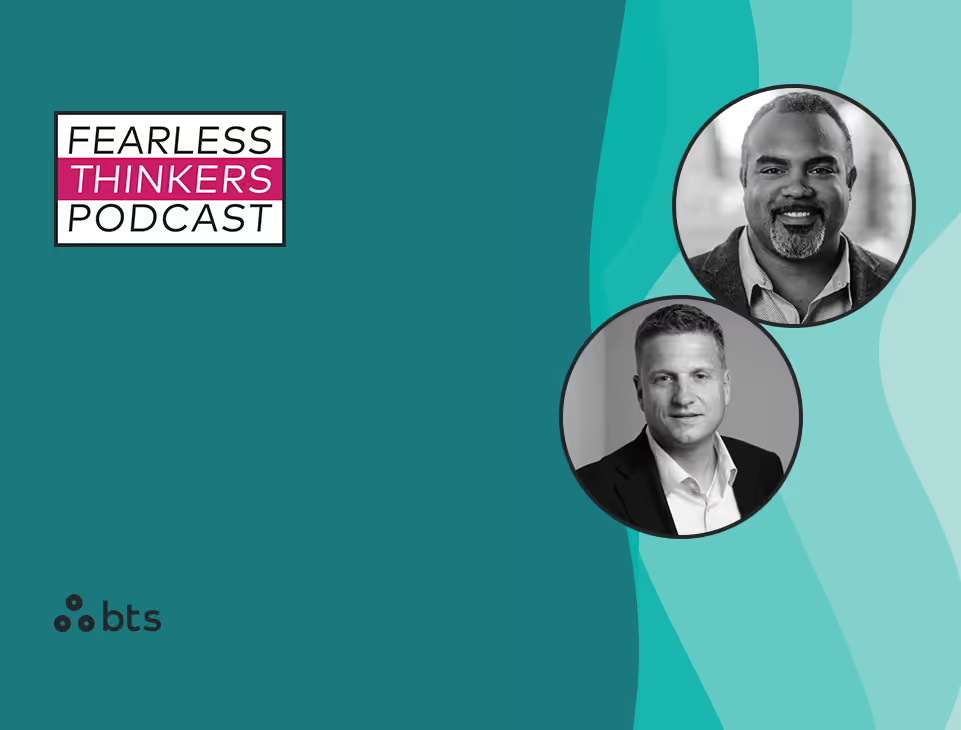
In this episode, Rene Groeneveld and Jason Davis expand on evolving ideas for integrating sales and marketing and customer centricity.

Ready to start a conversation?
Every successful transformation begins with a meaningful conversation. Connect with us to explore how BTS can partner with you to make the shift.


.avif)