Evolving sales and marketing methodologies


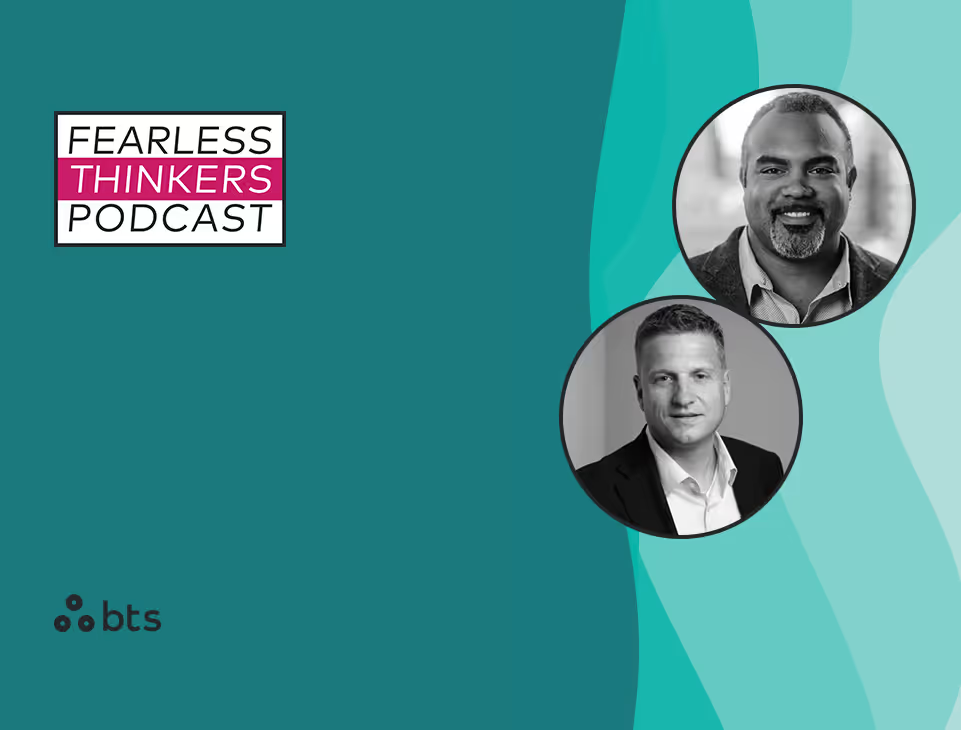
In this episode, Rene Groeneveld, Head of the Global Sales and Marketing Center of Expertise, and Jason Davis, Solution Design and Innovation for the Sales and Marketing Center of Expertise, expand on ideas such as the gradual integration of sales and marketing and the timelessness of customer centricity.
Most of us want to lead in a way that matters; to lift others up and build something people want to be part of. But too often, we’re socialized (explicitly or not) to lead a certain way: play it safe, stick to what’s proven, and avoid the questions that really need asking.
This podcast is about the people and ideas changing that story. We call them fearless thinkers.
Our guests are boundary-pushers, system challengers, and curious minds who look at today’s challenges and ask, “What if there is a better way?” If that’s the energy you’re looking for, you’ve come to the right place.
Find this episode on:

.svg)
Masami: Welcome to Fearless Thinkers, the BTS podcast. My name is Masami Cookson, and our host is Rick Cheatham, Head of Marketing at BTS. Hey, Rick.
Rick: Hey, Masami. What's going on in your world today?
Masami: Well, I just bought an apartment in New York City, and I am basically neck-deep in home improvement projects. And it kind of feels like I have two full time jobs at once.
Rick: Gosh, only two? The last time I did a major renovation, it felt like five. But no, in all seriousness, say I feel your pain on that. And it actually is a good segway in today's show because we've got Rene and Jason from our Sales and Marketing Centers of Excellence here to talk about the major shifts that all of our clients are having to make in their go to market strategy right now, with all that's going on. I'm sure many of them feel like they have two or three jobs right now, too.
Masami: Totally. What were a couple of things that stood out in your mind?
Rick: Gosh, probably the first would be something that many of us have been talking about for years, which is the blurring of the lines between sales and marketing. And how most buyers, even in a business-to-business environment, want to be able to do their own research before they talk to a salesperson. So, that integration becomes more important than ever. And then the second big idea is really about how sellers can eliminate barriers to try to make it easier to buy. So, instead of me pitching my product, it's actually thinking from my customer’s perspective and getting clutter out of the way to keep them moving. But those are just a couple of the big ideas that they were willing to share with us. So, I don't want to give too much away or steal their thunder. Let's jump right in. Hi, everyone. Thanks for joining us today. On today's show, we've got two of my favorite people on earth. First, Jason Davis, our head of design and innovation for our sales marketing CoE. Hey, Jason.
Jason: Hello, Rick.
Rick: How's your day so far?
Jason: Going well so far. Looking forward to being here.
Rick: Great. And then secondly, we have Rene Groeneveld, partner at BTS and Global Head of our Sales and Marketing CoE. Hey, Rene.
Rene: Hi, everyone. It's good to be with you.
Rick: Where in the world did you find yourself today?
Rene: I am in Europe at the moment, but it's good to be with you guys.
Rick: Well, I appreciate it. You know, it's become way past cliche to say these are unprecedented times, and I assumed that everyone's go to market strategy is having to shift in one way or another. What are some of the trends, Rene, that we're seeing in sales and marketing these days?
Rene: Let me start by shifting the focus of your question. We have the honor to speak to around 100 clients last year and this year in really personal interviews: to CEOs, CMOs, COOs, Heads of Sales, Heads of Marketing. And actually, we always started with, ”What are your clients trends?” So, what are the clients’ client trends you see? Because this drives the change in go to market and go to market strategies, as you've just mentioned, and also the trends in sales and marketing. Rene, cont.: So, it was quite obvious that the digital transformation and disruption played the biggest, biggest role when we asked them about their clients trends and what they see out there. What you hear is it's a challenging marketplace out there. It's higher customer expectations, more and more complexity, higher demands from vendors. And of course, not just thanks to Covid, but as a general trend, a changing customer, buying behavior, driving again. If their game is changing, I think we have to up and change our game in terms of sales and marketing. And without triggering it more and more: that was really a global trend, the need for sustainability, ESG and other trends. And of course, there's other things further down the road, but I would say these are the four or five key trends in general.
Rick: And I guess, Jason, it makes me makes me wonder because I think you beyond the trends are really in touch with the day-to-day impact of, for lack of a better way of saying it, users. How does this digital transformation shift really affect probably I would say front line sales managers and salespeople?
Jason: Yeah, Rick, I'd say it really affects it in two ways. One, from the customer side of things, they have way more access to information and insights and trends and what's going on in the marketplace and what's going on with competitors than ever before. And what sellers used to do is really bring that information in, in addition to the products and services they had, and kind of position everything together.
But that's really become so ubiquitous in terms of access for customers that that value that customer or salespeople used to bring is less so. The second piece is, for salespeople and sales managers, there's so much information, it's difficult to sift through what might actually be really relevant for their customers. So, finding ways to cut through the noise of information and insights and trends and analyst reports and product, and what's going on in the economy or globally: it's very challenging for sellers to really cut through that so they can focus their message, focus their time with their customers on the things that matter the most.
Rene: I was just thinking, Jason, just to add on: what I heard quite often is people still differentiating, saying, is this really a B2B or is this a B2C trend? And what we also saw, not just in all our projects and in the market research we do, but also in the interviews, is that it's almost like these two worlds are merging or colliding, or however you want to put it. So, B2B clients expect more and more like a B2C, Amazon-like experience. So, they're not just happy with the purchase order sent out or three weeks after the order; they want to know a lot more beyond the “Where’s my shipment… Is it still on a container ship somewhere in front of Long Beach Harbor?” And the other way around COVID and other trends made B2C companies change and being more interested in B2B elements, like buying center analysis, key account management, and other things, become stronger and stronger. So, it's almost not black and white anymore, but it's a gray area in between. That's also something we realized.
Jason: Rene, it's interesting you say that, that personal service that customers are expecting is so foreign for B2B sellers. Typically, it's been true: “How does my company serve you?” And now it's really, “How does this individual serve one other individual?” Working from home, especially over these last couple of years, the lines between work and personal really blurred, and I think that fed into some of what customers are experiencing and their expectations, in that, “I'm at home, I'm used to being served as an individual who lives in this house and I buy things just for me or just for my family. Jason, cont.: And, all of a sudden, now those expectations have crept into my interactions with my vendors that I'm working with day in and day out at work. And I want this same level of service. To the point you made that I get from the Amazon as the personal consumer, I want that exact same level of service from the partners that I'm working with at work.
Rick: Actually what both of you are saying makes me think about… One of those things we’ve been talking about for years is the importance of integrating Sales and Marketing. Rene, what are big shifts you’re seeing on the Marketing side of things in order to accomplish that goal?
Rene: I mean, Rick, you said something very powerful and important. I think we've been speaking about this for ages as well, but finally, digital and other trends really made it almost a necessity for sales and marketing to merge and to think as one. Of course, both still have their place, still have their rules, still have their specific tasks to do, but if you think about a real integrated end-to-end approach and journey, maybe marketing creates the lead, and that's the lead management and the lead nurturing. But at a certain point, and I think Jason, you mentioned that, the very well preinformed customer then meets sales, or meets the company, for the first time offline or online.
So, sales starts somewhere else but still has to do the closing and the follow up and everything. And then maybe at a certain point, customer success or customer service take over, and in the end, marketing takes over to not just create loyalty, but also to again nurture and create the new leads. So, it's almost like a circle. And what do you see in the marketing -- the number one trend we found out in our research was really the need for a more data driven, we call it evidence-based marketing, which means not just based on assumptions or gut feel or some simple ROI calculations of the past, but really based on more research and data, as I said.
And there's more and more marketing automation, more and more use of AI around it because it's almost too much data to capture from a human being. Another thing you can see in marketing is: this world is changing. But for instance, sustainability, if you give a promise as a company to be carbon neutral by 2035 or 2040 or whatever, this has an impact on your business model. This has an impact on your go to market and this has an impact on your sales and marketing and sales and marketing excellence.
So, what we've seen over the past few years, things like sustainability or digital, become more and more a business model question and a business question, and not so much just a communication or… another topic. And another thing you can find into integrating sales and marketing is there's more and more focus on true client insights, true value creation. And this is along the whole customer journey, and customer journey management becomes more important. And what we also saw out there, a lot of clients ask us to support because they found out that their value propositions of the past were way too product focused, maybe solution-focused for a better…, but not really client focused. And I always say in marketing, I've been dreaming about this for 20, 25 years, but we're getting closer to this one-on-one marketing idea, called marketing made personal.
Rick: Well, gosh, Renee, that's that's a lot, and and a lot to reflect on. So, I'm wondering, Jason, if you could if you could take those things and distill them down to some of the key insights from the work that we're doing with clients in these areas? Not only to just help us understand the ideas, but also what's the thing that potentially a sales manager could go do in her organization today to make a difference?
Jason: So, Rick, that’s a good question. If I put this in the perspective of a sales manager, the first thing they really need to do themselves and do with their sellers is get a clear picture of, “What’s the full map of the value that customers want?” It’s beyond products and services, it goes into things like brand reputation and who they want to work with, it's the interpersonal relationship between individuals, and it's so much more than just what it has been in the past. And if you can help your sellers really map that out, and what's the full picture value the customers need to have to really feel like they want to engage in a buying relationship, that's the first step.
The second step is, as your sellers are getting into conversations with their customers, really steering the conversations toward the way that they can serve their customer and their customers’ organization in the best possible way.
And then the third component of this is how is it that you can make it easier for customers to shift back into buying mode. There's been so much anti-buying inertia over the last couple of years and even before that between extra stakeholders coming in, and decision paralysis happening, and so much uncertainty happening over the last couple of years. If sellers can make it a bit easier for their customers to buy, and shift their focus on what are the critical steps that are necessary, getting some of those stakeholders in that have to be there and the sellers doing some of the work for those stakeholders to help them understand the value that they can bring — it makes it easier for customers to step back into the buying mode.
And then from a manager's perspective, your job is really to fuel your sellers ability to do this, and it's everything from coaching them on the skills that are necessary, to removing some of the internal barriers, or making internal connections at your company so that your sales can get things done, just as much it is as it is you co selling with them being hip to hip or on the same phone with them helping to map their customer value with customers and steer them towards what's best-suited for them, and help them shift back into the buying mode.
Rick: Yeah, it's very interesting to me. (That whole concept of anti-buying inertia… I think is something that I'll probably steal from you, it's a good phrase.) But if I'm understanding you right, helping people to see clarity and all of that chaos is really probably what could separate the great from the average right now.
Jason: Definitely the clarity, and making it easier. And if I just add one thing to that, it's also about how showing partnering with you will help the customer get to where they want to get to faster. And part of that speed comes through clarity, but another part of it comes through your overall value proposition: that you're communicating from the beginning and early days of marketing all the way through to sales and then to customer service after the fact. Rene? Oh, absolutely.
And let me take exactly these great thoughts from a different angle. I actually produced this week at two conversations with clients on that, who said, actually, we feel like our sales process doesn't fit the modern world and the buying process and what our clients want and need and the value behind it. You mentioned, Jason, they asked us to review the sales process, and what I answered was, “Let's make sure that we understand the buying process and the changes on the client side first, then make sure that we update and synchronize your sales and selling process and take that to the next level that the whole marketing support.” The integration with the go to market and the marketing process is aligned, so that marketing feeds selling feeds buying, and hopefully creates the not just the mapping and the shifting, but also the steering you mentioned.
Rick: Great. So, anything that you wanted to say that we have not hit yet.
Rene: I think as a summary, we just touched about that. It's more and more complex, it's more and more volatile, it's more and more VUCA, whatever you call it, out there. And, on the other side nowadays, selling and nowadays marketing requires answers that are simple. And please don't get me wrong, it's not just falling back into sales methodologies of the 1980s or nineties and just challenging your clients or just spinning around ideas. I think it requires a new approach. It requires deep client insights and an updated, value-oriented selling process and integration of marketing.
Jason: Yeah, if I just added one other thing, I think the integration is critical of marketing and selling, and the integration, all of it, has to revolve around the customer's buying cycle. They're going to engage with organizations through marketing, communications upfront, through the website, through different other channels that are related to that, all the way through to the sellers, and that integration of marketing has to revolve around those interaction points that the organization has with their buyers. So, staying true to what's happening in that buying cycle for your customer, and delivering the insights and delivering the value, at each step along the way that they need to progress forward towards making a buying decision.
Rick: Wow. Well, I appreciate both of those summaries, and I know that you're probably two of the busiest people I know, but I'll probably see if we can continue these conversations and maybe go a little bit deeper in the coming weeks. Because with the global economic trends and the continued recovery from COVID and supply chain challenges, our listeners are going to be hungry for help in figuring out which go to market shifts are going to make the greatest impact. So I hope we can make this a regular thing. I really, really appreciate you both for joining me today.
Jason: Happy to be here. Thank you.
Rene: Thanks, Rick. Thanks, Jason. Thanks for listening. That was fun. Let's continue.
Related Content