Desayuno ejecutivo - Velocidad comercial: la fricción que nadie mide | MX
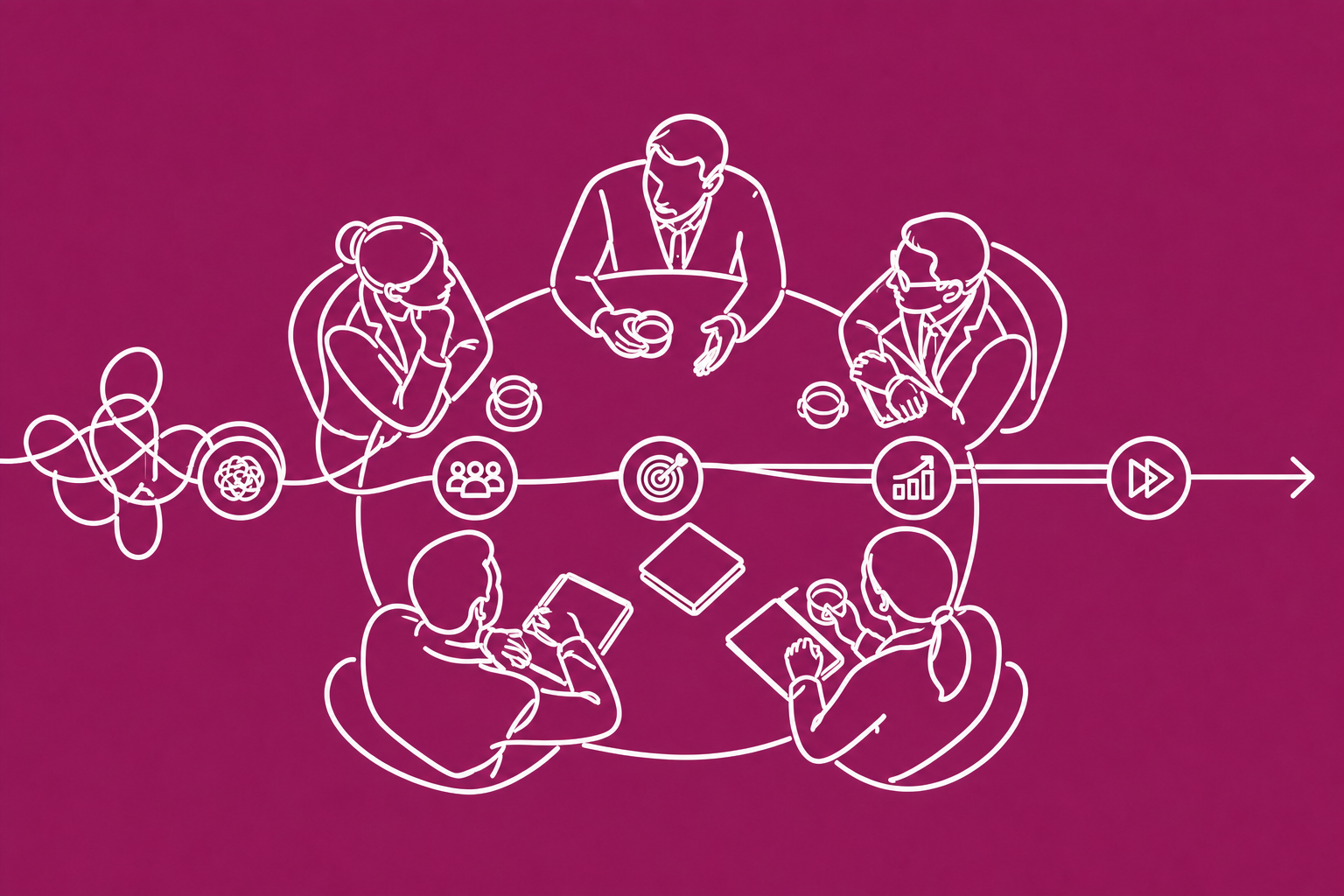
El problema rara vez es la estrategia. Es la fricción interna: la resistencia que consume la energía de la organización comercial antes de llegar al cliente. Más esfuerzo no la resuelve; saber dónde se origina, sí.
En este desayuno ejecutivo reuniremos a líderes comerciales de distintas industrias para explorar qué hace que algunos equipos cierren más rápido y cómo identificar los puntos que frenan la velocidad comercial.
Trabajaremos con las 5 C (claridad, cobertura, capacidad, cadencia y confianza), un marco desarrollado para diagnosticar la organización comercial frente a condiciones best-in-class observables. Revisaremos casos reales y contaremos con un invitado especial del área de estrategia comercial, que compartirá su experiencia de transformación: qué condición abordaron primero, qué cambió y qué siguen ajustando.
Será una mesa reducida y una conversación práctica entre pares, sin deck ni presentación de venta, para quienes cargan el número y buscan acelerar resultados.
En esta sesión:
· Compararás tu organización con las condiciones que sostienen a los equipos comerciales de alto desempeño.
· Identificarás las cinco condiciones de la velocidad comercial: claridad, cobertura, capacidad, cadencia y confianza.
· Conocerás casos reales de transformación comercial y cómo se redujo la fricción.
· Escucharás la experiencia de un invitado especial del área de estrategia comercial.
· Intercambiarás ideas con líderes de distintas industrias en una conversación práctica entre pares.
¿Quién debería participar?
Directivos de áreas comerciales, estrategia comercial, business partners comerciales y responsables de modelos de negocio que buscan acelerar resultados y tomar mejores decisiones.
¿Tienes dudas? Escríbenos
Related Content


lorem ipsum

Today’s customers are more informed, more selective, and more time-poor. They need conversations that help them prioritize, decide, and move forward.
And yet, 58% of sales meetings fail to create real value.
Not because sellers lack capability, but because conversations are not designed to move decisions forward.
“Customers don’t act on every need they recognize.
They act when something becomes a priority.”
In this short executive brief, you’ll discover
- Why most conversations inform… but don’t drive action
- What actually makes customers prioritize and move
- How to create urgency without damaging trust
- The shift from presenting solutions to enabling decisions
- What separates conversations that stall from those that accelerate momentum
If your teams are experiencing stalled deals, delayed decisions, or slow pipeline movement, this brief will help you understand why, and what to do differently.

AI is reshaping how organizations think about go-to-market
Tools are smarter. Content is easier to produce. Execution feels faster than ever.
But for many teams, something’s still off.
Growth is sluggish. Sales cycles feel stuck. Content isn’t landing. Leaders keep asking for more—but what they really need is better.
Because that’s the trap: when performance plateaus, many companies start adding. More tools. More messaging. More campaigns. More enablement.
It feels like progress. But often, it’s just motion—without momentum.
The most effective GTM leaders are starting to realize that the answer isn’t more. It’s better execution of the right strategy—with the right people, at the right moments.
That simple shift in thinking changes everything.
The illusion of progress: When “more” feels like a solution
The allure of AI is that it removes friction. It gives teams the ability to move fast and produce at scale. That’s a gift—but also a risk.
When growth slows, it’s tempting to flood the system with content and activity. New talk tracks. New sequences. New assets. More volume, more reach, more automation.
But if the fundamentals aren’t sound, you’re just amplifying misalignment.
Without a clear GTM strategy at the center, that content doesn’t connect. Sellers don’t know how to use it. Customers don’t know what to do with it. And suddenly your teams are working harder—but not driving real results.
Better is about focus—not flash
The most mature GTM teams aren’t chasing complexity. They’re pursuing clarity.
They start by asking sharper questions:
- What do our top sellers already do well—and how do we scale that behavior?
- Where are we falling short in executing on our strategy?
- What’s the one thing we need to get right before we try to scale?
These questions drive focus. And that focus turns strategy from theory into traction.
When enablement and marketing efforts ladder up to a shared GTM playbook, capability building becomes a multiplier—not an afterthought. It’s not about equipping people with more—it’s about helping them execute what matters most.
AI doesn’t replace alignment—it accelerates it.
AI should enhance execution, not distract from it
Used well, it can help teams personalize outreach, generate insights, and build assets faster. But AI doesn’t tell you what to say, who to target, or why your message matters. That still requires a well-defined GTM strategy, strong customer understanding, and aligned messaging.
And most importantly, it requires talent that’s equipped to bring it all to life.
AI won’t fix a disconnected team or a fragmented customer experience. It will just help you scale the wrong things faster—unless your foundation is strong.
Don’t scale what you haven’t nailed
Before you double down on more, ask yourself: have we nailed the fundamentals?
- Do our sellers understand the buyer’s real problems?
- Is our messaging consistent, clear, and rooted in our value proposition?
- Are our commercial teams aligned around shared motions and moments?
If the answer is “not yet,” then adding more tools or content won’t move the needle. In fact, it might make things worse—by creating clutter, confusion, and competing signals in the field.
The real leverage comes when you pause and invest in better execution. That’s what makes strategy stick.
The risk of “more”
- Misalignment between strategy and execution
- Content that’s produced, but not used
- A GTM engine that’s busy, but not effective
The upside of “better”
- Teams focused on the right moments that matter
- Capability building that drives real business outcomes
- A GTM motion that feels clear, confident, and connected
Where to go from here
AI is not going away—and it shouldn’t. But it’s time to get intentional about how you use it. Not to create more noise, but to sharpen your signal.
That starts with strategy. With execution. With talent.
And most of all—with clarity.
Because in a world of infinite GTM choices, better is your competitive edge. It’s what separates teams that deliver impact from teams that deliver volume.
So don’t start with more. Start with better.

In today's fast-changing business environment, excelling in Revenue Growth Management (RGM) is essential for Commercial Leaders aiming to boost revenue and profit, both now and in the future.
Unlike traditional methods that confine RGM to pricing actions, forward-looking Commercial Leaders recognize that activating a holistic, end-to-end RGM strategy that is consumer/shopper focused and customer-back, leads to more significant growth and allows leaders and teams to not only anticipate, but actively influence consumer demand and customer needs.
Historically, Revenue Growth Management (RGM) has been approached as a temporary and reactionary project, which was typically led by external experts in response to inflationary markets. This limited approach confined the benefits to a small part of the business and focused on short-term results, rather than embedding RGM as an ongoing, fundamental aspect of business strategy that could deliver sustained, long-term growth.
Today, mature RGM organizations treat RGM strategy and execution much differently, positioning the actions at the center of their strategic operations, embedding capabilities deeply within their organizational processes and ways of working. This transformation is not just procedural but is a shift that forces RGM strategy, tactics, and mindset into every action and function of the business.
Strategic integration of RGM at scale: A roadmap for success
- Build strong in-house expertise: To see the scaled benefits of RGM, develop strong capabilities within your commercial teams and intermediate understanding of your cross-functional teams. When your leaders and teams fully grasp RGM tactics and mindsets, it creates scaled-impact that can be sustained without external reliance.
- Encourage cross-functional collaboration: The effectiveness of RGM strategy and execution is only fully realized when it involves a fully cross-functional team. Promoting collaboration between sales, marketing, finance, R&D, and the supply chain enriches insights, strategy and execution feasibility, and organizational success.
- Integrate RGM strategy into key business processes: By connecting RGM directly to critical operations such as budgeting and strategic planning, you ensure that RGM principles are woven into the fabric of annual planning instead of being treated as a one-time project. This integration influences everyday decisions and guides long-term business strategies.
- Overcome implementation challenges with effective change management: Embracing a robust RGM approach involves substantial change and a shift in traditional revenue growth mindsets. Address these challenges through strong change management practices, aligning team incentives with new strategies and providing clear, successful examples of RGM in action to inspire and motivate your teams.
The competitive edge of building RGM capability across the organization:
- Encouraging innovation from Consumer-Back: It’s no surprise that RGM should be activated starting with consumer and shopper insights. When truly building a strategy from the consumer-back, you build a mindset and process that is ripe for innovation. This helps your company stay competitive and lead industry trends and demands, instead of reacting.
- Aligned decision-making for the short and long-term: A thorough RGM strategy speeds up and improves the day-to-day decision-making process of consumer and customer facing commercial teams. It helps ensure that decisions—like setting pricing strategies, choosing promotional activities, or allocating resources—are aligned with the market’s immediate needs and long-term goals for the category.
- Boosting market responsiveness: In today’s volatile business climate, the ability to swiftly adapt to market changes is invaluable. Decentralizing RGM capabilities enables cross-functional local teams to be agile to market shifts in strategic ways, turning potential challenges into opportunities, while still staying aligned to the longer-term market objectives.
- Cultivate a results-driven culture: Building RGM roles across the organization allows for greater ownership and accountability to improve revenue and ultimately grow market share. This means a greater population has a direct role to play in driving business performance and are responsible for keeping an external pulse on consumers, shoppers, and customers.
Implementing a cohesive RGM strategy, instilling the right mindsets, and providing the leaders and teams with the tools and processes needed to be successful, is no small feat. However, the revenue, profit, and market share impact can be substantial when an aligned RGM strategy is deployed at scale. This strategic commitment positions your company for enduring success and a powerful competitive advantage in today’s dynamic consumer, shopper, and customer landscape.

lorem ipsum

lorem ipsum

lorem ipsum

lorem ipsum

lorem ipsum

lorem ipsum

Even the best sales strategies are stalling. Not because of your pitch, but because your buyers can't align internally. Learn how "Activator Selling" can help you fix that.
lorem ipsum

BTS was recognized as a Top 20 Assessment and Evaluation Company in 2023 by Training Industry, Inc.
lorem ipsum

The ability to enter a state of flow during sales discussions can lead to greater customer trust and faster decision making, and this state can be achieved through triggers such as adequate challenges, preparing to be in the moment, setting an agenda for each exchange, and reflecting on each flow event.
lorem ipsum
.png)