

Insights


Learn how The Walt Disney Company has shifted their approach to doing business amidst the COVID-19 crisis in this interview with Silvia Ferrari, Head of Italy HR, and Marco Rosetti, Managing Director at BTS Design innovation and VP of BTS Italy.

Teal Reamer, Senior Director, shares how BTS partnered with one of our clients to restructure and reinvigorate their performance management process in this video.

STOCKHOLM, SWEDEN and SAN FRANCISCO, CA – BTS GROUP AB (publ), a world-leading strategy implementation firm, won 19 Brandon Hall Group Excellence Awards in partnership with clients. These represent some of BTS’ best solutions delivered to a variety of clients including:
- ADSG
- Bayer
- HP
- Northwestern Mutual
- Schindler Group
- Anglo American
- Cepsa
- Marsh
- Salesforce
- TUV SUD America
- Aurizon
- China Minsheng Bank
- Medtronic
- STC
- Western and Southern Financial Group
“Amidst this year of immense change, we are honored to be recognized for our partnerships with clients,”
said Rick Cheatham, CMO at BTS.
“Deep industry understanding and collaboration are foundational to the solutions we provide. We’re very grateful for our clients’ trust and look forward to more success in the coming years."
These awards include 13 gold, 2 silver, and 4 bronze, ranging from Best Inclusion and Diversity Strategy to Best Learning Program Supporting a Change Transformation Business Strategy.
“Organizations around the world highly value Brandon Hall Group Excellence Awards – so much so that we received a record number of applications in the middle of a global pandemic,”
said Rachel Cooke, Brandon Hall Group COO, and HCM Excellence Awards Program lead.
“The awards provide valuable recognition and validation of best practices in all areas of HCM at a time when they have never been more important to both employers and employees."
Entries were evaluated by a panel of independent, senior industry experts, Brandon Hall Group analysts and executives based on fit, design, functionality, innovation and measurable benefits. Find the list of winners here.

For decades, assessments have been a proven tool that organizations turn to for hiring and promoting the right people. However, did you know assessments can also be used to create more diverse and equitable succession? In this moment when organizations are thinking carefully about their talent pools, promoting, hiring, and developing talent inclusively is critical.
How do assessments help with inclusion?
Properly developed assessments take the human bias element out of the evaluation equation. By establishing clear, specific criteria, your organization won’t rely on your hiring manager’s “gut feeling.” Instead, you’ll be able to carefully calibrate your assessments to ensure they are actually measuring what’s required for success on-the-job. Validated assessments yield successful business outcomes for companies and produce fair and accurate results for participants. Not all assessments are created equal, so administering multiple assessments and simulations are an effective way to diminish adverse impact, meaning that doing so diminishes discriminatory effects on protected groups, thus promoting inclusion.
Hiring talent isn’t the only time when assessments can be used to promote inclusivity. During the development process, once an employee is in a role and a manager views them favorably, the manager will likely help the employee access development opportunities and ultimately get promoted. However, without a formal assessment process for selecting who accesses these development programs or clear guidelines describing how they work, there is significant potential for bias. Managers informed about assessments learn that using the results of an assessment for selection is more reliable and accurate than relying on their “gut feeling.” This “gut feeling” is what typically results in managers identifying high potentials that look exactly like the existing management. Leveraging assessments can prevent this from happening and ensure that talent opportunities are directed to the right people.
Do all assessments help with inclusion?
Not just any assessment will work towards the goal of hiring a more diverse candidate pool. Assessments that are focused on the behaviors and mindsets needed to be successful on the job are critical. These types of assessments evaluate candidates for the skills that matter in their specific day-to-day working environment, such as diffusing a situation with an angry client or mentoring a junior employee. On the contrary, assessments that test for knowledge (popular examples include IQ tests or the SAT) are known to cause an adverse impact. Talent decisions made using those assessments negatively impact protected groups. Qualified candidates can be passed over because the assessment is biased towards individuals with specific backgrounds, which adversely impacts individuals based on race, color, religion, socio-economic status or otherwise that is not relevant to the job.
What does an assessment that successfully promotes inclusion look like?
A leading financial services organization wanted to evaluate how previous work experiences impacted new hires’ performance over time. For many years, the firm had prioritized hiring individuals with specific work experiences, assuming they would perform better in a financial services environment. However, they recognized that they were missing opportunities to hire non-traditional candidates.
Thus, the firm hired BTS to create a validated assessment, which was aligned to the behaviors and mindsets that new hires need on-the-job. As part of the recruitment process, the firm evaluated each candidate with an assessment that simulated the job. Candidates who passed the assessment were hired, and the firm followed their progress over multiple years.
This study produced telling results – the farmers, housewives, and unemployed candidates passed the assessment at equal rates. In addition, the assessment predicted multiyear success for non-traditional candidates.
In conclusion
Organizations have always used assessments to eliminate bias and create an objective way to evaluate candidates. At a time when inclusion is top of mind for most organizations, properly developed assessments remain the tried and true solution for selecting and developing diverse candidate pools.

Business leaders know delivering value to customers requires all parts of an organization – sales, marketing, operations, planning, legal – to work together.
Each team has a part to play, but if they work independently rather than interdependently, creating that value can be inefficient at best and put at risk in far too many cases. Lack of cross-functional collaboration is a major impediment to successful strategy execution.
In a recent Harvard Business Review article, Sull and others studied 8,000 managers in more than 250 companies. When asked to identity the greatest obstacle to executing the company’s strategy, 30% of managers cited the “failure to coordinate across units.” Managers also said, “They are three times more likely to miss performance commitments because of insufficient support from other units than because of their own teams’ failure to deliver.”
A team might have great internal alignment, highly engaged team members, and all the other typically cited internal characteristics of a high performing team, but still fail to meet their performance targets because of a lack of collaboration with other teams. Teams do not work in isolation. They work in a network of teams. If you only look at your own team’s internal dynamics, which might be excellent, the lack of collaboration across teams is still going to put your team at risk of missing its performance targets.
So, how do you increase cross-functional collaboration?
Find out what is getting in the way
A good first step is to find out what behaviors are getting in the way. This isn’t always easy, as most team assessments do not measure the interactions and dynamics between teams. They only look at internal team dynamics. If you don’t look for or measure external dynamics, you will not uncover the sources of the problem and clues about what steps to take to increase cross-team collaboration.
When clients come to us with cross-functional issues, first we explore how the lack of collaboration is impacting their business objectives. Then, we often use our Leadership Team Performance Index (the Bates LTPI™) to uncover the behaviors that are helping and hurting the team’s ability to reach their performance objectives. This allows us to uncover and measure both internal and external team dynamics, because unlike other team assessments, the LTPI™ measures both. The LTPI™ is a validated 360 survey that not only asks the team leader and team members to rate the team on observable behaviors but allows other teams and key stakeholders to rate the team.
The LTPI™ model examines three dimensions (Culture, Credibility and Collaboration) and 15 facets of team behavior. One of the 15 facets is “Awareness,” which we define as “Being attuned and attentive to others' thoughts, feelings, emotions, and viewpoints; considering other stakeholders' situations.” In Awareness, the team gets feedback from other teams and key stakeholders on how well they are taking the needs of people not on the team into account. For example, the Awareness facet allows the team to get rated on items including how often they talk to people not on the team about how the team’s actions are impacting them. The LTPI™ also asks how well the team actively tries to resolve differences with other teams. These are two particularly critical areas to explore if you are having trouble with silos.
How data sheds the light on where to focus
To understand what is getting in the way of collaboration, you need to collect relevant, valid data, on the behaviors that make a difference in teams working well together.
Take the example of a cross-functional leadership team that is not trusted around the organization to collaborate sufficiently to deliver on their critical corporate business objective.
Mary was a senior officer at a large construction company and her division had just been tasked with building a new plant for their own company. It was going to be, by far, the largest infrastructure project in the history of the company. The executive team told Mary that they had significant concerns about the ability of her team to complete the project on time and on budget.
We met with Mary who was also very concerned about the lack of trust and collaboration among her team. Team members were skeptical of their peers’ capabilities. Everyone thought that they were brighter than everyone else and had all the answers themselves, so saw no need collaborate.
Mary agreed to have the team complete the LTPI™ survey. In addition to rating themselves as a team, they asked for and received feedback from other teams and key stakeholders.
Before sharing the feedback with the team, we asked them to identify five facets in which they needed to excel if they were to complete the new plant on time and on budget After they selected these facets, they examined their actual results.
It turned out that their strengths were not the facets they deemed as most important. And, their lowest rated facets gave everyone insights into what specifically was going on that was making collaboration a challenge. The raters from both the team itself, and from outside the team, felt that team members engaged in self-serving behaviors. They were not curious about anyone else’s ideas (which is not a surprise if every member thinks they are the smartest). They did not feel they belonged. They did not feel accepted or respected by teammates. And, as a result of these feelings, the team’s ability to make good decisions was stymied.
The results were not a complete surprise to anyone, but the data put these issues on the table in a clear, well-defined, practical way and made them discussable. They could no longer afford to ignore what they all knew. They knew they had to deal with their lack of collaboration.
Acting on the insights
The next step was to figure out what to do with what they learned. As a starting point, we facilitated a 2-day working session during which they created a shared vision for the team and learned a process for collaborative decision-making and problem solving.
The shared vision created a sense that they are all on the same team – that they are interdependent. And, they can only reach their own goals by helping others on the team reach their goals. Now, they had a reason to collaborate. They knew why it was necessary.
Facilitating collaborative problem solving, where they worked on solving real, actual problems they were facing as a team, showed them how they could work together. They began to appreciate and leverage their differences instead of dismissing them. They actually began to enjoy working together!
Eight months later the new plant was completed ahead of time and under budget. Trust levels with the executive team shot up. Even collaboration the next level down from the team went up as their leaders began to behave differently. Not only did the team’s collaboration increase, but it also increased for the network of teams below them.
As Stanley McChrystal said in his best-selling book Team of Teams: New Rules of Engagement for a Complex World, “Organizations must be networked, not siloed, in order to succeed.”
While this may be easier said than done, it can be done with the right set of tools and the right carpenters.
Click here to learn more about the background of the LTPI™.

As a manager, you may be thinking, “how can I possibly give feedback in the middle of a pandemic?” and “Why now?” Most are probably thinking, giving feedback is a huge risk. But in the current environment, doing so is more important than ever.

Why? Employees face a myriad of challenges daily – working virtually, maybe working less, operating different shifts. The way people work has changed significantly – and so have expectations. In the past, everyday conversations would provide an opportunity for managers to communicate new expectations and give feedback to direct reports, but in today’s virtual environment, those casual yet critical interactions have largely fallen by the wayside.
During this strange time, it is your job as a manager to keep your people engaged. Doing so requires you to clearly define what success looks like and how to get there. But for the average people leader, properly evaluating an individual’s performance, the ‘what’ and ‘how,’ is fraught with danger. The below scenarios highlight why:
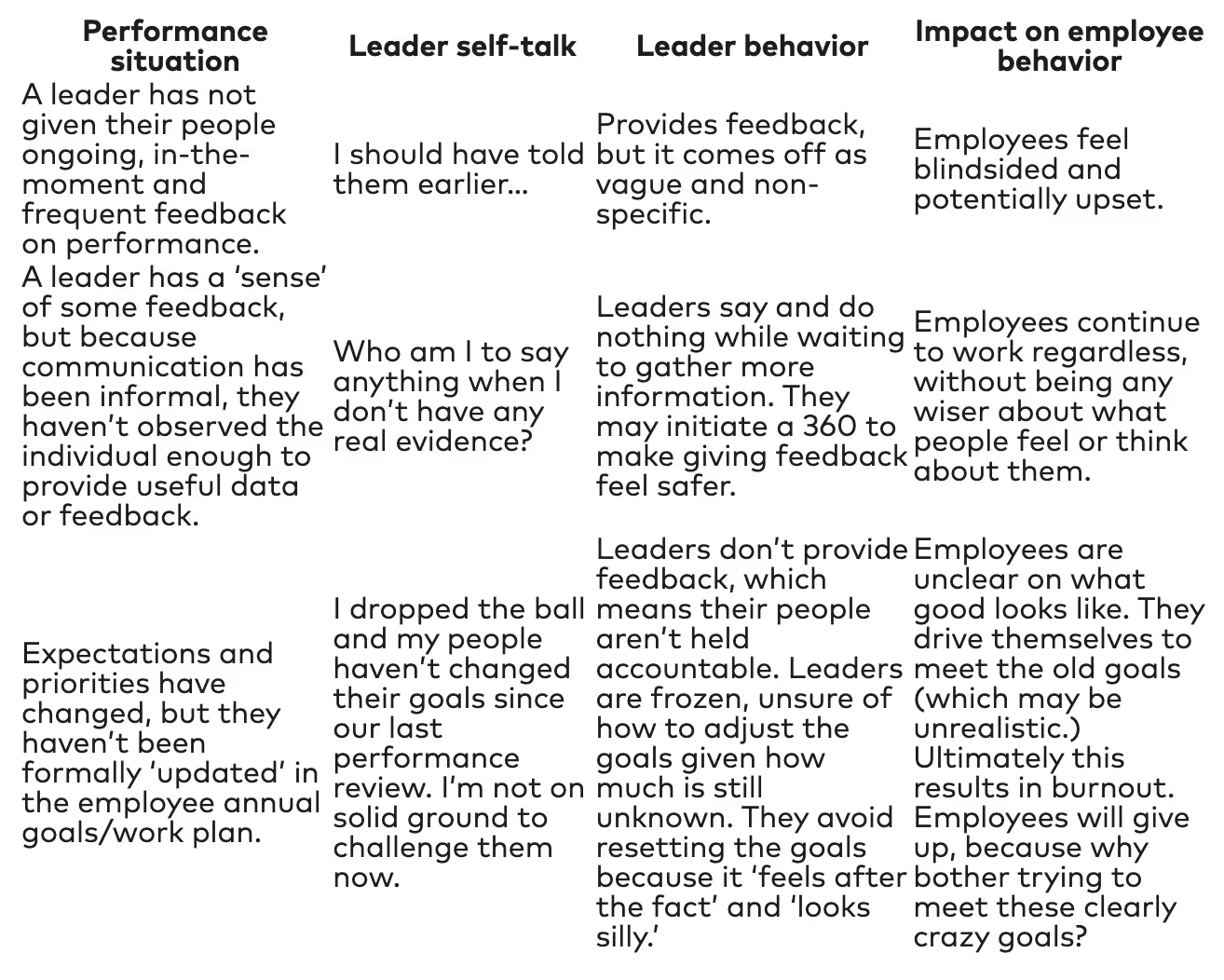
So what is the antidote? There are three key steps you can to take to make an outsized impact on your people:
1. Be Prepared
- Take time to reflect and take some notes about each person before you have your performance conversation. Use your calendar as a prompt to remember the key moments/interactions so your feedback is more data driven.
- If the feedback is serious and has consequence, make it very specific and direct. Write out a script if it helps you (and be willing to go off script, once well-rehearsed.)
- If the feedback is more developmental and less serious, acknowledge specific situations and leverage them for development coaching conversations. Invite them to rise above the situation and consider it from a broader view. For example, “Do you recall when you led the team meeting last week? We didn’t get through the full agenda and ran over by 20 minutes. Let’s set that moment aside specifically and think, what went well? What could have been better? What is the learning here? If you were doing the same thing next week, what would you do now?” etc.
2. Be Safe – Bring structure to feedback conversations so that even in the virtual context there is safety while providing feedback. For example:
- Give a frame for feedback that is positive and growth focused. In BTS we like to use “what’s working well” and “even better if…”
- Set aside ten minutes at the end of a team meeting and ask people to share their views on what went well, and what would be “even better if…” Using the chat feature is one way to get your introverted team members to contribute to the conversation.
- Set the expectation with your team that each one-on-one must include a moment for feedback, for both the leader and direct report.
- When setting up the quarterly/monthly reviews, set an agenda in advance that includes an explicit call out for feedback – asking people to reach out in advance of the meeting to get input from their peers.
3. Be Real:
- Go into every ‘tough’ feedback conversation with your head clear and your heart open. Going in with judgments, assumptions or heavy emotions could possibly make it a regretful conversation.
- Admit your mistakes as a leader to yourself first – without blaming or judging yourself, COVID-19, the business, or the situation. Know that you’re learning how to lead in a crisis too. The next step in being real is being willing to admit these mistakes to others.
- Adjust goals for the team as best you can, even if it’s later than you’d like. If you can’t change the goals for now, then share this with your team and decide when you will next review them.
In every organization, from top to bottom, everyone is still mastering feedback. A moment like this will expose gaps and make them look like chasms. Support your people with focused, consumable, digital and virtual development on giving (and receiving) feedback, so every leader out there can feel empowered and inspired, in every feedback conversation.

3 priorities to ensure success in remote working and learning
As the world surpasses 12 million recorded cases and 540,000 deaths from Coronavirus, it is becoming increasingly clear that recovery will be a slow and painful process. The COVID-19 pandemic has massively disrupted the economy and aggravated longstanding social inequalities, resulting in a resurgence of social justice protests.

Despite these massive shifts, some businesses and governments, whether consciously or unconsciously, still cling to the hope of a “return to normal” — normal markets, normal profit margins and normal electoral cycles. This is a mistake. The future will not look like the past.
Amidst the tragedy caused by COVID-19, organizations must find their footing and work diligently to create the new normal. The question is, in this unknown world, will your organization lead or follow?
Why corporate learning is critical
In the “new normal” caused by the pandemic, remote working and learning have already emerged as critical for success. Before COVID-19, only 33% of corporate training was done via virtual classroom or self-paced digital learning while 54% was still delivered in person. Yet in-person learning, as every university is finding out, is now a very risky proposition.
To survive in the new environment, businesses will need to reverse that balance and shift far more to remote learning. The traditional obstacle preventing companies from moving to digital learning was cost, though this had dramatically improved in the years leading up to COVID-19. The challenge now is that businesses in survival mode have already started cutting their learning and development budgets at precisely the moment when they should be maintaining or increasing them.
Today’s barrier is not just a delivery issue, meaning how training is delivered within corporations, but a prioritization issue – businesses need to reserve budget for training. The purpose of corporate training is to help onboard employees and support them in all aspects of their functions through continuous training. Because the pandemic is changing the very way in which business is done, corporate training is mission critical for people to perform at their best. Furthermore, the kind of corporate training previously carried out may be neither possible nor desirable today. Both the delivery and the content of corporate training need to be rethought and redesigned.
Surprisingly, the answer is not to just do more “online.” As work-from-home (or living-at-work) — whether loved or hated — becomes a permanent part of the new normal, companies need to help their staff explore and refine both the optimal work processes and their boundaries. This necessitates a tolerance for the unknown, a willingness to take risks, an acceptance of mistakes, and a dedication to experimentation. For the foreseeable future, the virus has made companies and employees alike pioneers.
Defining the new normal will require experimentation around three human-centered priorities:
1. Reboot communication and consultation
In the traditional manager-worker relationship, the worker’s experience often takes a backseat to the manager’s authority. This balance has shifted because the business’ survival now depends on front-line workers managing the daily risks and difficulties of customer interface under pandemic conditions.
As speed, safety and flexibility all become more important, managers need to truly listen to their front line, which is closest to the pulse of this rapidly moving situation and is — literally — running the risks. Any manager who does not truly listen to their front line is on borrowed time.
Agility and adaption to local circumstances are now more essential than ever. Businesses must innovate service delivery and customer service on the fly and week by week. At the same time, there is also now less margin for error with respect to safety protocols and quality standards.
The managerial impulse will be to go more rigid, with tighter one-size-fits-all protocols and processes. Instead, these layered challenges are best handled through iterative communication, feedback loops and consultative processes. As a number of studies begin to tease out the relationship between individual and group work, and the benefits of moderation, timing and bursts in communication, teams need to continually test out what works for them.
2. Accelerate diversity and inclusion
It is now well documented that COVID-19 and its knock-on effects disproportionately affect vulnerable populations — minority communities, the elderly, women, the poor. Therefore, part of the response to the virus must be to reverse the effect of these long-standing social injustices.
In remote learning, promoting diversity and inclusion must consider questions of equal access. Managers need to give careful attention to broadband connection, IT equipment, and even access to working spaces in the home.
Overall, less than half of all households (48%) have what the 2018 US census defines as “high connectivity”: a laptop or desktop computer, a smartphone, a tablet, and a broadband Internet connection. According to the same census data, minority households were the least likely to have high connectivity. Low-income households were far less likely to have high connectivity than high income households (21% of households with an income under $25,000 v 80% of households with an income of $150,000). The rural/urban divide also compounds this gap: only 54% of low-income rural households had high-speed broadband versus 96% of high-income urban households. There is work to do.
COVID-19 is also eroding decades of hard-fought gender gains in the workplace as women lose jobs at a faster rate than men. Remote work and corporate training need to be redesigned to ensure they do not disadvantage caregivers — mainly but not exclusively women — working out of the home. The overall understanding of remote work and training needs to evolve from a benevolent tolerance of the “toddler run” and the “potty break” to a new reality in which comprehensive and tailored child care are seen as critical.
Above all, businesses will now need to work even harder to reach out and recruit, retain and promote a diverse workforce at every level.
3. Act with empathy (and expect it from others)
No matter how tech savvy you may be, all workers have been pushed to use and rely on technology far more than in the past. As companies and managers navigate the physical changes to working in the pandemic, it is important to remain attuned to the psychological and emotional needs of employees and customers.
COVID-19 has heightened the challenge of maintaining a work-life balance, and employees may need more flexibility from managers to mitigate this issue. More seriously, there are many for whom home may not be a place of comfort and safety. Awareness of these issues is the mandatory “new normal” baseline for managers.
For example, the virus has disproportionately affected older citizens. Older learners and workers are not only getting sick at higher rates, they are also more likely to be challenged by the increased use of technology and new ways of working, so care must be taken to ensure they are not left behind. Corporate remote learning and operations need to extend beyond one-size-fits-all learning models to address these needs, as it started to do with addressing accessibility requirements.
Solving these problems and the many unknowns still over the horizon will require genuine empathy — felt and acted on by those in leadership. Regardless of the business age and size, success will also require a spirit of entrepreneurship and experimentation.
Contribute to the new normal or be consumed by it
In times of change, the data shows that those who act fast and engage firmly with the new reality will do the best in the long run. Organizations that fail to step up and contribute to formulating the new normal will be left to embrace the reality created by others. If you’re not at the table, you’re probably on the menu.
As they pivot, managers will need to embrace a posture of humility to help their people see success. If you think you know what the new normal is, think again. None of us do. Listen to those around you, care for them, trust them, and they will help you create the future. We are all pioneers now.

Surprised by your employees’ productivity working from home? You may be considering how you can capitalize on the transition that’s already occurring and accelerate the shift to a remote-first work environment. However, before you do, there are some critical lessons that you can learn from businesses already working in a virtual environment.

Reimagining the office
As human beings, it is difficult to think about the future without viewing it as an incremental improvement over the present. In today’s virtual environment, most organizations are attempting to recreate everything that was happening in an office environment and do it online. This is a common mistake that happens all the time – but it’s not actually the most effective way to transition.
In addition, many employers have invested significant sums of money in corporate campuses to improve collaboration. As companies have invested more in keeping people engaged at the office – leaders are left wondering how to walk away from these major investments and what takes their place.
So, how do you transition to a remote-first environment?
1. Reimagine don’t recreate: List out the assumptions you have about in-person work and provoke each one of them, reimagine what those tasks and activities might look like in a virtual work environment.
For example, many assume that: “if we become remote-first, we’ll never see each other again.” If in-person interaction is critical for your company culture and productivity, repurpose the office environment as a co-working space for employees to collaborate with each other when they need it. This opens opportunities to use smaller spaces that are closer to concentrations of employees, for example a co-working space in the city and an option for those in the suburbs – shifting away from a more traditional corporate campus.
In the COVID-19 environment, this requires some thoughtful consideration on what types of interaction need to occur in person and which interactions can happen over the phone or video chat, but there is no need for absolutes. Provide your team with options to meet in person if they prefer and can do it safely.
What does this look like in practice? A great example to look at is Automattic - a distributed digital publishing company (think WordPress and Tumblr) with over 1200 employees spread across 77 countries and 93 different languages. While a fully remote organization, the company still values in-person interaction, which helps them to maintain their culture – they have simply flipped the standard ratio (mostly in-person and infrequently remote) to mostly remote and infrequently in-person.
2. Lead the change: If leaders are still in the office, the rest of the company will aim to come into the office – if you want to be remote-first, leaders must commit to being remote themselves.
Face time with senior leaders is often considered an important rite of passage for corporate cultures, and the more time a leader spends communicating with you the better chance you have of being noticed for a promotion or a high-impact project.
In a remote-first organization, leaders can create a level playing field for a distributed workforce that rewards outcomes and not the person who is the first one in, last one out, or sends emails at all times of the day.
In shifting to remote-first, your leadership team must model the way they want employees to act. This means the leaders must also go remote and build new communication habits in their organization to allow for asynchronous collaboration and updates.
We are going fully remote first at Quora. Most of our employees have opted not to return to the office post-COVID, I will not work out of the office, our leadership teams will not be located in the office, and all policies will orient around remote work. (1/2)
— Adam D'Angelo (@adamdangelo) June 25, 2020
3. Flip the ratio of in-person to virtual interactions: In-person interactions don’t go away in a remote-first world, they are more targeted and thoughtful. Provide stipends to employees for team meetings, one-on-ones, and other interactions and set guidelines on when in-person interactions should happen and when they are not needed.
People are surprised when I say this, but I think in-person is really key. And so we just flip it, so instead of saying you have to be around your colleagues 48 weeks of the year and do whatever you want for a month, we say be wherever you want for 48 weeks out of the year and for three or four weeks a year we’re going to bring you together.
- Matt Mullenweg Automattic CEO
Remote-first companies need to set clear expectations and guidelines for when teams should come together (in a co-working space, coffee shop, or elsewhere) and limit those interactions to ones that add more value being together in-person than virtually – flipping the old co-location ratio as Automattic has done.COVID-19 has challenged common biases of where work can be done most productively, and you’ll find that teams (equipped with the right tools and resources at home) can be surprisingly productive without being co-located.
And who says you can’t have office perks while at home? It can be as simple as repurposing the money invested in your latte machine to provide a stipend for a green screen, dual monitors, microphones, and a high-quality web camera (and maybe an UberEATS subscription for some snacks when desired).
4. Create a new rhythm of communication: Asynchronous communication involves a new communication rhythm — repurposing emails/check-ins and other meetings and creating new norms for how information is communicated and how others can contribute to building on ideas from other parts of the company.
Leaders should consider building a new asynchronous rhythm of doing business. Instead of emails and calls (which in a distributed workforce are tough to schedule across time zones) – consider a blogging system like what Automattic uses called P2s to document progress on projects.
P2s are posts written every day by employees to summarize what they have been working on, the problems that they might have encountered, and the discussions they had that day. If you think about the purpose of in-person meetings, whether face-to-face or on Zoom, this is typically what people are doing – unearthing hidden information from the organization to see what folks are working on, reach group decisions and find ways to collaborate.
By documenting what is happening on P2s, it has become a cultural norm at Automattic for all employees to read P2s and uncover what is happening around the company. This communication method creates a transparent organization without FOMO (fear of missing out) when not included in a meeting or copied on an email chain. Using an internal search index, you can look up P2s and follow certain topics (like Google Reader) to stay informed on progress.
5. Honor what made your culture great while continuing to grow: Continue to honor what makes your culture great, remote-first doesn’t mean you have to lose it – it offers new opportunities to build your culture and invite more talent into your organization that you previously may not have had access to.
If you ask any leader what makes their organizational culture great, you will likely get a range of responses from company to company. Some companies value a strong safety and compliance culture that enables them to reduce risk in their work environment, while others value an entrepreneurial environment where they are afforded creativity to take on challenges. Employees on Glassdoor rarely say that office perks make a company great – it’s about the people, work environment, and opportunities provided.
Those same positive attributes can be reimagined (not recreated) in a remote-first environment. It can be as simple as creating space on employees' calendars for “making time.” Making (or Maker’s time) is a concept created by Paul Graham, founder of Y Combinator, which advocates for blocking a large portion of each day for individuals to do focused project work without fear of interruption or task-switching – for example blocking each morning until 12:30 PM for individual work.
By reducing the need for emails and check-in calls, it creates more dedicated work time for employees to creatively solve challenges and is a great example of reimaging the virtual workplace vs. recreating interactions we typically had in person when located next to each other.
To encourage comradery, you can promote small team or one-on-one interactions amongst employees by providing gift cards for lunch or coffee so employees located near each other can meet and network. Another option is for leaders to participate in targeted, fun interactions across the company – for example, virtual trivia nights, a virtual scavenger hunt, or hosting a “bring your kids to work” on a company or department-wide Zoom call. Anything to create a positive environment representative of your company culture.
Remote-first work allows organizations to honor and celebrate what made their office cultures great and re-invest time and resources to continue improving on that culture forward in a distributed work environment where you have access to more talent outside of your city.
So, what’s next?
The current work environment offers both challenges and opportunities. Shifting to a remote-first permanently can make sense for organizations moving forward that have seen the benefits of this shift but doing so doesn’t need to be a daunting challenge. By learning from organizations who have been doing this and doing it well for years, your organization can meet the challenge of the future, while preserving your culture, accessing new talent and reimagining your work environment to unlock productivity.

These last few months have given us all a trial run as news anchors.
We sit in front of the camera on our computers and chat with the audience just like a news program. Though many of us came in the world of virtual meetings kicking and screaming, we have acclimated. Our mobile phones are second rate. Virtual video has won.
Now that we are living in the virtual world, we’re starting to develop a more discerning eye. We judge what we see, often harshly. Sure, it’s been fun to laugh at cute puppies and unexpected guests in the background during virtual meetings, but the novelty of the faux pas is wearing off. Many people are thinking, “It’s time for me to up my game and ‘go pro.’”
One reason for a flourishing interest in showing up with a stronger virtual presence is that virtual is here to stay. Companies have started rethinking the need for so much office real estate. People are dispersed anyway. Commuting in most places is hell. Travel is expensive, and it takes a heavy toll on the mind, body, and soul.
Even with all their flaws, virtual meetings will still be convenient when offices open again. You can wear sweatpants, help your spouse make dinner, all while being very efficient at work. Good virtual meetings improve teamwork and can build strong bonds. A well-run meeting can democratize debate, encourage participation, foster diversity of thought, and speed work to get more done.
You, on the small screen
Given all these changes, it may be time to take stock from a communications professional’s perspective. Survey your personal “studio” – your home office – that stolen space in the guestroom, or corner of the dining room. Ask yourself, “What’s the message I’m sending? How does this place reflect on me as a leader and a professional?” Empty walls, bad lighting, layers of family photos on rickety shelves, and dead plants are not leadership brand builders.
Then, take stock of the VIRTUAL you. Who shows up on the screen? Each meeting with a colleague, client, investor, prospect, analyst, or an entire team is an opportunity to make a powerful, lasting impression. After spending two decades of my career in television news, I can tell you that the thought you put into this is not just a nice to have, it is a survival skill. You must be ready for the game. As I used to say to my friends who wondered how we met our deadlines, “Six o’clock comes, whether you’re ready or not.”
Not a natural-born skill
Being on camera is not a natural born skill. Professionals spend years experimenting to get their on-camera presence right. Through trial and error, they develop polish and their own authentic style. However, you can adopt habits that work if you know a few rules of the game.
Showing up in the little video square is obviously different from standing at the front of the room, though good presenters have habits that do translate. Eye contact, facial expression, small gestures make a difference. Mastering the “little screen” can be easier if you know the rules of the virtual road.
Six strategies from the news desk
In that spirit, I offer 6 tips from the news desk that can help you bring your best self to the virtual world, communicate effectively, and show up ready to shine.
- Ready or not, it is “showtime.” On TV, when the red light goes on, professionals set aside whatever is going on in their lives, and I mean impending divorce, children falling off bicycles, and general life mayhem. When the camera is live, it is “go time.” Leave life behind. You cannot be distracted. You have a job to do.
Showing up in the moment reflects on your leadership and your professionalism. If you come unprepared, missing the right documents, fumbling for the agenda, and trying to locate a spreadsheet, you are not ready for prime time. It’s okay to give others grace for this, as a lot of people we work with are in back to back meetings. As a leader, though, you set the standard. Make a habit of collecting yourself a few minutes prior to each meeting. End meetings early, take a break, prepare, and be on time and focused for the next one. - Leaping “through the lens.” Your computer is an inanimate object. When we look at machines, we tend to be less animated and more “machine-like” in style. To go pro, you must overcome this tendency. Look at the dot that is your camera, make direct eye contact, and imagine you are there in the room. Really “see” people on the other side of the lens.
Sometimes it helps to remember the people on the other side of the camera are not just colleagues, clients, or prospects, but friends. Take time to ask how they are doing. Listen and respond appropriately. Let the conversation breathe. Do not allow yourself to be distracted by email or your spouse asking you whether you picked up the mail. Show people you are paying attention by conveying emotion through facial expression and vocal tone. Let them know they have 100% of you right now. - Warming it up. Along the same lines, warm up the meeting by taking responsibility for welcoming others and setting the tone. Imagine you’re hosting your own show. Give some thought ahead of time about topics that will warm up the conversation before you begin, even for just a minute. Make the meeting more than a transaction.
This is important because working virtually you don’t have available to you all the usual ways of warming up conversation in the room: arriving at an office, offering coffee, catching up on the weather, are all out the door in the virtual world. The best television anchors consider themselves hosts. They invite intimacy with appropriate small talk and curiosity about others. This rapport builds trust, bridges the technical divide, and makes you a memorable presence in the virtual world. - Virt-U-al YOU. The virtual you is the best version of you in a small screen. How you appear in the frame matters. There’s also the question of when to stand and when to sit. Sitting works most of the time, so get a good chair that allows you to sit up straight, employing pillows or props if you need them to be comfortable. Slouching is disrespectful. For formal presentations, consider standing. TV anchors have a variety of places on set where they can do a demonstration, show you a map, share a visual. Standing also energizes you and communicates respect. Consider standing for a keynote, analyst day presentation, board or investor meetings and sales finals.
- Your virtual wardrobe. Sweatpants and sneakers, check. Fine for most of the time (except when standing on camera). You may be one of those people who just feels more professional getting dressed for your day and that’s great. What matters for everyone is what is happening from the waist up. I worked with a co-anchor who sailed his boat every day, came in around 5:00 pm, washed his hair in the sink, threw on a coat and tie and was ready to go. No one in our audience knew he did not own a pair of dress pants.
The key is to pay attention to your “communication center” – essentially, your face, head, and shoulders. Think about where you want people to focus – on you. Clothing should be attractive and simple. No distracting patterns or oversized jewelry unless fashion or creativity is your stock and trade. No one wears ties except for formal presentations anymore, but men are the worst offenders when it comes to casual. Wearing your Saturday fleece on a virtual meeting says, “I would rather be watching Netflix.” Make an effort. It is a sign of respect for your audience and your people. - Ad lib and be liberated. News anchors go with the flow of the news effortlessly even when off script with breaking news because prior to the broadcast, they have read up, talked with sources, prepared for interviews, and reviewed the producer’s scripts. This preparation is part of the routine and gives them the confidence to improvise when they need to.
Just because you’re on the small screen doesn’t mean you can skip rehearsals or preparation for presentations. It’s even more important because sitting alone with the camera is unforgiving if you fumble or get flustered. Take the time to practice with PowerPoint, study your notes, and have a game plan. If you have rehearsed, are on top your game and well prepared, you’ll be liberated and able to ad lib when the moment arrives. You will never have to let them see you sweat.
As we have learned from the news anchors who make this look so easy—it is possible to embrace the camera and develop the habits that help you can connect with any audience, inspire them, and energize the virtual room. If you take the opportunity to learn the lessons from the news desk, you’ll be ready to “go pro” in your next virtual meeting.

The speed and impact of the COVID-19 pandemic took most leaders and organizations by surprise. While this disruption is a dramatic outlier, leaders need to recognize that disruptions happen all the time. Some are unexpected, like COVID-19, while others are not. Businesses often disrupt themselves to innovate or react to new market demands. The bottom line: planned or not, disruption is here to stay. So how will you prepare your leaders for the next one?
When does disruption occur?

Understanding when disruption happens is a critical first step in preparing for it. Most disruptions are smaller than COVID-19, yet still have a significant impact on the business. Often self-initiated, disruptions occur when the business sets a new vision and goals or makes changes in strategy and operating models to adapt to marketplace forces. Culture transformations, acquisitions, mergers or other organizational change efforts also create disruptions. Frequently, more than one of these changes is happening at a time.
Why is disruption occurring more frequently now than ever?
In today’s environment, change is the new constant. Since the end of the twentieth century, the advent of the Internet and rapid advancements in technology have dramatically increased globalization and connectivity, accelerating the rate of change beyond anything seen before. In turn, this has shifted how leaders must approach change.
What did change look like before?
In the past, change was viewed as a straightforward process – a controllable event with a beginning, middle and an end. To prepare for change, leaders would plan for it, manage it and course correct to get to the end and be done with it.
Leaders embraced the mindset that with change comes risk. They believed change must be controlled to mitigate the various risks involved. This mindset allowed leaders to create the illusion of steadiness and calmness – something that historically came after change. This is called the stability mindset.
Change is uncomfortable for most people, so leaders often try to use the stability mindset to make their teams feel safe and secure, which enables them to perform at their best. However, in today’s business environment, this natural reaction is misguided. Persistent change means that treating change like a fixed set of events doesn’t align with reality.
Leading in today’s world
To be successful, leaders are now required to embrace the new belief that change is good fortune. Leaders must hold an opportunity mindset, embracing change as ongoing and necessary for growth and cultivating the belief that opportunity only comes with change. This new mindset turns on its head how leaders of the past perceived risk. Instead of associating risk with change, today’s leaders must understand that risk actually comes from NOT changing and remaining with status quo. Inertia causes organizations to lose ground and fall behind. Thus, change is not only necessary, but advantageous for businesses to adapt. Leaders who embrace an opportunity mindset can navigate change with a sense of confidence rather than hesitation or doubt.
Mindsets matter
The way leaders think about change is one of the biggest determinants of how successful change will be1 . Therefore, it is critical to examine preexisting organizational and individual mindsets about change. Typically ignored, these can provide critical information to help unlock transformation.
To help identify your individual and your organization’s mindset towards change, below are four different types of executives and organizations. Each example profiles an organization’s underlying relationship with change and identifies whether it embraces a stability or opportunity mindset.
Change Receivers:
Leaders who perceive change as pushed upon them feel a lack of control, resulting in a flight response. When leaders are in the habit of being a receiver of change, they are passive in their reaction and feel out of control, as if there is nothing they can do to prevent what is happening. Leaders with this response to change abdicate their own authority. The change receiver holds a stability mindset.
For example, a high-tech manufacturer set in motion a significant go-to-market global transformation. The changes brought by its new strategy shifted expectations for sellers, but these changes also touched product development, supply chain, customer support and finance. Senior leaders just below the c-suite reported that the “decisions are made by HQ” and even referenced “looking up” for direction as a behavioral norm in the company. These leaders tended to:
- Wait for direction or decisions from others before moving forward
- Refrain from taking action in new situations to avoid conflict
- Escalate decisions, assuming such judgements are “above my pay grade”
- Accept decisions or direction even when they don’t think they will work
Change Resistors:
Leaders who try to maintain their power and authority by pushing back against change. These leaders strive to protect the past by resisting the change with the belief that it will go away in the near future. Leaders will freeze, choose inaction or only take actions that they can control. Resistance can take many forms, such as questioning the authority of the change leaders, seemingly agreeing and then doing nothing, and citing reasons why the change does not apply to them. These leaders hope to wait out change. The change resistor holds a stability mindset.
For example, a global manufacturing company would routinely rotate high-level senior leaders as part of their development plan. During the rotation process, these senior leaders sometimes faced resistance, skepticism and inaction from their new team of leaders. The local leaders knew from their past experience that they could passively resist the new direction and continue doing what they were doing because their new senior leader would change again soon – as would the direction. In this case, resisting change was the leaders’ best path to stability. This led them to:
- Refrain from speaking up, even when holding an alternative perspective that would provide needed insight
- Bring up reasons that something could not be done based on precedent or history
- Agree, and then find reasons not to execute on the stated commitment
- Poke holes in the plan as a means to avoid taking action
- Criticize change efforts without offering alternative ideas or help
Change Controllers:
Leaders who believe that they can control change and its effect around them. These leaders create detailed plans, launch initiatives, manage events, or do anything that gives them a sense of control. Why is this a fight response? Taking action feels good, but even when executing the most well-crafted plan, a leader will encounter unexpected circumstances.
If the leader believes they have controlled the change with their plan, then obstacles and missteps are failures. When this happens, there can be a tendency to ratchet up reporting and accountability, micromanage or even to seek to blame for mistakes or lack of progress. This behavior gives them a sense that they are managing change. They often believe that it is up to them to help get their team or organization “through” the change. The change controller holds a stability mindset.
For example, an Oil and Gas organization recently launched a new strategy. As part of identifying what was needed to move the strategy forward, they reviewed critical processes designed to aid strategy execution. During the review, the senior team realized that their approach to quarterly business reviews would hurt progress toward their strategy rather than moving it forward. The senior team determined that their detail-oriented questions were “backward looking” and provoked ineffective behaviors rather than learning and forward progress, so they completely changed it. These change controllers tended to:
- Make decisions independently with limited input from colleagues
- Seek information that supports their personal agenda
- Ask detailed questions about why progress is slow or results were less than planned
- Give detailed instructions on what to do rather than inquire about what has been tried
- Discount obstacles raised by others to keep to the original plan
Change-Ready LeadersTM
Leaders who see change as normal, constant and the source of new opportunities. Leading change from this perspective requires a new set of great behaviors from leaders. A leader can choose to lead change rather than avoid it, resist it or try to control it. To lead change means leaders are scanning the environment, anticipating what is coming, and seeing opportunities where others see challenges. In some cases, it means thinking through a Plan B (and Plan C) because they know that Plan A will not work perfectly. Leaders focus more on aligning their teams on direction and purpose rather than telling people what to do. They create an environment where people learn, adapt and change together. The change-ready leader holds an opportunity mindset.
Change-ready leaders also focus on gaining emotional agreement from teams around the change being implemented and the reasons for doing it. This is a departure from the common idea that leaders only need to focus around explaining the “why” behind the change when communicating to individuals. Alignment around the vision is more beneficial for teams so they become invested in changing rather than focused on the why behind the change. Great leaders understand that letting people find their own reason for change and developing that understanding is critical to building trust.
How do great change-ready leaders lead? They try new tactics and implement new leadership competencies that they may not have used before. These competencies are brought to life in the form of behaviors, which are a result of having a different mindset and response to change. A change-ready leader holds an opportunity mindset and believes that change is expected, normal and constant. In order to make that mindset come alive, great change-ready leaders:
- Rally others around the positive reasons for continual change
- Accept the conflicting views, assumptions and feelings of the team
- Promote the company’s purpose while simultaneously balancing the reality of today and future possibilities
- Engage diverse teams to work together on difficult challenges while holding them accountable
- Encourage the team to accept change, paradox and complexity as facts of life that yield new opportunities
While these change-ready leader behaviors may seem to be common across companies, they are actually represented uniquely in each organization. Mindsets are universal across organizations, yet their application is contextual. This means that great leadership is not a carbon copy across all companies – an organization’s culture plays a significant role in terms of what makes a leader great on the job.
To become change ready, it is critical for leaders to understand and codify both the “how” and “when” to lead change within the context of their own organization. This works best if leaders can define what great change leaders do differently relative to average leaders in the form of capabilities and behaviors. In tandem with change leader capabilities and behaviors, identifying the pivotal moments where leaders need to demonstrate the capabilities and behaviors is an excellent tool for development.
Identifying these pivotal moments allows leaders to immediately recognize the situations where, by changing their actions, they will have the largest impact..
To prepare for the next disruption, leaders need to uncover their current response to change, understand why and how it served them in the past, and then shift to seeing change as a new constant. Once this change in mindset happens, behaviors will shift consistent with being a change leader within the context of their organization. Adopting a more productive relationship to change during the COVID-19 crisis will help leaders navigate the current situation and come out of it more prepared and confident for the next disruption. With tools in hand, perhaps they will even seek opportunities and create disruptions of their own.

We created the BTS Sales Index to give a simple and easy-to-understand predictive monthly metric that gives enterprise leaders the right vantage point by which to view their critical business decisions.
BTS Sales Index June 2020 Update
-3.8
BTS Sales Index June 2020:
105.0 (-3.5%)
May 2020* in the Economy
- Aggregate revenue of BTS 1000 decreased for the third consecutive month from $3.384 trillion in April to $3.265 in May, declining by $119 billion
- Employment rose by 2.5 million jobs in May, the largest monthly gain in new jobs since the BLS started tracking the data in 1939
- Leisure and hospitality, food services and drinking places, and construction sectors saw the highest increases in employment
- The unemployment rate improved from 14.7 percent in April to 13.3 percent in May
- Even with a 17.7 percent increase in retail spending in May, major retailers J. Crew, Neiman Marcus, and J.C. Penney declared bankruptcy
- With many companies and businesses operating at half capacity, expect more long-term effects
*the June update is reflective of May 2020 data
Why
Line of business and sales leaders tasked with making strategic decisions don’t have a good measure of confidence when deciding to ramp up production or invest in customer relationships. Quarterly GDP numbers and the S&P 500 paint two different pictures of economic performance, the former too slow to incorporate new data and the latter too likely to overreact to investor sentiment.
We created the BTS Sales Index to give a simple and easy-to-understand predictive monthly metric that gives enterprise leaders the right vantage point by which to view their critical business decisions.
What
The BTS Sales Index represents the aggregate total revenue of the 1,000 largest publically traded companies in the US in one simple to understand number.
How
As mentioned above, the BTS Sales Index is comprised of the total revenue of the largest 1,000 publically traded companies incorporated in the US. Every month, we collect the total revenue reported by these companies and run the data through our custom-built indexing tool. The index uses the total revenue of the BTS 1,000 companies at the end of the second quarter of 2013 as its baseline because the economy showed signs of stable recovery. Unemployment was back to normal rates, housing prices remained steady, and stock prices were back to record levels.

This article was originally published in Thrive Global here.
It’s up to leaders to cultivate the right coaching mindset to lead their teams through this health crisis.
This time of unprecedented change leaves many feeling overwhelmed, stressed, and frustrated. For leaders, however, it’s now mission-critical to dial up support for your team members. Bringing a coaching mindset to the way you lead them will help you actively accompany your people through these extraordinary and uncertain times.
To leverage the power of a coaching mindset, you’ll need to believe people have potential and can grow, trust that others will rise to do their best when stretched, and embrace curiosity rather than jumping in to fix others’ mistakes. That’s not to say there aren’t moments when fixing is important. But now more than ever, a coaching mindset will help you empower your teams and allow them to see things in new ways, creatively adjust to the new normal, and foster meaningful connections.
These factors are all crucial for business success and personal well-being.
Cultivating a Team Mentality Remotely
Trust, safety, and comfort are important for any team — remote or not. And if we really think about it, the focus of coaching is on conversations. With that in mind, the following tips should help get you started:
1. Set the table. If you’ve ever set a holiday table or prepared for an event, you know how much thought goes into setting the scene. That same care should apply when you manage remote teams. You need to set the right conditions to come together with some regularity. Otherwise, it’s nearly impossible to lead successfully.
Establish clear guidelines and expectations, and detail the exact start and end times of your meetings. Co-create with your teams about how you want the meetings to feel and what you want to accomplish. If you have yet to have this discussion about the “how” of virtual working, it’s a real opportunity to use a coaching mindset to take what you’ve learned about what’s working and what could be even better if you shifted things around.
When leading virtually, I prefer the less-is-more approach and keep meetings to 50 minutes or less (unless they come with scheduled breaks). Going this route often requires a little more preparation from all attendees. By creating and sending pre-reads, you’ll leave time for lively discussion. Also, the 50-minute meeting gives everyone a 10-minute gift to reset for the next one.
2. Focus on genuine conversations. A coaching mindset is incredibly valuable when leading remotely. Challenge employees to think differently about problems rather than giving the solution yourself. Connect, stay curious, and engage in dialogue. Get people talking and give them room to reflect, explore, and grow.
Coaches also do more than challenge their teams — they provide support. Although time might feel limited, devote a few minutes of your meetings to discuss something other than work or schedule micro check-in meetings to ensure everyone feels connected to the team as a whole.
3. Prioritize presence. Your presence is always critical, but it’s even more so when you’re working virtually. If you fail to “show up” and are distracted during meetings, your people know it and will model what you are doing. This behavior directly impacts the team’s engagement and productivity.
Take stock of the environment employees must now work in and check in on how their transition to remote work is going. What this looks like is entirely up to you, but I ask questions like these: How can I help? What’s working for you? What can I be doing better? What tools do you need to make this work for you? Are there any resources I should make available to you?
Consider that many employees must now work and home school children. Likewise, nearly everyone is shouldering a psychological burden right now (in fact, nearly a quarter of employees worry about going stir-crazy in the midst of COVID-19). So it’s OK to adapt your expectations with the times. Be flexible with yourself and others, change up meeting times, put a pause on certain projects and start new ones, and learn new skills together.
As we experience a global pause, you have an unmatched opportunity to take a fresh look at what’s next for yourself and others. Adopting a coaching mindset is liberating and allows you to meet the challenges of today while staying open to future possibilities.

Originally published by Business2Community.In the past, businesses facing change saw it as a temporary disruption with a beginning, middle, and end. After a new normal is achieved, the thinking goes, the business “recovers” and life returns to normal. That mindset no longer reflects the changes that organizations face. Product life cycles are a fraction of before, customer experience is a huge part of connecting with consumers, and disruptive competitors with compelling value propositions emerge suddenly.To keep up, organizations have to make change a way of working and make constant adaptation a permanent part of their cultures.
Why Change Has Changed
When John Kotter formulated his eight-step process for change management in 1995, the goal was to reach a specific point: to arrive at a new status quo. Though updated in 2012, the model itself hasn’t changed much: It still involves creating urgency and a vision, building a team of volunteers, and getting short-term wins to help ease the company into the shift.Given how much change itself has changed, why do we still cling to this model? Kotter’s thinking was certainly not wrong, but now change happens on a much shorter cycle. Businesses used to introduce new products every few years, resulting in much longer, more stable life cycles. If companies changed, they maintained the same business model and reordered certain processes. With today’s continuous product releases, however, processes constantly shift.Our understanding of the customer experience was also vastly different. Companies could research what consumers bought and wanted to buy, but they couldn’t tap into what motivated their customers every day. A business’s goal was to create a popular new product rather than change how companies treated customers.On the rare occasions that mandated new technologies, the waterfall process of spec, design, test, pilot, implement, learn, and use could take years. In every case, the goal was to reach a point when the change was over.
How to Keep Up With Change When It’s a Constant
In an era of constant change, organizations need to develop mindsets that embrace change as part of everyday business. Taking these steps makes an organization better prepared to implement and withstand change:
1. Set dynamic outcomes instead of static benchmarks. When companies view change as a means to an end, the plan for change is fairly clear-cut, so it makes sense to wait until the plan is set before enacting it. When change happens constantly, however, waiting for fully detailed deliverables will make keeping up almost impossible — and they will never be completely right anyway.Instead, set emergent outcomes that are defined enough to move forward but not so well-defined that they become disempowering for the next level of leaders. Outcomes include defining what changing expectations leaders will face in the new environment and what strategies and practices they should develop to meet those expectations.
2. Create change leaders, not cheerleaders. An “army of the willing,” as Kotter called it, may be the least confrontational approach to take — if you have the time. But when you see change as a part of the new business model, all leaders need to be change leaders.Change leaders must shift the source of their confidence from certainty around their plan to faith in their own abilities to lead and in their teams’ abilities to execute. The best way to create change leaders is to immerse employees in the experience of the future state. PowerPointing the highlights won’t work: Leaders need to be engaged in that future experience and then apply it through real work. Immersion shows them firsthand what new levers they must pull to accomplish their objectives.
3. Shift the company’s mindset entirely. When an organization views change differently, it transforms its entire outlook on how it does business, treats employees, and serves customers. As a result, people have to change their behavior, which means changing their mindsets in several ways. As Tony Robbins often mentions, that involves carefully framing the questions they ask themselves.When a client was launching a new strategy, we helped them identify the pivotal moments when reimagining and making different choices would move them toward new business results faster. For example, when preparing for and conducting their quarterly business reviews, we helped them shift away from parsing out “How did we do?” and “What didn’t work?” Reviews instead became focused, asking “What can we do next” and “How do we remove the obstacles?” A seemingly small change at a pivotal moment dramatically accelerated the success of their strategy.
4. Build a change-centered culture. Achieving transformational change in an organization is more than just the cumulation of individual behavior shifts; it’s a communal activity. Therefore, people in organizations need support beyond the individual level. They need to know that the system — including behaviors and culture — is changing, too.From the start, companies can create a supportive network through structured leader-led meetings, with intact teams focusing on the same kind of content, material, and expectations. Alternately, cross-enterprise teams simultaneously focusing on the same leader expectation or cultural element can have a similar tipping-point effect. Brief, regular opportunities to collaborate and learn from peers helps change leaders gain the confidence and support to overhaul their daily operating rhythms, norms, and ways of working.Change is no longer an occasional challenge to resolve as soon as possible. Instead, it’s the defining characteristic of virtually every marketplace. The most prepared companies make constant change their prevailing business models.To learn more about how to activate new ways of working through transformational moments, download this whitepaper.

This article was originally published in Chief Executive here.
You need your team to give their best effort—but they won't deliver if they're living in a culture of fear. As CEO, you can help break that cycle.
Imagine this scenario: One of your employees comes to you, frustrated with a colleague who seems to be blocking their intention to embark on a new project.
What do you do? How you manage these kinds of situations determines whether you create a psychologically safe environment that allows your employees to thrive.
A two-year study of team performance at Google found that teams that allow employees to take risks without feeling insecure or embarrassed are consistently the highest-performing. That’s because employees can say or do what they know is really needed without worrying about others’ responses or getting negative feedback from the boss.
Psychological safety relies on trust: Employees need the security of knowing that others won’t think less of them if they say what they think, make a mistake, or share a crazy idea. As CEO, you play a central role: Studies consistently find that empathetic leaders more effectively create trusting relationships that translate into higher employee satisfaction and performance. Conversely, leaders who don’t relate to their teams often struggle to motivate employees.
If you can help others become more empathetic and open to the thoughts and ideas of people who are different from them, you will go a long way toward building psychological safety and, as a result, a high-performing organization.
Lead From a Place of Understanding
So how should this situation be handled? According to data from tens of thousands of similar scenarios, one response has a disproportionate impact. Teaching this response to your senior leadership and encouraging them to do the same with their teams will create a long-term impact and help drive your business:
1. See: Get in other people’s shoes. When facing a situation like the one at the beginning of the article, the first challenge is helping your employee get into the other person’s shoes. If employees are struggling to influence their teams, it may be that their own judgments and experiences are getting in the way of understanding others’ perspectives. Help employees create trust, safety and connection by putting themselves in their colleagues’ shoes and seeing the world through their colleagues’ eyes. Letting go of preconceived notions and embracing other people’s perspectives creates empathy.
2. Hear: Ensure others feel heard. The foundation of psychological safety is ensuring that the other person feels heard. Once you have helped the employee see the world from the other person’s perspective, the next step is helping them think about how to let the other party feel heard. Guide your employee toward listening with an open heart and reflecting what they hear. When people feel heard, they can more readily empathize with each other and make space for the other’s perspective. True listening creates a psychologically safe space for even difficult conversations. CEOs should model this style of empathetic listening with their direct reports.
3. Connect: Speak to their needs. Once your employee has truly seen and heard their colleague’s perspective and ideas, they can share what is important to them in a way that aligns with the team’s needs. Your employee can show empathy and understanding by addressing the team’s concerns when they respond. If your employee has watched and listened with empathy, the message will be more compelling.
The most high-impact conversations always follow this sequence. First, see the other person, then make them feel heard, then speak to their needs. Coaching employees to do this—and developing their empathy skills in the process—will create the atmosphere of psychological safety that businesses need to reach their full potential. When individuals and groups feel secure, they will uncover new insights and become truly innovative on all levels.

This article was originally published in CEOWORLD here.
The closest parallel to today’s COVID-19 pandemic might be the 1918 Spanish flu outbreak, which is a time few living people can remember. Consequently, modern executives are now expected to make unprecedented management decisions without any direct experience or information. Still, that doesn’t mean they can’t evaluate what has worked and what hasn’t for other leaders — such as those from Italy.
Italy made early headlines as the first Western country to be impacted significantly by the coronavirus. This also means it could hold the seeds for managerial best practices. Did leaders inspire confidence? Were they able to navigate expected and unexpected employee reactions to lockdowns and quarantines? Did they foster anxiety or positivity? How do leaders prepare their businesses to emerge from this crisis in good shape?
My company has an office in Milan, and we’ve worked with them to interview business leaders in Northern Italy to identify moments that were critical for them. We also mapped out the optimal response to each scenario.
Leadership Tactics to Rely On
As the CEO of Italian tire company Pirelli said earlier this month, careful preparation could mean your company emerges from this pandemic stronger than ever. However, mobilizing and engaging employees in a changing or uncertain environment will present significant challenges.
So what would Italian leaders describe as being the core insights to learn from in responding to COVID-19? Here are five tried-and-tested tips leaders can keep in mind to ensure their companies — and their people — are supported through the pandemic:
1. Give people control in times of uncertainty. Telling a team that everything’s going to be fine doesn’t cut it or fuel empowerment. Instead, it sounds like a platitude — and that prediction might also be wrong. As The New York Times reported, one Italian Democratic Party leader told his constituents to carry on with life as usual at the end of February. By mid-March, he had been diagnosed with the virus, too.
Everyone understands the negative aspects of the pandemic — the danger here is that people end up feeling like they lack control. This can make people feel hopeless, then helpless: According to a 2020 report from the Centers for Disease Control and Prevention, helplessness leads to withdrawal and eventual disengagement.
Teams can take bad news. But great leaders find a way to frame challenges in a way people can respond to and give them something they can control. For instance, a leader might announce: “Times are tough, but we’re not giving in. We need to move our business online. How soon can you be ready?” This message is one of realism and grit, and it invites others to be part of solving a problem. It gives them back control despite any uncertainty.
2. Forge human connections. Empathy and emotional intelligence are valuable skills, but they’re especially important during uncertain times. Almost everyone is working remotely. Many people are juggling childcare and, as a result, need to flex their hours within the working day. With these sweeping changes, it’s crucial to approach each employee’s situation with sensitivity.
Humans also crave connection. Ironically, remote work has been heralded as everything from the key to heightened productivity to the inevitable wave of the future, but research from San José State University indicates that job satisfaction drops with more virtual hours.
This means leaders must also create and celebrate shareworthy moments. Otherwise, workers won’t feel bonded and critical informal conversations (such as noticing when colleagues have too much on their plates and offering to share the workload) will be missed.
In Italy, for instance, sheltering residents took it upon themselves to connect via impromptu outbursts of joy and resilience. This can certainly be replicated in a business context: Even 15-minute teleconferencing breaks or virtual watercooler chats allow for these vital informal connections.
3. Banish preconceived biases. “People issues” don’t go away during a crisis. All leaders will still have high and low performers and people who are easy and difficult to work with. What we’ve learned from Italy, however, is that the judgments and biases we’ve built up about people in previous years must be treated with care. The situation is different, and individuals are under complex (and often unexpected) pressure.
We heard many stories from Italy about this: Leaders who took a few extra minutes to hold back their judgments — and really seek to understand what was going on in their new context — saw their compassion pay out in dividends.
Is it hard to disregard past data and jettison biases? Absolutely. However, it’s important to give everyone the benefit of the doubt (at least initially) and view situations through different lenses based on changing workplace dynamics. Instead of operating on “transmit” rather than “receive” impulses, executives should listen and understand before offering feedback.
4. Turn meltdowns into learning moments. Leaders in Italy said that if your team is big enough, you can almost guarantee that one or more people will have a meltdown. Those people might express their feelings if they trust you enough, but others will bottle it up. This is inevitable.
Individuals are gripped in fear because of COVID-19’s potential impact: They might fear losing their job or believe that their career is over. Meltdowns can come swiftly when people feel overly stressed, so it’s important for leaders to understand how to help employees deal with these concerns.
Unfortunately, too many executives try to make workers feel better or try to fix the problem temporarily. That’s not the answer. The only way to successfully coach people through a meltdown is to allow them to express their feelings and concerns. Only then can everyone gain perspective and discuss realistic ways forward.
5. Be open to a new reality with customer behavior. Customers aren’t showing the same purchasing habits in this changing world, which means we all have to let go of our pre-coronavirus assumptions. It’s a myth that uneducated people get stuck in their ways. The brightest ones are usually the most attached to their beliefs: They’ve seen those beliefs ring true in the past, and they have the intellect to keep justifying their position. But the world is changing fast.
As an article in Harvard Business Review explained, Italy’s initial intervention delays were because of confirmation bias. In other words, people in power treated COVID-19 like something familiar. It wasn’t, and it didn’t transmit as expected. Therefore, countless Italian citizens fell ill because everyone was unprepared for a virus that behaved unlike anything they had seen before.
We saw this pattern emerge with Italian business leaders as well. Customers’ buying patterns changed, and their needs shifted. Italian leaders found their teams responding using old mindsets and assumptions, which meant more deals were lost.
It might seem challenging to adapt, but we do it every day when we synthesize incoming information. During this crisis, leaders must acknowledge the changing world and rapidly pivot when customers postpone or cancel orders. That way, companies can maintain and nurture key relationships.
Over the coming months and years, leaders will be judged on their actions surrounding and responses to COVID-19. Those who learn from the missteps of others will rise to the forefront as proactive, flexible, and compassionate.

Envision your ideal annual sales kickoff. It’s probably an exciting event where you rally the troops so that they’ll spend the year closing deals left and right, inevitably dominating the competition and boosting your bottom line to new heights. Right? The problem is, most businesses usually don’t experience such dramatic success.

That’s because most businesses treat their sales kickoffs as one-time events without integrating their main strategic messages into follow-up activities and training throughout the rest of the year. In fact, 71% of organizations don’t deliver any follow-up training after their annual kickoff events. So how do you ensure your company does things differently?
For your sales kickoff to yield real results, you need a well-thought-out plan for following up with sales reps that reinforces key messages and maintains the team alignment created during your kickoff.
Igniting year-round success
Big annual kickoff events can act as powerful catalysts for a successful sales year, building momentum and generating the excitement necessary to overcome the day-to-day obstacles. But sales kickoffs can’t and don’t happen year-round. They leave vast in-between stretches for expectations to be forgotten and motivation to dwindle.
However, when companies treat their sales kickoffs like springboards for the entire year and make it clear that more information will be coming after the initial event, they’ll see better compliance among the sales reps and better alignment on their teams.
The key to boosting morale and powering momentum is creating a truly engaging event that’s tied to overarching strategic goals. A sales kickoff will be hard to forget if it contextualizes the strategy in what reps really experience on the job and is coupled with follow-up trainings that bring reps back to the emotional connection they felt during the kickoff. Sales kickoffs that go beyond the event and take the strategy off the paper and put it into action help carry alignment and excitement throughout the year.
Planning Beyond the Event
To create effective follow-ups with sales teams that achieve lasting change, implement these four best practices in your kickoff planning:
1. Design a Road Map.
Don’t wait until after your kickoff to plan the follow-up. As a very first step, design a full map of every step you plan to take: where you’re starting and where you want to go, the vision driving your strategy, and the “how” you’ll need to keep sales reps informed and engaged. A map keeps your strategy cohesive and makes communicating your plans considerably easier.
Focus on significant milestones and analytics that align with your overall business strategy, and tailor the plan to fit your organization’s unique needs, processes, and culture. Make sure your map is simple enough to read quickly and easily and aligns everyone in terms of purpose and expectations so that they know the end goal upfront. After all, it’s easier to jump on board with a plan when its purpose is clear.
2. Keep in Touch Quarterly.
Keeping in touch can mean a variety of things, but be sure to check in with the sales team at least quarterly. If it makes sense, embrace a variety of ways to stay connected. This could mean combining e-learning with peer phone calls or showing videos of customer testimonials of others’ success.
Sales leaders should share updates and insights on initiatives, and sales enablement teams can help keep the momentum alive. Highlight specific wins using the learnings from the kickoff if you can. As they say, success breeds success.
3. Take Small Steps.
With each meeting or conversation, check in on progress and challenges with the strategy and adjust if needed. Don’t be afraid to adjust and involve the team in making the adjustments. Don’t expect people to change overnight, but celebrate the small changes they do make. The more opportunity to provide for them to practice the wanted changes, the more comfortable they will become with their clients and the more success they will have.
Give them time to adjust, but keep moving forward to new material. At the same time, provide opportunities for constructive conversations with peers so that sales reps can learn from one another. Peer groups can facilitate healthy accountability and help reps find clear paths to mastering new ways of working.
4. Embed New Steps in Daily Processes.
Sales reps need to know the specifics of how a new approach will look in everyday processes. Handing out a playbook at an event is a good start, but go beyond that to incorporate new and repeatable habits into the daily workflow.
Whether you’ve presented general industry insights or introduced new sales solutions, get those new ideas into daily tools like new collateral, the customer relationship management system and leader coaching conversations. Practice and exposure to the new way of doing things will help them adapt to the unique situations that constantly pop up in the field.
Event follow-up can come in many forms. Having a plan and adjusting it early and often will let you reap the benefits of your investment in a kickoff event. Keep your employees motivated through appropriate follow-up training and you’ll see improved productivity, enriched culture, and a more lucrative bottom line.
Want to get a glimpse into how we drive profits for companies through transforming their sales organizations?
Check out this case study to learn more.

This article was originally published in Fast Company here.
You need to adopt a growth mindset and give up some of your old beliefs.
Throughout my leadership coaching career, I’ve worked with thousands of professionals, helping them shift their outlooks and ultimately transform themselves.
When you want to change something in your workplace, you need to adopt a growth mindset. It doesn’t matter if you’re an individual transitioning to a leadership position or the CEO of the company trying to overhaul its culture. You need to believe that you can acquire new abilities through learning and dedication.
It’s a mindset you need to cultivate deliberately. I once coached a woman who emerged from a meeting with her boss, obviously rattled. She felt that she had messed up the meeting and infuriated her boss, but when we unpacked the situation, she recognized her own hyperbolic negative self-talk.
It turns out she had failed to answer just one question. She’d interpreted an eyebrow raise from her boss to mean that he was angry. But when we distinguished the drama from the truth, she realized that her value was well-demonstrated and that she was needlessly worried about others’ perceptions of her. For her, change required shedding judgmental self-talk and embracing a more balanced worldview.
Achieving a mindset change like this means overcoming the following four (common) barriers to transformation.
1. Your work environment. Your work culture may trigger certain detrimental mindsets. For example, if you work in a fast-paced, high-stress, high-expectations environment, it may trigger your emotions and reinforce the feeling that you need to work harder, no matter the effects.
To combat this, watch for the ways that your environment may restrain your growth. One team leader I spoke with was trying to engage an investigative mindset to uncover ways to make her team more efficient, but found that she was continually confronting crises instead of stepping back and asking questions.
She recognized that she was letting her high-pressure environment block her breakthrough thinking. So she decided to use the team’s challenges as prompts for her investigative mindset, and called a 30-minute team brainstorm. Within 10 minutes, hearing her teammates’ perspectives revealed the source of the inefficiency. In that way, she used the team’s fast pace to her advantage. Understanding the culture of your workplace and how it affects you will help reveal what’s valuable and minimize those factors that hinder you.
2. Your old (bad) habits. Breaking long-standing patterns takes continual, conscious effort. This requires committing to action learning, deliberately applying what you’ve learned through real-life experimentation, and consciously picking up new habits.
To ensure that new mindsets and habits stick, commit to real situations where you can implement your learning. Just as you might typically set SMART goals, create specific, tangible experiments within your action learning plan.
For example, don’t say you’ll experiment on Thursday. Instead, be specific. For example, resolve to activate the most clear-seeing version of yourself when you’re at a 1 p.m. meeting (which in the past tends to trigger some unproductive habits.) Create a clear accountability plan with a coach or mentor so that you’re more likely to succeed, and then reflect and review your progress after each experiment. You’ll have more success accessing your new mindsets and processes and throwing aside unhelpful old patterns if you create new neural pathways through experience.
3. Your attachments to mindsets and worldviews. All of us have mindsets and worldviews—each composed of thoughts, physiology, and feelings—that form our senses of self. Some identities or mindsets are tricky to abandon, and many people find it challenging to reframe their self-perceptions.
For example, I coached an Army veteran who was attached to being seen as tough. When we examined his perspective that toughness was crucial for getting results, he clung to the familiarity of that mindset.
How can you break free? First, look at the costs versus the benefits of your worldview. In the veteran’s case, the benefit was accomplishing tasks, but the cost was upsetting his coworkers and stunting his long-term productivity. Next, test your assumptions against your real-life experiments with the new mindset. The veteran began with an experiment in listening before offering directions and observed the results.
Finally, preserve what’s useful about that original mindset or identity. You’ll never completely shed it, but you can find ways to be more flexible and introduce choice into how you exercise your old mindset or identity.
4. Your attitude toward learning. One significant barrier to experimenting, learning, and developing a growth mindset is a fixed mindset or fear of failure. That’s why it’s crucial to foster a love of learning, so you can build the resilience to dust yourself off each time you fail.
This means silencing negative self-talk when you fail or preventing a lack of confidence from derailing you. Exercise self-compassion and embrace the mindset that learning is an adventure. Think about your current attitude toward learning and the healthy mindsets that you can adopt to propel you forward.
Notice when you find yourself saying, “I can’t,” “It’s pointless to . . . ” or “This won’t work.” Tap into your realist perspective to clean your viewing lens. As with the client who saw her boss’s raised eyebrow as a sign he thought she was incompetent, work on separating what’s happening in your head with what’s happening in reality. Interrogate each assumption, reconnect to the feeling of competence and confidence, and ask yourself how you respond to circumstances resourcefully, or with an outside-the-box mindset.
Change won’t be instantaneous, but practice allows you to access new mindsets and skills that remove the barriers hindering your advancement, and in turn, help you reach new levels of mastery.

This article was originally published by Glassdoor for Employers here.
As COVID-19 continues to spread, business leaders are laser-focused on safety. That means postponing or canceling travel, sending employees home to work remotely, and even closing their doors when no other options remain. We’re already seeing a spike in layoffs for companies that are losing too much revenue to keep all of their employees on payroll.
Although business will eventually return to normal — or at least some new version of normal — it could take over a year. When it does, leaders will face the reality of a tougher marketplace, more demanding clients, and the need to innovate relentlessly. Likewise, employees will have survived layoffs, illness, and disruptions at work. In order to prepare for the future, forward-thinking companies should double down on their investment in employee development by taking a significant chunk of development efforts virtual now to improve morale.
Offering remote learning opportunities, particularly when employees are isolated in their homes, demonstrates a tangible commitment to employee development that won’t go unnoticed. An overwhelming 94% of workers know how vital continued learning is for their careers, but nearly half (49%) say they don’t have time to do it at work (Source: LinkedIn, “2020 Workplace Learning Report”). By implementing virtual and digital learning while COVID-19 brings normal operations to a halt, leaders can invest in employees and lay the foundation for better retention and stronger operations at the same time.
Make Virtual Normal
Even as significant portions of the workforce perform their jobs from home, virtual learning remains a largely untapped opportunity. Remote development initiatives are an investment in your workforce that can keep people aligned despite the distance between them. These opportunities can also teach learners how to lead through uncertainty and change during difficult times.
Virtual learning can be amazing (just as in-person learning can) — but in ways that are perhaps surprising. It allows people to learn how they learn best: together. Virtual sessions allow for on-point, focused facilitation that can adapt to feedback in real time. They’re also asset-light and easy to schedule, meaning you don’t need to find a physical space or worry about having uncomfortable chairs. Besides this, using virtual classroom technology and other digital tools also helps people become more proficient in tech.
To create effective virtual learning programs, follow these key steps:
1. Start at the top. To normalize virtual learning, get your company leaders on board first. You’ll benefit from broader buy-in if the CEO and the rest of the executive team actively participate in (and preferably lead) some of your virtual learning programs and alignment or change initiatives. It will also help if these individuals leave their professional personas at the door and demonstrate relatable qualities such as vulnerability and authenticity. And because much of the learning will take place in the flow of work, having leaders as teachers will help enable, engage, and align people more effectively in moments of need.
2. Add interactive elements. If sitting through a lecture is challenging in person, it’s exponentially more difficult when your team is doing remote learning on the living room sofa. To hold people’s attention, limit presentations to 30 minutes or less and add interactive elements such as simulations, exercises, and practices. Engage people and offer immediate feedback based on their decisions to keep them interested.
3. Use data to target pivotal needs. This certainly applies not just to virtual learning, but also to any learning. In challenging times, however, less can be more. Virtual and digital learning allow you to target the most crucial needs for the day. And because virtual learning sessions are generally shorter than classroom workshops, they allow for greater focus on the concepts or skills that are useful in moments of need.
Tests or assessments can reveal where your people excel and where they need more practice. As people are working more remotely, collecting this data now is more critical than ever. It’s a means to improve and personalize the journey for people and make your virtual initiatives more effective.
4. Preserve a human touch. Virtual development can feel decidedly disconnected, particularly for first-time practitioners. The good news? It doesn’t have to. Lean on coaches and subject matter experts to lead virtual learning sessions, and offer virtual office hours that empower your team to go the extra mile and seek more information. Create portals with social features or, even better, use team collaboration tools such as Slack that allow people to ask questions, share content, and interact with one another instantly from any location.
5. Reimagine the experience. Implementing a virtual learning program doesn’t mean simply taking an analog program and digitizing it. Reimagine virtual experiences using design thinking, and employ digital experiences and tools when design and outcomes call for it.
Just consider exercises normally done with flip charts and sticky notes by teams in physical classrooms. These exercises can easily be done with common tools we use on our computers every day in ways that make team readouts even easier in the virtual classroom. Or, you could use digital crowdsourcing tools to instantly aggregate all teams’ work and make it better by allowing peers to rate that work and comment to identify agreed outcomes or better solutions to problems. By reimagining the experience, you won’t just have an effective session — you’ll also come away with an incredible amount of information that informs future successes.
Virtual learning and development initiatives can help busy employees better themselves whenever and wherever it’s convenient. This motivates them when morale would otherwise sink, particularly during stressful times when they’re working remotely and away from colleagues. Development opportunities are always important, but this pandemic should spur companies to implement these initiatives now while face-to-face learning is impractical. Those that do will reap the benefits long after we’ve emerged from this crisis situation.

This article was originally published in Sales & Marketing Management here.
It’s not enough to prepare for a sales call with general industry knowledge. Sellers need business acumen: a customer-specific grasp of business objectives and the metrics a customer uses to measure success.

Sellers need these insights in order to be agile in conversation and adjust their talking points as needed to address the motivations of different executives. That’s how they can position themselves — and the companies they work for — as true partners in success.
As it stands, only 20% of salespeople are prepared to offer any real value during a sales call. For sales leaders, it’s essential to develop their teams’ business acumen so that sellers are equipped to develop ongoing relationships with customers.
Customer-Centric Sales
Business acumen brings credibility. A seller who can range around in a conversation, listening for cues to shift to different business priorities and genuinely landing on the executive’s radar, will be invited back for further meetings.
This savvy also allows sellers to engage around the entire sales cycle and open up opportunities throughout. When sellers can see things from a customer’s perspective, they become trusted advisors.
Sales leaders can build their teams’ business acumen by facilitating the following steps:
1. Gather deep industry knowledge.
It’s not enough to have company-specific information; sellers need a working knowledge of their customers’ industries as well. It goes beyond “show me you know me” to being able to demonstrate exactly how a product or service will benefit a business — or, more to the point, the person seated across the table or fielding the call.
Sellers need to gather in-depth information about prospects and customers. Hit up social channels, read their 10-Ks, and keep up with industry press to know what’s going on right now: What are prospects’ recent struggles? Successes? Competitors? Customers they serve? What are the personas and demographics? All this information can provide context, allowing the seller to speak directly to prospects’ pain points and develop custom solutions for their businesses.
2. Develop the skills to secure a meeting.
Of all the skills to master as salespeople, getting introductions tops the list. In fact, 70% of customers value “connected processes” — contextualized engagements. Think of it as a seamless hand-off between a person in the seller’s network and a decision maker at a company.
Introductions entail more than the introduction itself. They also involve a strong point of view and the right questions to ask so that the customer executives open up about their businesses. It’s all about being relevant and bringing value to the conversation.
Related Post: 4 Ways to Help Your Salesforce Excel
3. Understand customers’ metrics.
Many salespeople enter the room with some understanding of a customer’s business challenges. Not as many come in with knowledge around the financials, initiatives, and KPIs used to measure success. Knowing how an executive will measure success lets a seller speak to those points specifically.
The seller must focus on the customer by offering assistance, following up regularly, and even helping to strategize next steps. The goal here is to ensure that the customers adopt the company’s products or services and see its business value. After all, their success will encourage additional purchases and a stream of revenue over time.
Related Post: How to Lead High Value Meetings with Senior Executives
4. Pair the offer with the value proposition.
Sellers need to have an offer that’s helpful or valuable. They need to know the products or services that will address the customer’s business challenges.
These discussions should carry over into training and enablement. One way to prepare sellers is through simulations, which let customer-facing teams immerse themselves in a customer’s challenges. Being on the inside of a business allows sellers to become more intuitive and develop custom solutions for current customers. And practice, whether with a seller’s manager or a professional coach, helps sellers to develop confidence in a safe environment.
Business acumen opens up the playing field for sellers, whether that’s through a new opportunity, greater customer success, or increased influence with a different executive within the customer’s business. Conversational agility and opportunity will give sellers the consultative skills that foster successful relationships.

Originally published in CEOWORLD Magazine.
Most Millennials might not have been working during the last recession, but they’ve grown up feeling its effects.
Now, they’re standing on the edge of another huge economic slump — only this time, they’re shouldering a lot more responsibility.The COVID-19 crisis is impacting every industry, and it will transform the way we work for months — maybe even years. Your Millennial employees are likely feeling uneasy and looking to leaders to help them ride out the storm. Will you be there for them?
Why Millennial Workers Are on Edge
Due to the last economic downturn, this generation is already living in a volatile, uncertain, complex, and ambiguous situation (often abbreviated as VUCA). A recession will certainly amplify all of those elements.We’re talking about a generation that has already found itself in tough times financially compared to its parent’s generation. Many Millennials are probably doing well enough on their own; they have a decent job, pay the bills, and live somewhere comfortably. But they’re surviving paycheck to paycheck and are unable to put much toward savings. Plus, most Millennials have less than $5,000 in backup funds — so if their income stops flowing, they won’t make it far.Financial struggles aren’t the only burden Millennials have to bear during the COVID-19 crisis. Their physical well-being is at risk, too. Although the disease appears to impact older people most severely, it can certainly be serious among young people as well. This is especially true considering Millennials have seen increased rates of obesity, Type 2 diabetes, high blood pressure, heart disease, and even some cancers.Reactions to crises are also likely to be more intense with this generation considering that mental health conditions are more prevalent among it. Existing anxiety disorders and depression can worsen at this time, as can general feelings of loneliness and social isolation.All of these factors — exacerbated by the extraordinary new stresses of life in a pandemic — could leave your Millennial employees vulnerable to increased anxiety and uncertainty.
How to Help Your Millennial Employees Develop Resilience
You can’t fix your Millennial employees’ financial health, give them better immune systems, or cure their mental illnesses. But you can offer them at least one helpful skill: resilience. This is crucial for not just getting through times of crisis, but also being at our best when it’s most needed.Here are just a few starting points for caring employers to start cultivating a culture of resilience that will help their Millennial cohorts survive and thrive in this new climate.
1. Balance emotion and reason. Anxiety can soar when emotions exceed reasoning. Balancing emotional empathy with a rational discussion about problems and solutions will be key to reassuring and empowering Millennial employees. Leaders who put people first and lead with purpose will help employees find the right balance. Don’t ignore your employees’ emotions — showing empathy and care can help individuals and teams increase performance.
2. Help employees overcome triggers and negative self-talk. Another way to help employees gain better resilience is to help them compare emotions to truth. We teach employees a method called ETC (or emotion, truth, choice) to do this.First, recognize what you’re feeling: What am I feeling, and what is my self-talk like at this moment? Then, assess the reality of the situation: What is the truth at this moment? After that, evaluate the answers to those two questions to make the best choice: What are my options, and which decision is best? This process helps us get out of reactive patterns and gives us the capacity to choose our response.
3. Start future-storming. Tomorrow will be different than today. And smart people will struggle to see the future for themselves because of practical, present-day biases that anchor them to the present. We’ve moved from what was merely a VUCA environment to a time where disruptions come with unprecedented speed and impact: In other words, what seemed unthinkable three weeks back is now normal.All of this means it’s time to future-storm. Today, set time aside to unpack the trends buffeting and accelerating our world, consider how they interact with each other, and reveal the possible scenarios in the future that might matter to your business. These processes can be liberating, and they help us lift our gaze and see opportunity when situations feel grim. Doing this activity as a team should make you all feel more equipped to face the challenges ahead and identify opportunities that might not be obvious.
4. Create a playbook. You can tell your employees that you’re dedicated to helping them ride out the storm, and that might provide them momentary comfort. But to keep them feeling confident amid uncertainty, give them a list of actions you’re going to try and resources you’re going to provide. Set these moves out now so you don’t scramble to build a resilience playbook once another crisis strikes.
Your Millennial employees might look like they’ve got it together, but they’re going to be some of the most vulnerable workers in our society over the coming months. You can’t fix everything for them, but you can give them a gift that keeps on giving. Help your younger workers to grow more resilient with you, and you’ll keep them thriving now and into the future.

There is a famous quote by Verna Myers, a leading diversity and inclusion expert that says, “Diversity is being invited to the party. Inclusion is being asked to dance.”
We’d go one step further. If diversity is being invited to the party, and inclusion means being asked to dance, then belonging is being asked for input into the playlist for the dance music and feeling free to ask anyone you want to dance with you. And even more importantly, that next step to belonging is not just a nice thing to have, it’s where you start to get real benefit when it comes to team and business performance.
Being invited or being asked to dance assumes a one-way power relationship. The person has to be invited by someone else. The person has to be asked to dance by someone else. You may be included, but someone else has the decision rights on whether that will happen. There is no assumption of a two-way, reciprocal relationship. You have to wait to be asked. You have to wait your turn.
On the other hand, belonging, at least the way we define it at Bates, assumes a two-way or reciprocal relationship. You don’t have to wait for someone to ask you to dance. You can determine who you dance with. You have as much a right to influence the playlist as anyone else – even if your music choices might be different than anyone else’s. You are not only accepted for who you are, you are expected to be who you are.
There are significant differences between being included and feeling like you belong, and those differences matter.
At BTS, we have done a great deal of research on belonging. In fact, it is one of our 15 facets in our team assessment, the LTPI™. Two of the items in the Belonging facet are:
- Team members actively solicit and respect each other's ideas and views.
- The team ensures everyone has the opportunity to participate.
For us, belonging isn’t just “having a seat at the table” (another metaphor for inclusion). Too often a seat at the table also means to “sit in or stay in your place.” Belonging is about having a legitimate, respected voice at the table. It is about team members having mutual accountability to make sure everyone’s views are heard and debated. The “table” is a place for everyone to actively exchange and debate ideas, not just a place to sit. And it is everyone’s responsibility to make sure everyone feels like they belong.
Getting Belonging Right
Unfortunately, there are numerous misperceptions about belonging, misperceptions that can make the difference in creating a high performing environment. For example, one recent article states that people feel they belong, “When sitting at the table, you see and hear people like you.” No! If you look around the table and everyone is “like you”, you are probably in a highly homogenous group. It is easy to feel like you belong if everyone is the same.
What teams and organizations need to work on is making everyone feel like they belong when they are part of diverse teams. Research has shown that diverse teams are more innovative and productive precisely because of the different points of view people bring to the table. To innovate you need to encourage the expression of differences. If you look around and everyone is like you, chances are everyone will have the same point of view, making it more difficult to come up with innovative ideas.
To feel you belong does not mean you fit in because you are just like everyone else. It means you fit in because your uniqueness is part of what makes the team more effective as a whole. At Bates, we firmly believe that a high performing team sets free the genius of its members to create the extraordinary together. In fact, that is our definition of a high performing team.
As a leader, you must set free the unique gifts everyone can contribute. That is when everyone feels they belong.
What Leaders Can Do
The main thing is to make belonging a regular topic to discuss as a team.
For example, if you use Slack or some other instant messaging platform, periodically send out a brief 2 or 3 item survey asking people how they feel about issues such as:
- Your ideas being respected in team discussion
- Your ideas being solicited in team discussions
- Being comfortable being their authentic self
No need for long answers. Maybe their answers are limited to J, K, or L. Keep it simple and easy to respond. The goal is to then use the responses as a basis for a discussion.
Is there a variation in answers? If so, what does this mean? If not, what is the team doing right they need to keep on doing?
Remember, the goal is to make sure all team members feel they belong, and not just that they are included. You want to support people in expressing their different points of view. You want team members to get up and dance and not wait to be asked.
As the on-going coronavirus crisis has shifted our interactions to video meetings, leaders we work with have become increasingly aware that how we appear on screen can have a significant impact on our presence. The BBC interview video that went viral a couple of years ago vividly, humorously, and memorably illustrated the consequences of not managing your surroundings when you’re on camera.So how can we improve the way we show up on video? Here are five guidelines to quickly upgrade your presence on video. To help remember them, think about being aware of your “FIELD of vision” on video.
Frame
Most people tend to sit too far from the camera which makes it difficult for people to see your expression. Adjust your camera so that your head and shoulders fill most of the frame. At the top of the frame, it should appear that there’s about an inch of space above your head, and the bottom of the frame should be below your shoulders at your armpits. A good model is television news anchors.Also, consider what’s in the background. It’s fine to have a couple personal items in view but eliminate anything in the background that could be distracting. You want others on the video call to pay attention to you, not to the knickknacks behind you. Avoid eliminating everything from view. You can also try using a neutral virtual background but be aware that parts of your image may flicker as the system works to hide what’s behind you.
Images
To help you make appropriate eye contact with other meeting participants, position their images near your camera so that when you look at them, you will also appear to look into the camera lens. Also, many video platforms allow you to “stop self-view,” which will remove your image from your display while still allowing others to see you. Since we naturally are drawn to look at ourselves, removing this distraction will help you maintain appropriate eye contact. And, appropriate eye contact doesn’t mean you have to stare fixedly at the camera the entire time. We don’t maintain eye contact that way in person. Be aware that to look at others on the call, you must look at the camera, not at their image.
Elevation
One of the easiest improvements comes from raising the camera to eye-level by putting your laptop on a stand or a couple of books. A low camera angle aimed up at your face will draw attention to your nose and chin rather than your eyes. Position the camera so you are looking straight ahead, not down at the table.
Light
If your face is unevenly lit, the shadows will distract others. A light source in front of you such as from a window or a lamp will be the most flattering. One option we recommend is to mount a “ring light” around the camera of your laptop or other device. These are very inexpensive and easy to install and are being used by professionals including television commentators to illuminate themselves on camera.Also be aware of lighting behind you. If there’s a strong light source such as a window or ceiling fixture behind you, your face will become a silhouette as the camera tries to compensate for the brightness. On the other hand, if the background is completely black, such as in a basement office, that is also distracting because you’ll appear to be floating in a void.
Distance
This is the flip side of sitting too far from the camera. People sometimes forget the camera and lean in to scrutinize something on the screen, such as small text on a slide. Others on the call will see your forehead looming into view, an image that is unflattering, conveys inexperience, and undercuts your credibility. If something is difficult to read, ask the presenter to increase the image size.Following this handful of guidelines will greatly improve perceptions of your leadership presence in video meetings which are likely to be a large part of our work lives for the foreseeable future.
.avif)
Based on unmet need and inbound physician inquiries, your team has decided to launch a new biopharmaceutical right now - during a pandemic. With a different molecule or indication, you may have made a different decision. But given your current circumstances, you have decided to move forward with launch.
So, what’s next? How do you do it? What is different from a typical launch provided the current environment and projections over the next three to twelve months?
To be successful, you’ll need to create a flexible launch plan that is adaptable to changing market scenarios. As part of the plan, you’ll need to redefine your customer segmentation, which includes public health and economic factors; create new marketing resources that reflect an entirely virtual customer and patient journey; rapidly upskill your field team on virtual engagement skills; and run virtual launch meetings that effectively drive outcomes despite constraints.
A Launch Plan that Adjusts to Market and Public Health Triggers
While you’ve decided to move ahead with the launch, your execution plan should anticipate new developments in the healthcare ecosystem and remain agile to respond to those scenarios. First, you’ll need to identify these scenarios and the appropriate responses. To do this, war game various economic and public health conditions with your cross-functional team to determine how to move forward within different possible operating environments.
Data from past launches will likely hold little insight into your upcoming launch, and there will be a paucity of reliable data for some time. As a result, your war gaming models will likely need to rely on “what-if” analyses grounded in the shared expertise of your team. General economic forecasts and the epidemiological model of your choice can provide a firm starting place but should include outlier scenarios to provoke your launch team’s best thinking.
Based on this scenario planning, you can then identify alternative launch plans that can be implemented based on external triggers. This gives your team the flexibility to operate under ongoing uncertainty and alignment on what to do in each scenario.
Reprioritize Regions, Accounts and Customers Based on Economic and Public Health Factors
Given your launch plan, your sales team will need to re-segment their customer base to include factors beyond the appropriate patient population, coverage and prescriber affinity. New factors to include will be Covid-19 cases within a territory, cases within an account, the effect of the pandemic on physician load (depending on specialty they may be experiencing a surge or lack of patients), unemployment claims within territory (coverage changes will reduce new patient starts and adherence), and virtual access to prescribers.
This reprioritization could lead to a wholly different initial focus for your field organization, potentially away from academic institutions and toward community-based clinics. Physicians and patients alike may be quickly moving to lower-risk treatment locations.
Redesign Marketing for Entirely Virtual Customer and Patient Journeys
The status quo approach to designing physical core sales aids and leave behinds needs to be completely replaced by digital assets and messaging. The first step is rapidly translating existing assets to virtual and gaining approval for electronic dissemination. However, your marketers will also need to rethink their approach and create “digital first” assets to support your field team.
On the consumer and patient side, they will have limited access to their clinicians and thus will turn to online resources and education more than ever before. Your patient-facing teams will need to meet that upswell of demand with new and engaging resources that move them along their patient journey.
KOL and Speaker Bureau engagement will also need to become digital, providing opportunities to engage during live sessions, connect with peers, and share insights firsthand—potentially allowing for real world data capture.
Rapidly Build Your Field Team Members’ Virtual Engagement Capability
Field team members, from salespeople to account management, medical affairs, patient advocacy, and field reimbursement, are highly skilled in face to face interactions. Given the nature of their roles, their technical proficiency often lags behind that of home office employees. They will need to be rapidly upskilled on first the basics of using virtual communications platforms like Zoom, Veeva Engage, and Google Meet, as well as the key differences between physical and virtual interactions.
Next, they will need to begin building the capabilities to change provider behavior using communication platforms and the new interactive tools being created by marketing. Optimal use of these tools will allow for the capture of real time data, providing insights to help marketing be more agile.
This upskilling can happen mostly asynchronously, through peer collaboration and with coaching from your existing field training team. Successful field adoption will be a factor of execution tools that are easy to digest, readily on-demand, and emphasize practice and outcomes.
Virtual Launch Meetings that Drive Impact
The best face to face launch meetings convey best practices and ideas to the field team, allow for opportunities for deep practice, and create a sense of purpose and teamwork on behalf of patients. The best virtual launch meetings can do this too—but with new constraints and opportunities. With much of your field team responsible for caregiving demands at home, there is no need for launch meetings to be six hours a day for four days in a row. In fact, for many people, that is impossible while children are out of school.
With diminishing returns and screen fatigue, it’s important to experiment with the structure, duration, and modality of these virtual gatherings. Maintain enthusiasm throughout the meeting by keeping days shorter. Prioritize personal application time and small work groups.
Beyond the agenda, new virtual platforms allow for peer best practice sharing, foster interaction through polling and live Q&A, and replicate the practice sessions that keep the commercial team engaged and energized.
Create a wraparound experience by sending branded swag ahead of time and providing meal delivery during the event. Set aside time for carefully designed virtual networking to encourage new connections and organic relationship building. Done well, virtual launch meetings can educate, upskill and motivate your team in different but equally effective way as the face to face meetings of the past.
Launch and Learn Fast
Thousands of people’s efforts and expertise go into launching a pharmaceutical product, and it’s hard to get it right during the best of times. During the Covid-19 era, you’ll be prepared to succeed by creating a flexible launch plan that shifts based on market and public health conditions; reprioritizes regions, accounts and customers based on new economic and pandemic related factors; encourages your marketing team to innovate on their digital approach; gets the field ready to engage virtually; and drives results through a wholly new approach to virtual launch meetings.
These are some things you can plan and predict. Once you begin to engage customers, your initial meetings will be fact finding missions that should inform your approach as fast as possible. Expect to be wrong about the future fairly often. It’s always an honor to serve patients, and during this ongoing public health crisis, this is truer than ever, and the stakes are even higher. Stay humble, be prepared to be wrong, and get ready to learn fast.

The COVID-19 pandemic has created unprecedented challenges for everyone, but as advisors to organizations undergoing tremendous change, professional services firms are being uniquely impacted by the crisis. Through managing existing relationships and projects, consultants have a front row seat watching their clients’ businesses transform - priorities are constantly shifting, decision making teams are changing and new business models are emerging. At the same time, the firm’s own business models are under pressure to evolve. Working in this new reality isn’t easy, and leaders need to take action to help their consultants thrive.
There are five major challenges consultants need to overcome – here’s how you as a leader can help.
Challenge 1: Confusion and uncertainty

Consultants are feeling unsure of how to deal with clients and projects, how they can keep adding value, how long the crisis will last, and what the long-term impact will be on their clients. They are also uncertain about the firm’s future. Will the principles of the past still hold as the services, delivery mechanisms, and success measures are all shifting? This confusion and uncertainty will reduce consultants’ productivity by clouding their thinking and slowing decision making.
Leader’s call to action: Plan for the business whilst focusing on the team
One of the first things you need to do as a leader is come up with a business plan that has clear indicators of success – this will give each person on your team a sense of control, focus, and empowerment. Make sure the indicators are adapted to the current environment, and that it is obvious to the entire team how they can achieve results. Each person’s priorities and actions should be fully transparent. In addition, highlight the team’s collective power as a driving force. Make sure to focus on team success (using team objectives) so that your people shift their perspective from the individual to the team. Having a destination and clear measures of success creates a more positive environment, a stronger team, and provides a counter voice to negative self-talk.
Challenge 2: Magnification
One effect of the crisis is heightened emotions that are more sensitive to triggers. As emails from colleagues, leaders or clients come in or changes in ways of working are established, it is as if everything is happening under a magnifying glass. The implications of the smallest change given the circumstances can feel huge for a consultant. Moments of crisis also increase the tendency to read more into the negative aspects of any situation. As such, consultants will develop a mindset of always preparing for the worst, which impacts their overall wellbeing, productivity and teamwork.
Leader’s call to action: Constantly provide perspective
Assuming your team will view all changes in a negative light, help them look at the situations and events through a more objective lens and challenge their reactions. Doing so in a calm and objective manner will also demonstrate that things are under control. In addition, authentically focusing on the positive aspects of the change or some uplifting news will help balance out the negative thoughts and maintain productivity.
Challenge 3: Lower confidence
As client demand for current projects decreases and new projects aren’t being funded, consultants will start to doubt their abilities. They will feel uncertain about the value they bring to clients and the firm. They will question their judgement, actions and ultimately if they are fit for the job. These doubts reduce confidence, which will impact consultants’ work and potentially create a negative spiral where these concerns become reality.
Leader’s call to action: Double down on recognition
When consultants start having doubts as to their performance and worth, leaders need to show empathy and provide recognition. Great leaders demonstrate an understanding of the situation and reward the right behaviors and actions. While the bottom line is likely not to be as expected, you should make sure to reward smaller successes along the way. Research shows that focusing on gaps often feeds negative spiraling while rewarding progress helps everyone to stay the path.
Challenge 4: Frustration and lack of patience
Whilst traditional work slows down and client responses are delayed, paradoxically the number of internal meetings increases. This dramatically changes the way work gets done and exponentially increases the need for proactive relationship management as well as investing time to upskill and learn the new ways of working. While the amount of work is way higher, the outcomes are not comparable. This effort to results ratio can fuel consultants’ feelings of frustration. Consultants will start to look at this paradox and convince themselves that this is a sign of errant strategy or actions. They will lose patience and therefore decrease the discretionary effort they put into their work.
Leader’s call to action: Provide Reassurance and wisdom
Leaders need to help their people to understand that patience is a key success factor amidst change. While day-to-day frustrations are possible, perhaps even likely, your people will need to be reminded that dealing with frustration can be part of the job and that the particular frustrating aspects of today’s circumstances will not exist in the future. Leaders also need to be honest about their mistakes and any changes to the plan. It is critical for leaders to role model the behaviors they want their consultants to emulate and demonstrate that they themselves are patient and are listening whilst ready to take decisive action when necessary.
Challenge 5: Exhaustion
In a crisis, consultants are under high amounts of stress and often lose sleep. They lose their ability to refresh and recharge the mind and body. Ultimately, exhaustion clouds their thinking and weakens their immune systems – something that is critical to avoid during these times.
Leader’s call to action: Energize by providing inspiration
Leaders need to provide their consultants with inspiration. Celebrating achievements, developing the right culture, and role modeling self-care are the best ways to boost the team’s energy. In moments of crisis it is too tempting for leaders to work themselves to exhaustion. While done with the best intentions, you are demonstrating to consultants that this is the expected behavior, which will ultimately result in reduced productivity. To keep consultants inspired and engaged, model the behavior you want them to embody in your daily actions, rather than organizing lots of all-hands meetings that fill up people’s calendars.
Maintaining a completely positive mindset through crisis is impossible, however, leaders in professional service firms must focus on helping their teams decrease the moments of negativity, lower confidence and frustration. Doing so requires a strong focus on empathy and paving a vision for the success forward. As stated by Napoleon, “A leader is a dealer in hope.”