

Insights


Creating and communicating the vision effectively to engage and inspire the organization is essential to leadership success. In their research on Ascending to the C-Suite, McKinsey found that this is the most important factor for a successful transition into a new C-suite role: 88% of the 1000+ executives they interviewed said it was very or extremely important to create a shared vision and alignment around their strategic direction across the organization. This is also among the most difficult things for leaders to carry out: just 30 percent of all respondents (and 39 percent of those reporting successful transitions) say it was easy to create a shared vision in their new role.
This finding comes as no surprise to us. In our Executive Presence Index (or ExPI™), of the 15 different facets that we measure that collectively comprise executive presence, the one that gets rated dead last is Vision. The consistency of this finding across the 1,000+ leaders who have taken this assessment is striking and calls out the critical need to address the vision challenge for any leader looking to make an impact.
Understanding the Vision Challenge
In the ExPI™ model, Vision is equal parts strategic thinking and inspiration. Some leaders get high or low ratings on both elements, while some receive more mixed reviews—relatively high on items related to strategic thinking but much lower on inspiration, for example.
Predictably, this topic of vision comes up very frequently when we conduct ExPI insights conversations with the leaders who take the assessment. So why is Vision the lowest-rated facet? Here are four observations we have made in working with leaders to understand their feedback and their behaviors.
- Leaders may confuse a quantitative goal with an inspiring vision… and most people aren’t inspired by, say, reducing cost of goods sold by 5%.
- Leaders may believe that articulating a vision is not really a part of their job description unless they’re in the C-suite.
- Leaders get the idea that they need to be the source of the inspiring vision… and they don’t know how to come up with one.
- Some leaders do have a good vision but believe that being emotionally inspirational is just not in their DNA.
Tips to Tackle the Vision Challenge
How can we as leaders overcome these obstacles? Here are five tips for amplifying the facet of vision and connecting more effectively to inspire, steer, and motivate others:
- Go on a “Vision Listening Tour” to get others’ ideas about what an inspiring vision might look like—then synthesize and share what you learned, giving credit where it’s due.
- Be sure to talk about a powerful purpose or mission regarding where you’re going and why as an organization, function, or team—not just quantitative goals.
- Share success stories to help make your vision feel more realistic, exciting, and attainable.
- Remember that you can be inspiring without going against the grain of your authentic voice and style: You can share your vision quietly and calmly if that’s who you are.
- Remember that articulating a vision is a job for every leader at all levels… and set aside time for creating and communicating it on your calendar.
If articulating a vivid and compelling vision is difficult for you, take some comfort in the fact that you’re in good company! On the ExPI, leaders who get high scores in the facet of Vision are definitely in the minority. To flip that around, though, imagine how much you’ll stand out among other leaders if you can turn this quality from a development theme into a strength! When you bring Vision into focus, your stakeholders will be ready to set their sights on a future that feels like the possible dream.

I recently read an HBR article discussing why the traditional approach to leadership development doesn’t always work.
It stated that instead of traditional methods, the best way to identify, grow and retain leaders to meet today’s demands is to “Let them innovate, let them improvise and let them actually lead.”
Over the past 30 years, as we’ve partnered with clients facing a vast range of challenges, we’ve seen the truth behind this – that people learn best by actually doing. That’s why business simulations are such a powerful tool: they allow people to do and lead within a risk-free environment, and condense years of on-the-job learning experience into a few days, or even hours.
We also know that learning is not just a “one and done” situation – it is a continuous experience. In many cases, a learning journey, which blends a variety of learning methodologies and tools over time, is the most powerful means of shifting mindsets, building capabilities and driving sustained, effective results.What a learning journey looks like depends entirely on the context of your organization. What challenges are you addressing? What results are you driving for? What does great leadership look like for your organization?
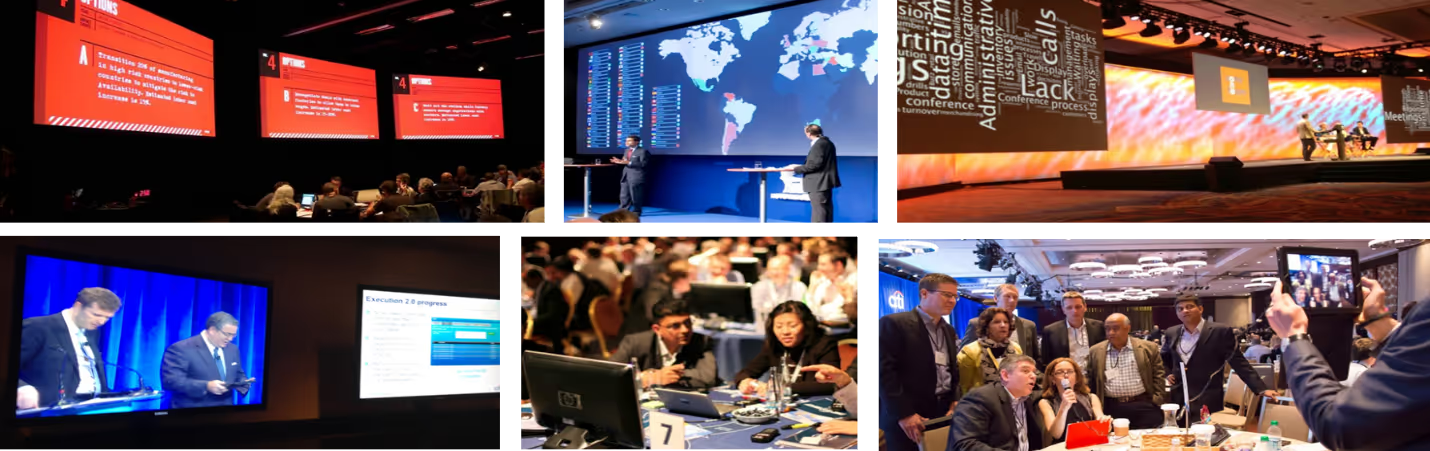
To bring this to life, imagine the following approach to a blended learning journey for aligning and developing leaders – in this scenario, within a financial services firm: Financial technology has “transformed the way money is managed. It affects almost every financial activity, from banking to payments to wealth management. Startups are re-imagining financial services processes, while incumbent financial services firms are following suit with new products of their own.”
For a leading financial services company, this disruption has led to a massive technology transformation. With tens of thousands of employees in the current technology and operations group, the company will be making massive reductions to headcount over the next five years as a result of automation, robotics and other technology advances.
This personnel reduction and increased use of technology is both a massive shift for the business as well as a huge change in the scope of responsibility that the remaining leaders are being asked to take on moving forward. As such, the CEO of the business unit recognizes the need to align 175 senior leaders in the unit to the strategy and the future direction of the business, and give them the capabilities that they need to effectively execute moving forward.
To achieve these goals, BTS would build an innovative design for this initiative: a six-month blended experience, incorporating in-person events, individual and cohort-based coaching sessions, virtual assessments and more. Throughout the journey, data would be captured and analyzed to provide top leadership with information about the participants’ progress – and skill gaps – on both an individual and cohort level, thus setting up future development initiatives for optimal success.
The journey would begin with a two-day live conference event for the 175 person target audience, incorporating leader-led presentations about the strategy. The event would not just be talking heads and PowerPoint slides, but rather would leverage the BTS Pulse digital event technology to increase engagement and create a two-way, interactive dialogue that captures the participants’ ideas and suggestions. Participants also would use the technology to experience a moments-based leadership simulation that develops critical communications, innovation and change leadership capabilities, among other skills.
romAfter the event, participants would return to the job to apply their new learnings. On the job, each participant would continue their journey with four one-on-one performance coaching sessions, in addition to a series of peer coaching sessions shared with four to five colleagues. They also would use 60-90 minute virtual Practice with an Expert sessions to develop specific skill areas in short learning bursts, and then practice those skills with a live virtual coach. Throughout the journey, participants would access online, self-paced modules that contain “go-do activities” to reinforce and encourage application of the innovation leadership and other skills learned during the program.
As a capstone, six months after the journey has begun, every participant would go through a live, virtual assessment conducted via the BTS Pulse platform. In three to four hours, these virtual assessments allow live assessors to evaluate each leader’s learnings from the overall journey and identify any remaining skill gaps. The individual and cohort assessment data would then lead to and govern the design of future learning interventions that would continue to ensure the leaders are capable of implementing the strategy.
As you can see, this journey design leverages a range of tools and learning methodologies to create a holistic, impactful solution. It’s not just a standalone event – each step of the journey ties into the one before, and the data gathered throughout can be used well into the future in order to shape the next initiative .
Great journeys or experiences like this can take many forms. In addition to live classroom and virtual experiences, there is an ecosystem of activities, such as performance coaching, peer coaching, practice with an expert, go-dos, self-paced learning modules, and more, that truly engage leaders and ensure that the learnings are being reinforced, built upon, practiced and implemented back on the job. We find that these types of experience rarely look the same for every client. There are many factors that determine which configuration and progression will make the most sense. There is one common theme that we have found throughout these highly contextual experiences, however – that the participant feedback is outstanding and the business impact is profound.

Throughout her more than 15-year career at BTS, Jessica has pioneered turning strategy into action through the use of customized experiences & simulations for leading Fortune 500 clients and many large and start-up software companies in Silicon Valley. Jessica leads BTS USA with P&L responsibility for offices in San Francisco, Philadelphia, New York, Chicago, Phoenix, and Austin.
Although one of the most-discussed topics in business today, meaningful diversity seems to be elusive for most companies. We sat down for a casual and candid conversation with Jessica and uncovered some surprising insights about our clients’ challenges in creating a more diverse and inclusive workplace, and what companies can do about it.
We are lucky to have snagged a few moments of Jessica’s time — squeezed between a flight to New York for a client meeting and her morning school drop-off duties — to hear her perspective.
JENNY JONSSON: We have a lot to cover today, so if it’s ok with you, we’re going to jump right in! First, we would love to hear a little about your journey to becoming a Global Partner (GP) – and of course, it’s hard to conduct research for a paper on diversity and ignore that there’s a gender imbalance at our GP level.
JESSICA SKON: Well first of all, while I may be the only female Global Partner, I don’t want to lose sight of the fact that we do have a lot of women leaders at BTS: 35% of our Heads of Office are women. With that said, what I can say about my experience is that it has been fair. I don’t think I would still be here if I didn’t feel the expectations and the performance processes over the last 17 years were fair, and I have never felt like gender has been a factor in performance conversations. When I reflect on that after talking to other female leaders, that’s a pretty big deal.
MJ DOCTORS: Why do you think your experience has been so different from what many other working women encounter?
JS: Before my first Global Partner meeting, where we were looking at candidates for Principal and above, I was told, “This is always the best meeting of the year.” I wondered how it could be so drastically different than any other meeting, but they were right — it is an entirely data-driven, unemotional, and fair process.
It was a simple process and there were no biases. There are three parts to how we evaluate partners up for promotion:
- The background information on each candidate includes all of the specific promotion criteria and supporting data.
- The leader recommending the promotion gives a 5-minute summary emphasizing their view of the candidate’s weaknesses and areas for growth in the coming years.
- A fellow partner who has done due diligence against the facts acts as the “inquisitor” and shares findings.
This approach ensures it isn’t just a pitchfest. And this process is also something that has trickled down to other areas of the business, reducing a lot of the biases in our hiring and promoting.
JJ: Have you been approached by clients asking for guidance on a similar data-driven approach?
JP: Absolutely, clients realize they need to make this shift. I think it’s going to happen really quickly: we already have one client whose CEO has asked us to rebuild their entire performance system so that it’s more data-driven, more accurate, and more fair. In many companies, the way things are now, it’s often gray and you can’t help but rely on relationships and favoritism to guide promotion decisions.
MD: As part of our research, Jenny and I took a look at how BTS USA is performing on diversity metrics. While most publications and companies measure diversity by simply looking at gender and race (such as Fortune’s 50 Most Diverse Companies), we believe diversity is much more than that. Our definition encompasses gender and race, but also age, socioeconomics, gender identity, sexual orientation, education, life experiences, disability status, and personality traits — and the list could go on. However, as we currently only have results across race and gender, that’s what we’ll share here. How do you feel when you look at these charts?
JS: You’re bringing me back to 5 years ago when we had the same color chart for gender as we do now for ethnicity — which was horrifying. I think we all knew it was a problem but we weren’t mature enough in our thinking to solve it. Once we all woke up and clearly defined that we had a gender parity problem across the company, we were persistent and fixed it, and now I am proud of our gender pie chart. That is something I love about BTS: if we can clearly articulate a problem, we tend to be able to solve it. That’s actually the key for leaders across most industries: the art is being able to clearly define the problem.
But I think that we’re at ground zero again for the next phase. I would love for us to apply the same rigor we used to address gender disparities to other forms of diversity so that in 3 or 4 years we have a better mix, and why wouldn’t we?
JJ: Can you outline specifically how we made progress on our lack of gender diversity?
JS: We took a few major steps:
- Our Heads of Office decided it was a top priority. Without top leadership’s buy-in, you can’t really make progress.
- Then we identified the key pain point: for us, it was the entry to the funnel. Then we brainstormed the best ways to attract more female candidates.
- This led to some “ahas” about the root cause of that pain point. Many people think that consulting is inflexible and it’s difficult for employees with children to succeed. But there’s nothing further from the truth at BTS. Our Global CEO is quite progressive and incredibly flexible and open-minded when it comes to letting employees do what they need for their lives.
- So then our leaders got on the megaphone: our (now retired) US CEO began flying to each of our offices to talk about it, and I got on the phone with candidates to tell them my story of being a young working mother. A lot changed once we started to focus on it.
- In reviewing our hiring interview process, we also realized we could be more clear in our criteria, with observable behaviors and a more robust scoring rubric. This change eliminated any unconscious bias and we found that woman were scoring as high as our male candidates. When we looked in the past, they were (on average) scoring lower.
MD: Besides clearly defining the problem, what other factors pushed forward this change?
JS: Clients started noticing and asking for more women consultants, so it became an easy sell to our leadership. Our demographics should match – or even be ahead of – our clients’ demographics. We shouldn’t have to be scrambling every time a client says, “Um… there’s a lot of men here.” Sure, some traditional clients may not have said anything, so for some folks internally it was more difficult to understand the impetus behind the huge investment we were making in changing our recruitment process. But we also had enough examples of women starting at BTS who didn’t have many female role models. And we realized, we have to change this or some of our best people are going to leave.
JJ: So what about our clients? You have spent significant time over the past 20 years with CEOs and senior leaders of some of the world’s top companies. What aspects of diversity are they discussing the most?
JS: In the last couple of months, I have heard many top executives discussing how to change the paradigm of their leaders to promote and move people around who don’t necessarily fit the makeup of the candidates from the past. So for example, one client said that they have been really good at keeping people for life, but realize that they might not be able to maintain that with millennials, unless they can keep having great careers for them.
Also, companies still tend to focus on “the résumé”: did the applicant go to an Ivy League school, did she have a fancy job, how long did he work in this department, etc. All of this has been the formula for success over the last 50 years. But if we don’t crack that mindset, there will be amazing people who don’t get put in the right positions, because unconsciously our leaders are not seeing them or they are not open-minded enough to realize that this candidate might be better suited than that more traditional-looking candidate.
MD: What is some advice you would give clients to change that mindset?
JS: You and all your leaders have to first recognize your beliefs and own them before any mindset change can happen. That may be kind of obvious, but getting yourself and your senior leaders to fully own their beliefs is hard. You have to be both very self-aware and constantly striving to improve. It’s a battle every single day.
So when an executive comes to me and says, “This is weighing on my mind at the company-wide level,” I don’t say, “Well there’s a diversity training that we can do.” I do say, “You’re talking about changing deeply rooted mindsets: this requires getting leaders to articulate, own, and put those issues on the table, and commit to changing their beliefs moving forward.”
This is crucial to making sure you have the right people in the right jobs and you’re retaining the people that you want, which ultimately enables you to make the company successful. That is an immense amount of work, including interventions, working sessions, and sometimes coaching. It’s sometimes getting the most skeptical leaders to become the owners of this and driving these change management efforts. It’s deeper than just a training class.
JJ: If it’s not just a training class, what do you see as the platform?
JS: Any time you’re trying to drive large scale transformation, it’s a good idea to run experiments. And once they get some momentum and prove to be successful, you should shine a really big light on them to get broad adoption and then begin the comprehensive change management process.
So even though it’s out of our core services, I try to give clients ideas on small stuff they can do that is totally different than anything they have done before, to shake up people’s way of thinking about how they recruit, hire, train, promote, and think about people. I think a strong example of an initiative a company has experimented with is a leading software company and their strategic partnerships with nonprofits who help them access more and different talent pools.
So – once those initiatives have gained that momentum, it would be fun for us to do some consulting with their executives first around owning the beliefs, the history (it’s important to honor the history and not just break it), what worked in the past, what beliefs do you now hold as a result, and what are you going to do moving forward. All of this can be built around an experience that shifts people’s mindsets. It’s not so much diversity training… it’s a mindset shift process that starts at top leadership.
MD: Are there any companies that are beginning to successfully make this mindset shift and use more data-driven approaches to evaluation?
JS: Not really… that’s what’s tough about this. It’s bizarrely new. The more BTS is asked to provide broader talent services, the more surprised I am. We’re basically back in the Stone Age. It’s not pretty.
But we’re starting to work on something internally to track an individual’s acquisition of skills in a moment-based approach. At the beginning of a project the individual comes up with specific skills that she wants to work on. Then, during critical milestones and at the completion of the project, the rest of the team gives feedback on those specific areas. That’s real curation of a skillset, where the individual can own her career progress, people can validate it, and the company can say, “oh, she’s telling us she’s ready for a promotion, look, she’s actually done all of these things and demonstrated she can be successful.”
JJ: So really it’s democratizing the job application and promotion process.
JS: Yes! That’s exactly why many of our clients have turned to selection and assessment solutions. Assessments enable our clients to reduce unconscious bias in the hiring and promotion processes and ensure that a candidate has the actual skills necessary for the role, as opposed to a particular degree from a particular university, which is, at best, only a moderate proxy for job fit. Through these solutions, our clients effectively expand their talent pool and improve the likelihood that the candidates they hire have both skill and culture fit, which can lead to increased cognitive diversity – that is, team members who have different backgrounds and thus approach problems in different ways – improved retention, and reduced recruiting costs.
MD: We are seeing some progress from expanded talent pools, but the critical question is, once a female or a non-white employee has joined a company, why aren’t they moving up as fast as white men?
JS: I think maybe it goes back to the issue that I heard from one of our clients: there’s a history of certain roles looking and acting a certain way. It’s hard to overcome the unconscious bias of hiring and promoting people who fit that perception.
It could also be that people aren’t putting their hat in the ring for those promotions. Women and people from certain cultures aren’t oriented toward self-promotion and won’t put their hat in the ring if they are only 10% confident they’ll be successful. So in that case, you really have to focus on the current leaders: it’s so important that they understand this dynamic. Even at BTS, there are so many outstanding individuals who don’t self-promote, and you have to be the megaphone for them.
JJ: When running our leadership development simulation experiences, BTS has always encouraged participants to form the most diverse teams possible (gender, culture, geography, role, tenure, etc.). What’s the origin behind why we ask our clients to create diverse simulation teams?
JS: Initially, this was primarily because our clients value enabling leaders to create networks across the company, more so than because of any inherent desire for cognitive diversity. Clients often come to us when they need a push toward a “one company” mindset, so simulation teams are built to bring people out of their silos and align around a single company goal.
But, nowadays, people recognize that cognitive diversity is a good thing. That being said, at BTS, we are very protective of our culture and team environment, and sometimes we’re guilty of mistaking like-minded people as a proxy for “I think I’ll get along with you”. So you have to have two heads when hiring: we want someone different who will shake us up, but we also want to be at peace and have fun and a strong culture fit.
MD: If you could leave one piece of advice for leaders hoping to create a more diverse and inclusive workplace, what would it be?
JS: In alignment with Liz Wiseman‘s book, “Rookie Smarts,” I’m trying to get leaders to crave being rookies again. If you’re going to learn as fast as the pace of change, and be able to transform yourself, you have to be a bit of an adrenaline junkie with a “rookie mindset”. I want people to realize that it’s not scary to do something different and new – it’s exciting. And, if you put yourself in an uncomfortable role, you get humbled, become curious, and seek advice from the best around you. As a result, you will most likely do the best work of your life.
There is a correlation between the “rookie mindset” and shifting beliefs in support of a more diverse team: we need leaders who crave differences. That has to be the overarching mindset when you’re recruiting and looking to add members to your team. If you crave differences in skills and personal history and combine that with culture-fit, then innovative ideas, high performance, and fun should follow. Others will notice the benefits of the diverse team and follow, assuming the appropriate recruitment and performance systems are in place. That’s how you start to shift mindsets at the top and eventually throughout the company.
About the Authors
Diversity has been a passion area for both MJ Doctors and Jenny Jonsson, both of whom have spent significant time – prior to and while at BTS – working to improve economic opportunities for women, immigrants, and individuals of varying socioeconomic backgrounds.

You’re buckling in for an overseas flight in a brand-new Boeing 777. The pilot comes on the PA: “Ah, ladies and gentlemen, our flight time today will be six and a half hours at a cruising altitude of 33,000 feet. And I should mention that this is the first time I have ever flown a 777. Wish me luck.”
Before setting foot in the real world, pilots, military personnel and disaster response teams use intense simulations to learn how to respond to high-intensity challenges.Why should we place corporate leaders and their teams in situations without first giving them a chance to try things out? The risks are huge — new strategy investments can run into the hundreds of millions of dollars. BTS offers a better way to turn strategy into action: customized business simulations.
‘Now I Know What it’s Like to be CEO’
A customized business simulation of your enterprise, business unit or process, using real-world competitive dynamics, places leaders in a context where they step out of their normal day-to-day roles and gain exposure to the big picture. Participants make decisions in a risk-free environment, allowing them to experience critical interdependencies, execution best practices and the levers they can use to optimize their company’s key performance indicators. It takes the concept of a strategy and makes it personal, giving each individual the chance to see the direct impacts of their actions and the role they play in strategy execution.
Leading corporations are increasingly turning to business simulations to help build strategic alignment and execution capability when faced with the following business challenges:
- Key performance objective and new strategy implementation.
- Accelerating strategy execution and innovation.
- Improving business acumen and financial decision making.
- Transforming sales programs into business results accelerators.
- Leadership development focused on front-line execution.
- Implementing culture change as tied to strategy alignment.
- Modeling complex value chains for collaborative cost elimination.
- Merger integration.
Within minutes of being placed in a business simulation, users are grappling with issues and decisions that they must make — now. A year gets compressed into a day or less. Competition among teams spurs engagement, invention and discovery.
The Business Simulation Continuum: Customize to Fit Your Needs
Simulations have a broad range of applications, from building deep strategic alignment to developing execution capability. The more customized the simulation, the more experience participants can bring back to the job in execution and results. Think about it: why design a learning experience around generic competency models or broad definitions of success when the point is to improve within your business context? When you instead simulate what “great” looks like for your organization, you exponentially increase the efficacy of your program.
10 Elements of Highly Effective Business Simulations
With 30 years of experience building and implementing highly customized simulations for Fortune 500 companies, BTS has developed the 10 critical elements of an effective business simulation:
- Highly realistic with points of realism targeted to drive experiential learning.
- Dynamically competitive with decisions and results impacted by peers’ decisions in an intense, yet fun, environment.
- Illustrative, not prescriptive or deterministic, with a focus on new ways of thinking.
- Catalyzes discussion of critical issues with learning coming from discussion within teams and among individuals.
- Business-relevant feedback, a mechanism to relate the simulation experience directly back to the company’s business and key strategic priorities.
- Delivered with excellence : High levels of quality and inclusion of such design elements as group discussion, humor, coaching and competition that make the experience highly interactive, intriguing, emotional, fun, and satisfying.
- User driven: Progress through the business simulation experience is controlled by participants and accommodates a variety of learning and work styles.
- Designed for a specific target audience, level and business need.
- Outcome focused , so that changes in mindset lead to concrete actions.
- Enables and builds community: Interpersonal networks are created and extended through chat rooms, threaded discussions and issue-focused e-mail groups; participants support and share with peers.
Better Results, Faster
Well-designed business simulations are proven to significantly accelerate the time to value of corporate initiatives. A new strategy can be delivered to a global workforce and execution capability can be developed quickly, consistently and cost-effectively. It’s made personal, so that back on the job, participants own the new strategy and share their enthusiasm and commitment. This in turn yields tangible results; according to a research report conducted by the Economist Intelligence Unit and sponsored by BTS, titled “Mindsets: Gaining Buy-In to Strategy,” the majority of firms struggle to achieve buy-in to strategy, but those that personalize strategy throughout their organization significantly outperform their peers in terms of profitability, revenue growth and market share.
Business Simulations: Even More Powerful in Combination
Comprehensive deployment of business simulation and experiential learning programs combines live and online experiences. The deepest alignment, mindset shift and capability building takes place over time through a series of well-designed activities. Maximize impact by linking engagement and skill building to organizational objectives and by involving leadership throughout the process.
Putting Business Simulations to Work
Simulations drive strategic alignment, sales force transformation, and business acumen, financial acumen and leadership development, among other areas. A successful experiential learning program cements strategic alignment and builds execution capability across the entire organization, turning strategy into action. Results can be measured in team effectiveness, company alignment, revenue growth and share price.
Learn more about business simulations
Learn how BTS Business Simulations can help with your initiatives.
Fill out the form below to have a BTS representative contact you.

To be an impactful leader, you need to build trust, establish credibility, and be able to mobilize teams. Sounds easy, but it's not. It's not just about making a business case and expecting teams to do what needs to be done. It requires honing a number of specifically developed skills to embody the executive presence of a leader who can make a real difference.
“Tom,” a leader within a Fortune 50 technology company, was challenged with some big concerns at work. One of his newly inherited departments had been significantly downsized. Those left in the organization were severely overworked and afraid they’d lose their jobs. They were spinning their wheels due to the pressure and creating waves throughout the organization.
Tom was under other pressures— his boss was pushing him to meet a very challenging revenue goal, and Tom needed another team to make significant progress on three large projects. Because of his tendency to be hot headed, especially under pressure, he often came away from internal and external conversations regretting things he said.
Tom wasn’t hitting the mark with his communication style. As a result, his style stifled creativity, caused fear, and slowed issue resolution. Tom cared deeply about his organization; he felt personally responsible for each person’s success. However, his actions didn’t reflect his concern. His staff didn’t feel much of a connection to him.
He needed to develop resonance quickly within his teams and across the organization. Once Tom saw how the pressures were showing up in his communication style, and how this was affecting his organization, he became determined to make changes.
Within six months, his organization’s creativity skyrocketed. They won company-wide recognition for innovative ideas. They began to solve issues faster and form stronger relationships internally and externally. They successfully brought the projects to fruition, and Tom came very close to hitting his aggressive revenue target.
Most important to Tom, he became a leader who inspired both the hearts and minds of those who work for him.
What are some lessons we can all learn from Tom’s experience?
- Make a conscious effort to be completely present in each interaction.
Tom focused on what the other person was saying rather than thinking ahead to what he planned to say next. He sought to understand the other person rather than trying to influence an objective or an agenda with the person. He suspended judgement and evaluation in order to actively listen and hear what the other person was saying. This took much practice. When you take the time to be fully present, people feel valued and empowered.
- Create a sense of purpose in conversations by making your goal to understand.
Tom paused and reflected on what was being said before responding. He verbalized what he heard to check his understanding. He found he could grasp a better understanding of the other person’s feelings and intent. When you take these steps, your positive intent comes through and others feel safe to correct any misperceptions you may have.
- Practice these skills in each interaction, both one on one and in meetings.
Tom noticed when he wasn’t fully present and actively listening, learning from each experience. He asked his trusted advisors to let him know when they felt he wasn’t listening. Through repeated practice, you can drive greater understanding and alignment, helping your team work in concert as a more cohesive group.
When you slow down enough to invest time and energy in building resonance with the people you need to influence, you reap a dual benefit: You can liberate yourself from a great deal of micromanaging because there is a much freer two-way flow of communication, and, like Tom, your team will thrive because they have a new sense of ownership and engagement with the team’s direction, goals, and accomplishments.
It’s all about engagement: Once you’re more tuned in to the hearts and minds of those you need to influence, you’ll find others start changing their tune.

Have you ever found yourself in the middle of a meeting feeling frustrated with a conversation that seemed to be going in circles? The answer seems so clear, but people are talking, not doing! High-energy, go-go, get-it-done people often find the pace of discussion and decision making is maddeningly slow. And in these situations, our frustration and impatience can be written all over our faces.
In our research on executive presence, we’ve found many leaders face this challenge. It’s associated with one of 15 qualities of a leader we measure in the research-based model - Restraint.
We define Restraint as “the ability to display a calm disposition, characterized by reasonableness and by avoidance of emotional extremes or impulsiveness.”
Over the last year and a half, we’ve used the Executive Presence Index (or ExPI™) to assess the executive presence of over 1,000 leaders and quite a few leadership teams as well. I’ve analyzed hundreds of these assessments and been struck by how frequently Restraint is one of the lower-rated facets in the model.
Why would that be? Our hypothesis is that many leaders have risen in the ranks because they are driven, decisive individuals whose “action bias” has helped them get things done.
As one HR business partner told me the other day, high potentials think “it’s all about working hard and being technically proficient. They think, ‘If we just work the crank harder, we’ll get ahead.’ That thinking is absolutely right—up to a point. However, as you move to a more senior level, the very qualities that helped you advance can start working against you.
An action bias can start to feel to others as impulsive or dominating, leaving little room for others to share their ideas or concerns. If you don’t slow down, ask questions, and show that you can discuss hot topics with cool deliberation, then you’re going to shut down dialogue. When you do, people may start to perceive that you’re lacking in any number of qualities of Executive Presence, including Concern, Humility, Composure, Resonance, and Inclusiveness.
One leader who comes to mind here is “Dan,” who we met while he was attending one of our Executive Presence Mastery Seminars. As part of a reflection exercise, Dan shared a story about a meeting with his boss and the leader of another business unit. This other leader announced that he had made a decision: He was going to throw out a sizable amount of inventory because it didn’t meet his needs for a market. Dan could not believe that this guy had made such a “dumb” decision, and he was quick to make his opinion known. As you would imagine, his comments generated a lot more heat than light.
Dan realized that his intention to make his opinion known was overshadowed by the negative impact it had on others. “Berating him about it accomplished nothing—except making him see me as unreasonable, hot-headed person.” Dan’s boss intervened and began asking questions. His tone was matter of fact, and he quickly helped his counterpart drill into what steps could be taken at this point to make the most of the situation—in light of the fact that the decision had been made, for better or worse.
In the “wisdom sharing” discussion that followed, the facilitator recommended that Dan find a trusted advisor who could help him monitor his level of Restraint. When the coach conducted a follow-up coaching call several weeks later, Dan reported that he had shared the developmental goal with a handful of trusted peers. They’d actually joked with him about it—suggesting that he needed one of those dog collars that sends a small jolt of electricity when the dog’s behavior is out of bounds.
Everyone laughed at that, but it led to a good idea. Now when Dan starts to get agitated and frustrated in a meeting, his colleagues simply cue him by slipping their hands up around their throats, as if they’re touching an imaginary dog collar!
What’s exciting about understanding your challenges, and sharing them with others, is that they become partners in your leadership development. None of us can go it alone. Having an assessment of your qualities of presence, understanding the impact you’re having, and sharing your plan to improve with trusted colleagues can help you accelerate your growth and become the leader you want to be.

Our family of four just got back from a ski vacation in Big Sky, Montana. Skiing out west has been a family tradition for many years, but this trip felt a little more special than usual: My daughter, Hannah, is a senior in high school, so when she goes off to college the kids won’t have the same vacation week anymore. So our thinking is that we just won’t do a ski trip again for at least five years.
When we got to Montana, Hannah announced that she wanted to take a ski lesson on the first day. This was only mildly surprising. Thanks to years of ski school, she’s the best skier in the family—beautiful form. But she hadn’t been on skis for a couple of years and wanted to get comfortable again. So that made sense.
After another day, though, Hannah told me that she wanted to sign up for another lesson. Now I was frankly puzzled. Was this really necessary? I honestly didn’t see the point, but I kept my mouth shut and decided to see what happened when Hannah signed up for a half-day group lesson one afternoon.
When we met up late in the day, Hannah couldn’t wait to tell me about her lesson. What luck! No one else showed up for the group lesson, so Hannah got a private lesson for the same price. Better still, it was a fantastic experience. “We just really clicked,” Hannah told me. Hannah had always hated skiing moguls, and she would shy away from deep powder. The instructor gave her specific, practical advice for tackling both, and she had not only handled some of the toughest trails on the mountain—she enjoyed them, too.
Of course, the success was a two-way street. “The instructor really loved working with me, too,” Hannah said. “Whenever he suggested trying a really tough trail, I just said, ‘Sure! Why not?’ I guess that not everyone is always up for whatever.”
It didn’t stop there. Hannah liked the instructor so much that she signed up again for another lesson the next afternoon. He insisted on meeting my wife and me afterward and talked about what a wonderful time they’d had. I think he actually wanted to set my daughter up with one of his sons! Obviously it was a real lovefest between a talented skiing instructor and a game student.
Sometimes when I meet some of our executive coaching clients here at Bates, I have the same reaction that I had when my daughter wanted to keep taking lessons. All of our coaching clients are extremely successful leaders who are already doing so many things well. So why are they signing up for coaching, going through our executive presence assessment, and attending our programs?
The answer is simple. Like my daughter on the mountain, they may be “good enough” in many ways. But they have the humility to know that they could be better and the desire to tackle greater challenges with that much more skill and confidence.
As you rise in the ranks as an executive, the terrain gets steeper. When it comes to business imperatives, the moguls get bigger, and the powder may get knee deep; a stumble or fall has much greater consequences.
Under the circumstances, reaching out for expert assistance is not a sign of weakness. Quite the opposite: Getting coaching tells your team that you’re determined to keep improving until you reach the summit.

A few years ago, our family flew from Boston to Iceland for a two-week vacation. The flight is only 4 ½ hours, so I was happy enough to occupy myself by reading while sampling some chocolate-covered licorice—a popular Icelandic treat.
Predictably, however, I got a little restless after about three hours. So I started fiddling around with the soft-touch video screen on the seatback in front of me. I checked out our flight path and looked at a tourism video. Then I noticed another tab on the screen: “Surveys.” Why not? I shrugged and clicked on the tab. Immediately, a message came up: “There are no surveys at this time.” Oh, well. But then I noticed that there were two buttons below the statement. One said “True” and the other said “False.”
I suddenly felt like I was faced by one of those existential riddles. You know: “If a tree falls in a forest and no one is there to hear it, does it make a sound?" So I tried to think of how to respond to this “survey question.” Was it really true that there were no surveys at this time? It seemed that way, but I puzzled over which choice to make.
I finally selected “True.” To my amazement, another message popped up: “Thank you for participating in the survey.”What?! Did this mean that there really was a survey? Although I knew that I probably had just stumbled on some sort of technical glitch, I couldn’t help feeling like I had been given a one-question test… and I had managed to get it wrong!
As I was thinking about this experience recently, I could see some parallels to what we face as business leaders. In the digital age, we all rely heavily on the one-way communication of emails. How many times have you read an email that left you just as perplexed as I was when trying to make sense of that Icelandaic survey? Too often, you can end up exchanging a handful of emails over several days in order to get clear on something that could have been resolved with a 20-second meeting or phone call.
But what really haunts me is the other end of it. What if I’m sending out emails to my stakeholders that are leaving them as baffled, dejected, and incredulous as I was over that survey? I may never know. They may quietly brood over my message, or they might just hit “delete.” That’s another risk of relying on one-way communication: You often get no real data on how your message went over.
Email is a necessary and invaluable communication vehicle. But many leaders use it as their default vehicle rather than making more deliberate choices about which vehicles to use in different situations. When you use email, it’s going to be much more difficult to convey your authenticity, your concern, and your vision. It’s also going to be very hard to have real dialog with your stakeholders, as so much is lost when we take away the inflection, emotion, body language, and facial expressions that we can read and react to in a face-to-face meeting or on a videoconference.
When you rely too much on one-way communication, you might have as much trouble as I did determining what’s true or false.

A while back, I heard an anecdote on the radio about cellist Yo-Yo Ma, and it really struck me. Surprisingly, Ma said that once of his biggest inspirations was chef, author, and television personality Julia Child.
Huh?! Well, it turns out that thinking about Julia Child helped him get in the right mindset before a performance. He would think about watching her on television, making a roast chicken that looked beautiful—only to have it fall off the plate and onto the floor. Did she flip out? No, she never stopped smiling. She just acknowledged what happened and went on with the show.
Reflecting on this, Ma realized that the best mindset he could have as a performer was to ensure that his audience was having a good experience—rather than worrying about being perfect. Speaking to the St. Louis Post Dispatch last October, he said, “The idea of performing is hosting. It’s like you’re giving a party. You invite people to come to a place and enjoy something special; basically, they’re subject to whatever you dish out. You want them to have a great time, they want to have a great time, and what are you doing to facilitate that?”
In a Malcolm Gladwell article that I read years ago, Yo-Yo Ma also admitted that he used to strive for perfection in performance. When he was 17, he practiced a Brahms sonata for a year with technical perfection in mind. So what happened when he did that? “In the middle of the performance I thought, I’m bored. It would have been nothing for me to get up from the stage and walk away. That’s when I decided I would always opt for expression over perfection.
”There is a valuable lesson here for executive presentations. In my experience, many leaders worry too much about precision when they present. Aiming for total accuracy, it’s easy to end up with text-heavy PowerPoint slides—and far too many of them. And once you have a ton of bullets on a slide, you usually feel compelled to read them all. At best, slides still tend to distract the audience’s energy away from you—and the presentation is really all about you, not your visuals.
Think about it: What would you rather be able to say at the end of your presentation?
- I covered every point perfectly and spoke without a single stumble.
- I connected deeply with the audience, and I could sense that they were completely engaged with my presentation.
It’s a no-brainer, isn’t it? If you’re able to really connect with your audience’s questions, concerns, and needs, they won’t even notice if the imperfections that jump out to you as the expert.
Of course, there’s a catch here. Connection trumps precision… but the more you master your topic through preparation and practice, the more you’re freed up to focus on connecting with the audience. When you don’t have to work to remember your key points and transitions, you can concentrate more on your eye contact, gestures, and reading the room.
So give some thought to drawing some inspiration from Julia Child, just as Yo-Yo Ma does as a concert performer. When you’re giving a speech, you’re the host, and your job is to set the tone and make sure that everyone has a good experience.
That’s a recipe for a successful presentation.

Last night I started reading a book by Irvin Yalom, a psychiatrist who has written several novels that I’ve loved. But right now I’m reading something different—a book of short lessons he’s learned from many years of working with patients.
Early in his career, Yalom was inspired by something he read. The gist of it was that all people have a natural tendency to want to grow and become fulfilled—just an acorn will grow up to become an oak—as long as there are no obstacles in the way. So the job of the psychotherapist was to eliminate the obstacles to growth.
This was a eureka moment for Yalom. At the time, he was treating a young widow. Suffering through grief for a long while, she wanted help because she had a “failed heart”—an inability ever to love again.
Yalom had felt overwhelmed. How could he possibly change someone’s inability to love? But now he looked at it differently. He could dedicate himself to identifying and eliminating the obstacles that kept her from loving.
So they worked on that—her feelings of disloyalty to her late husband, her sense that she was somehow responsible for his death, and the fear of loss that falling in love again would mean. Eventually they eliminated all of the obstacles. Then her natural ability to love—and grow—returned. She remarried.
Reading this story made me think of the responsibility of leaders toward the people they need to develop—and for the growth and learning that leaders themselves require to be the best that they can be.
Many leadership development challenges seem overwhelming—even impossible. The leaders that we coach usually have a list of areas where they want to get better, but how? How do you “build better relationships with your peers and direct reports”? How are you supposed to “get out of the weeds and demonstrate enterprise-wide thinking” or “build executive presence”? All of these goals are as abstract as they are huge.
So the best approach is to not focus on the huge and fuzzy goal. What we try to do is to break these goals down into concrete actions through working on real-time business problems. To put it simply, though, we do just as Yalom does: We identify the obstacles and work toward knocking them off, one at a time.
Leadership development is not usually a quick fix. You’re not going to develop executive presence through a half-day workshop or a one-time meeting. If you’re interested in meaningful, lasting growth—whether for yourself or for those who work for you—it’s a commitment.
But don’t ever forget that we’re all capable of growth throughout life and our careers. The trick is to find the right coach or mentor who will guide you through that obstacle course.

Every few months, we hold a Speak Like a CEO Boot Camp—a two-day event geared to helping leaders improve their powerful presentation skills. It’s always satisfying to hear how much people enjoy learning to use our tools, but I’ve found that our segment on Storytelling for Leaders is often the area that executives find to be transformational.
At one recent boot camp, a compliance executive shared a riveting personal story with his small group. During the first Gulf War, he had to drive from one base to another on a desert road in the middle of the night. Unfortunately, he managed to get off the road… and he kept going. “If I keep going, maybe I’ll recognize something,” he thought. But he soon realized that one sand dune looked pretty much like the next one.He stopped his truck and pulled over… and freaked out. He imagined all of the ways in which he might die. Maybe a sniper would spot him, or he would stumble on a mine. Or perhaps he would die in a less dramatic way: He had no food or water, and the temperatures would skyrocket the next morning. Maybe he just wouldn’t find his way back.
It was a beautiful, starlit desert night. He had an idea. Maybe he could navigate his way back by the stars! But then he realized he had no clue as to how to do that. It was comically absurd.
In great dismay, he sat down on his back bumper and lowered his head. And there he saw his answer. Do you know what it was? His own tire tracks! He turned around and followed his tracks for several miles and finally found the road. He was saved.
As soon as the story ended, his fellow Boot Camp attendees raved about his storytelling skills. He was stunned. Amazingly, he had never told anyone the story—hadn’t thought about it until Suzanne, our CEO, read a list of memory prompts that brought this remarkable story to mind.
Then someone shouted out, “Hey! That’s a great compliance story!” That was even more of a revelation. The story could be used as a metaphor for what happens when things go wrong with compliance: You go off of a path, and you get in trouble… and the farther off you are, the deeper the trouble… but retracing your steps can save you.
Compliance executives have a tough job. They often see no way around citing rules and regulations in a dry presentation, while their audience suffers through it. On that day, this executive suddenly could see how he could tell a story to engage the emotions of his audience while making a powerful, relevant point that they would remember for a long time.
Great leaders have learned somewhere along the way that they need to be storytellers. Your annual report is a story. Your business successes are a story. Lessons about failure are also stories that help your important audiences understand why they must do more than just show up. The best stories touch people's hearts and ignite their energy to act. I urge you to go down that road and learn how to tell powerful stories.
The irony of taking the time to look back is that what you remember will drive you forward more quickly. Like the soldier who veered off that road, the tracks from your history can ultimately lead you where you want to go.

In my work as an executive coach, I meet at least once a month with each of my coaching clients.
I often talk to them on the phone and exchange emails with them as we work on their real-time business challenges. So, what happens in those conversations? Recurring themes start to come up. I find that many leaders have a “talk track” of words and phrases that they use all the time—without always being aware of the impact. For better or worse, this talk track ends up becoming part of their executive presence and their brand as a leader.
One of my clients had a talk track for many years that led to a reputation for negativity. In one meeting alone, I noticed that he had described about ten different work experiences as “nightmares.” Strong word! So we talked about this talk track. And the next time I heard him lapse into that way of talking, I decided to delve into it. “What I just heard from you was an example of that ‘talk track’ we’ve talked about,” I said. “So let’s talk about this. You say it was a ‘nightmare.’ Okay—why do you call it a nightmare?”
The upshot was that he had made a sales presentation but didn’t get the deal. I said, “Let’s use accurate language to describe the situation.” Was it a nightmare? No. Maybe it was a disappointment. Maybe he could have said, “Unfortunately, we didn’t get the deal” or “They decided to go with another vendor” and state why, objectively. My goal was to get him to stop “catastrophizing” when something didn’t work out.
This leader didn’t want to be defined by that negative “talk track” anymore. So I told him that the only way to do that is to turn up the volume on a very different talk track—one that captures the brand and presence that you want to project.
I’ve had clients who always talked about how difficult or challenging or complex things seemed to them. You’ve probably had a boss or colleague with any number of talk-track themes:
- “I’m so exhausted/overwhelmed/unhappy/unappreciated….”
- “Everyone here is useless/stupid/incompetent….”
- “It’s such a difficult environment/project/client/travel schedule…”
- “That will never work/We won’t get that deal/It’s a dumb idea/What were they thinking?”
Often people aren’t even aware of how much they harp on a conversational theme and how negatively this lack of executive presence is affecting their professional brand. So what can you do to make sure your talk track is working for you and not against you as a leader? Take these four steps:
1. Identify your talk-track themes.
What are the words and phrases that you find yourself constantly using in conversations at work? Write down the things you seem to say almost every day—or think about what themes come up all the time for you in conversation at work or elsewhere.
2. Consider the impact of your talk track.
As a leader, your words carry more weight than others. You’re setting the tone for your team or division or organization. Whether that tone is absurdly optimistic, cynical, critical, upbeat, energized, or overly emotional, it’s going to be the model for others. Make sure that your talk track is consistent with the values and behaviors you want to drive.
3. Challenge the reality of your talk track.
How accurate is your talk track? Do you have a natural tendency to see the part of the glass that’s empty? How do you respond to setbacks? Do you gloss over the pain? Do you make a mountain out of a molehill? It’s crucial for leaders to be balanced, objective, and real about what’s happening. Your language choices need to reflect that.
4. Consider what you could say differently.
It’s easy to lapse into your talk track. When you catch yourself saying the same old things, try to catch yourself as if an alarm was going off. Can you find another way to say it—something that’s consistent with the brand and presence you want to project.
Don’t get me wrong. Leaders do need to be “real” about challenges and setbacks, and a somber tone may be appropriate and even helpful at times. The goal is to become more aware of your talk track and what it’s doing for you and others. As a leader, people take their cues from you. Before you know it, your talk track can dominate or drive the culture.
Changing your talk track is a challenge. Our ways of talking and viewing the world are pretty ingrained through several decades of life experiences. But change is also very possible. Pump up the volume on a more positive talk track for the holidays, and your presence will be viewed as a gift.

A while back I heard a few people talking about public speaking. Person A was talking about their anxiety about making presentations. Trying to make him feel better, Person B said, “Public speaking is just like riding a bike!”
That got my attention. It seemed to be a comforting little sound bite. The only problem was that it was wrong. Public speaking is not like riding a bike. But it got me thinking about leadership communication and learning in general.
What does it mean if we say that something is like learning to ride a bike? We’re saying that it’s a skill that initially may seem pretty difficult to learn… but once we figure it out, we can do it successfully without thinking—even if we don’t do it at all for years at a time. It’s the reassuring idea that you’ve acquired a skill that you will never lose.
There’s no question that we all learn many skills that are like riding a bike. Driving is a good example. Most of us were white-knuckle drivers when we first got behind the wheel, but what about now? On long highway drives, I sometimes snap out of a daydream and realize I have no memory of anything that happened on the road in the last 15 minutes. That’s because I don’t have to think about driving when I do it—not unless there is intense traffic or some other unusual circumstance.
Many other skills are the same—reading, typing, doing simple math in your head, and so on. But quite a few sophisticated skills are quite unlike riding a bike. In other words, there are skills that are definitely learnable and where your level of mastery can improve substantially. However, you’ll probably never be really great at these skills without vigilant, ongoing practice, preparation, reflection, and reinforcement.
Some examples that come to mind with leadership communication: Selling, managing change, inspiring your teams, and, yes, public speaking. What’s so different about these areas? A few things:
- They involve an audience. If you were making your first speech in several months or years, would you find that you could do it almost unconsciously? I couldn’t. You can never be on auto-pilot when you’re delivering any sort of message to an audience. Just as the saying goes that you can never step in the same river twice, no two audiences are ever the same—even if you’re speaking to your internal teams each quarter. All sorts of circumstances change regularly, and you have to consciously adjust your message to address the ever-evolving needs of your audience.
- To maintain performance at a high level, sophisticated skills require ongoing practice. Yo-Yo Ma may be the world’s best cellist, but he estimates that he still puts in roughly 2,000 hours of practice each year. That’s an average of 5.5 hours daily. If he stopped practicing altogether, he obviously could still play the cello. But he wouldn’t be the best cellist for much longer.
- Skill mastery typically requires continual learning and reinforcement over time. Practice is critical, but it’s not sufficient. When you think about areas such as selling, motivating, and public speaking, there is always more to learn. There is evidence now that 90% of what we learn at a workshop, for example, dissipates within one year. To ensure the needle keeps moving in the right direction, you need to be a perpetual student. That may involve reading about the subject, hearing about it, going to a workshop, and getting expert advice. Whether you’re a tennis pro, a psychiatrist, or a VP of Sales, having a coach to help you with your real-time challenges can have an enormous impact to give you that reinforcement over time.
As a leader, you’ll no doubt hear from companies that want to offer you “quick-fix” solutions for perpetual leadership development challenges—areas such as executive presence, employee engagement, and public speaking.
But lasting, meaningful mastery is not a quick fix. Sophisticated skills need reinforcement: A better motto for these skills would be “use it or lose it.” Because some things are quite unlike riding a bike,