Locations

Bienvenido a BTS España

Impulsamos a las personas a dar lo mejor de sí mientras transformamos la forma en que las organizaciones aprenden, cambian y consiguen resultados.

Somos el líder global en transformar la estrategia en acciones y resultados a través de las personas. Contamos con más de 30 años de experiencia en el mercado español, con oficinas en Madrid, Barcelona y Bilbao, trabajando en empresas líderes del mercado y con más de 18 clientes del IBEX 35.

Creemos que, para ejecutar cualquier iniciativa estratégica de forma exitosa, la clave son las personas. Las compañías necesitan que sus personas estén alineadas con la visión de éxito de la organización, generando el mindset adecuado para que aborden los cambios necesarios y desarrollando sus habilidades para adoptar las nuevas formas de hacer y generar así los resultados de negocio esperados.

Habla con uno de nuestros expertos
Contáctanos

Últimas noticias y eventos

Blogposts
June 8, 2026
5
min read
Built for a different world: Five talent shifts AI is forcing now
AI is changing work fast, but many organizations are still using talent practices built for a different era. Here are five emerging shifts every talent leader should have on their radar.

You can't predict the future. You can be disciplined about how you face it.

That's where Future Storming comes in. Future Storming is a process for looking at the trends and signals already visible in the market, understanding how those forces connect, and thinking more clearly about where they may lead.

Recently, we've been applying that lens to talent strategy, running Future Storming sessions with talent leaders across industries to understand which forces are already reshaping how organizations find, develop, and retain the people they need. When you look across those conversations, one thing is hard to miss: AI runs through almost all of the most significant trends, and not as a future scenario. It's already reworking the talent systems most organizations have leaned on for years, often quietly, and often faster than leadership teams have had time to respond.

From these sessions, five high-likelihood, high-impact shifts have emerged as the ones every talent leader needs to be watching right now. What follows is what each of them may mean for your organization.

1. The frameworks most organizations use to define great leadership were built for a different era

Skills and competency models describe work that no longer exists in many roles or that AI now performs alongside, or instead of, humans. The gap between what organizations say they're selecting and developing for, and what the work actually requires, is widening quietly.

This creates a real problem. Organizations that don't redefine what great looks like now will be developing the wrong people for the wrong future optimizing for capabilities that are becoming less predictive while under-investing in the ones that matter most.

  • Rebuild leadership profiles from a future-back perspective, starting with where the business is heading, not where it has been.
  • Focus on the distinctly human capabilities AI cannot replicate judgment in ambiguous conditions, relational intelligence, ethical reasoning, the ability to set direction when there is no precedent.
  • Increase the use of behavioral observation in selection and development. It's the only methodology that shows how someone actually thinks and decides under real pressure.

The signal worth chasing isn't on a resume, it's in the room in how someone handles a real situation, under genuine pressure. It's the only place where someone can't prepare their way out of being themselves.

2. Human differentiators are the last mile AI cannot close

Judgment. Empathy. Creativity. The ability to navigate genuine ambiguity. These are increasingly what separates human contribution from AI output and they're precisely the things most talent systems have always found hardest to measure.

For a long time, organizations could afford to treat these as qualities that would emerge naturally with experience. That's no longer an option. The human differentiators are becoming the job. And most organizations still aren't measuring them well.

The methods exist behavioral assessment, simulation, structured observation. And AI is now making them accessible at scale in ways that simply weren't possible before. The question isn't whether to use them. It's how to deploy them thoughtfully, with the governance and transparency that -stakes talent decisions require.

  • AI-powered behavioral observation that surfaces how people actually perform in the flow of work, (i.e. judgement, decision-making, adaptability) not self-report
  • Assessment that evaluated how people work with AI, not just without it because that's increasingly what the role looks like
  • Simulation-based approaches that reveal thinking in action - the kind of evidence no credential or output can provide

3. The talent pipeline is broken

AI is displacing the early-career work that has traditionally served as the on-ramp into organizational life. Those tasks once gave emerging employees something more valuable than work product. They gave them foundational experiences, relationships, and judgment. The kind of judgment that eventually grows into leadership.

The impact won't show up immediately. That's exactly what makes it worth paying attention to now. Within three to six years, benches will thin and succession pipelines will require far more intentional investment. Organizations will find themselves asking why their internal talent isn't developing the way it used to.

The organizations that get ahead of this have a real opportunity to build something more deliberate, more equitable, and better suited to the capabilities the future actually requires.

  • Invest in real, simulation-based experiences, putting emerging leaders into the decisions and pressures that build genuine organizational judgment, not just task exposure.
  • Redefine what early-career development is, building toward the capabilities the future requires, not the ones the old job description described.
  • Build feedback into the flow of work. AI behavioral observation and practice AI role plays make continuous development possible at scale. The experience that used to happen informally has to be designed now.

4. People need to re-skill faster than any development model was built to support

People need to reskill faster than any development model was built to support.  Most organizational development infrastructure was built around a longer, more stable arc of skill acquisition. AI is compressing that arc significantly.

The implication isn't just that training needs to be faster. It's that the whole architecture of how organizations identify, develop, and deploy talent needs to be built for continuous recalibration not periodic refresh.

  • Prioritize adaptability and learning agility over static expertise. The ability to acquire new capabilities quickly matters more than the specific capabilities someone holds today.
  • Treat reskilling as a continuous organizational process, not an episodic program.

5. AI is absorbing leadership work and culture is losing it's anchor

This is the shift that's easiest to underestimate, and hardest to recover from once it arrives.

Culture is what people see leaders do. The behaviors leaders model how they make decisions, how they show up in hard moments, what they choose to reward and what they let go are how organizational culture gets transmitted. It doesn't travel through stated values. It travels through visible human behavior.

AI is absorbing the work that used to make leaders visible as humans making choices. Performance reviews written by AI. Communications drafted by AI. Coaching conversations mediated by AI. When the distinctly human work disappears, so does the signal. People don't know what to watch anymore. And culture which depends on that watching starts to fray.

The organizations that navigate this well won't be the ones that use less AI, they'll be the ones most intentional about which leadership behaviors remain visibly human, and why.

The behaviors that held culture together need to be rebuilt around what humans uniquely contribute now and that starts with getting the success profile right. That's exactly what the Future Ready Profile is built for.

Strengthen empathy-centered leadership capabilities. The human dimensions of leadership matter more, not less, as AI takes on more of the technical work.

  • Strengthen empathy-centered leadership capabilities. The human dimensions of leadership matter more, not less, as AI takes on more of the technical work.
  • Reinforce organizational purpose and human-centered culture as anchors.
  • Treat culture as something you design, not something you inherit.

What this means

The organizations that navigate this well won't be the ones that adopted AI fastest, they'll be the ones that invested just as deliberately in the human systems around it.

These five shifts aren't warnings. They're design problems, and design problems have answers. The talent systems that come out of this moment can be more intentional, more equitable, and more fit for purpose than anything we've built before.

At BTS, this is the work we're doing every day. If you'd like to think through what any of it means for your organization, we’d love to talk.

The thinking in this article was shapped by Future Storming sessions, including a SIOP 2026 workshop, and by ongoing conversations with talent leaders navigating these shifts in real time.
Blogposts
May 5, 2026
5
min read
Eight weeks, 24 countries, one diamond: The pattern behind our applied AI breakthrough.
Part 2 in a series. BTS CEO Jessica Skon shares stories and lessons on what made the first Applied AI diamond spread, what it felt like inside the team that built it, and what we see as clients adopt this approach.

In Part 1, I told you about the three decisions we made two years ago and the simulation flywheel that produced our first Applied AI diamond.

Here’s the field-notes version.

Over 80% of our global business have now adopted a new Applied AI approach for doing simulations in the first eight weeks, across 24 countries and every practice.

The flywheel didn’t stop with simulations. It moved into finance, sales enablement, legal, operations, and client delivery. Teams started building agents and bringing them onto their own org charts. We didn’t plan for any of that. We built the conditions for people to find their own breakthroughs.

What it felt like inside the flywheel.

When the simulation team went live with their first clients on the new way of working, the lead person hit a wall. Their words:

“You’re asking too much. You’re making me be a full-stack developer. Up until this point I did a small part, and I sent it to the team, and they built off the back end, and they brought it back. And now I have to end-to-end soup to nuts, basically alone.”

There was graphic UI work nobody had been trained for, the fear of delivering quality below what BTS expects of itself, and the weight of not having a playbook. This was not the joyful adoption story most consultancies tell.

Then something shifted. Six members showed up for product testing, where the usual was two or three. The work created teamwork I hadn’t seen at BTS in years. The breakthrough was not an instantaneous change from skepticism to celebration. It was a breakdown in confidence, then rally, then bonding. If we didn’t make room for the breakdown, we would have lost the rally.

The other breakthrough was global teamwork; not yet a BTS core strength. Our culture is beautiful: high-freedom and entrepreneurial. But people’s first identities are to their countries. Almost every prior attempt we’ve made at a global initiative has failed. The one exception was Covid. So, when I say what happened next surprised me, I mean it.

I asked to join the simulation team’s Slack channel rather than pulling them into status meetings. What I got to watch in the mornings was someone in South Africa waking up, posting “I tried this and got stuck,” then London adding on, then San Francisco weighing in, then a surprise breakthrough overnight from Tokyo. We didn’t engineer that. Curious and determined BTS’ers did. The problem was interesting enough that the org chart didn’t matter. It was amazing to see and a glimpse into the next evolution of the BTS culture.

The pattern: Explore, expand, institutionalize, renew.

What we’ve now seen play out, both inside BTS and with clients, follows the same four-step pattern. Each step asks a specific decision of the leader.

Explore.

Stay stubborn on the aspiration and fluid on the path. Our breakthrough wasn’t the path we originally took. We changed tools and approaches. Nobody could have foreseen that. And if the team had taken the first six months of learnings from AI as their definitive “this is the detailed path we will follow,” we never would have gotten the disruption. Five different tool combinations were tried before we found the one that worked. Companies that lock into a single path or tool too early are betting against compounding capability that doubles roughly every seven months. That is not a bet I’d take.

Expand.

Run the old way and the new way side by side. When the simulation team’s breakthroughs got real, the instinct was to retreat into more internal testing. We did the opposite. They ran old way and new way in parallel on 6 or 8 live client projects across all three geographies. Every single one ended up going live the new way. The backup was always there. They didn’t need it.

Institutionalize.

Burn the boats. The simulation team committed that no new client work would be done the old way after January 1. The other practice leads then committed to dates within Q1, even though most of them had not yet experienced the new way themselves. They had to trust their colleagues. If you can do it for the most complex thing, you could probably do it for the less complex ones. By February 15, we had approaching 90% global adoption across 24 countries, across all practices. I was shocked and proud. We had spent years failing at exactly this kind of global rollout.

Renew.

Treat your agents as contractors. People on our diamond teams are now managing 30+ agents they built themselves. Our teams give agents performance feedback. We terminate their contracts when they don’t deliver. We expand the responsibility of agents when they outperform. The frontier question we’re wrestling with now is token budgeting. Two friends of mine running engineering-heavy companies believe that within 6 - 9 months, their token cost per engineer will exceed the cost of the engineer. Whether that’s the right framing is open. The question is real, and every CEO will be asked some version of it within the year.

What had to be true for this to scale.

Once we achieved this amazing global innovation, the leadership sat down to figure out what made it work. We named five things. None of them were about the technology.

Real pain points as the starting point. We had so many people frustrated from those ways of working, all the back and forth and all the wasted time, that this was gold for them. The old way was already painful. The new way wasn’t a forced disruption; it was relief. Find the workflow where the pain is loudest and start there.

The diamond unlocked creativity, it didn’t constrain it. This was the most differentiated insight, and the one most leaders miss. It wasn't "here's the new tasks and rules." It was, "once you learn how to do this, the sky's the limit. You can be even more creative." If your rollout feels like a new set of rules constraining your people, you’ve built the wrong thing.

Pair deep expertise with fresh eyes. The disproportionate share of our breakthroughs came from a tenured tinkerer with total command of the work, paired with someone new to the role who hadn’t yet built the muscle memory of how it had always been done. Without that pairing, you get incremental improvements to the work you already know how to do, instead of a reinvention.

Refuse the “people are too busy” reflex. When I brought the rollout to the global leadership team, the excuses came fast. “Our people are too busy. They’re burnt out. Q1 is going to be busy. No one’s going to have time.” My response: “This is a chance to eliminate the tasks you dread and expand what you love. I know it is a short push of extra work, and I think after the fact you and your team will feel joy and pride and say it was the best time we ever spent.” This is the moment most AI rollouts die.

Senior leaders must lead by example and do the work themselves. This is not middle manager’s job. This is not something you delegate. Even though you don’t build simulations anymore, you must know what this is. One of our partners proactively put time on senior leaders’ calendars and forced them to do the work. Once they started building, the excitement grew, and they could advocate for the rollout because they understood it. If your executives haven’t put their hands on the keyboard, you don’t have a rollout. You have a memo.

What we’re seeing across clients.

We’re now running this play with client organizations across industries and geographies. The companies whose flywheels are accelerating paired their A-players with their early-career talent, pulled IT and legal into the working sessions, refused the “too busy” reflex, and put their senior leaders’ hands on the keyboard. The companies whose flywheels are stuck almost always have a leadership pattern at the center of the stall. Not a tooling pattern. Not a governance pattern. A leadership pattern.

If this resonates, let’s talk.

If you read Part 1 and asked yourself whether your flywheel was turning, the question I’d add now is sharper: do you have the conditions in place for a diamond to appear? If yes, you’re already moving. If no, the technology will not save you.

Here's where we're starting with clients: a working session, half day to a full day, with a small group that owns one of your highest-friction processes. Together we map where your first diamond is most likely to land, how to set up the side-by-side trial, and what your version of "burn the boats" should look like.

The destination, if we do this right, is a self-reliant culture of applied AI inside your company. 5, 10, 15 diamonds compounding into a fundamentally different way of operating. From what I have experienced this is a once in a career opportunity for dramatic shareholder value creation if you get that muscle going. I say that because I'm watching it happen, in real time, inside our own company and across our client base.

If you want to get your flywheels spinning and map your first diamond, start here. Bring your hardest workflow. We'll bring the playbook.

Blogposts
April 20, 2026
5
min read
Why we didn't wait: A CEO's field notes from two years of applied AI
AI value is compounding, not linear. BTS CEO Jessica Skon shares how experimentation fuels flywheels, and how breakthrough “AI diamonds” emerge and scale.

Three decisions that changed everything.

Two years ago, we made three deliberate decisions about how BTS would move with Applied AI.

We would become our own Customer Zero.

While others were building strategies, defining governance, and waiting for clarity, we made a different call: we decided not to wait. Not because the stakes were low, but because they were high. And because in a space evolving this quickly, clarity wouldn’t come from planning. It would come from movement.

So instead of starting with a roadmap, we started with three principles:

  1. No top-down mandate. The people closest to the work figure it out.
  2. IT must evolve from gatekeeper to enabler - leading AI trials and fast experimentation.
  3. Don’t wait for certainty.

We set the organization in motion, and once we did, things started to move quickly.

What if we started this company today?

Waiting for certainty is itself a choice, and it’s costing companies more than they realize.

We started where we knew the work best: our simulations. No perfect plan, just teams moving, trying, and iterating.

Simulations are core to who we are at BTS. Companies that simulate don’t just make better decisions; they execute faster and build more engaged cultures.

The team asked a simple question:

"What if we were to start our company today?”

That question started the flywheel.

They asked IT for a few licenses and started building - vibe-coding, writing agents, and testing tools - moving at a pace that would make any VC-backed start-up smile.

The messy middle.

At first, the team was underwhelmed.

The early reports were blunt:

“Not good with math.”
“Poor graph capabilities.”

The team wasn't discouraged. They kept tinkering - jumping between tools, staying on top of new releases, experimenting constantly.

This was a small team, across 24 countries, building off each other’s ideas. Laughing at crazy creations. Breaking things. Iterating in a sandbox alongside real clientwork.

Each cycle produced something:

  • A sharper scenario
  • A faster build
  • A more powerful simulation

The flywheel was turning, and it was generating something real.

When the diamond appeared.

Then something shifted.

The team moved into client trials across five countries. They figured out ISO compliance and built the architecture to handle the complexity, the “spaghetti.”

And what emerged wasn’t incremental:

  • What used to take weeks started happening in days.
  • Limited creativity started to feel like unlimited innovation.
  • Clients became self-serving.
  • Agentic simulations were built directly into client systems for real-time updates and preparation.

This was our first AI diamond - a high-impact outcome created by many cycles of experimentation compounding into real value.

It only appeared because we kept the flywheel turning, each cycle increasing the odds that something would break through.

95% adoption in eight weeks.

Then it was time to take the AI diamond global.

BTS is decentralized and highly entrepreneurial. We operate across 24 countries and 38 offices, where local teams have real autonomy.

And historically? That’s meant a low appetite for adopting something built somewhere else and pushed from the center.

So we expected resistance.

Instead, something surprising happened.

In the first eight weeks, we saw 95% adoption across our global footprint.

It felt completely different from our own digital initiatives, ERP implementations, top-down rollouts of the past.

This moved on its own. Why? 

We realized it didn’t start with a framework or a model, it started with a feeling.

The feeling of being at the leading edge of one’s craft and profession.

  • Joy
  • Excitement
  • Pride

As we watched this play out across teams it stopped feeling like isolated wins.

There was a pattern to it. A repeatable, organic, innovation motion.

And the flywheel didn’t stop with simulations.

It spread across finance, sales enablement, legal, operations, and client delivery. Some cycles led to small improvements, and others revealed new diamonds.

Not becausewe planned for them, but because we built the conditions for people to find them.

The question I'd ask any CEO right now: Is your flywheel turning, or are you still waiting for the perfect plan?

In part 2, I’ll share the key success factors behind the breakthrough, and what we’re now seeing across more than 120 global clients.

Nuestros diferenciadores

Global y local

Más de 40 años de experiencia combinando conocimiento global, experiencia sectorial y cercanía local. Ayudamos a nuestros clientes a transformar su negocio y generar valor sostenible.

Centro de excelencia en medición de resultados

Medimos el impacto de cada proyecto mediante indicadores de negocio (lagging) y de actividad (leading). Así aseguramos la adopción efectiva de nuevas capacidades, incluida la IA, y su traducción en resultados tangibles.

Digital, virtual e impulsado por IA

Combinamos capacidades humanas, tecnología e inteligencia artificial para identificar, priorizar y escalar casos de uso de alto impacto. Mejoramos la toma de decisiones, el aprendizaje, el desempeño y la experiencia de empleados y clientes mediante soluciones experienciales.

Asesoramiento de confianza

Referente en transformación cultural asesorando a compañías líderes en su sector, como servicios financieros o energía, para una mejor gestión en su día a día.

IA centrada en las personas y el negocio

Impulsamos la adopción de la IA desarrollando capacidades, nuevos comportamientos y confianza en su uso. Nuestro enfoque garantiza una transformación efectiva, sostenible y orientada a resultados.

Empowering Your Organization with Strategy Execution, Leadership, Talent and Succession Solutions

In today’s fast-paced business environment, organizations face numerous challenges in executing strategies, ensuring continuity, preparing for future needs, and cultivating a culture of excellence. At BTS, we understand these challenges and have developed comprehensive solutions that bridge strategy with leadership and talent capabilities to deliver impactful results.

Services

Select Services Partner in the Claude Partner Network

Como partner de Anthropic en el Claude Partner Network, ayudamos a las organizaciones a convertir el potencial de la IA generativa en resultados reales de negocio. Diseñamos e implementamos casos de uso prácticos, impulsamos la adopción en los equipos y desarrollamos las capacidades necesarias para integrar Claude de forma efectiva en los procesos de trabajo. Combinando nuestra experiencia en transformación empresarial con la tecnología de Anthropic, aceleramos el camino desde la experimentación hasta la creación de valor sostenible.

Services

Liderazgo

Los grandes líderes crean equipos diversos e inclusivos, capacitan y motivan a las personas y a los equipos, y elevan los resultados de la organización.

Los líderes de hoy deben adaptarse a un mundo que cambia rápidamente, mientras se mantienen compasivos y con la humildad necesaria para relacionarse con sus equipos en una relación más humana. BTS tiene un profundo conocimiento y experiencia en la ejecución de iniciativas de desarrollo de capacidades de liderazgo, utilizando diferentes metodologías y tipos de intervención, que proporcionan las herramientas para afrontar este nuevo entorno.

Services

Ventas y Marketing

La integración de marketing y ventas es transformadora.

En el mercado actual, los equipos de ventas, marketing, productos y servicios se enfrentan a ciclos de compra cada vez más acelerados, mercados fragmentados y exigencias de clientes. BTS ha pasado años realizando una extensa investigación y trabajando con las mejores organizaciones de ventas y marketing del mundo para obtener una comprensión profunda de los momentos críticos en el journey de un cliente. Aprovechando esta comprensión, equipamos a los equipos de cara al cliente con las habilidades y la mentalidad necesarias para acelerar los resultados, cerrar ventas rápidamente y brindar servicios superiores que harán que sus clientes regresen.

Services

Ejecución de la estrategia y transformación del negocio en la era de la IA

Pasar de la estrategia a la ejecución puede ser un proceso desafiante. Para ejecutar con eficacia nuevas estrategias comerciales y culturales en el entorno empresarial actual en constante cambio, los líderes deben inspirar a los equipos para que cambien su mentalidad y comportamiento, así como sus iniciativas y formas de trabajar. También sabemos que el cambio ha cambiado. Los enfoques tradicionales de gestión del cambio no pueden seguir el ritmo de la evolución empresarial actual. BTS puede ayudar a tu equipo a comprender, adaptarse y prosperar en nuevos entornos competitivos, brindándole la alineación y la mentalidad necesarias para ejecutar tus estrategias a escala.


Services

Talent Insights

Services

Safety

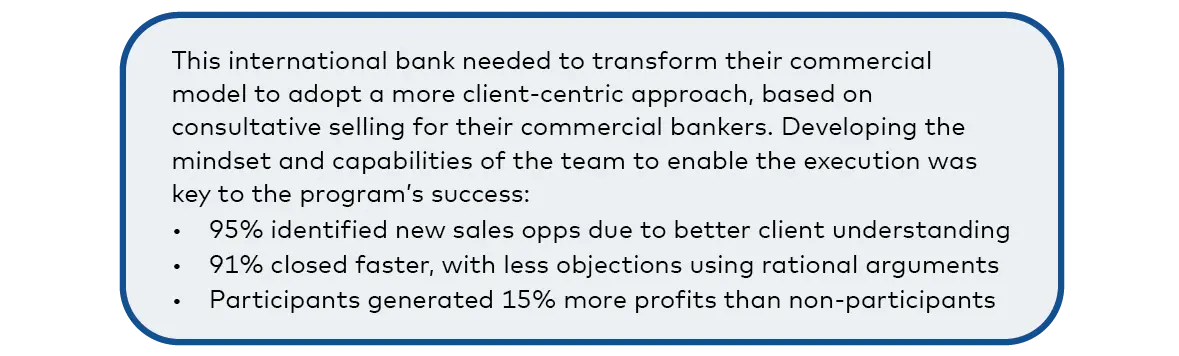
Text block describing an international bank's transformation to a client-centric commercial model, highlighting 95% better client understanding, 91% faster closing, and 15% higher profits for participants.
Text describing improvements in a multinational fast food chain’s Australian leadership team: engagement score rose from 55 to 77 in 3 years, 77% retention of new managers in 12 months, and turnover decreased from 65% to 45% in 12 months.
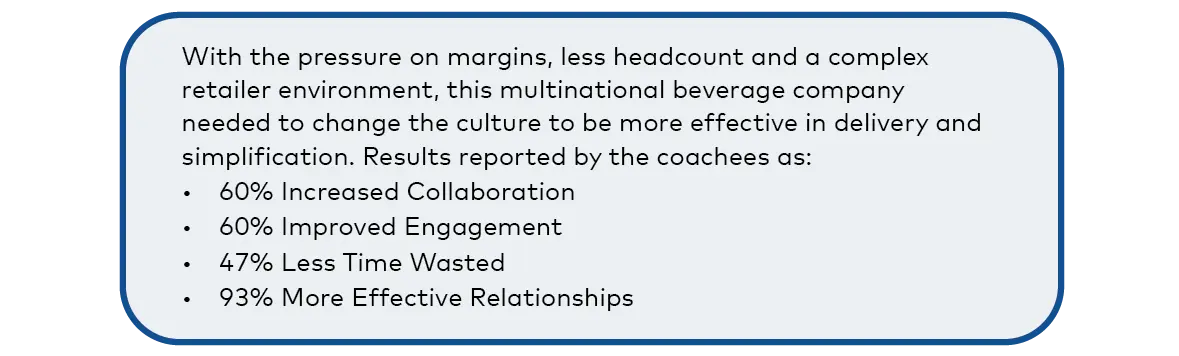
Text box describing a multinational beverage company's culture change with results: 60% increased collaboration, 60% improved engagement, 47% less time wasted, and 93% more effective relationships.
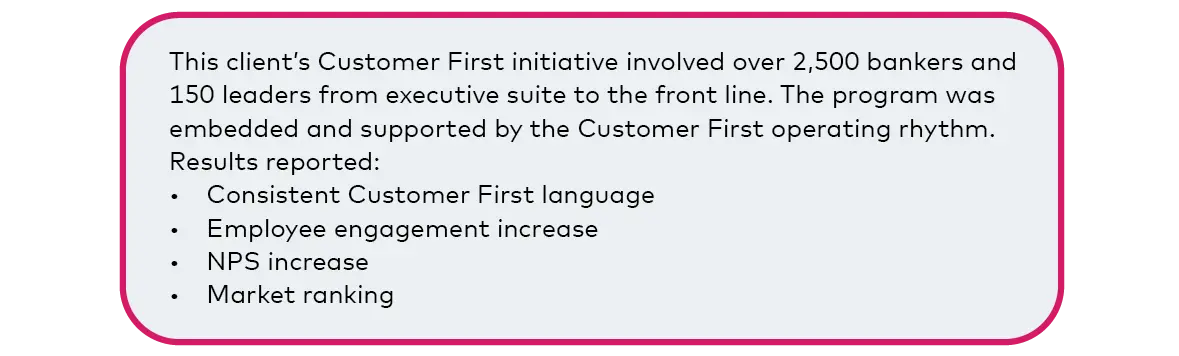
Text describing a Customer First initiative involving over 2,500 bankers and 150 leaders, highlighting results such as consistent Customer First language, increased employee engagement, NPS increase, and market ranking.
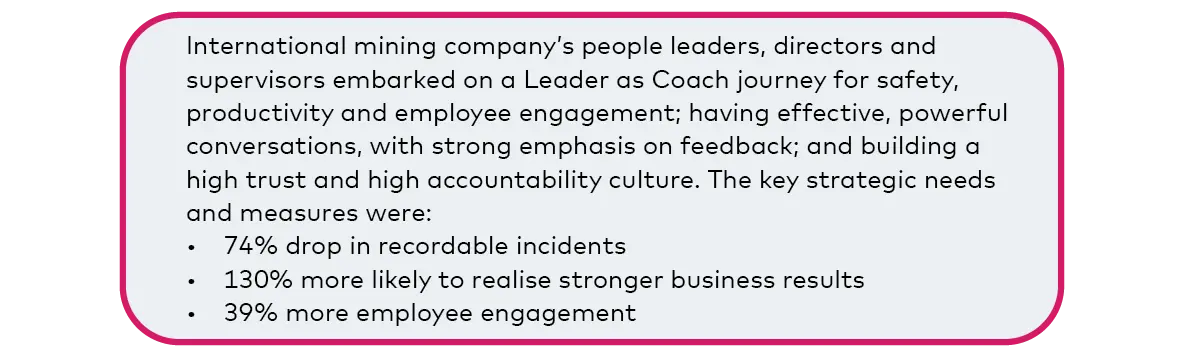
Text describing an international mining company's leadership journey focusing on safety, productivity, employee engagement, effective feedback, and high accountability, with key outcomes: 74% drop in recordable incidents, 130% higher likelihood of stronger business results, and 39% more employee engagement.
Text describing a software company onboarding its leadership team to a cloud business via an executive development program with results: 97% clarity on values, 94% energy and purpose, 90% progress on business challenges.
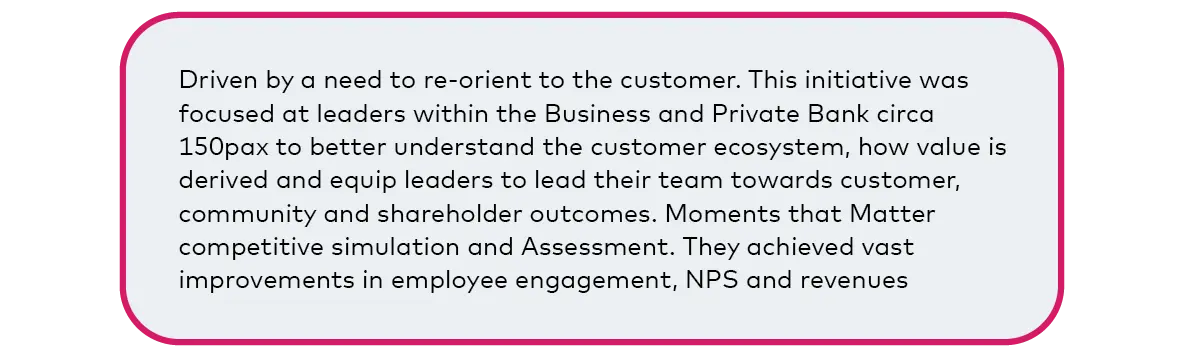
Text describing a leadership initiative aimed at Business and Private Bank leaders to enhance customer focus, understanding of customer ecosystem, and improving employee engagement, NPS, and revenues.
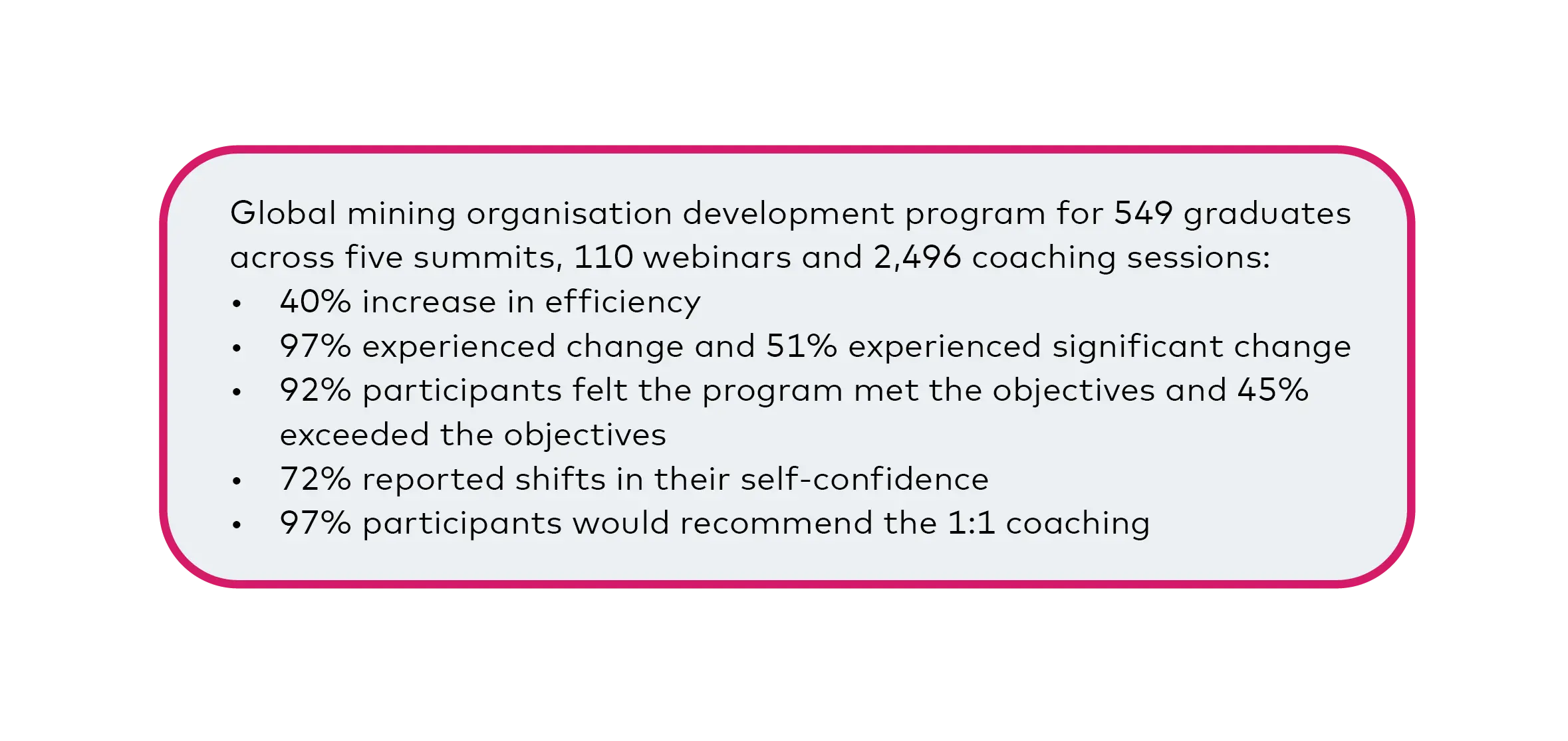
Text summary of a global mining development program with 549 graduates, 5 summits, 110 webinars, and 2,496 coaching sessions showing increases in efficiency, change experiences, meeting and exceeding objectives, self-confidence shifts, and high coaching recommendations.
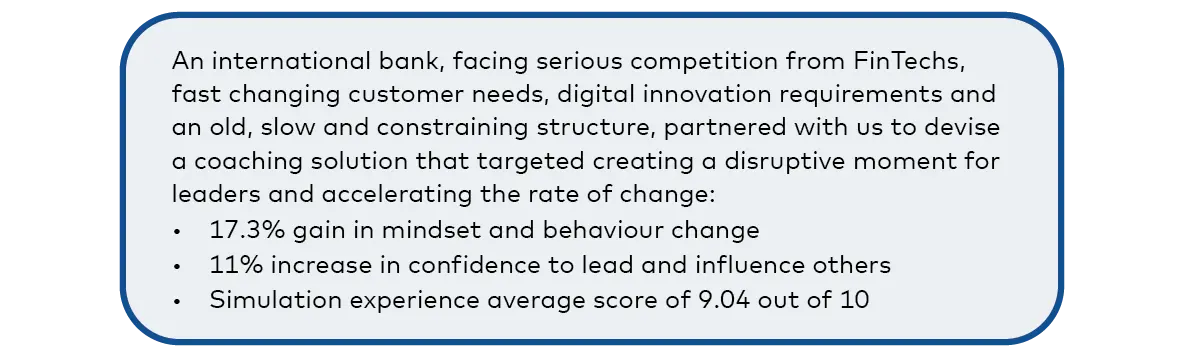
Text describing an international bank partnering to create a coaching solution, achieving 17.3% mindset gain, 11% confidence increase, and 9.04 simulation score.

BTS España

Estudio

Observatorio de Ejecución Estratégica

En BTS pensamos que una estrategia, un plan estratégico si se prefiere, es tan importante como lo es su ejecución. Esta idea no es nueva y, sin embargo, conviene verificarla de forma periódica para confirmar su validez.

Si la premisa inicial se confirmara, habría pues que indagar en los facilitadores y los obstáculos de esta ejecución estratégica. Nuestra premisa o hipótesis es que la cultura organizativa y la alineación con la estrategia son dos elementos facilitadores fundamentales, que no pueden faltar si se quiere que la estrategia diseñada y planteada tenga éxito.

Our Smart Learning Methodology
Bridge the gap between knowledge acquisition and effective application
Logo for 456 Smart Learning with stylized numbers and a figure holding a star inside the number 6.
4line Learning logo with colorful curved lines in blue, green, red, yellow, and orange beneath the text.
Provide Flexible Learning Approaches That Extend Beyond the Classroom

Weaving 4 distinct ways of learning that serves the 70-20-10 development model, creating community and momentum to deliver maximum learning impact.

Gradient blue ascending bar chart with five vertical bars of increasing height from left to right.
Engage Learners to Drive Their Learning Journey​

Process that engages learners to effectively acquire, retain, and apply new mindsets, skillsets, and toolsets in their life and work.
Learning Laos logo with a stylized figure reaching for stars inside the number 6, and a color bar with yellow, orange, green, dark green, red, and maroon below.
Remove Application Barriers and Sustain Learning for Impactful Real-Life Actions and Outcomes

6 targeted application boosters focusing on developing action (application) in real-world scenarios for impact.


Clients we partner with
Client stories

Leadership coaching as a culture enabler

To build a sustainable approach to recent success, and to reach their goal of becoming the best performing, most trusted, and respected consumer packaged goods company locally, the organisation identified the need to develop a leadership coaching culture. BTS Coach developed a coaching effectiveness program, as a new way of leading both people and business performance.

Learn more
Smiling man in glasses and black suit with blue tie, standing with arms crossed in bright modern office corridor.
Client Stories

Multipliers: Elevating the leadership mindset

A leading provider of software for property and casualty insurers recognised a need to become more agile and tap into its full capabilities. To do so, the company needed an engaging way to virtually build excitement within the group, which was located remotely, while expanding its leadership skills, particularly for financial leaders.

Learn more
Smiling woman wearing glasses sitting at a desk in a bright modern office.
Client Stories

Leading during uncertainty

Facing challenging times within a difficult market, a recent acquisition, and quality issues, a leading consumer goods business recognised the need to develop its leaders. The organisation wanted to equip its leaders with the skills to manage through and out of this period of uncertainty.

Learn more
Man in glasses and blue shirt smiling while looking at a tablet sitting on outdoor steps.
Client stories

The Change-Ready™ leader

A high-tech global manufacturing company set a new strategy, revolutionised their go-to-market approach, and went through a re-organisation. Feeling uncertain and lacking confidence about their ability to lead the change in their BUs and functions, the organisation’s leaders needed to become change-ready while not always necessarily being able to be face-to-face with one another.

Learn more
Smiling woman with raised arms dancing joyfully in a modern office hallway.
Client stories

The people side of Agile transformation

Facing a rapidly changing and highly competitive environment, a leading American financial services corporation knew that they needed to shift to become more agile and customer-centric to continue to succeed, shifting leadership behaviours from command and control to a more service-oriented “servant leadership” mindset.

Learn more
Smiling man with short black hair wearing a white shirt in a softly blurred indoor setting.
Careers

Trabajar en España

Trabajar en BTS significa trabajar en una organización que pone a las personas en primer lugar. Queremos ser la consultora más atractiva para trabajar, y eso se refleja en un entorno de trabajo donde tienes oportunidades para crecer desde el primer día.

En BTS España trabajarás con equipos diversos, en un entorno meritocrático y divertido donde podrás tener mucha exposición tanto interna como con nuestros clientes. Trabajarás con organizaciones de referencia de distintas industrias, lo que te permitirá acelerar tu curva de aprendizaje y no parar de aprender.

¿Te animas?

We at BTS, acknowledge the Traditional Custodians of the land on which we work, the Wurundjeri and Eora people. We pay our respects to Elders, past, present and emerging, and recognise all traditional custodians continued connection to land, waters and community.

Oficinas e Información de Contacto

Bilbao
Bilbao
Simon Bolivar Kalea 27-1, Office No. 4
48013 Bilbao
+34 94 423 5594
Madrid
Madrid
Paseo de la Castellana 91, 5th Floor
28046 Madrid
+34 91 417 5327
Netmind – Barcelona
Netmind – Barcelona
Plaza del Gas, nº 1 Edificio B – 5th Floor, Office 203
08003 Barcelona, Spain