Locations

Welcome to BTS North America

We're in the business of inspiring and equipping people to do the best work of their lives. And when people do the best work of their lives, they create better businesses and a better world.

BTS is the global leader in transforming strategy into action and results through people. With offices throughout the US and Canada, we bring over 30 years of experience in the North American market working with leading companies across all industries.

People are the key to successfully executing any strategic initiative. Companies need their people to be aligned with the organization’s vision of success, generating the right mindset for them to address necessary changes, develop skills, enable transformation and generate amazing business results.

Talk to one of our experts
Contact us

Latest content

Blogposts
March 20, 2026
5
min read
Qué funciona y qué no en las transformaciones y cambios culturales
Cómo liderar un cambio cultural real en tu organización: insights prácticos, errores habituales y un enfoque probado para alinear estrategia, liderazgo y comportamientos hacia resultados sostenibles.

¿Se puede cambiar la cultura de una organización?

Hoy en día, hay pocas organizaciones que no se encuentren inmersas en uno (o varios) procesos de transformación cultural. Nuevas formas de trabajar en organizaciones más planas y adaptativas, mejoras en la cultura de seguridad, orientar la organización hacia sus clientes, transformaciones de las áreas comerciales, mejora de la excelencia operativa, por citar algunas.

Y es aquí donde viene una de las grandes preguntas:
¿se puede cambiar la cultura de una organización? Y, si es así, ¿cómo se hace?

Para ayudar a responder a estas preguntas, que a menudo nos hacen nuestros clientes y sobre las que hay mucho escrito, me gustaría compartir lo que en BTS hemos aprendido en los últimos 38 años sobre qué funciona y qué no (hasta ahora, que en esto de los cambios culturales uno nunca deja de aprender).

La buena noticia es que la respuesta a la pregunta de si se puede cambiar la cultura de una organización es sí.
La dificultad viene al responder a la segunda: ¿cómo se hace?

¿Un proyecto? ¿Una iniciativa?

Un punto importante a considerar es que los procesos de cambio o transformación cultural no son un proyecto con un inicio y un fin; es un proceso en constante evolución. Y esto es algo que en ocasiones genera tensión en las organizaciones, a menudo acostumbradas a un enfoque basado en proyectos.

¿Qué es crítico y a menudo se suele ignorar?

Hay una serie de elementos que, si se tienen en cuenta y se utilizan adecuadamente, harán que los esfuerzos de transformación sean mucho más eficaces. Desafortunadamente, muchas veces se ignoran.

Estos elementos críticos son:

  • Involucrar a la gente. Cuanto más se hace partícipes de la transformación a las personas (a todos los niveles), más altas son las probabilidades de que implementen los cambios requeridos.
  • Para entender el cambio hay que tangibilizarlo y experimentarlo. Consiste en conectar el marco teórico con acciones del día a día. Explicar la foto completa con transparencia es clave.
  • Todos los cambios traen consigo cosas positivas, pero también tienen impactos negativos. Explicar la foto completa con transparencia es clave.
  • Cambiar la cultura implica tiempo y requiere identificar y cambiar los “mindsets” y las estructuras diarias (símbolos) que definen cómo se hacen las cosas en la organización.
  • La cultura debe estar fuertemente conectada con la estrategia.

¿Cómo recomendamos estructurar los procesos de cambio cultural?

Nuestro enfoque se compone de cuatro etapas: establecer resultados, crear líderes de cambio, incrustar cambios clave y sostener las nuevas formas de trabajo.

1. Establecer resultados

El primer paso en cualquier proceso de transformación es establecer resultados claros. Es crucial identificar los impulsores de la transformación y definir los resultados deseados de manera que se logre un verdadero alineamiento a nivel ejecutivo. A medida que se avanza, hay que conectar los puntos entre el propósito y la visión, entendiendo de dónde se viene, dónde se está y hacia dónde se quiere avanzar. Además, es esencial conectar la transformación con los objetivos organizacionales.

Algunas acciones relevantes de esta fase son:

  • Recopilación de información (entrevistas, focus groups, visitas a operaciones,…)
  • Diagnósticos culturales
  • Definición de expectativas (Leadership Profiles

2. Crear líderes de cambio

En BTS creemos que todos los líderes son también líderes de cambio. Adoptar una mentalidad de “líder de cambio” requiere que los líderes experimenten y vean lo que se espera de ellos. Desde el inicio, es vital impulsar a la acción con ‘trabajo real’, como establecer nuevas prioridades y comunicar de forma transparente y eficaz.

Hay que comprometer (emocional y racionalmente) a los líderes con el cambio y hacerles ver cómo pueden impactar en la cultura a través de acciones concretas en el día a día.

Por último, es necesario proporcionar apoyo continuo para los cambios de mentalidad y comportamiento más difíciles y recoger retroalimentación sobre lo que funciona y lo que no en esta etapa.

Algunas acciones relevantes de esta fase son:

  • Elaboración de Playbooks para roles críticos
  • Despliegue de programas de liderazgo y cambio
  • Feedback loops con los niveles ejecutivos

3. Incrustar cambios clave

Para lograr un cambio significativo, es esencial identificar los modelos mentales actuales y ofrecer nuevos que apoyen el estado deseado. Crear rutinas y símbolos que refuercen el cambio, así como identificar procesos, prácticas, eventos o normas ancladas en las viejas formas de trabajar, es crucial.

Cocrear nuevas formas de trabajo para su activación inmediata ayuda a cimentar estos cambios. A medida que se avanza, cambiar los sistemas y procesos que soportan y refuerzan los cambios cruciales es fundamental para el éxito a largo plazo.

Algunas acciones relevantes de esta fase son:

  • Coaching a líderes
  • Montar Sprints culturales
  • Cascadear el cambio al resto de la organización
  • Assessments para medir cambios de comportamientos

4. Sostener las nuevas formas de trabajo

El cambio no es solo un esfuerzo individual, sino también un fenómeno social. Por ello hay que proveer de las redes sociales necesarias para apoyar los cambios de mentalidad y comportamiento. Intervenir con apoyo individual para roles críticos y períodos específicos, así como incorporar nuevas formas de trabajo, asegura la continuidad del cambio.

Por último, hay que utilizar datos para analizar lo que funciona y lo que no, permitiendo crear el siguiente conjunto de intervenciones y apoyo necesarios.

Algunas acciones relevantes de esta fase son:

  • Integración de los Playbooks en el ciclo de talento de la organización
  • Practica de los nuevos comportamientos en el día a día con bots potenciados por IA
  • Diseño de una oficina para monitorizar el cambio y definir nuevas acciones
  • Diseño y lanzamiento de Comunidades de Práctica (CoP)

La importancia de ser paciente e impaciente a la vez

Los procesos de transformación cultural son uno de los elementos más retadores, ya que nunca existe una receta única.

Ser estratégicamente paciente (teniendo claros esos resultados deseados y evitando dar bandazos), pero tácticamente impaciente (realizando acciones en las fases expuestas anteriormente y viendo qué funciona y qué no, para pivotar y corregir) es clave en los procesos de transformación.

El enfoque de las 4 fases ayuda a ello, posibilitando que estos viajes se conviertan en una experiencia enriquecedora para la organización, y no en un dolor de los que dejan cicatriz en la memoria colectiva.

Este es solo un resumen.
Si quieres profundizar en el enfoque completo, ejemplos y claves prácticas:

Descarga el PDF completo y accede a todo el contenido.

Blogposts
March 19, 2026
5
min read
Ocho cambios que están dando forma a organizaciones más seguras y sostenibles
Comprende los cambios clave que están redefiniendo cómo las organizaciones integran la seguridad y la sostenibilidad en su desempeño, a través del liderazgo, el aprendizaje continuo y sistemas operativos resilientes.

En todos los sectores, la seguridad está experimentando un cambio estructural. Lo que antes se gestionaba principalmente como una función de cumplimiento o una métrica de desempeño se entiende cada vez más como un reflejo de cómo las organizaciones están diseñadas, lideradas y mejoradas de forma continua.

En entornos complejos y de alto riesgo, la seguridad no se logra únicamente mediante un mayor control o programas adicionales. Surge de la interacción entre el comportamiento del liderazgo, el diseño operativo, los entornos de decisión y la capacidad de la organización para aprender y adaptarse.

Basándonos en la ciencia global de la seguridad, el enfoque de Human & Organizational Performance (HOP), la investigación sobre seguridad psicológica y nuestra experiencia en transformación en múltiples industrias, identificamos ocho cambios clave que están definiendo la próxima evolución de la cultura de seguridad.  

1. La seguridad como valor organizacional central

La seguridad está dejando de tratarse como una prioridad cambiante. Las prioridades compiten. Los valores guían.

Cuando la seguridad se convierte en un valor central, influye en la toma de decisiones, en los compromisos bajo presión, en la planificación operativa y en la asignación de recursos. La seguridad pasa a ser una consecuencia natural de cómo funciona el sistema, en lugar de una iniciativa añadida a la producción.

Este cambio también redefine el rol de las funciones de seguridad: de supervisar el cumplimiento a habilitar un desempeño seguro y sostenible.

2. El aprendizaje como disciplina operativa

Las organizaciones están integrando el aprendizaje continuo en las operaciones diarias. En lugar de centrarse solo en lo que falló, exploran señales débiles, casi accidentes, fricciones operativas y adaptaciones exitosas.

El aprendizaje se convierte en una capacidad clave que acelera la generación de insights, fortalece la resiliencia y mejora la calidad de las decisiones.

3. Responsabilidad del liderazgo en todos los niveles

La cultura de seguridad se reconoce cada vez más como una capacidad de liderazgo, no solo como responsabilidad del área de HSE.

  • Los directivos marcan la dirección y el tono.
  • Los mandos intermedios traducen las expectativas en decisiones operativas.
  • Los supervisores configuran el entorno de decisiones del día a día.

Las organizaciones exitosas convierten las expectativas de seguridad en comportamientos concretos de liderazgo y rutinas diarias, generando claridad y alineación entre niveles.

4. La seguridad psicológica como infraestructura

Una cultura de seguridad sólida depende de entornos donde las personas se sientan seguras para hablar.

Cuando los empleados perciben seguridad psicológica, las señales débiles emergen antes, los riesgos se discuten abiertamente y el aprendizaje se acelera.

La seguridad psicológica es una infraestructura operativa, no un tema “blando”.

5. Amplificar lo que funciona

Existe un reconocimiento creciente de que la mayor parte del trabajo se realiza de forma segura, a menudo en condiciones variables.

Estudiar el éxito revela la capacidad adaptativa y fortalece la resiliencia. Esto complementa el análisis tradicional de incidentes al reforzar la experiencia y la confianza.

6. Alinear el trabajo “imaginado” con el trabajo “real”

Los procedimientos y planes rara vez capturan perfectamente la complejidad operativa.

Las organizaciones líderes reducen la brecha entre políticas y realidad operativa incorporando la perspectiva del personal de primera línea y empoderando la autoridad para detener el trabajo.

El objetivo es una mejor alineación entre diseño y ejecución.

7. Diseñar para la toma de decisiones humana

Los incidentes suelen derivarse de sesgos cognitivos predecibles como la normalización de la desviación, el sesgo hacia la producción, el exceso de confianza y el sesgo retrospectivo.

Reconocer estas trampas en la toma de decisiones desplaza el enfoque de culpar a las personas hacia fortalecer los entornos de decisión.

8. La evolución cultural como capacidad a largo plazo

Una cultura de seguridad sostenible requiere integración en lugar de reinvención, desarrollo estructurado de capacidades en lugar de programas puntuales y medición del impacto conductual en lugar de métricas de actividad.

Las organizaciones que tienen éxito:

  • Integran la seguridad en los sistemas existentes de liderazgo y operación
  • Diseñan itinerarios de aprendizaje que apoyan la aplicación en el día a día
  • Miden el cambio de comportamiento y los resultados operativos
  • Refuerzan el progreso de manera consistente en el tiempo

La evolución cultural es un compromiso sostenido con la alineación del sistema y el desarrollo de capacidades.

Conclusión

La evolución de la cultura de seguridad trata menos de añadir controles y más de fortalecer sistemas.

La seguridad es algo que las organizaciones producen: a través de la claridad del liderazgo, el diseño operativo, la seguridad psicológica y el aprendizaje continuo.

Quienes integren estas capacidades de forma consistente no solo reducirán riesgos. Construirán organizaciones más resilientes, sostenibles y de alto desempeño.

Sources & references:

  • WorldSteel Association. Safety Culture & Leadership Fundamentals.
  • Norsk Industri (2025). Safety Leadership and Learning: A Practical Guide to HOP.
  • D. Parker et al. / Safety Science 44 (2006). Development of Organisational Safety Culture
  • Hollnagel, E. (2014). Safety-I and Safety-II: The Past and Future of Safety Management.
  • Hollnagel, E. (2018). Safety-II in Practice: Developing the Resilience Potentials.
  • Conklin, T. (2012). Pre-Accident Investigations: An Introduction to Organizational Safety.
  • Edmondson, A. (2018). The Fearless Organizations
  • Reason, J. (1997). Managing the Risks of Organizational Accidents.
  • Resilience Engineering research (Hollnagel,Woods, Leveson and others).

Blogposts
March 19, 2026
5
min read
Eight Shifts Shaping Safer and More Sustainable Organizations
Understand the critical shifts redefining how organizations embed safety and sustainability into performance, through leadership, continuous learning, and resilient operational systems.

Across industries, safety is undergoing a structural shift. What was once managed primarily as a compliance function or performance metricis increasingly understood as a reflection of how organizations are designed, led and continuously improved.

In complex and high-risk environments, safety is notachieved through stronger enforcement or additional programs alone. It emerges from the interaction between leadership behavior, operational design, decision environments and the organization’s capacity to learn and adapt.

Drawing on global safety science, Human & Organizational Performance (HOP), research on psychological safety, and our cross-industry transformation experience, eight key shifts are shaping the next evolution of safety culture.


1. Safety as a Core Organizational Value

Safety is moving beyond being treated as a shifting priority. Priorities compete. Values guide.

When safety becomes a core organizational value, it shapes decision-making, trade-offs under pressure, operational planning and resourceallocation. Safety becomes the natural consequence of how the system operates,rather than a campaign layered on top of production.

This shift also redefines the role of safety functions, from compliance policing to enabling safe and sustainable performance.


2. Learning as an Operating Discipline

Organizations are embedding continuous learning into everyday operations. Rather than focusing only on what failed, they exploreweak signals, near misses, operational friction and successful adaptations.

Learning becomes a core capability, accelerating insight, strengthening resilience and improving decision quality.


3. Leadership Ownership at All Levels

Safety culture is increasingly recognized as a leadership capability, not solely an HSE responsibility.

Executives define direction and tone.
Middle managers translate expectations into operational decisions.
Supervisors shape the daily decision environment.

Successful organizations translate safety expectations into concrete leadership behaviors and daily routines, creating clarity and alignment across levels.


4. Psychological Safety as Infrastructure

A strong safety culture depends on speaking-up environments.

When employees feel psychologically safe, weak signals surface earlier, risk trade-offs are openly discussed and learning accelerates.

Psychological safety is operational infrastructure , not a soft topic.


5. Amplifying What Works

There is growing recognition that most work is completed safely, often under variable conditions.

Studying success reveals adaptive capacity and strengthens resilience. This complements traditional incident analysis by reinforcing expertise and confidence.


6. Aligning Work-as-Imagined and Work-as-Done

Procedures and plans rarely capture operational complexity perfectly.

Leading organizations reduce the gap between policies and operational reality by inviting front line input and empowering stop-work authority.

The goal is better alignment between design and execution.


7. Designing for Human Decision-Making

Incidents often stem from predictable cognitive biases such as normalization of deviance, production bias, overconfidence and hindsight bias.

Recognizing these decision traps shifts focus from blaming individuals to strengthening decision environments.


8. Cultural Evolution as a Long-Term Capability

Sustainable safety culture requires integration rather than reinvention, structured capability journeys rather than one-off programs, and measurable behavioral impact rather than activity metrics.

Organizations that succeed:

  • Integrate safety into existing leadership and operational systems
  • Design earning journeys that support day-to-day application
  • Measure behavioral change and operational outcomes
  • Reinforce progress consistently over time

Cultural evolution is a sustained commitment to system alignment and capability building.


Conclusion

The evolution of safety culture is less about adding controls and more about strengthening systems.

Safety is something organizations produce — through leadership clarity, operational design, psychological safety and continuous learning.

Those who embed these capabilities consistently will not only reduce risk. They will build more resilient, sustainable and high-performing organizations.

Sources & references:

  • WorldSteel Association. Safety Culture & Leadership Fundamentals.
  • Norsk Industri (2025). Safety Leadership and Learning: A Practical Guide to HOP.
  • D. Parker et al. / Safety Science 44 (2006). Development of Organisational Safety Culture
  • Hollnagel, E. (2014). Safety-I and Safety-II: The Past and Future of Safety Management.
  • Hollnagel, E. (2018). Safety-II in Practice: Developing the Resilience Potentials.
  • Conklin, T. (2012). Pre-Accident Investigations: An Introduction to Organizational Safety.
  • Edmondson, A. (2018). The Fearless Organizations
  • Reason, J. (1997). Managing the Risks of Organizational Accidents.
  • Resilience Engineering research (Hollnagel,Woods, Leveson and others).

Blogposts
March 17, 2026
5
min read
AI-Enabled Customer Centered Conversations
Why most sales meetings fail to create value, and how to intentionally build urgency, trust, and momentum into every conversation.

Most sales meetings don’t fail.
They just don’t lead to a decision.

And that’s where value is lost.

Today’s customers are more informed, more selective, and more time-poor.

They don’t need more product pitches.
They need conversations that help them prioritize, decide, and move forward.

And yet, 58% of sales meetings fail to create real value.

Not because sellers lack capability, but because conversations are not designed to move decisions forward.

“Customers don’t act on every need they recognize.

They act when something becomes a priority.”

 In this short executive brief, you’ll discover:

  • Why most conversations inform… but don’t drive action
  • What actually makes customers prioritize and move
  • How to create urgency without damaging trust
  • The shift from presenting solutions to enabling decisions
  • What separates conversations that stall from those that accelerate momentum

If your teams are experiencing stalled deals, delayed decisions, or slow pipeline movement, this brief will help you understand why, and what to do differently.

Download the Executive Brief and learn how to design conversations that actually move decisions forward

What makes us different

Business and people centric

We operate in the intersection of strategy consulting and people development. We meld deep understanding of your strategy and performance with our ability to create transformative experiences.

Unrivaled simulations

Our 30+ years as the global leader in modeling roles, businesses, strategies, cultures, and workflows will help your people feel included in the company’s direction and give your leaders the ability to practice the behaviors needed for your company to evolve.

Turning strategy into action

Our personalized journeys of learning, development, and execution, help people and organizations develop new habits, and come out stronger, better aligned, and more prepared to execute their strategies.

Client obsessed

Relentlessly contextual to your strategy and culture, we co-create our programs around the metrics and behaviors that will help you align your people and create positive results.

Empowering Your Organization with Strategy Execution, Leadership, Talent and Succession Solutions

In today’s fast-paced business environment, organizations face numerous challenges in executing strategies, ensuring continuity, preparing for future needs, and cultivating a culture of excellence. At BTS, we understand these challenges and have developed comprehensive solutions that bridge strategy with leadership and talent capabilities to deliver impactful results.

Services

Leadership Development

Great leaders create inclusive communities, empower individuals and teams with higher levels of motivation, and lift organizational results.

Today’s leaders must adapt to the rapidly changing world while maintaining the compassion and humility needed to relate to teams on a human level. BTS has deep understanding and expertise in leadership coaching and development, leveraging diverse methods to equip leaders with the tools to succeed.

Services

Sales & Marketing Strategy

Integrating marketing and sales is transformational.

In today’s market, your sales, marketing, product, and service teams face accelerating buying cycles, fragmented markets, and demanding buyers. BTS has spent years conducting extensive research and working with the world’s best sales and marketing organizations to gain a deep understanding of the critical moments in a buyer’s journey. Leveraging this understanding, we equip your customer-facing teams with the skills and mindsets needed to accelerate results, close sales quickly, and provide elevated service that will keep your clients coming back.


Services

Strategy Execution & Business Transformation

Going from strategy to execution can be a challenging process. To effectively execute new business and culture strategies in today’s constantly changing business environment, leaders must inspire teams to shift their mindsets and behaviors as well as initiatives and ways of working. We also know that change has changed. Traditional change management approaches can’t keep up with today’s business evolution. BTS can help your team understand, adapt, and thrive in new competitive landscapes and cultures, providing you with the alignment and mindset necessary to execute your strategies at scale.


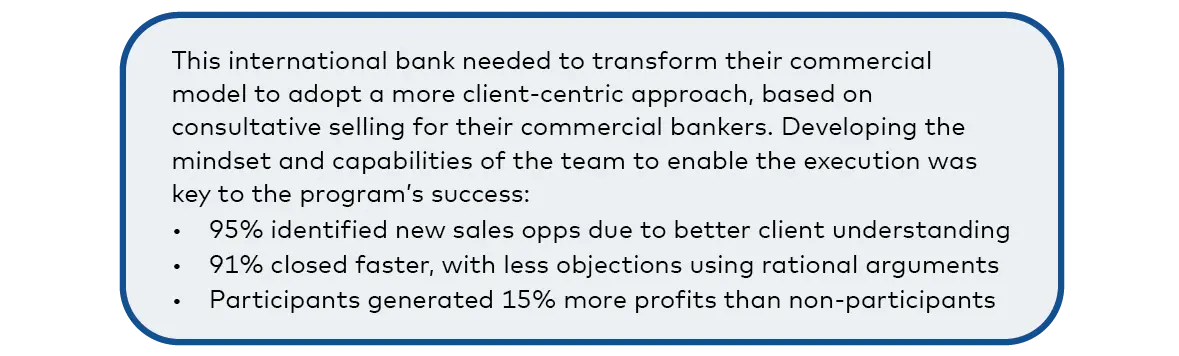
Text block describing an international bank's transformation to a client-centric commercial model, highlighting 95% better client understanding, 91% faster closing, and 15% higher profits for participants.
Text describing improvements in a multinational fast food chain’s Australian leadership team: engagement score rose from 55 to 77 in 3 years, 77% retention of new managers in 12 months, and turnover decreased from 65% to 45% in 12 months.
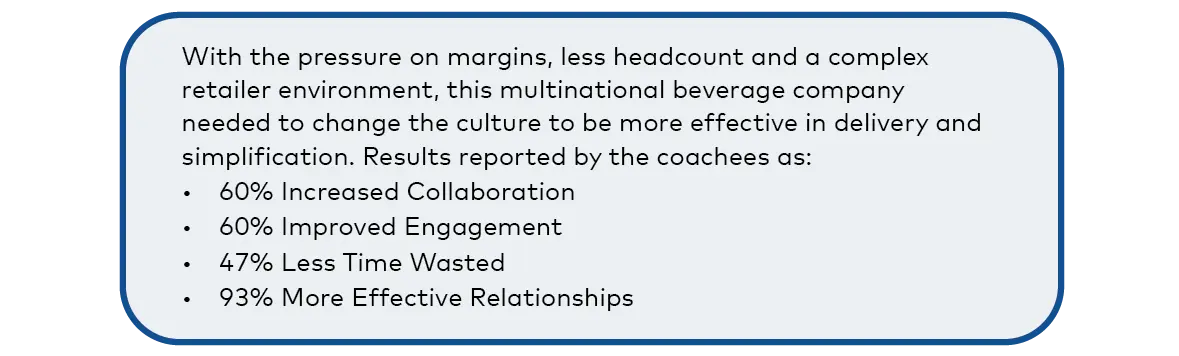
Text box describing a multinational beverage company's culture change with results: 60% increased collaboration, 60% improved engagement, 47% less time wasted, and 93% more effective relationships.
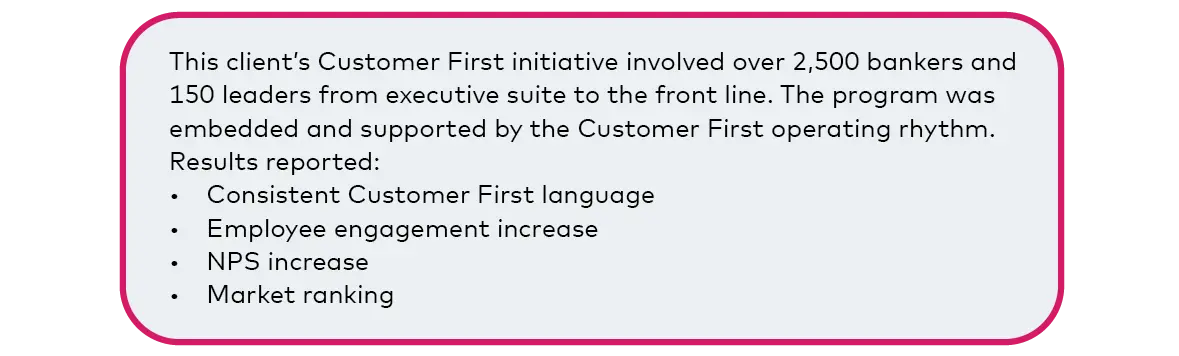
Text describing a Customer First initiative involving over 2,500 bankers and 150 leaders, highlighting results such as consistent Customer First language, increased employee engagement, NPS increase, and market ranking.
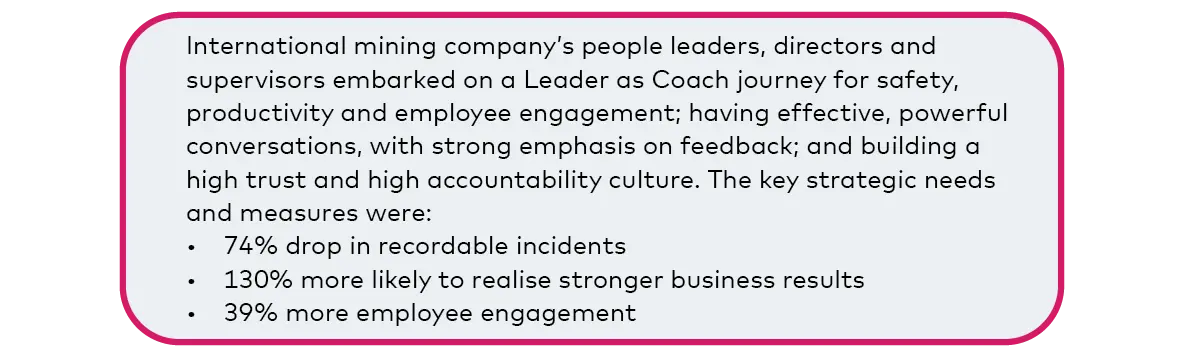
Text describing an international mining company's leadership journey focusing on safety, productivity, employee engagement, effective feedback, and high accountability, with key outcomes: 74% drop in recordable incidents, 130% higher likelihood of stronger business results, and 39% more employee engagement.
Text describing a software company onboarding its leadership team to a cloud business via an executive development program with results: 97% clarity on values, 94% energy and purpose, 90% progress on business challenges.
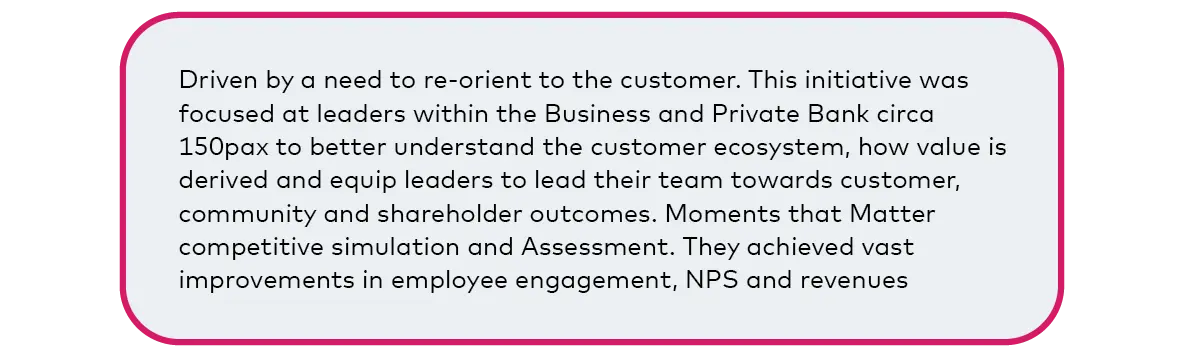
Text describing a leadership initiative aimed at Business and Private Bank leaders to enhance customer focus, understanding of customer ecosystem, and improving employee engagement, NPS, and revenues.
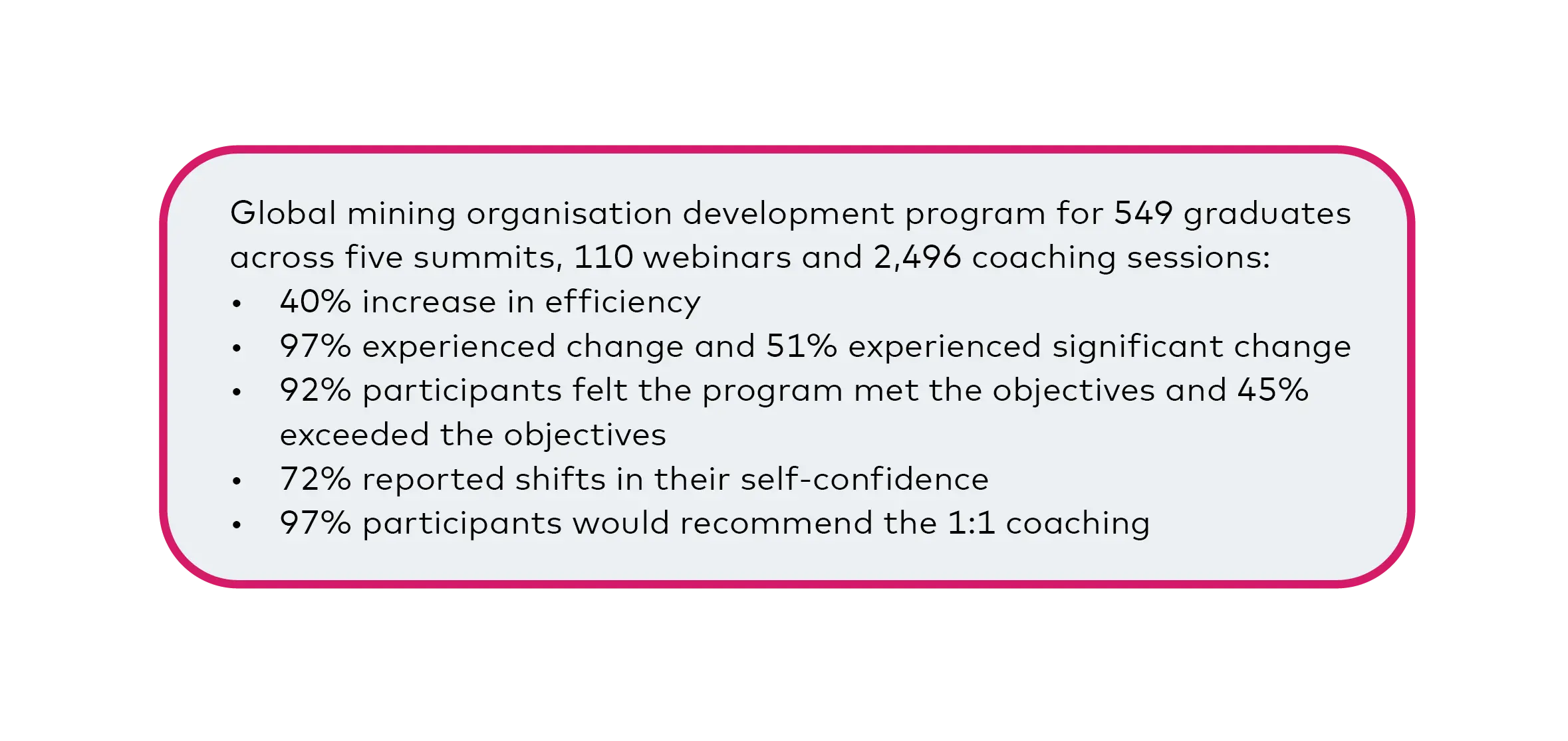
Text summary of a global mining development program with 549 graduates, 5 summits, 110 webinars, and 2,496 coaching sessions showing increases in efficiency, change experiences, meeting and exceeding objectives, self-confidence shifts, and high coaching recommendations.
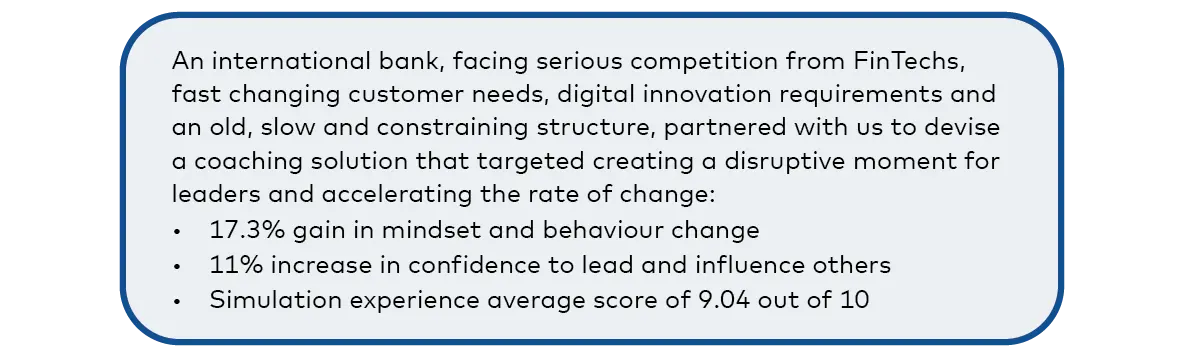
Text describing an international bank partnering to create a coaching solution, achieving 17.3% mindset gain, 11% confidence increase, and 9.04 simulation score.

Level up your team’s thinking to an enterprise value mindset

How to leverage strategy modelling and business simulations to break up silo thinking, embed new ways of working, and increase collaboration across boundaries to drive enterprise thinking.

Our Smart Learning Methodology
Bridge the gap between knowledge acquisition and effective application
Logo for 456 Smart Learning with stylized numbers and a figure holding a star inside the number 6.
4line Learning logo with colorful curved lines in blue, green, red, yellow, and orange beneath the text.
Provide Flexible Learning Approaches That Extend Beyond the Classroom

Weaving 4 distinct ways of learning that serves the 70-20-10 development model, creating community and momentum to deliver maximum learning impact.

Gradient blue ascending bar chart with five vertical bars of increasing height from left to right.
Engage Learners to Drive Their Learning Journey​

Process that engages learners to effectively acquire, retain, and apply new mindsets, skillsets, and toolsets in their life and work.
Learning Laos logo with a stylized figure reaching for stars inside the number 6, and a color bar with yellow, orange, green, dark green, red, and maroon below.
Remove Application Barriers and Sustain Learning for Impactful Real-Life Actions and Outcomes

6 targeted application boosters focusing on developing action (application) in real-world scenarios for impact.

Clients we partner with
No items found.
Client stories

Leadership coaching as a culture enabler

To build a sustainable approach to recent success, and to reach their goal of becoming the best performing, most trusted, and respected consumer packaged goods company locally, the organization identified the need to develop a leadership coaching culture. BTS Coach developed a coaching effectiveness program, as a new way of leading both people and business performance.

Learn more
Smiling man in glasses and black suit with blue tie, standing with arms crossed in bright modern office corridor.
Client Stories

Multipliers: Elevating the leadership mindset

A leading provider of software for property and casualty insurers recognized a need to become more agile and tap into its full capabilities. To do so, the company needed an engaging way to virtually build excitement within the group, which was located remotely, while expanding its leadership skills, particularly for financial leaders.

Learn more
Smiling woman wearing glasses sitting at a desk in a bright modern office.
Client Stories

Leading during uncertainty

Facing challenging times within a difficult market, a recent acquisition, and quality issues, a leading consumer goods business recognized the need to develop its leaders. The organization wanted to equip its leaders with the skills to manage through and out of this period of uncertainty.

Learn more
Man in glasses and blue shirt smiling while looking at a tablet sitting on outdoor steps.
Client stories

The Change-Ready™ leader

A high-tech global manufacturing company set a new strategy, revolutionized their go-to-market approach, and went through a re-organization. Feeling uncertain and lacking confidence about their ability to lead the change in their BUs and functions, the organization’s leaders needed to become change-ready while not always necessarily being able to be face-to-face with one another.

Learn more
Smiling woman with raised arms dancing joyfully in a modern office hallway.
Client stories

The people side of Agile transformation

Facing a rapidly changing and highly competitive environment, a leading American financial services corporation knew that they needed to shift to become more agile and customer-centric to continue to succeed, shifting leadership behaviors from command and control to a more service-oriented “servant leadership” mindset.

Learn more
Smiling man with short black hair wearing a white shirt in a softly blurred indoor setting.
Careers

Working in North America

Working at BTS means working in an organization that puts people first. We want to be the coolest consulting firm to work for, and that is reflected in a work environment where you have opportunities to grow from day one.

At BTS North America, you’ll work to transform the world’s leading organizations. With every client engagement, BTSers dive deep into an organization’s strategies, business models, and leadership behaviors to uncover what really makes it tick. Then, you and your colleagues across the globe team up to develop and deliver transformational solutions that unlock the organizations’ potential – from C-suite to the front line.

Whether you’re a business analyst, executive assistant, senior consultant, design lead, or managing director, at BTS you won’t be a cog in the machine. We believe that given freedom and responsibility, our people are limitless. Expect to make an impact from day one, collaborating with our most senior leaders on projects for some of the biggest names in business.

We at BTS, acknowledge the Traditional Custodians of the land on which we work, the Wurundjeri and Eora people. We pay our respects to Elders, past, present and emerging, and recognise all traditional custodians continued connection to land, waters and community.

Locations & Contact Info

San Francisco (US-West)
222 Kearny St. Suite 1000
San Francisco, CA 94108
+1 415 362 4200
Chicago (US-Central)
200 S Wacker Drive Suite 850
Chicago, IL 60606
+1 312 509 4750
New York (US-East)
New York (US-East)
350 Fifth Ave Suite 5020
New York, NY 10118
+1 646 378 3730
Toronto
Toronto
460 Richmond St W. #700
Toronto, ON M5V 1Y1
+55 (11) 5505 2070
Cincinnati
Cincinnati
2900 Reading Road Suite 235
Cincinnati, Oh 45206
+1 513 556 5511
Phoenix
Phoenix
4742 N. 24th St. Suite 120
Phoenix, AZ 85016
+1 480 948 2777
Advantage Performance Group
100 Smith Ranch Road Suite 306
San Rafael, CA 94903
+1 800 494 6646
Rapid Learning Institute – A BTS Company
435 Devon Park Dr. Bldg, 510
Wayne, PA 19087
+1 877 792 2172