Offerings

Value-added negotiations

Sellers overthink negotiations and they become overwhelmed because they don’t have a clear roadmap to maneuver this critical customer interaction

Experience the BTS difference

Based on our research and years of insights, we believe Value-Added Negotiations will help you and your team transform the approach to negotiations.

Great negotiators can turn every negotiation into a successful, collaborative agreement, and Value-Added Negotiations will make this a reality for your organization. This program works from the proven premise that every negotiation should involve multiple dimensions of interests and offers a straightforward model to plan and engage in negotiations effectively, which we have developed through a 5-module program.

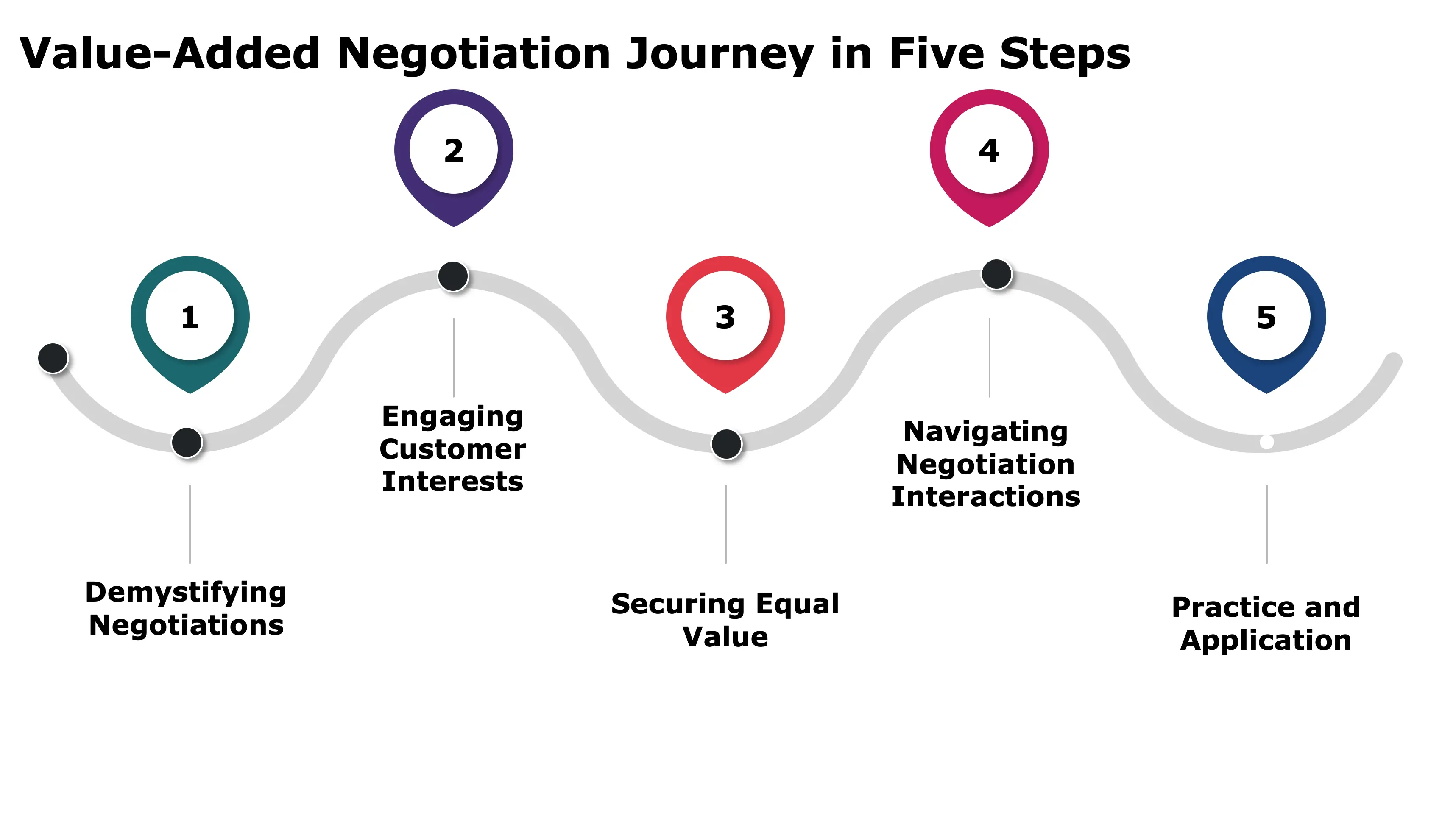
  • Module 1: Demystifying Negotiations
  • Module 2: Engaging Buyer Interests
  • Module 3: Securing Equal Value
  • Module 4: Navigating Negotiation Interactions
  • Module 5: Practice and Application
Contact us
Timeline graphic titled 'Value-Added Negotiation Journey in Five Steps' showing five numbered steps: 1. Demystifying Negotiations, 2. Engaging Customer Interests, 3. Securing Equal Value, 4. Navigating Negotiation Interactions, 5. Practice and Application.

I need my sellers to understand the changes in processes, customer mindsets, and selling outcomes that occur during downturns or other times of distress.

Program Details

Format
Virtual or In-person
Duration
Each module is 90 to 120-minutes in length
Capacity
15-35 participants per session is recommended
Delivery options available for a 1.5-day in-person session or spread out over a two weeks virtually

Related offerings

Clients who have worked with BTS on Value-Added Negotiations have also shown interest in:

Related Content

Inisights
March 17, 2026
5
min read
AI-enabled customer centered conversations
Why sales meetings fail to deliver value, and how to design conversations that build urgency, deepen trust, and accelerate decision-making.

Today’s customers are more informed, more selective, and more time-poor. They need conversations that help them prioritize, decide, and move forward.

And yet, 58% of sales meetings fail to create real value.

Not because sellers lack capability, but because conversations are not designed to move decisions forward.

“Customers don’t act on every need they recognize.
They act when something becomes a priority.”

 In this short executive brief, you’ll discover

  • Why most conversations inform… but don’t drive action
  • What actually makes customers prioritize and move
  • How to create urgency without damaging trust
  • The shift from presenting solutions to enabling decisions
  • What separates conversations that stall from those that accelerate momentum

If your teams are experiencing stalled deals, delayed decisions, or slow pipeline movement, this brief will help you understand why, and what to do differently.

Inisights
June 11, 2024
5
min read
Embedding RGM at scale: A strategic advantage for modern Commercial Leaders
Commercial leaders must adopt a holistic, consumer-focused RGM strategy for sustainable growth and a competitive edge.

In today's fast-changing business environment, excelling in Revenue Growth Management (RGM) is essential for Commercial Leaders aiming to boost revenue and profit, both now and in the future.

Unlike traditional methods that confine RGM to pricing actions, forward-looking Commercial Leaders recognize that activating a holistic, end-to-end RGM strategy that is consumer/shopper focused and customer-back, leads to more significant growth and allows leaders and teams to not only anticipate, but actively influence consumer demand and customer needs.

Historically, Revenue Growth Management (RGM) has been approached as a temporary and reactionary project, which was typically led by external experts in response to inflationary markets. This limited approach confined the benefits to a small part of the business and focused on short-term results, rather than embedding RGM as an ongoing, fundamental aspect of business strategy that could deliver sustained, long-term growth.

Today, mature RGM organizations treat RGM strategy and execution much differently, positioning the actions at the center of their strategic operations, embedding capabilities deeply within their organizational processes and ways of working. This transformation is not just procedural but is a shift that forces RGM strategy, tactics, and mindset into every action and function of the business.

Strategic integration of RGM at scale: A roadmap for success

  1. Build strong in-house expertise: To see the scaled benefits of RGM, develop strong capabilities within your commercial teams and intermediate understanding of your cross-functional teams. When your leaders and teams fully grasp RGM tactics and mindsets, it creates scaled-impact that can be sustained without external reliance.
  2. Encourage cross-functional collaboration: The effectiveness of RGM strategy and execution is only fully realized when it involves a fully cross-functional team. Promoting collaboration between sales, marketing, finance, R&D, and the supply chain enriches insights, strategy and execution feasibility, and organizational success.
  3. Integrate RGM strategy into key business processes: By connecting RGM directly to critical operations such as budgeting and strategic planning, you ensure that RGM principles are woven into the fabric of annual planning instead of being treated as a one-time project. This integration influences everyday decisions and guides long-term business strategies.
  4. Overcome implementation challenges with effective change management: Embracing a robust RGM approach involves substantial change and a shift in traditional revenue growth mindsets. Address these challenges through strong change management practices, aligning team incentives with new strategies and providing clear, successful examples of RGM in action to inspire and motivate your teams.

The competitive edge of building RGM capability across the organization:

  1. Encouraging innovation from Consumer-Back: It’s no surprise that RGM should be activated starting with consumer and shopper insights. When truly building a strategy from the consumer-back, you build a mindset and process that is ripe for innovation. This helps your company stay competitive and lead industry trends and demands, instead of reacting.
  2. Aligned decision-making for the short and long-term: A thorough RGM strategy speeds up and improves the day-to-day decision-making process of consumer and customer facing commercial teams. It helps ensure that decisions—like setting pricing strategies, choosing promotional activities, or allocating resources—are aligned with the market’s immediate needs and long-term goals for the category.
  3. Boosting market responsiveness: In today’s volatile business climate, the ability to swiftly adapt to market changes is invaluable. Decentralizing RGM capabilities enables cross-functional local teams to be agile to market shifts in strategic ways, turning potential challenges into opportunities, while still staying aligned to the longer-term market objectives.
  4. Cultivate a results-driven culture: Building RGM roles across the organization allows for greater ownership and accountability to improve revenue and ultimately grow market share. This means a greater population has a direct role to play in driving business performance and are responsible for keeping an external pulse on consumers, shoppers, and customers.

Implementing a cohesive RGM strategy, instilling the right mindsets, and providing the leaders and teams with the tools and processes needed to be successful, is no small feat. However, the revenue, profit, and market share impact can be substantial when an aligned RGM strategy is deployed at scale. This strategic commitment positions your company for enduring success and a powerful competitive advantage in today’s dynamic consumer, shopper, and customer landscape.

Inisights
April 10, 2024
5
min read
Reimagining relationship banking for small businesses
Strengthening relationship banking is crucial for banks to support SMEs, driving economic growth and innovation.

While small and medium-sized enterprises (SMEs) play a vital role in driving economic growth and innovation, they often face unique challenges when dealing with banks. This makes relationship banking crucial to their success. By strengthening their relationship banking models, banks can differentiate themselves from competitors by improving the support they provide to SMEs, helping these businesses overcome challenges and thrive in the marketplace. In discussions with owners of SMEs about their experiences with banks, four common concerns emerge:

  1. Access to credit. Obtaining financing for purposes such as working capital, expansion, or equipment purchase is a significant challenge for SMEs. Banks often perceive them as riskier borrowers due to their limited credit history, lack of collateral, or volatile revenue streams, which can make it difficult to secure loans.
  2. High interest rates and fees. SMEs may face higher interest rates and fees compared to larger, more established businesses due to banks' perception of greater default risk, as well as limited financial transaction volumes.
  3. Complex application processes. SMEs often face time-consuming and complex loan application processes, requiring extensive documentation such as financial statements, tax returns, and business plans.
  4. Inflexible lending terms. SMEs may struggle with inflexible lending terms, including strict collateral requirements, short repayment periods, or covenants that restrict operational flexibility. These terms can make it difficult for SMEs to manage cash flow and invest in growth.

By adopting the following approach, relationship managers can help businesses overcome these challenges:

  • Advocate for clients within the bank, helping them secure financing for business expansion, capital investments, working capital growth, and asset accumulation.
  • Offer guidance on optimizing cash resources within the constraint of limited capital resources.
  • Provide advice on managing personal wealth accumulated through business ownership.

This approach requires a set of knowledge and capabilities:

  • Business acumen—an understanding of SMEs’ unique needs and business challenges.
  • Recognition of the essential role cash flow plays in small business success and an understanding of how to optimize it.
  • Familiarity with the financial impact of bank products on SMEs' finances.
  • Understanding of small business funding models, including the roles of owners, banks, and investors.
  • Insight into the migration of SMEs to medium-sized enterprises.

Equipped with these capabilities and this knowledge, bankers can employ critical relationship management skills at four key stages:

  • Planning. Gain local market knowledge and industry/sector expertise before engaging with clients.
  • Discovery. Approach SMEs with a focus on their unique needs, recognizing the distinct characteristics of owner-managed and owner-financed businesses.
  • Engagement. Position offerings from a client-impact perspective, rather than a bank- product perspective, addressing the specific needs and challenges of SMEs.
  • Closing. Adopt a partnering approach and act as an advocate for SME clients within the bank, particularly when dealing with credit functions and decision-makers.

By focusing on these areas, banks can enhance their relationship banking model for SME customers, providing personalized support and tailored financial solutions to help small businesses succeed in a competitive landscape.

Negotiation traits that matter
Six negotiation skills: Openness - open mind and collaborative attitude; Flexibility - agile conversation flow; Thoughtfulness - tests intuition with objective data; Preparedness - considers critical issues; Inquisitiveness - explores ideas collaboratively; Presence - confident and attentive in conversation.
Two hands in business suits holding chess pieces over a large red question mark surrounded by a magnifying glass, clipboard, and pencil on a light blue background.

Demystifying negotiations

Participants explore gaps around good versus great negotiation dynamics.

Learning objectives:

✔️ Understand sellers’ current approach to negotiations.

✔️ Recognize the dynamics at play during different types of negotiations.

✔️ Learn to engage in value-based negotiations through short, focused collaborative interactions.


Engaging buyer interests

Participants explore the advantages of understanding their customers’ interests versus positions

Learning objectives:

✔️ Describe the relationship between a buyer’s interests and the why behind their positions.

✔️ Use effective questioning skills to peal the onion to get to the root cause of a position.

✔️ Learn to engage in value-based negotiations through short, focused collaborative interactions.

Four young professionals having a business discussion at a table in a bright office.
Person in suit holding two wooden puzzle pieces each labeled WIN, fitting them together symbolizing a win-win situation.

Securing equal value

Participants explore the cost versus value model to ensure that they are trading equal value.

Learning objectives:

✔️ Learn how to create offerings that are high value to the customer at a low cost to the seller.

✔️ Build negotiating skills by applying negotiating best practices to different situations.

✔️ Respond effectively when other parties engage in non-cooperative behaviors.

Navigating negotiation interactions

Participants comprehend and utilize the validate, explore, and agree (VEA) model in tactical situations.

Learning objectives:

✔️ Apply questioning techniques to validate the buyer’s perceived value of an offering.

✔️ Engage in structured exploration of alternatives to co-create new offerings.

✔️ Evaluate alternatives against the impact of the buyer’s business objectives.

Two silhouetted men in suits shaking hands on a diagonal red and white background, casting long shadows.
Illustration of two business figures pushing oversized opposing chess kings on a board with a world map in the background.

Practice and application

Participants practice and apply their skills in a customized mock negotiation

Learning objectives:

✔️ Practice and experiment with new negotiation techniques and models in a customized mock negotiation.

✔️ Evaluate your negotiation skills, receive feedback on your performance, and identify areas for improvement.

Neon sign with pink circular symbols and white text 'bts' mounted on a wall covered in rows of vintage cassette tape images.

Ready to start a conversation?

Every successful transformation begins with a meaningful conversation. Connect with us to explore how BTS can partner with you to make the shift.