The keys to attracting and hiring better candidates, faster.

Brad Chambers, Head of Talent Acquisition Solutions, shares ideas for hiring better candidates, faster, at each step of the process.
March 25, 2025
Guests
Subscribe to the BTS newsletter
Follow us on Linkedin
Follow BTS on Linkedin
Share

In Episode 11 of Fearless Thinkers, Brad Chambers, PhD, Head of Talent Acquisition Solutions, takes us through the hiring process from a candidate’s perspective, highlighting the moments organizations can leverage to ensure a better fit for both parties.

About the host
No items found.
About the show

Most of us want to lead in a way that matters; to lift others up and build something people want to be part of.But too often, we’re socialized (explicitly or not) to lead a certain way: play it safe, stick to what’s proven, and avoid the questions that really need asking.

This podcast is about the people and ideas changing that story. We call them fearless thinkers.

Our guests are boundary-pushers, system challengers, and curious minds who look at today’s challenges and ask, “What if there is a better way?”If that’s the energy you’re looking for, you’ve come to the right place.

Read Transcript

Related Content

Inisights
January 8, 2026
5
min read
The state of critical roles: why readiness still lags behind intent
This blog breaks down what makes a role truly critical and the capabilities needed to build a future-ready, high-impact talent strategy.

Across industries, leaders agree: critical roles, those with outsized impact on organizational success on business success, deserve focused attention. And yet, most organizations still struggle to define them clearly, identify the right talent, and build the readiness needed to execute when it matters most. Despite years of investment in succession planning and high-potential pipelines, most organizations still lack the clarity and consistency needed to execute critical role strategy with confidence.

What are critical roles, really?

We define critical roles as those that disproportionately impact business outcomes and are hard to fill, often cross-functional, and deeply tied to strategic execution. They aren’t always the most senior roles, but they’re the ones that, if left vacant or poorly filled, slow down growth, innovation, or transformation. These roles often require capabilities that go beyond technical expertise like influence across silos, decision-making without full control, and the ability to navigate ambiguity.

Many organizations assume they know their critical roles, but often these definitions are inherited, outdated, or driven by hierarchy, not business value. We encourage clients to pressure-test role criticality by asking: How does the law of supply and demand apply when the demand for this critical role is high, but the supply is limited due to how difficult it is to find, train, and develop ready leaders?

The maturity challenge: what the data shows

Despite prioritizing critical roles, most organizations are not where they want to be:

  • Only 21% say successors for critical roles are truly ready1
  • Just 25% have clear development plans for people in these roles2
  • 50% are starting to expand beyond executive roles, but definitions are still narrow3

This results in a rise of business risk. Transitions stall. Significant business moments like product launches, market expansions, or leadership shifts get delayed or derailed. Even when roles are named and successors are listed, too often it’s the same few people rotating through stretch assignments without real role-level clarity or successor variety.

Three distinct talent needs we see

At BTS, we see three pivotal talent needs organizations must design for:

  1. The role has evolved, but the leader hasn’t. The strategy has shifted, but expectations haven’t been redefined.
  2. The pipeline is unclear. It hasn’t been clearly identified who belongs on the bench or whether the right people are even in it. Without visibility and targeted development, readiness remains more of a guess than a strategy.
  3. A decision needs to be made now, and it must be right. The risk of getting it wrong is high, and factual, objective evidence is needed.

Readiness isn’t a one-time conversation; instead, it’s a continuous discipline. The most advanced organizations are building systems, not just lists.

Seven enablers of a critical role strategy

In our work across industries, the most effective organizations are building discipline around critical roles, not just process. We’ve identified seven drivers that consistently separate high-performing strategies from reactive ones. These show up in different ways depending on where an organization is at on their journey:

  1. Strategic alignment: Roles are clearly tied to business goals and future priorities.
  2. Role definition: Roles are defined by impact, not hierarchy.
  3. Building profiles: The definition of success in role is based on the future, not the past.
  4. Wide-ranging talent pipelines: Bench strength reflects diversity of experience, geography, background, and perspective.
  5. Immersive development: Successors build real readiness through stretch roles, simulations, and job previews. Coaching enhances these experiences by helping leaders process feedback, build self-awareness, and apply learning to their context.
  6. Retention strategy: Incumbents are supported with personalized development and visible investment.
  7. Continuity planning: Institutional knowledge is captured and transitioned before it walks out the door.

What great looks like in practice

Most organizations rely on role titles, tenure, and intuition. But that’s not enough for roles that carry real risk. Organizations that are closing the readiness gap are doing more than refreshing succession charts. They’re investing in: custom success profiles, assessment-backed talent decisions, and development experiences that reflect the real demands of the role. Great organizations don’t just offer development; they also create role-specific experiences that build the judgment, fluency, and resilience required for the real pressures of the job. It’s not just about knowledge; it’s about role conditioning.

How future-ready is your approach? A quick checklist

Use this checklist to pressure-test the strength of your critical role strategy:

  • Have you defined critical roles based on future business impact, not just titles?
  • Are success profiles aligned with what the business will require tomorrow?
  • Do you know who’s in your bench and how ready they are?
  • Are your placement decisions based on structured assessment, not gut feel?
  • Are your successors learning through stretch experiences and role previews?
  • Are incumbents receiving targeted support that drives their retention and growth?
  • Do you have a plan for knowledge transfer if someone in a critical role left today?

What you can do now

  • Clarify what roles are truly critical by future impact, not just past precedent
  • Be honest about readiness and measure it before placing someone in role
  • Invest intentionally and build immersive, real-world development to match role demands
  • Don’t confuse visibility with readiness; make decisions based on data, not familiarity
  • Prepare leaders before they transition into a critical role so they’re ready to thrive from day one

Critical roles don’t just need names next to them. They need clarity, intention, and investment. Organizations that treat critical role strategy as a leadership capability, not just a process, are the ones driving growth and resilience in today’s market. This isn’t just about building a bench. It’s about building belief, from the front line to the C-suite, that the right people are leading in the moments that matter most.


1Gartner, 2023 report
2The Talent Strategy Group, Critical Roles Report, Apr 2025
3Korn Ferry, Revamping Succession Planning, Nov2023 report

Inisights
August 14, 2025
5
min read
From fragmented to integrated: Why talent is now a business imperative
Discover why integrated talent strategy is now a business imperative and how aligning people, culture, and systems drives performance and growth.

We have more tools, technologies, and data than ever, yet talent challenges are only growing more complex.

AI is reshaping how work gets done, shifting roles and the skills required. Remote and hybrid models continue to redefine how teams collaborate, lead, and build culture. Economic pressure is forcing organizations to do more with less, making talent efficiency a business necessity. And employee expectations are rising people want more purpose, growth, and flexibility than ever before.

These shifts aren’t just complicating the landscape; they’re rewriting the rules. For years, talent operated one step removed, supporting strategy, but not shaping it. That worked when business was linear and predictable. Strategy was set at the top, cascaded down, and talent filled the gaps. But that world is gone. Today, strategy shifts in real time. You can’t launch a new go-to-market plan, integrate an acquisition, or drive cultural change without people who are aligned, capable, and ready to deliver. And that readiness can’t be an afterthought, it has to be future-back.

That’s why a new kind of talent leadership is emerging, one that moves beyond standalone programs and focuses instead on building integrated systems. It’s a shift from reacting to problems to anticipating what the business will need next; from patching broken processes to designing for performance from the start. In this model, talent strategy is no longer fragmented. It becomes a connected ecosystem where hiring, development, performance, and culture work in sync, aligned to business priorities and built to deliver results. In this environment, integrated talent strategy isn’t just good HR, it’s how business gets done.

The AI revolution and its real-world talent application

AI is revolutionizing how organizations attract, develop, and retain talent. From automating performance reviews and job descriptions to enabling personalized career path development, the promise of AI is clear. However, many warn of a trough of disillusionment. Reality often falls short due to insufficient data, immature infrastructure, and misaligned objectives between business leaders, talent leaders and across functions. Without a clear problem definition, technology risks accelerating misalignment instead of solving meaningful challenges.

Organizations must first define the outcomes they seek whether efficiency, insight, engagement, or growth before deploying technology solutions. As AI adoption expands, success will depend on whether organizations match the right tools to the right problems. Having the discipline to make this evaluation will be game-changing when it comes to delivering impact.

Skills-based organizations: substance or semantics?

The rise of skills-based models reflects both a desire for innovation and a rebranding of long-standing HR practices. While the framing may have shifted, the underlying work—job analysis, development planning, and performance alignment remains constant. Many of today’s talent challenges aren’t new; they’re longstanding issues being reframed under new labels.

To move the conversation forward, leaders must avoid fixating on language and instead focus on what truly drives performance when it comes to talent models: clear role expectations, relevant development paths, and contextualized application of skills. Prioritizing the right core activities will deliver the talent performance you need, regardless of what it’s called.

Manager capability as the linchpin

The most innovative talent strategies still rely on a critical success factor: the people  manager. Whether it’s performance enablement, development conversations, or cultural reinforcement, execution hinges on manager capability. The success of most talent initiatives ultimately depends on whether managers are equipped to implement them effectively. Manager enablement is the operational layer that determines whether talent strategies deliver impact or stall. Managers also shape the day-to-day experiences that influence engagement, growth, and retention.

Investing in scalable, practical, and embedded manager development is essential to unlock the potential of any talent system. Currently this remains a challenge to plan and execute in many companies, while some at the leading edge have leaned into this and are making progress. Looking forward, organizations that prioritize preparing their managers for delivering what’s next will yield more rapid results for the business.

Integrated talent management: moving from silos to systems

Gone are the days when talent functions could operate in isolation. Today’s organizations require an integrated approach that connects succession planning, workforce strategy, learning, performance, and employee experience. For business leaders, the structure of HR functions is secondary to receiving actionable guidance that accelerates hiring and performance outcomes.Achieving true integration means moving beyond siloed initiatives and building a connected system where talent strategies reinforce one another across data, design, and delivery. It’s not about where each piece sits, but how well they work together to deliver consistent, business-relevant outcomes.

For example, when identifying successors for executive roles, the best organizations take a systemic approach. They leverage business leader input to nominate high-potentials based on a consistent set of standards. They add rigorous assessment of people and business capability (often using external support) to reduce bias, confirm potential for more complex roles, and identify gaps. They then employ tailored development, run in partnership among the business, talent, and learning with external support, to address identified gaps. This multi-faceted approach incorporates perspectives from the business and HR while leveraging best practices from inside and outside the company, and ties outcomes to business imperatives.

Bringing “Integrated Talent” to life in your organization

Integrated talent refers to the intentional alignment and coordination of all talent-related functions such as hiring, learning, succession, performance, rewards, and workforce planning under a unified strategy that directly supports business goals. Instead of fragmented programs running in parallel, integrated talent strategies are designed and executed as a cohesive system, with shared data, consistent language, and a focus on outcomes that matter to the organization. It’s about designing for the whole employee lifecycle, not just optimizing parts of it in isolation.

The most effective partnerships, including those with consultants and external experts, often blur internal and external boundaries, delivering seamless support to business leaders.

Key recommendations for talent leaders to move to an integrated talent approach

So what does it take to lead effectively in this environment? Several key priorities are emerging:

  • Understand the evolving business context: Start with a clear understanding of the organizational environment, where the business strategy is going, and the role of culture in supporting growth, before proposing solutions.
  • Customize with purpose: Balance tailored approaches with scalable standards to drive consistency.
  • Build your internal base: Credibility is built by understanding internal politics, brand sensitivities, and cultural norms.
  • Elevate the employee experience: Amid ongoing disruption, meaning, purpose, and psychological safety are essential stabilizers. Make this a priority, and the business will follow.
  • Build meta-skills: Leadership development must focus on adaptability, resilience, empathy, and systems thinking; the capacities needed to lead through complexity.
  • Develop an enterprise mindset: Today’s talent leaders must be business-centric, fluent in financial and strategic conversations, and capable of integrating disparate talent functions to construct a coherent whole. They must translate data into compelling narratives and foster strong partnerships both within HR and across the enterprise.

Most importantly, talent leaders must see themselves not just as HR professionals, but as organizational architects, designing the systems, cultures, mindsets and experiences that enable growth.

Conclusion: Talent strategy integration isn’t a trend. It’s your edge.

The world of work is not simply changing. It is being fundamentally redefined. Integrated talent strategy is no longer a future aspiration; it is a current imperative. To deliver on this mandate, talent leaders must: align their strategies tightly with business priorities; build managerial capability at scale; and use technology with precision and discipline. They must create strong, trusted partnerships across internal and external boundaries, and focus on clarity over complexity. The siloed HR model has reached its limits. The future belongs to those who embrace integrated talent strategy as a core business driver.

Inisights
April 23, 2025
5
min read
How future-back thinking turns uncertainty into strategy
Discover how future-back thinking turns uncertainty into actionable strategy, helping leaders prepare for evolving challenges by designing for the future, not just reacting.

In late 2023, we set out to answer a question we kept hearing from clients:

How do you prepare for what’s next—when “next” keeps changing?

That question has only become more urgent in 2025. Today’s leaders are navigating rapid shifts—from AI’s integration into nearly every role to volatile markets and a growing disconnect between employee expectations and organizational readiness. Planning feels harder than ever—because the future keeps accelerating while our tools and assumptions stay anchored in the past.

Too often, strategic planning is built on outdated logic: start with what’s already in motion, layer on incremental improvements, and forecast trends forward. But in today’s environment, that approach isn’t just ineffective—it’s risky. It reinforces legacy thinking. It prioritizes what’s easy over what’s essential. And it creates strategies built for a version of the world that no longer exists.

That’s why we took a different approach. We gathered a team of I/O psychologists, academics, and senior talent leaders—not to react to trends, but to reimagine what the future of talent, leadership, and learning might truly demand.

To guide the process, we used a method we often apply with clients: future-back thinking.

What is future-back thinking?

Future-back thinking flips traditional strategy. Rather than starting with today’s constraints, it begins with a bold vision of future success—and works backward to define what it will take to get there.

This approach helped us look past short-term pressures and surface deeper signals. It made the future feel more actionable—and more human.

It also reminded us why innovation is so rare: Most organizations are wired to protect what’s familiar. We prioritize feasibility, optimize what exists, and assume continuity. In uncertain times, we tweak around the edges instead of reimagining what’s possible.

Future-back thinking breaks that cycle. It turns ambiguity into alignment—and strategy into design.

It starts with a better question:

What will the future demand—and what will we wish we’d done sooner?

Because it’s not about being right. It’s about being ready.

Five bold predictions—and how they became reality

When we applied future-back thinking to the future of talent and learning, five provocative themes emerged. Each was grounded in signals we were already starting to see—but at the time, they felt ambitious.

We captured them in our original blog, Navigating the New Dawn of Talent Strategy—a look at what might shape how organizations attract, develop, and lead talent over the next 3–5 years.

Now, just two years later, those signals have become strategy. Here’s how the predictions stack up against today’s reality:

1. Skills × jobs (the remix)

Then: We predicted that rigid job architectures would give way to more fluid, capability-based models—ones that reflect how people actually grow and how business needs evolve.

Now: That shift is well underway. Many organizations have begun redesigning roles around transferable skills and capabilities, creating more dynamic paths for growth, mobility, and performance.

2. AI-powered learning

Then: We anticipated GenAI would unlock personalized, real-time learning at scale, integrated into the flow of work.

Now: GenAI is now embedded in many organizations’ learning ecosystems—powering smart coaching, adaptive learning paths, and knowledge retrieval in the flow of work.

3. Diversity as differentiation

Then: We forecasted a shift from DEI as a compliance mandate to DEI as a core driver of innovation, adaptability, and growth.

Now: High-performing organizations are building cognitive and cultural diversity into teams, treating it as a strategic advantage—not a checkbox.

4. AI as a leadership partner

Then: We imagined a future where AI would augment—not replace—leaders, supporting better decisions, planning, and communication.

Now: That’s exactly what’s happening. Leaders are using AI to model scenarios, synthesize insights, and communicate with more speed and clarity.

5. Decentralized, human-centric leadership

Then: We projected leadership would decentralize, moving closer to the front line and defined by mindset more than title.

Now: Leading organizations are scaling leadership behaviors across levels and embedding psychological safety, inclusion, and empowerment into day-to-day work.

These predictions weren’t about chasing trends. They were about imagining what the future might require—and preparing for it before it arrived.

That’s the power of future-back thinking: it doesn’t just forecast change. It helps leaders design for it.

Start thinking differently now

Most strategic plans start by looking around—at what exists, what’s already in motion, what feels feasible. But the brain doesn’t just collect data. It builds habits. It channels information into familiar paths. And it reinforces what it already knows.

That’s good for speed. But bad for imagination.

Future-back thinking challenges that. It deliberately disrupts those neural paths. Instead of adjusting today’s structures, it starts at the endpoint: a bold future state. Then it reverse-engineers the shifts required to get there.

This shift—from refining the familiar to reimagining what’s possible—is what organizations need now.

Here are three provocations to help you start:

  1. What assumptions are we treating as facts? The most dangerous limits are the ones we no longer see.
  2. What would someone from a completely different world do? (A customer, a child, Beyoncé?) Try role-storming to unlock new angles.
  3. What if we had no legacy systems to maintain—what would we build from scratch? Imagine a blank slate.

These questions aren’t just creative warm-ups. They help you unstick your strategy from old grooves—and build what’s essential.

Because in a world that’s constantly changing, the biggest risk isn’t getting it wrong. It’s staying stuck.

How BTS helps leaders and teams think beyond today

Our brains—even at their most capable—get stuck in “rivers of thinking,” defaulting to what feels safe instead of what the future demands.

At BTS, we help organizations break that cycle.

Future-back thinking is more than a framework—it’s a provocation. A way to disrupt habitual planning, reframe challenges, and design from a place of possibility.

We work with leaders and teams to:

  • Break from old patterns by surfacing the assumptions quietly guiding decisions
  • Align around vivid, future-state scenarios that challenge status-quo thinking
  • Role-storm bold ideas into strategic options that unlock creativity
  • Simulate future decisions to build confidence and agility
  • Build the mindsets and capabilities your strategy requires

Because the real risk isn’t change. It’s standing still.

Too often, organizations invest time and energy planning for a version of the world that no longer exists. They reinforce legacy mindsets, delay bold moves, and miss the moment.

Future-back thinking offers a way out. It gives leaders a structured way to reimagine what’s possible, align teams around the future, and start building toward it—now.

Let’s build what’s next—together. Learn how we help organizations prepare for the future.

Client Stories
March 10, 2022
5
min read
Readying high-potential talent for senior leadership roles
Learn how a multinational pharmaceutical and biotech organization partnered with BTS to prepare key talent for senior leadership roles.

lorem ipsum

Podcast
March 13, 2025
5
min read
Future-back thinking: The roadmap to effective leadership profiles
Discover how future-back thinking helps organizations create leadership profiles that prepare leaders for success in the rapidly evolving world of tomorrow.

lorem ipsum

Podcast
October 28, 2022
5
min read
The keys to attracting and hiring better candidates, faster.

Brad Chambers, Head of Talent Acquisition Solutions, shares ideas for hiring better candidates, faster, at each step of the process.

lorem ipsum

Whitepapers
February 10, 2026
5
min read
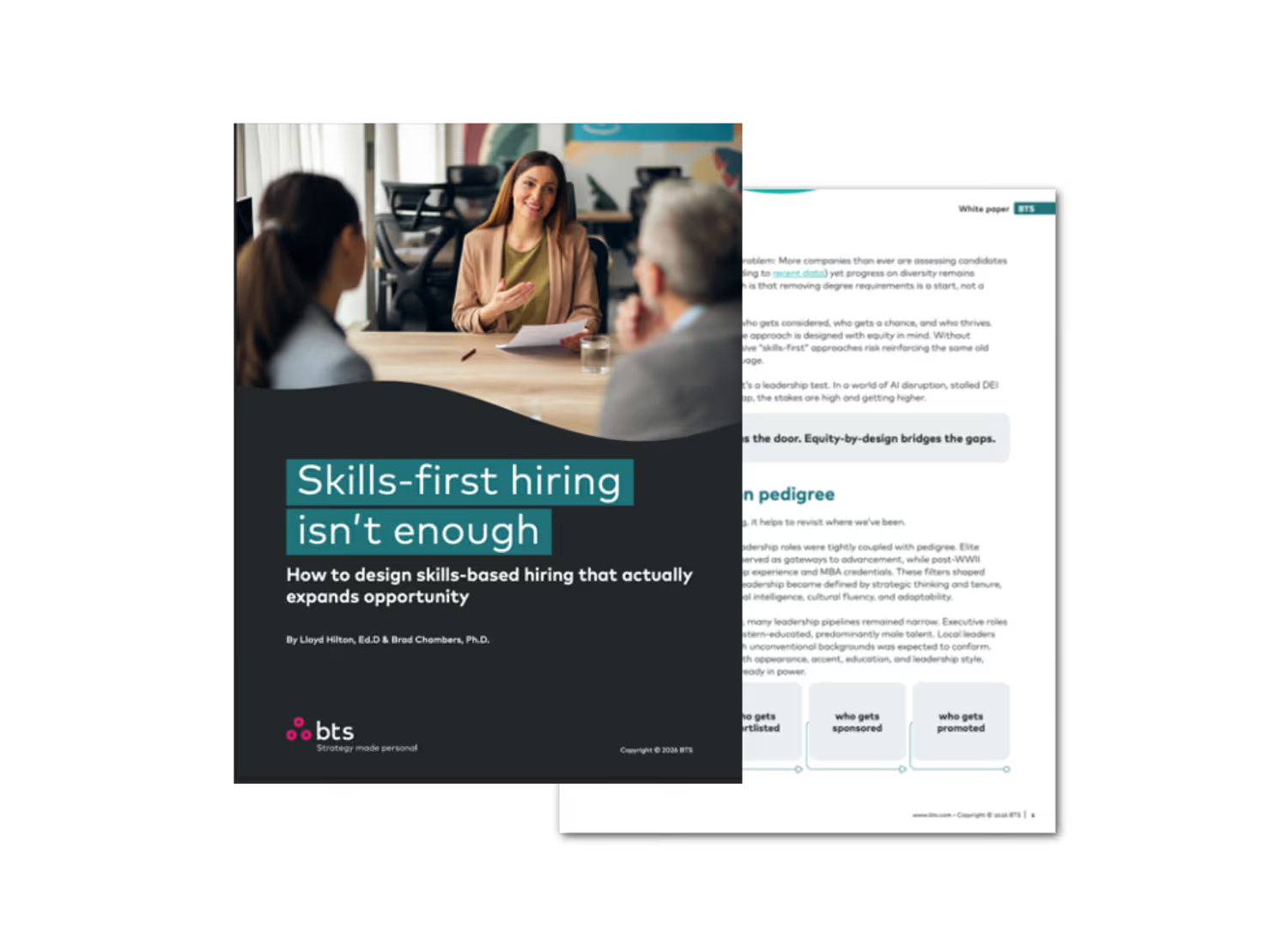
Skills-based hiring isn't enough
Learn how to design skills-based hiring that truly expands opportunity and drives diversity in your organization.

lorem ipsum

No items found.