
Calculated risks towards growth


Related content
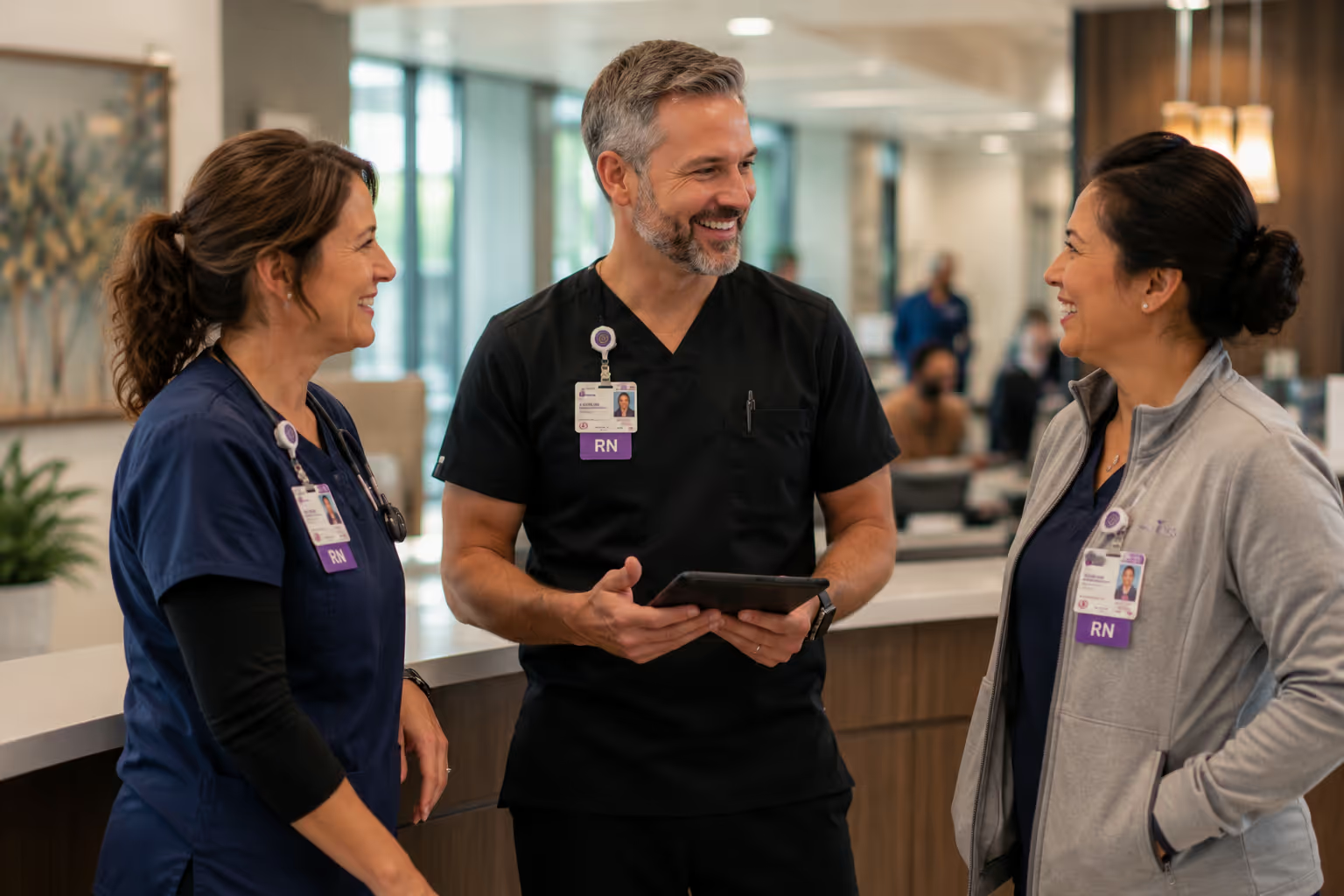
Client challenge
Wellstar Health System, one of Georgia’s largest healthcare systems, had already invested heavily in leadership development for senior leaders. But as the organization navigated rapid growth, a major acquisition, and the demands of a shifting healthcare landscape, it became clear that the greatest leadership challenges were happening at the front and midline.
“Some of the greatest leader challenges are really at the front and midline levels… we’ve invested heavily in leadership development, putting more emphasis on our front line and mid-level leadership in terms of outcomes, said Laura Dannels, Chief Talent Officer at the time.
We’re not an organization who believes in just investing in high performers… you’ve got to invest in your entire workforce.”
Wellstar partnered with Sounding Board to bring a more scalable, flexible coaching solution to leaders across the organization.
The solution
Partnering with Sounding Board, Wellstar designed a scalable, personalized coaching program to extend leadership development across the organization while maintaining the quality of one-on-one coaching.
A proprietary 360 assessment, aligned to Wellstar’s leadership behaviors, served as the foundation for each coaching engagement. This ensured development was directly tied to how leaders show up and lead in practice.
“We really wanted to ground the coaching to a framework that matters to our organization,” said Garry Gross, Executive Director of Leadership Development.
“Helping our leaders create an environment where our mission, vision, and values come to life was paramount.”
Program goals:
- Develop leadership capabilities aligned to Wellstar’s mission, vision, and values
- Deliver personalized, relevant development for leaders at all levels
- Strengthen the leadership bench and support succession planning
- Foster a culture of innovation, learning, and engagement
Program overview:
- Personalized, one-on-one coaching for leaders at all levels
- Capability development aligned to Wellstar’s values
- Serve with Compassion → Builds relationships
- Pursue Excellence → Drives results, leads teams, and plans strategically
- Honor Every Voice → Fosters inclusion and respect for differences
- Scalable delivery across frontline, mid-level, and clinical leaders
- Digital tools to track goals, capture insights, and measure progress
This approach made it possible to deliver consistent, high-quality coaching across roles and locations while keeping development relevant to each leader’s day-to-day work.
Results
As the program unfolded, Wellstar began to see a shift in how frontline and mid-level leaders showed up across the organization. Leaders in these critical roles had more consistent support navigating day-to-day challenges, and managers gained better visibility into how their teams were developing. Coaching became a more practical, embedded part of how Wellstar supports leaders in a complex healthcare environment.
Higher engagement and satisfaction
- 96% of participants said the coaching experience was worth the investment
- 99% said they could immediately apply what they learned to their day-to-day work
Measurable leadership growth
Participants reported double-digit growth across leadership capabilities including:
- Executive presence (+16%)
- Organizational collaboration (+14%)
- Strategic thinking (+13%)
- Time management and prioritization (+13%)
- Communication (+11%)
Stronger retention and mobility
- Coached leaders achieved a 90% one-year retention rate
- Retention for coached leaders was 31% higher than non-coached peers
- 3% of participants were promoted into new roles, exceeding organizational goals and industry benchmarks
Learn more about Wellstar’s leadership coaching journey with Sounding Board in this feature in Becker’s Hospital Review.

Client need
An aviation services provider with over 200 fixed base operations (FBOs) across five continents recognized the need for a standardized approach to hiring, training, and assessing its general managers (GMs). Facing complex market dynamics like industry consolidation and rising customer expectations, the company found that GMs were now expected to act as mini-CEOs. They needed a diverse skill set to drive revenue, manage talent, ensure safety, and maintain customer satisfaction. However, without a clear development path, it was difficult to consistently prepare GMs for this demanding role.
Solution
The organization partnered with BTS to develop a comprehensive leadership framework that defined expectations and built the necessary capabilities for GMs to thrive. This solution included:
- The playbook: A foundational guide outlining:
- GM profile: Key capabilities and behaviors for GM success.
- GM pivotal moments: 11 critical scenarios requiring strong leadership.
- GM experience map: Experiences that aspiring, new, and seasoned GMs should seek to ensure they excel in the role.
- The assessment: A multifaceted tool designed to:
- Evaluate current GMs by identifying development areas aligned with the GM profile.
- Assess aspiring GMs to define what development is needed to prepare them for the role.
- Screen external candidates to determine their readiness for GM responsibilities.
The assessment comprises several components, including:
- Moments-based assessment: A simulated environment where candidates demonstrate decision-making in job-related scenarios.
- Mindset explorer assessment: Evaluates alignment with key leadership beliefs.
- 360-survey: Provides feedback on participants’ strengths and development areas.
- Work preferences assessment and panorama assessment: Explore work style preferences, critical thinking, and problem-solving skills.
Results
The playbook and assessment have enabled the organization to identify and elevate high-potential leaders across its global locations. Since launching the program, numerous GMs have been promoted to leadership roles such as area director. The structured evaluation has empowered participants to uncover performance gaps and develop targeted growth plans. One GM, recently promoted to area director after following a personalized development plan, shared, “You are given the tools to succeed, and your future is in your hands. The assessments and the courses offered are outstanding and can be life-changing.”

Client need
A global professional services firm delivering risk advisory and insurance solutions to companies, institutions, and individuals was undergoing a strategic transformation to accelerate growth, increase operational efficiency, and prepare for the future. To succeed, this transformation would require investments to streamline processes and platforms, along with a shift in how people work. To improve operations, the organization had already segmented the business and reduced layers, attempting to drive simplicity, transparency, and distributed decision making across the firm. However, adapting to the new operating model would require systemic change.
The organization’s chief human resources officer (CHRO) engaged BTS to help jumpstart the strategic transformation. BTS collaborated with the organization to create a program that would align the broader leadership team, comprised of everyone below the executive committee, to this transformation. The goals of the program was to help leaders translate the new strategy into something meaningful and actionable at their departmental level, and also to catalyze the broader leadership team’s strategy execution.
BTS created a highly contextualized business simulation, including presentations, facilitated discussions, and focused training, all of which were customized for the organization.
Solution
BTS began the design process by interviewing 18 senior executives across the organization. These senior executives included the CEO, COO, CHRO, and presidents of regional divisions. They were selected to provide a broad representation of and perspective on the organization. The goal of this research was to define two broad topic areas:
The Business – understanding the organization's business model, the markets in which it operates, and the unique challenges and opportunities it faces.
The People and Leadership – understanding the behavioral and mindset shifts the organization wanted to see in its people, leadership, and culture.
Following the interviews with top-level executives, BTS conducted eight additional interviews with mid-level executives. This allowed for insight into specific business units and challenges referenced in the previous set of interviews.
Interview responses were distilled into a list of themes and organized into an “impact map.” The map defined the business impact envisioned by the organization and linked it to the knowledge, skills, behaviors, and mindsets the organization sought to foster.
The organization’s steering committee reviewed the impact map with the goal of gaining alignment on their key challenges, desired behavioral shifts, and key business results.
To achieve these behavioral shifts, the company collaborated with BTS to design a business simulation modeled after the company’s business. The simulation created a risk-free, engaging, and fun way to achieve learning objectives, and was composed of three rounds experienced over a two-day program. Each round had a theme with distinct learning points.
Round one was designed for leaders to learn how to optimize today’s business in service of driving long-term profitable growth. This involved gaining an understanding of the business landscape, as well as familiarity with the decisions and trade-offs that such growth requires. Round Two focused on the client, becoming a strategic advisor to clients, and enhancing leaders’ abilities to execute. Round Three prepared leaders for a future of making long-term investments in order to develop a sustainable competitive advantage.
Leaders were divided into teams of five at the beginning of the program. Each team included participants from a diverse array of functional and geographic sections of the organization. The experience was composed of seven main elements:
- Pre-Work and Introduction – Participants received a pre-start date reading assignment: a detailed case study featuring a fictitious company in a fictitious market environment. The company and market environment described were very similar to the organization and its environment. BTS facilitators kicked off the program by making a case for change, highlighting shifts in the market environment. Participants then broke off into pairs to reflect on those shifts and discuss what the changes meant for them as leaders. Then, BTS facilitators led a discussion wherein participants shared their reflections with the entire group.
- Strategy Session – In teams of five, leaders came up with a strategy for how they would lead the simulated company.
- Running the company - In their teams of five, leaders ran their simulated company by making over fifty critical decisions. Each team had their own designated breakout room where they would debate their decisions and enter them into a live digital-simulation platform. Periodically, teams would receive a “Wobbler,” which was an unexpected event that they had to respond to in real time (usually a competitor action, a client issue, or a talent issue). Their decisions impacted their KPIs and market share for each market and segment. Participants “ran the company” for three rounds, which represented a three-year timeframe.
- Know-Hows – After each round of running the company, participants came back to the main room for a teach-piece or “know-how,” which were skill or knowledge gaps identified as needing to be addressed. After Round One, the topic was “effective decision-making.” For Round Two, it was “future-proofing.” Round Three’s topic was “feedback culture.”
- Debriefs — With the entire group present, BTS facilitators reviewed the results for each team, linking the decisions that teams made to their performance. Each of the three rounds had a theme, and facilitators emphasized key takeaways related to these themes. At the end of each debrief, facilitators revealed where teams ranked against each other. Participants also received a report showing their team’s annual financial performance, along with another that summarized the competing teams’ performance.
- Application Session – During these sessions, participants committed to post-program actions, recording them using an electronic tool. Following the completion of the program, participants received follow-up reminders of their commitments at a scheduled cadence.
- Reflection Sessions — Solo reflections and team reflections were interspersed throughout the two-day program. During the solo reflections, which followed the know-how sessions and debriefs, participants reflected on what they had learned. After the “running the business” segments, participants reflected on their team dynamics. At the end of each day, BTS facilitated short discussions during which participants would share their reflections with the larger group.
To date, ten cohorts have gone through the program since its launch. Each cohort had 25 participants, all just below the C-suite.
At least ten more cohorts, each with a similar number of participants, plan to attend the program next year.
Results
Overall, the program was a great success. The CEO of the Italy division of the company concluded that the BTS program was “much better than any other session of its kind.” The CHRO and the executive team were enamored, and continued to communicate this in subsequent discussions. The organization also extended the original agreement to roll out even more programs.
In the application session section of the program, participants were asked to choose and commit to post-program actions related to on-the-job behaviors. Most frequently, they committed to actions around making informed decisions, prioritizing growth opportunities, and focusing on client relationships. These actions were aligned with the changes that the organization set out to make:
72% of participants stated or planned to have “tough conversations with colleagues about performance and/or with leaders about the business.”
74% of participants stated or planned to “focus on the broader client relationship and anywhere else you can solve risk for the client and align our value proposition.”
54% of participants stated or planned to “prioritize talent development, grow from within, and recruit externally when appropriate.”
Participant testimonials
“I thought this was the best training I’ve ever done. The learning from our team interactions was very illuminating. I loved the risk storming / pre-mortem methodology.”
“It was very useful for me, very genuine, and corresponded with reality. It was entertaining as well.”
“The simulation exercise was an outstanding learning tool. I would be very disappointed never to experience a similar exercise again AND would recommend that our company regularly use the software to measure learning.”
“The simulator tool was very comprehensive and intuitive. Enjoyed the cadence of mixing up sim time and organizational behavior group sessions in different teams. The feedback session was very useful. Excellent team of facilitators.”
Related content

Client need
A leading global wholesale bank needed to increase its market competitiveness by re-defining and implementing a differentiated growth strategy. This required significant leadership alignment, increased collaboration across regions, products, and functions, and faster execution. To increase competitiveness, leadership needed to rewire old mindsets, lack of clarity and siloed ways of working that were limiting their edge in the market, and build a performance culture grounded in enterprise value, feedback, and accountability.
Solution
BTS partnered with the head of the bank and the leadership team to design and deliver a structured engagement through a series of leadership off-sites, strategy definition sessions, and high-performance team experiences across EMEA, APAC, and the Americas to rapidly align, commit to, and execute the new strategy.
The work focused on:
- Co-creating the wholesale bank’s must-win battles and driving their activation and translation to the country, product, and function level.
- Resetting performance culture through a growth mindset, "brave spaces," and a sharper competitive edge.
- Creating a blueprint for high-performing teaming, with a consistent approach and language across the organization.
- Systematically removing key silos by tangibly strengthening collaboration and co-creation across the organization.
Through a series of assessments, practical tools, and focused application, leaders created joint ownership and commitment to the organization’s strategy, a culture of constructive conflict, stronger stakeholder engagement, and enterprise thinking, while defining new operating principles, ways of working, and must-win battles to accelerate execution.
Results
The partnership engaged more than 320 senior leaders globally and helped align teams around shared priorities, new ways of working, and enterprise-wide collaboration.
Key outcomes included:
- Joint ownership of defined regional strategies and cross-functional workstreams across EMEA, APAC, and the Americas.
- Year-on-year improvement in the EMEA Leadership Team's High-Performing Team Assessment (HPTA) scores across every facet .
- Increased alignment between country, product, and functional leaders .
- Leadership team meetings were redesigned for greater focus on collaboration, co-creation, and feedback; "corridors of cooperation" were established to share best practice across WB regions .
- A shift from "safe spaces" to "brave spaces" that encouraged constructive challenge and accountability, driving breakthrough client solutions and competitive wins
Testimonial
"This group has never come together in one room to align on an EMEA set of priorities, tradeoffs, or commitments."

Client need
A global fintech organization was navigating rapid growth amid increasing business and talent market volatility. As the company scaled, senior leadership recognized the need to strengthen leadership effectiveness and cultural alignment at the top of the organization.
The goals were to:
- Accelerate the effectiveness of critical C‑1/C‑2 leaders.
- Rebuild confidence and alignment around the company’s values.
- Gain deeper, actionable insights into the culture and leadership realities.
- Inform future senior‑talent decisions (selection, fit, succession).
The organization partnered with BTS to design a scalable approach that would both develop senior leaders in role while simultaneously generating insight to shape the future of the enterprise culture.
Solution
The result was a multi-year, integrated leadership partnership combining executive advisory and cohort-based simulations.
Together, BTS and the organization built a multi-year leadership partnership designed to accelerate senior leader performance while generating enterprise-wide insight.
The solution combined two core components:
- Executive advisory - targeted 1:1 engagements to shift behavior in real time
- Leadership simulations - cohort-based experiences to align leaders around operating principles and surface patterns at scale
By strengthening leaders in role while creating visibility into cross-organizational themes, the partnership supported both immediate performance and longer-term talent strategy.
Executive advisory
The work began with a six-month engagement for the top 7–8 senior leaders and expanded globally toC1/C2 roles critical to future success.
Each engagement:
- Followed a structured BTS advisory protocol
- Anchored development in the company’s values
- Focused on live enterprise challenges, stakeholder alignment, and decision-making
Because the work was grounded in real business priorities, impact was immediate. Themes across engagements provided leadership and HR with clear insight into strengths and friction points across the senior population.
Leadership simulations
Annual simulations reinforced enterprise priorities at scale.
These immersive experiences:
- Translated leadership expectations into applied decision-making
- Built a shared language across regions and functions
- Generated cultural and behavioral insight
Findings from both workstreams informed decisions related to selection, succession, and senior talent planning.
Results
During a period of growth and market pressure, the partnership strengthened critical leaders and clarified the future of the leadership bench.
Leader impact
Senior executives demonstrated stronger enterprise decision-making, clearer stakeholder alignment, and greater confidence navigating complexity. Leaders described the experience as one of the most valuable investments of their careers.
100% of participating leaders:
- Would recommend working with BTS
- Left with a clear development plan
- Valued their advisor as a thought partner on live business challenges
Cultural insight and talent strategy
As the work progressed, patterns emerged across leaders, revealing cultural strengths and previously unnamed friction points. HR and executive stakeholders gained across-organizational view of how leadership behaviors were shaping performance.
Expanding the work together
What began with a small senior cohort grew into
- Ongoing annual simulations
- Expanded advisory across global C1/C2 roles
- A pilot to scale coaching capacity and flexibility
Today, the work is embedded in how the organization strengthens and advances its senior leaders, a core component of its leadership strategy.
Testimonials
“My coach was instrumental in helping me to align with my manager on where and how to create more focus in my role. They held me accountable for results and follow-through. They helped me think through how to work the system with all of its’ big personalities and ever-changing dynamics.”
“My coach helped me to learn and claim my superpowers and stay focused on spending my time and energy in that space and to let others do that same thing.”

Client need
A leading global life sciences company was operating at the forefront of scientific innovation, delivering therapies to millions of patients around the world.
The organization's strategy called for Medical to play an increasingly visible and influential role across the enterprise, not as a scientific function operating in parallel with the business, but as a core contributor to strategic decisions spanning pipeline priorities, governance forums, and commercial direction. The ability of medical leaders to operate at that level had become a strategic imperative.
These leaders were not generalists. Many had built careers in academic and research settings, developing deep expertise in science and medicine. In their roles, they operated at the intersection of R&D and commercial, translating scientific insights into strategy, influencing governance forums, and shaping both pipeline and brand decisions. These were among the most complex and high-stakes leadership roles in the organization.
As these leaders took on broader, enterprise-facing responsibilities, the nature of their work shifted. They were expected to work across functions, influence diverse stakeholders, and contribute to decisions that balanced patient, scientific, and commercial priorities in increasingly complex, cross-functional environments.
While highly capable, many had not yet had the opportunity to develop these enterprise leadership skills. With strong competition for talent, the organization recognized the need to accelerate development from within and ensure its leaders could operate as true enterprise contributors.
Solution
BTS partnered with the organization to design and deliver a four-month immersive leadership journey focused on building enterprise leadership capability in some of its most critical roles.
The program engaged 165 leaders across six cohorts, primarily senior leaders in medical affairs, market access, and health economics. Designing an experience that would genuinely resonate with this audience required more than adapting a traditional leadership curriculum. These leaders operated in highly specialized roles, navigating governance forums, balancing scientific and commercial trade-offs, and influencing cross-functional stakeholders without formal authority.
To reflect that complexity, BTS co-created the experience with senior stakeholders across the business, grounding the journey in the actual decisions, stakeholder dynamics, and enterprise challenges participants faced in their day-to-day work. That specificity was essential to making the experience credible, relevant, and immediately applicable.
The program focused on strengthening three capabilities critical to enterprise leadership:
- Enterprise mindset
- Influencing across the organization
- Communication and storytelling
To build these capabilities, the journey combined assessment, practice, and application through a set of integrated experiences:
Enterprise simulation and assessment (in-person)
The journey began with a simulation based on real governance forums and asset-level decisions. Leaders worked through role-based scenarios with assessor-coaches, navigating trade-offs and stakeholder dynamics in a realistic enterprise setting.
Each session included immediate feedback supported by:
- Simulation observations
- 360 executive presence assessment
- Personality insights assessment
This established clear, evidence-based development priorities tied directly to each leader's role and business context.
Experiential workshops (2 x 1.5 days)
Leaders then participated in two immersive workshops focused on decision-making and influence in cross-functional environments.
Using real business scenarios, participants practiced aligning stakeholders, navigating ambiguity, and communicating complex scientific insights with clarity and impact. The workshops emphasized active practice and real-time feedback.
Individual coaching (throughout the journey)
Each participant worked with a dedicated assessor-coach to translate insight into action.
Coaching centered on upcoming business decisions and stakeholder interactions, with manager involvement helping reinforce alignment with enterprise priorities and day-to-day application.
Peer learning and application (ongoing)
Leaders participated in small peer groups that met throughout the journey to reinforce learning and accountability.
These sessions created space to reflect, share experiences, and apply new approaches in real time, helping build consistency across the organization.
Across every element of the journey, the work remained grounded in real business challenges. Leaders built capability by practicing the same decisions, conversations, and trade-offs they faced every day.
Results
The program's success led to continued investment, with new cohorts of more than 200 critical role leaders now underway. Overall, the program strengthened how leaders think, decide, and influence, improving both decision quality and cross-functional execution.
Impact was assessed through:
- Post-program surveys
- End-of-journey evaluations
- 49 structured interviews with participants and their managers
Every manager interviewed reported sustained positive behavior change. The most significant shift was in how leaders approached decision-making. Participants engaged stakeholders earlier, clarified trade-offs more effectively, and showed up with greater confidence in governance discussions. As a result, decisions moved faster and with less friction.
The impact extended beyond the Medical function itself. Colleagues across commercial, R&D, and other functions began noticing a tangible difference. Medical leaders showed up differently in joint forums, communicating complex scientific trade-offs more clearly and building alignment more effectively across competing priorities. Conversations that once required multiple rounds of clarification increasingly moved to alignment more quickly.
Leaders consistently improved in several key areas:
- Earlier alignment before formal decision forums
- Greater confidence navigating ambiguity and enterprise trade-offs
- Stronger influence across cross-functional groups
- Clearer, more concise communication of complex scientific insights
Collectively, these shifts improved cross-functional decision-making and execution across the organization. Leaders were better able to prioritize enterprise value, align diverse perspectives, and ensure medical insights were clearly understood and acted upon.
The impact extended beyond individual participants. Leaders applied these approaches within their own teams, reinforcing more consistent ways of working across the organization and helping position Medical as a strategic enterprise partner rather than solely a scientific function.