Unleashing the Power of Critical Role Pipelines: Securing Your Organization's Future
Organizations are grappling with the overwhelming challenge of attracting, developing, and retaining top talent to drive their bottom line. As a staggering 85 percent of organizations scramble to enhance their leader development programs, the spotlight has turned to the most critical roles within the company. These positions, often hidden in plain sight, are the linchpins that hold the key to the organization’s future success.
From the front lines to the back office, critical roles demand unique capabilities and are notoriously difficult to fill. Neglecting these roles in your talent development strategy can have dire consequences, leaving organizations vulnerable to competition and hindering the ability to adapt to the ever-changing business landscape.
The time has come for organizations to take a strategic approach to identifying and investing in these critical roles, or risk falling behind in the race for talent. In this webinar, industry leaders from BTS will unveil the secrets to building a robust critical role pipeline that not only meets but exceeds your organization’s future needs. Don’t miss this opportunity to gain a competitive edge and secure your organization’s place at the forefront of your industry.
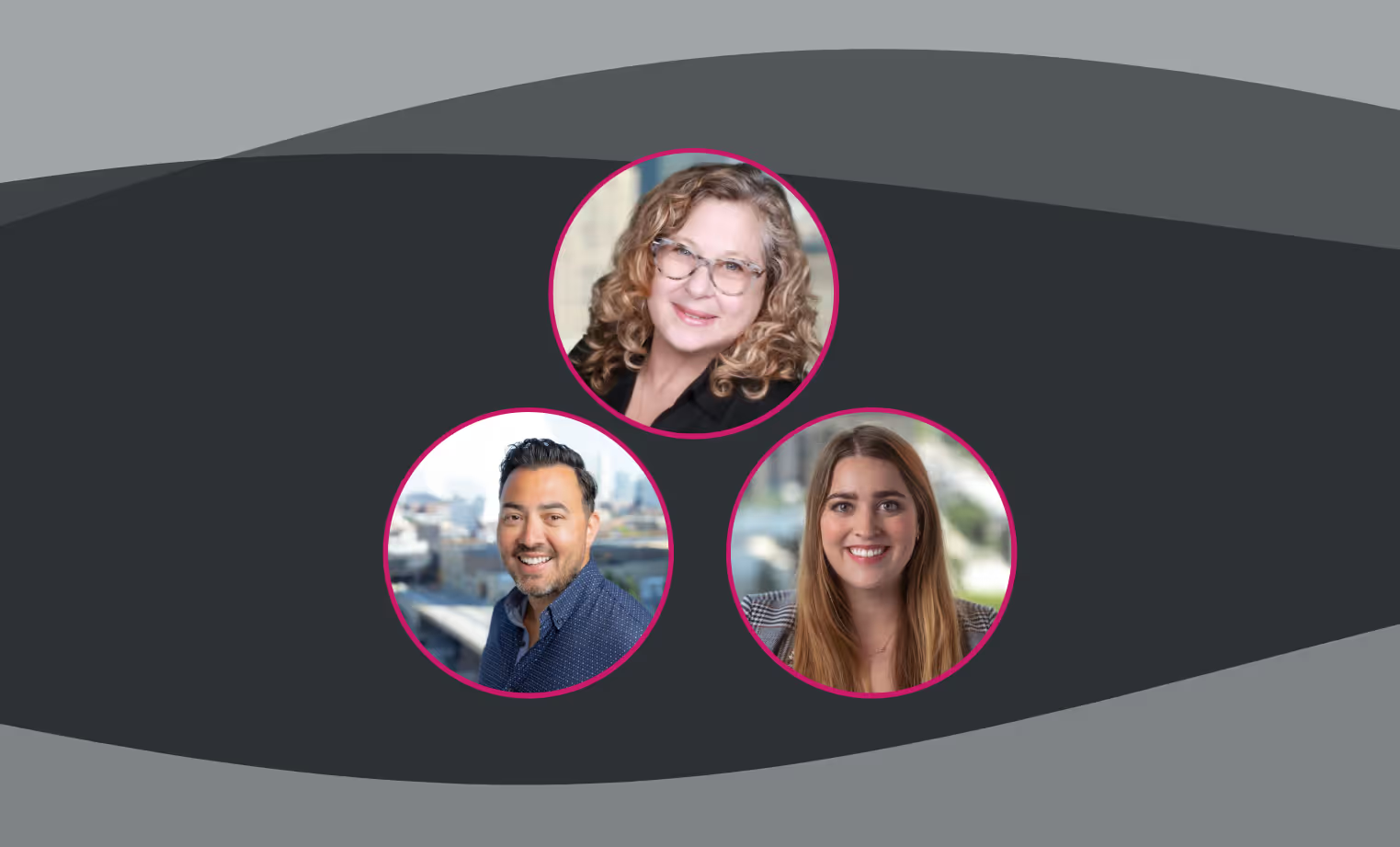
Josh Shadrick, Senior VP and Partner, Head of BTS Central, Lance Wilke, Senior VP and Partner, Head of Talent, Learning and Leadership Development Go-to-Market, and Lynn Collins, Head of Assessments for North America, BTS, will join moderator Claude Werder, Senior VP and Principal Analyst for Brandon Hall Group, in the discussion.
Related Content

lorem ipsum
lorem ipsum
lorem ipsum

You can't predict the future. You can be disciplined about how you face it.
That's where Future Storming comes in. Future Storming is a process for looking at the trends and signals already visible in the market, understanding how those forces connect, and thinking more clearly about where they may lead.
Recently, we've been applying that lens to talent strategy, running Future Storming sessions with talent leaders across industries to understand which forces are already reshaping how organizations find, develop, and retain the people they need. When you look across those conversations, one thing is hard to miss: AI runs through almost all of the most significant trends, and not as a future scenario. It's already reworking the talent systems most organizations have leaned on for years, often quietly, and often faster than leadership teams have had time to respond.
From these sessions, five high-likelihood, high-impact shifts have emerged as the ones every talent leader needs to be watching right now. What follows is what each of them may mean for your organization.
1. The frameworks most organizations use to define great leadership were built for a different era
Skills and competency models describe work that no longer exists in many roles or that AI now performs alongside, or instead of, humans. The gap between what organizations say they're selecting and developing for, and what the work actually requires, is widening quietly.
This creates a real problem. Organizations that don't redefine what great looks like now will be developing the wrong people for the wrong future optimizing for capabilities that are becoming less predictive while under-investing in the ones that matter most.
- Rebuild leadership profiles from a future-back perspective, starting with where the business is heading, not where it has been.
- Focus on the distinctly human capabilities AI cannot replicate judgment in ambiguous conditions, relational intelligence, ethical reasoning, the ability to set direction when there is no precedent.
- Increase the use of behavioral observation in selection and development. It's the only methodology that shows how someone actually thinks and decides under real pressure.
The signal worth chasing isn't on a resume, it's in the room in how someone handles a real situation, under genuine pressure. It's the only place where someone can't prepare their way out of being themselves.
2. Human differentiators are the last mile AI cannot close
Judgment. Empathy. Creativity. The ability to navigate genuine ambiguity. These are increasingly what separates human contribution from AI output and they're precisely the things most talent systems have always found hardest to measure.
For a long time, organizations could afford to treat these as qualities that would emerge naturally with experience. That's no longer an option. The human differentiators are becoming the job. And most organizations still aren't measuring them well.
The methods exist behavioral assessment, simulation, structured observation. And AI is now making them accessible at scale in ways that simply weren't possible before. The question isn't whether to use them. It's how to deploy them thoughtfully, with the governance and transparency that -stakes talent decisions require.
- AI-powered behavioral observation that surfaces how people actually perform in the flow of work, (i.e. judgement, decision-making, adaptability) not self-report
- Assessment that evaluated how people work with AI, not just without it because that's increasingly what the role looks like
- Simulation-based approaches that reveal thinking in action - the kind of evidence no credential or output can provide
3. The talent pipeline is broken
AI is displacing the early-career work that has traditionally served as the on-ramp into organizational life. Those tasks once gave emerging employees something more valuable than work product. They gave them foundational experiences, relationships, and judgment. The kind of judgment that eventually grows into leadership.
The impact won't show up immediately. That's exactly what makes it worth paying attention to now. Within three to six years, benches will thin and succession pipelines will require far more intentional investment. Organizations will find themselves asking why their internal talent isn't developing the way it used to.
The organizations that get ahead of this have a real opportunity to build something more deliberate, more equitable, and better suited to the capabilities the future actually requires.
- Invest in real, simulation-based experiences, putting emerging leaders into the decisions and pressures that build genuine organizational judgment, not just task exposure.
- Redefine what early-career development is, building toward the capabilities the future requires, not the ones the old job description described.
- Build feedback into the flow of work. AI behavioral observation and practice AI role plays make continuous development possible at scale. The experience that used to happen informally has to be designed now.
4. People need to re-skill faster than any development model was built to support
People need to reskill faster than any development model was built to support. Most organizational development infrastructure was built around a longer, more stable arc of skill acquisition. AI is compressing that arc significantly.
The implication isn't just that training needs to be faster. It's that the whole architecture of how organizations identify, develop, and deploy talent needs to be built for continuous recalibration not periodic refresh.
- Prioritize adaptability and learning agility over static expertise. The ability to acquire new capabilities quickly matters more than the specific capabilities someone holds today.
- Treat reskilling as a continuous organizational process, not an episodic program.
5. AI is absorbing leadership work and culture is losing it's anchor
This is the shift that's easiest to underestimate, and hardest to recover from once it arrives.
Culture is what people see leaders do. The behaviors leaders model how they make decisions, how they show up in hard moments, what they choose to reward and what they let go are how organizational culture gets transmitted. It doesn't travel through stated values. It travels through visible human behavior.
AI is absorbing the work that used to make leaders visible as humans making choices. Performance reviews written by AI. Communications drafted by AI. Coaching conversations mediated by AI. When the distinctly human work disappears, so does the signal. People don't know what to watch anymore. And culture which depends on that watching starts to fray.
The organizations that navigate this well won't be the ones that use less AI, they'll be the ones most intentional about which leadership behaviors remain visibly human, and why.
The behaviors that held culture together need to be rebuilt around what humans uniquely contribute now and that starts with getting the success profile right. That's exactly what the Future Ready Profile is built for.
Strengthen empathy-centered leadership capabilities. The human dimensions of leadership matter more, not less, as AI takes on more of the technical work.
- Strengthen empathy-centered leadership capabilities. The human dimensions of leadership matter more, not less, as AI takes on more of the technical work.
- Reinforce organizational purpose and human-centered culture as anchors.
- Treat culture as something you design, not something you inherit.
What this means
The organizations that navigate this well won't be the ones that adopted AI fastest, they'll be the ones that invested just as deliberately in the human systems around it.
These five shifts aren't warnings. They're design problems, and design problems have answers. The talent systems that come out of this moment can be more intentional, more equitable, and more fit for purpose than anything we've built before.
At BTS, this is the work we're doing every day. If you'd like to think through what any of it means for your organization, we’d love to talk.
The thinking in this article was shapped by Future Storming sessions, including a SIOP 2026 workshop, and by ongoing conversations with talent leaders navigating these shifts in real time.

Across industries, leaders agree: critical roles, those with outsized impact on organizational success on business success, deserve focused attention. And yet, most organizations still struggle to define them clearly, identify the right talent, and build the readiness needed to execute when it matters most. Despite years of investment in succession planning and high-potential pipelines, most organizations still lack the clarity and consistency needed to execute critical role strategy with confidence.
What are critical roles, really?
We define critical roles as those that disproportionately impact business outcomes and are hard to fill, often cross-functional, and deeply tied to strategic execution. They aren’t always the most senior roles, but they’re the ones that, if left vacant or poorly filled, slow down growth, innovation, or transformation. These roles often require capabilities that go beyond technical expertise like influence across silos, decision-making without full control, and the ability to navigate ambiguity.
Many organizations assume they know their critical roles, but often these definitions are inherited, outdated, or driven by hierarchy, not business value. We encourage clients to pressure-test role criticality by asking: How does the law of supply and demand apply when the demand for this critical role is high, but the supply is limited due to how difficult it is to find, train, and develop ready leaders?
The maturity challenge: what the data shows
Despite prioritizing critical roles, most organizations are not where they want to be:
- Only 21% say successors for critical roles are truly ready1
- Just 25% have clear development plans for people in these roles2
- 50% are starting to expand beyond executive roles, but definitions are still narrow3
This results in a rise of business risk. Transitions stall. Significant business moments like product launches, market expansions, or leadership shifts get delayed or derailed. Even when roles are named and successors are listed, too often it’s the same few people rotating through stretch assignments without real role-level clarity or successor variety.
Three distinct talent needs we see
At BTS, we see three pivotal talent needs organizations must design for:
- The role has evolved, but the leader hasn’t. The strategy has shifted, but expectations haven’t been redefined.
- The pipeline is unclear. It hasn’t been clearly identified who belongs on the bench or whether the right people are even in it. Without visibility and targeted development, readiness remains more of a guess than a strategy.
- A decision needs to be made now, and it must be right. The risk of getting it wrong is high, and factual, objective evidence is needed.
Readiness isn’t a one-time conversation; instead, it’s a continuous discipline. The most advanced organizations are building systems, not just lists.
Seven enablers of a critical role strategy
In our work across industries, the most effective organizations are building discipline around critical roles, not just process. We’ve identified seven drivers that consistently separate high-performing strategies from reactive ones. These show up in different ways depending on where an organization is at on their journey:
- Strategic alignment: Roles are clearly tied to business goals and future priorities.
- Role definition: Roles are defined by impact, not hierarchy.
- Building profiles: The definition of success in role is based on the future, not the past.
- Wide-ranging talent pipelines: Bench strength reflects diversity of experience, geography, background, and perspective.
- Immersive development: Successors build real readiness through stretch roles, simulations, and job previews. Coaching enhances these experiences by helping leaders process feedback, build self-awareness, and apply learning to their context.
- Retention strategy: Incumbents are supported with personalized development and visible investment.
- Continuity planning: Institutional knowledge is captured and transitioned before it walks out the door.
What great looks like in practice
Most organizations rely on role titles, tenure, and intuition. But that’s not enough for roles that carry real risk. Organizations that are closing the readiness gap are doing more than refreshing succession charts. They’re investing in: custom success profiles, assessment-backed talent decisions, and development experiences that reflect the real demands of the role. Great organizations don’t just offer development; they also create role-specific experiences that build the judgment, fluency, and resilience required for the real pressures of the job. It’s not just about knowledge; it’s about role conditioning.
How future-ready is your approach? A quick checklist
Use this checklist to pressure-test the strength of your critical role strategy:
- Have you defined critical roles based on future business impact, not just titles?
- Are success profiles aligned with what the business will require tomorrow?
- Do you know who’s in your bench and how ready they are?
- Are your placement decisions based on structured assessment, not gut feel?
- Are your successors learning through stretch experiences and role previews?
- Are incumbents receiving targeted support that drives their retention and growth?
- Do you have a plan for knowledge transfer if someone in a critical role left today?
What you can do now
- Clarify what roles are truly critical by future impact, not just past precedent
- Be honest about readiness and measure it before placing someone in role
- Invest intentionally and build immersive, real-world development to match role demands
- Don’t confuse visibility with readiness; make decisions based on data, not familiarity
- Prepare leaders before they transition into a critical role so they’re ready to thrive from day one
Critical roles don’t just need names next to them. They need clarity, intention, and investment. Organizations that treat critical role strategy as a leadership capability, not just a process, are the ones driving growth and resilience in today’s market. This isn’t just about building a bench. It’s about building belief, from the front line to the C-suite, that the right people are leading in the moments that matter most.
1Gartner, 2023 report
2The Talent Strategy Group, Critical Roles Report, Apr 2025
3Korn Ferry, Revamping Succession Planning, Nov2023 report

We have more tools, technologies, and data than ever, yet talent challenges are only growing more complex.
AI is reshaping how work gets done, shifting roles and the skills required. Remote and hybrid models continue to redefine how teams collaborate, lead, and build culture. Economic pressure is forcing organizations to do more with less, making talent efficiency a business necessity. And employee expectations are rising people want more purpose, growth, and flexibility than ever before.
These shifts aren’t just complicating the landscape; they’re rewriting the rules. For years, talent operated one step removed, supporting strategy, but not shaping it. That worked when business was linear and predictable. Strategy was set at the top, cascaded down, and talent filled the gaps. But that world is gone. Today, strategy shifts in real time. You can’t launch a new go-to-market plan, integrate an acquisition, or drive cultural change without people who are aligned, capable, and ready to deliver. And that readiness can’t be an afterthought, it has to be future-back.
That’s why a new kind of talent leadership is emerging, one that moves beyond standalone programs and focuses instead on building integrated systems. It’s a shift from reacting to problems to anticipating what the business will need next; from patching broken processes to designing for performance from the start. In this model, talent strategy is no longer fragmented. It becomes a connected ecosystem where hiring, development, performance, and culture work in sync, aligned to business priorities and built to deliver results. In this environment, integrated talent strategy isn’t just good HR, it’s how business gets done.
The AI revolution and its real-world talent application
AI is revolutionizing how organizations attract, develop, and retain talent. From automating performance reviews and job descriptions to enabling personalized career path development, the promise of AI is clear. However, many warn of a trough of disillusionment. Reality often falls short due to insufficient data, immature infrastructure, and misaligned objectives between business leaders, talent leaders and across functions. Without a clear problem definition, technology risks accelerating misalignment instead of solving meaningful challenges.
Organizations must first define the outcomes they seek whether efficiency, insight, engagement, or growth before deploying technology solutions. As AI adoption expands, success will depend on whether organizations match the right tools to the right problems. Having the discipline to make this evaluation will be game-changing when it comes to delivering impact.
Skills-based organizations: substance or semantics?
The rise of skills-based models reflects both a desire for innovation and a rebranding of long-standing HR practices. While the framing may have shifted, the underlying work—job analysis, development planning, and performance alignment remains constant. Many of today’s talent challenges aren’t new; they’re longstanding issues being reframed under new labels.
To move the conversation forward, leaders must avoid fixating on language and instead focus on what truly drives performance when it comes to talent models: clear role expectations, relevant development paths, and contextualized application of skills. Prioritizing the right core activities will deliver the talent performance you need, regardless of what it’s called.
Manager capability as the linchpin
The most innovative talent strategies still rely on a critical success factor: the people manager. Whether it’s performance enablement, development conversations, or cultural reinforcement, execution hinges on manager capability. The success of most talent initiatives ultimately depends on whether managers are equipped to implement them effectively. Manager enablement is the operational layer that determines whether talent strategies deliver impact or stall. Managers also shape the day-to-day experiences that influence engagement, growth, and retention.
Investing in scalable, practical, and embedded manager development is essential to unlock the potential of any talent system. Currently this remains a challenge to plan and execute in many companies, while some at the leading edge have leaned into this and are making progress. Looking forward, organizations that prioritize preparing their managers for delivering what’s next will yield more rapid results for the business.
Integrated talent management: moving from silos to systems
Gone are the days when talent functions could operate in isolation. Today’s organizations require an integrated approach that connects succession planning, workforce strategy, learning, performance, and employee experience. For business leaders, the structure of HR functions is secondary to receiving actionable guidance that accelerates hiring and performance outcomes.Achieving true integration means moving beyond siloed initiatives and building a connected system where talent strategies reinforce one another across data, design, and delivery. It’s not about where each piece sits, but how well they work together to deliver consistent, business-relevant outcomes.
For example, when identifying successors for executive roles, the best organizations take a systemic approach. They leverage business leader input to nominate high-potentials based on a consistent set of standards. They add rigorous assessment of people and business capability (often using external support) to reduce bias, confirm potential for more complex roles, and identify gaps. They then employ tailored development, run in partnership among the business, talent, and learning with external support, to address identified gaps. This multi-faceted approach incorporates perspectives from the business and HR while leveraging best practices from inside and outside the company, and ties outcomes to business imperatives.
Bringing “Integrated Talent” to life in your organization
Integrated talent refers to the intentional alignment and coordination of all talent-related functions such as hiring, learning, succession, performance, rewards, and workforce planning under a unified strategy that directly supports business goals. Instead of fragmented programs running in parallel, integrated talent strategies are designed and executed as a cohesive system, with shared data, consistent language, and a focus on outcomes that matter to the organization. It’s about designing for the whole employee lifecycle, not just optimizing parts of it in isolation.
The most effective partnerships, including those with consultants and external experts, often blur internal and external boundaries, delivering seamless support to business leaders.
Key recommendations for talent leaders to move to an integrated talent approach
So what does it take to lead effectively in this environment? Several key priorities are emerging:
- Understand the evolving business context: Start with a clear understanding of the organizational environment, where the business strategy is going, and the role of culture in supporting growth, before proposing solutions.
- Customize with purpose: Balance tailored approaches with scalable standards to drive consistency.
- Build your internal base: Credibility is built by understanding internal politics, brand sensitivities, and cultural norms.
- Elevate the employee experience: Amid ongoing disruption, meaning, purpose, and psychological safety are essential stabilizers. Make this a priority, and the business will follow.
- Build meta-skills: Leadership development must focus on adaptability, resilience, empathy, and systems thinking; the capacities needed to lead through complexity.
- Develop an enterprise mindset: Today’s talent leaders must be business-centric, fluent in financial and strategic conversations, and capable of integrating disparate talent functions to construct a coherent whole. They must translate data into compelling narratives and foster strong partnerships both within HR and across the enterprise.
Most importantly, talent leaders must see themselves not just as HR professionals, but as organizational architects, designing the systems, cultures, mindsets and experiences that enable growth.
Conclusion: Talent strategy integration isn’t a trend. It’s your edge.
The world of work is not simply changing. It is being fundamentally redefined. Integrated talent strategy is no longer a future aspiration; it is a current imperative. To deliver on this mandate, talent leaders must: align their strategies tightly with business priorities; build managerial capability at scale; and use technology with precision and discipline. They must create strong, trusted partnerships across internal and external boundaries, and focus on clarity over complexity. The siloed HR model has reached its limits. The future belongs to those who embrace integrated talent strategy as a core business driver.

lorem ipsum

lorem ipsum

lorem ipsum

lorem ipsum

Un análisis sobre los desafíos de la comunicación empresarial, el liderazgo y las tendencias que están marcando el entorno económico y corporativo actual.
lorem ipsum

Un enfoque estructurado e innovador para evaluar el talento a partir de comportamientos observables y decisiones reales, fortaleciendo la alineación estratégica y el desempeño organizacional.
lorem ipsum

BTS was recently recognized as a Top 20 Assessment and Evaluation Company in 2025 by Training Industry, Inc.
lorem ipsum