

Insights


Anthropic, the startup behind the generative AI chatbot Claude, recently polled 1,000 Americans, asking: what guardrails and values do you want AI systems to have?
The result? Anthropic’s existing AI principles only overlapped with 50 percent of what the public said they wanted. So, where’s the disconnect?
Anthropic found that the public wanted more "objective information that reflects all sides of a situation” and responses that were easier to understand. Anthropic also noted that the public was "less biased" than Anthropic across nine categories, including age, gender, and nationality.
So what?
The study highlights a broader disconnect between what the technology firms creating AI think people want and what people using these technologies—including your employees and your customers—actually want. This approach mirrors a mistake technology firms made in the past—inviting exclusively technical experts to advise on product design, even though the market for a product is the average consumer.
Now what?
We already know that trust is key to the adoption of AI systems, and that people are less likely to trust and use systems that they can’t control or didn't help to design. One approach to driving more user adoption and trust is soliciting more user feedback.
We also know that there can be a trade-off between control and performance of these systems: for example, allowing users to tweak algorithms to reflect their preferences often leads to reduced performance of the algorithm—thus defeating the purpose of using the system to begin with.
Next steps
Anthropic's findings illustrate a vital strategy for leaders to consider when implementing AI systems: include key stakeholders in AI design. How? By drawing input and inspiration from customers, employees, and partners in addition to your technical experts. The “pro move”? Do this in a way that produces systems that are both adopted and effective.
Put on your jerseys
Getting AI right is a team sport and will require input from a diverse set of talent in your business. Not easy to do, but well worth the effort.

Las organizaciones de todo el mundo son conscientes que a medida que disminuyen los riesgos derivados de la pandemia surgen nuevos desafíos en el horizonte. Con un mercado laboral en movimiento, la incertidumbre económica derivada del impacto de la guerra entre Rusia y Ucrania o las amenazas subyacentes de la crisis climática, el entorno empresarial seguirá teniendo un componente volátil en los próximos años.
Con el objetivo de afrontar los desafíos empresariales, las organizaciones apuestan por implementar nuevas metodologías para resultar más competitivas y eficientes. En este contexto, el 30% de las organizaciones a nivel mundial reconoce tener una alta tasa de madurez en agilidad empresarial, lo que supone un 7% de crecimiento respecto al año anterior, tal y como concluye “The Business Agility Report” de 2022, un análisis elaborado a nivel mundial que trata de esclarecer el grado de madurez digital en las compañías.
Para leer más, haz click aquí.
La calidad creativa multiplica por cuatro las ganancias de las empresas
En la sociedad actual, en la que la capacidad de atención de TikTok es la regla, la inmediatez es un factor fundamental para conseguir el éxito en un proceso de ventas. Los cortos períodos de atención de las personas implican que, durante una reunión anual de ventas, los niveles de participación se desploman. Las horas de reuniones consecutivas sin conclusiones procesables no solo son aburridas para los empleados, sino que tampoco marcan la diferencia para el negocio.En este punto, la creatividad emerge como un concepto fundamental para marcar la diferencia. Es un concepto que se aplica con éxito en al ámbito publicitario y en marketing. Según un estudio de Kantar y WARC, que analiza más de 250.000 anuncios globales, la calidad creativa multiplica por cuatro las ganancias de las organizaciones.Para leer más, haz click aquí.

Un buen proceso de sucesión en la alta dirección comienza con la comprensión completa de la estrategia empresarial futura
Uno de los desafíos que tienen por delante las organizaciones es el de afrontar la sucesión de la alta dirección. Se trata de un proceso que requiere una comprensión profunda de la estrategia empresarial de hoy y de los próximos años para determinar los atributos que debe reunir el sucesor. Philios Andreou, Deputy Chief Executive Officer de BTS Group, explica en esta entrevista cómo las compañías deben desarrollar los planes de sucesión para seleccionar a los líderes del futuro.
Según un estudio de la compañía Corporate Executive Board, entre el 50 y el 70% de los ejecutivos fracasan dentro de los primeros 18 meses de su promoción, independientemente de que provengan de dentro o fuera de la organización. Un problema que bebe de las dificultades de las empresas para detectar si las capacidades y la mentalidad de gestión están realmente en consonancia con las necesidades futuras de la organización. Philios Andreou, Deputy Chief Executive Officer de BTS Group, explica que es necesario analizar en profundidad la estrategia empresarial presente y futura para determinar los atributos que debe reunir el sucesor. El proceso, además, debe ser lo más transparente posible para evitar dudas y problemas. «Si las compañías buscan una sucesión a futuro, deben entender profundamente la estrategia empresarial de hoy y de los próximos años», subraya.
Para leer más, haz click aquí.

Una de las series más vistas y emblemáticas de HBO es “Succession”, que trata sobre el futuro de una compañía de medios y los retos de la sucesión de su fundador, el magnate Roy Logan. En la serie, los tres hijos del magnate pelean por ver quién puede ser el siguiente CEO junto con otros ejecutivos que llevan en la compañía mucho tiempo y creen haberse ganado el derecho a ello. Lo interesante para el espectador es que no está claro quién es el candidato más adecuado para la sucesión. Roy Logan tampoco está seguro de ello, por lo que testea continuamente a los candidatos con maneras poco ortodoxas y a veces incluso con temas que rozan las líneas de la integridad y de los valores de la sociedad.
En el mundo real, las compañías también se enfrentan a diversos retos cuando están pensando en momentos de sucesión. Acertar en este punto es crítico y estratégico ya que en ocasiones los candidatos no son ni perfectos ni listos. La raíz del problema está en el proceso y en las dificultades para detectar capacidades y mentalidad de gestión que se alineen con lo necesario para el futuro de la organización. Un estudio de Corporate Executive Board devela que entre el 50 y el 70 % de los ejecutivos fracasan dentro de los primeros 18 meses de su promoción, independientemente de que provengan de dentro o fuera de la organización.
Uno de los retos más típicos que se observa reside en la dificultad de tener claridad sobre el perfil del nuevo líder. Si buscamos una sucesión a futuro deberíamos estar entendiendo profundamente la estrategia empresarial de hoy y de los próximos años para tener un perfil de requerimientos que puedan ocupar la posición que sea clara y aporte criterios para la selección. En muchas organizaciones, en vez de profundizar en esto, se intenta buscar líderes parecidos a los que se retiran/salen o líderes alineados a los requisitos del éxito de hoy.
No es sorprendente ver que solo el 11% de los profesionales de Recursos Humanos se sienten cómodos con los planes de sucesión en su organización, lo que representa el porcentaje más bajo de la última década, según asegura el informe 2021 Global Leadership Forecast.
El segundo reto es construir un proceso correcto de identificación y evaluación para asegurar tener los candidatos adecuados. Teniendo en cuenta la criticidad de las posiciones y el impacto en la organización, es importante incidir en dos aspectos. Por un lado, un input multidimensional, es decir, múltiples fuentes de información para poder tener una información más holística, como una evaluación 360, entrevistas estructuradas, tests psicométricos etc..; y, por otro lado, una evaluación compleja y simulada de “situación de futuro” donde el candidato puede trabajar con un simulador desempeñando el rol futuro y trabajando con problemas / situaciones / presentaciones del nuevo rol bajo presión. Este tipo de simulaciones virtuales, son magnificas para “ver en acción” al candidato y aportan mucha información sobre su manera de gestionar el negocio, las personas, las situaciones y en general su manejo con stakeholders.
El tercer reto es la preparación para el futuro. Es muy probable que ningún candidato interno esté listo de primeras. Esto quiere decir que gran parte del éxito del proceso de sucesión es la preparación o la creación de “readiness – es decir cómo llegar a estar preparado”. Esto se puede impulsar dando a los candidatos formación, coaching, así como proyectos especiales y creando momentos para ellos para experimentar, aprender y crecer.
El cuarto reto es la transparencia del proceso, algo que crea bastante complejidad en la organizaciones. En el caso de la serie televisiva, el drama en las 4 temporadas trata de los problemas que genera el no tener transparencia – desde guerras entre candidatos, confusión en la organización y pérdida de valor al no estar nadie enfocado en el negocio. Esa transparencia no es fácil por temas de confidencialidad, pero cuanto mejor planificados estén los procesos menos dudas y problemas habrá.
El último reto es el onboarding correcto en el puesto. Se trata, por lo tanto, de “como incorporar a la persona al puesto de tal manera que nos asegure el éxito”. Los primeros años en el cargo son determinantes para el nuevo directivo o CEO que debe generar confianza, credibilidad y visión a su equipo para consolidar el negocio e impulsar la estrategia. En este período el objetivo debe ser reducir el riesgo al crear una zona segura que permita abordar diferentes enfoques, evaluar desafíos, generar discurso para audiencias diversas, establecer y administrar relaciones y dinámicas, así como desarrollar su equipo ejecutivo y realizar propuestas y toma de decisiones durante el primer año. En muchas ocasiones, este proceso puede ser reforzado con la presencia del anterior CEO o de un coach ejecutivo.
Con el objetivo de trasladar la cultura corporativa y estar prevenidos ante cualquier tipo de transición, las organizaciones deben considerar los planes de sucesión como una parte fundamental de su estrategia empresarial. Con un proceso holístico, transparente y anclado en un perfil de éxito de hoy y mañana, es perfectamente posible garantizar el futuro.
Para leer más, haz click aquí.

El bienestar de los empleados ha adquirido un papel cada vez más relevante en el plan estratégico de las empresas. Pero ¿qué iniciativas se están poniendo en marcha para conseguir mejorar la salud de los trabajadores.
El pasado mes de septiembre, Forbes reunía a un grupo de expertos, en el Hotel Único, de Madrid, para intentar dibujar cuál es la nueva hoja de ruta de las empresas sobre esta cuestión: Enrique Tapia, director general de Personas y Organización de Naturgy; Marta Zaragoza, Executive Vice President & Global Partner de BTS; Juan Carlos Rondeau, director general adjunto de Personas y Organización de MAPFRE; Imma Catalá, Global Head of Culture & Engagement de BBVA; y David Borreguero, Employee Success Business Partner Senior Manager de Salesforce.s, tanto en el plano físico como en el emocional? ¿Qué repercusión tienen estas medidas en su productividad y compromiso? ¿Qué beneficios aportan a las compañías?
La encargada de moderar la jornada era la periodista Mónica Valle, que preguntaba a los ponentes sobre las medidas que han implementado sus empresas para mejorar no solo el bienestar de sus empleados, sino también la involucración de los equipos.
Enrique Tapia, de Naturgy, sostenía que“en el actual contexto de cambios e incertidumbre, desde los equipos de RRHH debemos hacer foco en la importancia de la salud y el bienestar de nuestras personas, en todos los roles y niveles. Es un reto que debemos atender si queremos un proyecto empresarial sostenible”. Una afirmación con lo que se mostraba totalmente de acuerdo Marta Zaragoza y Juan Carlos Rondeau: “En MAPRE, el cuidado de las personas forma parte de nuestro ADN. Y para nosotros el bienestar de nuestros empleados es parte de nuestra propuesta de valor.” La directiva de BBVA, por su parte, apuntaba que “es vital escuchar de verdad a nuestros profesionales y demostrarles que atendemos sus peticiones”.
Para leer más, haz click aquí.

Early in your career, your ability to acquire technical knowledge and quickly demonstrate it is what made you a top performer.
But, as the old adage says (and I quote Marshall Goldsmith), “What got you here won’t get you there.” In other words, later in your career, moving fast and having all the answers is actually detrimental to your executive presence and your ability to motivate and engage others.
First, raise your hand if you identify with any of the following statements:
- I have a high capacity for work and move faster than those around me.
- I often know the right solution well before the team reaches the logical conclusion.
- My action bias is one of the reasons why I am so productive – it’s one of my best qualities.
- I know I need to pull others into the discussion, but I get frustrated when it slows down the process.
- I have a lot of ideas and solutions to problems that I tend to share quickly and often.
- I’ve been told that I get noticeably agitated or short when I feel things are not happening quickly enough.
- I feel as though I can help guide the team to the right answer when they get stuck.
And to take it one step further - sometimes best-laid intentions can be your greatest leadership derailers.
- “I want to be helpful.”
- “I want to move the conversation along.”
- “I need to get the team focused.”
- “I need to solve problems quickly.”
These moments can present a real crossroads in your professional development journey, and admitting you have a problem is the first step toward growth. When you recognize and harness restraint, create space for others, and shift the role you play in the discussion, suddenly the game changes.
How do you get there? Flip the script! Instead of coming up with solutions, push yourself to ask guiding questions. The most critical question: How can I help?
These four key words will help you turn the traditional top-down leadership approach on its head. Rather than jumping in with your own ideas or constructive feedback about why or why not an idea won’t work, asking how you can help opens the door for your team to speak up, learn, and grow. Holding this space for your team not only helps them to develop, but brings forth the new, unusual, and sometimes groundbreaking ideas that can transform your business. Imagine how your interactions, team decisions, leadership, and employee engagement will change if you begin asking instead of solutioning.
Case in point
A senior leader in the consumer goods industry was working on her executive presence. Her fast-paced style often left others feeling like they were constantly trying to catch up. She created the sense that she wasn’t open to others’ perspectives – even though that was quite the opposite of her intent.
Despite wanting to help the team move forward by providing solutions – in reality, she took up so much airtime that others felt there wasn’t room for them to introduce new ideas or debate. This leader needed to shift her approach. She needed to move from being a “problem solver” to a “solution facilitator.” How? By asking that simple question, “How can I help?”
When she started asking questions rather than offering solutions, she began putting some of the control back in the team’s hands. In doing so, she shifted the power dynamic within her team and leveled the playing field, allowing more diverse ideas to surface, which ultimately resulted in higher team engagement.
If you are a leader who quickly jumps in to solve problems, give this one small behavior shift a shot. Ask, How can I help? And then LISTEN. You might be surprised at what you get in return.

The accelerating pace of change in the modern workplace has necessitated a proactive approach to envisioning the future and what will be required to support organizations as they evolve and adapt.
To advance the conversation, we recently facilitated a future-storming session to reimagine the future of work and talent strategy.
Future-storming is the process of identifying risks and trends that might affect your business or industry vertical, combining them in new ways, and thinking of solutions to mitigate these risks. The ambition? To break the chains of traditional thought, sparking insights into the evolving domain of talent strategy.
Here are five transformative themes that surfaced during the session:
1. Fluidity of talent:
Gone are the days when “talent” described a fixed set of competencies an individual brought to the table. In today’s world, talent is an amalgamation of adaptability, resilience, and the capability to evolve. AI and automation, while replacing routine tasks, can't replace the human capacity to grow, reimagine, and pivot.
The traditional talent pool, defined by rigid skill sets, is making way for a reservoir of potential. It's about harnessing the innate human ability to unlearn, relearn, and traverse uncharted territories. Recognizing this fluid nature of talent can redefine how organizations recruit, retain, and nurture their human capital. The future will prize the ability to learn and relearn, shifting from fixed competencies to a reservoir of ever-evolving potential.
2. Skill evolution, continuous, embedded learning:
The gig economy drives continuous learning, demanding flexibility and growth. The concept of learning in organizations is evolving beyond formal training modules. Today's employees are in a perpetual state of growth, thanks to digital platforms, cross-cultural collaborations, and the changing demands of their roles.
No longer can learning be a one-off event. It must be seen as a journey where every experience, every interaction, and even every failure is an opportunity to grow. This shift to continuous learning also means embracing failures as valuable lessons, promoting a culture of curiosity, and embedding learning in everyday tasks. Organizations that foster curiosity and value each failure as a learning opportunity will lead the way. The pathway to career progression is increasingly carved by demonstrable capabilities.
3. Culture, diversity, and the rich tapestry of learning:
Cultural diversity isn't just a buzzword; it's an untapped treasure for organizational growth. There is a burgeoning global talent landscape with increased cultural exposure which fosters innovation and holistic problem solving. Diverse teams, with their unique experiences and backgrounds, bring varied problem-solving methodologies, fresh perspectives, and richer insights, serving as an invaluable asset for organizational growth.
These multi-cultural interactions and experiences act as opportunities for informal learning, introducing employees to different ways of thinking and innovative solutions. Encouraging such interactions not only fosters a sense of inclusivity but also ensures a holistic organizational growth trajectory.
4. Embracing the tech-human synergy:
The technological renaissance envisages a world where computers and robots assume many of our current roles, from documentation to Q&A. The emerging synthesis of technology and biology, including embedded tech and wearables, offers insights, from employee well-being to real-time emotional feedback.
While technological advancements promise efficiency and scalability, the human element's value remains unmatched. The blend of technology with human intuition, creativity, and empathy is the key to future success. The ideal modern professional is one who not only leverages technology but also understands its boundaries, ensuring that technology serves humanity and not the other way around. While technology offers efficiency, the human touch provides empathy, intuition, and creativity.
With advancements come ethical considerations, especially with AI and machine learning. Balancing technological ability with an ethical foundation ensures that organizations remain not just profitable, but also principled.
5. The subtle art of leadership:
Work will undergo an existential reevaluation. The rise of decentralized leadership, the emphasis on enriching organizational culture, and a holistic approach to talent assessment will redefine organizations. With flattened organizational structures, fostering trust and embracing entrepreneurialism are necessities. Leaders will be more focused on collaboration, understanding, and guidance. In this landscape, leadership also means being tech-savvy, yet understanding the nuances of human emotion is also requisite. It's about removing barriers, and being a facilitator and mentor.
Furthermore, as work boundaries blur, leaders need to be agile, adaptive, and always ready to guide their teams through tumultuous waters. The responsibility is to create environments where employees feel empowered, engaged, and eager to contribute.
Reflections
The future-storming session offered a blueprint for navigating the complex terrains of the talent landscape of tomorrow. The future of talent and learning is unfolding, and through sessions like these, we aim to empower leaders to be the sculptors of that future.
Collins, L., Hartog, S., Werder, C. (2023). Future Storming: Reimagining Talent Strategy for Today. Delivered at the Conference for Society for Industrial/Organizational Psychology, Boston, MA.

There isn’t a leader today that isn’t feeling the pain of finding, growing, and retaining the right talent to deliver on the pivotal bottom-line expectations of their Boards and key stakeholders that ensure health, growth, and sustainability.
According to the World Economic Forum, “businesses see talent as more strategically limiting to their performance than availability of capital.”
When it comes to critical roles, the stakes are even higher – positions that are hard to fill, are in high demand, and require unique capabilities are critical to the company’s future readiness. Strategically identifying and investing in critical roles gives your organization a competitive advantage, but only if done right. Critical role candidate selection and preparation must be executed thoughtfully, honoring the nuances and context of your organization’s strategic and cultural objectives.
In our experience, the real challenge with high-stakes talent planning is knowing: 1) where to focus, and 2) what to do now to implement and sustain a successful critical-role talent strategy. In this paper, we’ll explore how to ensure that your organization has a robust pipeline ready to meet its future needs. Together we’ll explore:
- Why leaders need to focus on critical role planning now
- How to identify critical roles, including the less apparent yet essential positions that may fly under your radar
- The key elements of a critical role talent strategy that can serve as a hidden accelerator for your company’s growth
- How to future-proof your organization’s leadership pipeline and ensure that your leaders possess the necessary skills to successfully navigate and shape the future
- Key methods to engage your critical roles to keep them inspired and committed to stay and succeed

In the fast-paced world of 2023, your employees’ attention spans rival that of a TikTok video.
With extreme weather events and economic uncertainty becoming daily companions, organizations face an uphill battle in maintaining employee engagement. Your employees find themselves at their desks questioning – why am I here? What is my purpose? Does this organization truly care about my present and future?
This disillusionment deepens when employees fail to see themselves represented in the organization’s leadership ranks. This is a problem – when diversity is lacking, leadership inadvertently creates a hierarchy that benefits those who resemble them, leaving many feeling like there’s no path to success.
Similarly, as employees struggle to stay engaged, feeling unseen and underrepresented, it becomes impossible for leaders to dismantle siloes and move the needle forward. Inspiring cross-functional collaboration or brokering transformation becomes inconceivable when employees don’t even feel connected to their place of work.
Feeling overwhelmed? You’re not alone. This is a leadership challenge that requires organizations to tap into purposeful leadership. Purposeful leadership is the key to enabling your leaders to inspire long-term organizational sustainability, create diversity and safety, and pave the way forward.
But what is purposeful leadership?
Purposeful leadership isn’t a one-size-fits-all model or concept; it’s a cultural shift rooted in leaders’ strengths, values and vision. It aligns leaders’ actions with the organization’s soul, strategy, and brand.
Here are the three essential elements of successful, purposefully led organizations:
1. Value-driven decision-making
Tapping into purposeful leadership allows leaders to be more agile and continue making decisions amid rapidly changing conditions. Rather than waiting to have all the facts and data, purposeful leaders rely on their values to make the right call and illuminate the path forward. For example:
- Environmental responsibility: A CEO of a major corporation decides to invest in sustainable and eco-friendly practices, even if it initially costs more, because they believe in the long-term value of protecting the environment.
- Employee well-being: A leader champions flexible work hours and work-life balance, valuing employee well-being over immediate profits.
- Ethical response: During crises, leaders prioritize employee and stakeholder safety, even if it entails short-term financial setbacks.
2. Stakeholder orientation
Purposeful leaders are guided by a strong moral compass and advocate for betterment, change and progress. They remain focused on the needs of employees, customers, shareholders, and society with every decision. At times, value-based decisions may seem at odds with profitability and efficiency, but purposeful leaders stay the course. They recognize that the decision that is best for society, employees, and customers is better for shareholders in the long-term. For example:
- Workplace safety: A manufacturing company invests in safety measures, putting employees’ health first.
- Quality products: An organization focuses on high-quality offerings, believing customer satisfaction leads to long-term success.
- Supply chain transparency: An organization maintains transparency in its supply chain, aligning with socially-conscious consumers.
3. Long-term sustainability
Value-based decision making helps purposeful leaders to generate long-term sustainability. They avoid quick fixes and guide others to see a vision for the future that has a much higher return decades into the future. For example:
- Renewable energy investments: A utility company heavily invests in renewable energy, ensuring a sustainable and profitable future.
- Training and skill building: A company prioritizes continuous employee training, seeing it as essential for long-term competitiveness.
- Innovation: A technology company allocates resources to innovation and long-term technological advancement, securing its position as a market leader.
With the desire to get the most from their leaders, inspire future-forward thinking, and retain and engage employees, many organizations try to make the shift towards purposeful leadership by leaning on safe, conventional approaches. However, true transformation requires more than just a few individual leaders to buy in. Across the business, all leaders need to be introspective, deeply connected to their role and purpose, and aligned with the organization’s mission.
Making this shift requires a significant intervention that touches leaders at multiple levels, encourages exploration, and fuels authentic growth. While this scale of intervention may seem daunting, the reward is worth the work. Adoption of purposeful leadership at scale is what will enable your organization to transform lives and leave an indelible mark on the future. Don’t wait for the next wave of change – now is the time to unlock the potential of purposeful leadership and transform your organization for the better.

How ready is your organization for AI?
According to AMD, 50 percent of enterprises are at risk of lagging behind in AI adoption. For those that are prepared or preparing, the shift from “What is AI?” to “How do I think strategically about using AI?” has occurred at an astonishing speed. This haste is mission critical – with AI’s potential to disrupt, adopting this new technology fast is essential for businesses who plan to be around five or even ten years from now.While the specifics vary by organization, there are three shifts that all organizations need to make to test their own AI fluency:
- Take A.I.M.Adopting AI goes beyond selecting the right models or services — it requires a blend of Application development, Infrastructure, and Measurable outcomes. In the short term, it is both possible and advisable to tinker with “off the shelf” solutions. In the long term, however, getting the most out of AI will require building a more robust infrastructure that flexes as the technology evolves, ties to the business needs and strategy, and links to the organization’s sought-after outcomes. Therein lies an opportunity to ramp up your team's AI acumen, staying ahead of "I.M." as the technology advances. Creating the expertise in-house and specifically in support of your AI strategy – whether through upskilling, strategic vendor partnerships, or a mix of both – will be the differentiator.
- Tip to get started: Build in a learning and training component to continuously upskill teams on current and emerging AI technologies and their roles in driving the business.
- Get ahead of the risks.Adopting AI is a complex issue, given a heightened awareness around its potential pitfalls. The task requires a level of AI acumen necessary to get and stay clear on the ethical and business-related risks associated with AI, as public and regulatory backlash arises due to issues of bias, security, and misuse. As you develop your AI acumen, you’ll want your team to get ahead of those risks by 1) partnering with firms and 2) investing in technologies that emphasize ethics and accountability in addition to costs and benefits. It can be easy to avoid this element, whether from fear or inertia; because that won’t serve you or your organization well, today is a good day to get ahead of tomorrow's risks.
- Tip to get started: Proactively develop a specific workstream and assign an accountable leader to guide, track, advise and manage the risk component as a core element of your AI strategy.
- Lean in on the people side.Adopting AI is a fundamentally different way of looking at how people work with technology to deliver their work — it’s an act that requires specific mindset shifts and skillset shifts for roles and people across the organization. Such shifts should help leaders, teams, and ultimately the enterprise 1) become comfortable with disrupting themselves, 2) grapple with privacy and data use concerns, and 3) innovate new pricing, product, and process strategies, among others. The challenge – and the opportunity – is to get specific about what needs to change and how to make the change happen, as well as keep up the momentum so that you can get to value more quickly.
- Tip to get started: Consider conducting a culture assessment to uncover the specific organizational and individual mindsets that are most in the way (or conversely, the most leverageable) to drive the kinds of behavior changes you need to adopt AI.
In summary, the business world is making some exciting shifts to capture the benefits of some intriguing technology. By focusing on these three ideas, organizations can successfully become AI-augmented as well. Exciting times ahead!

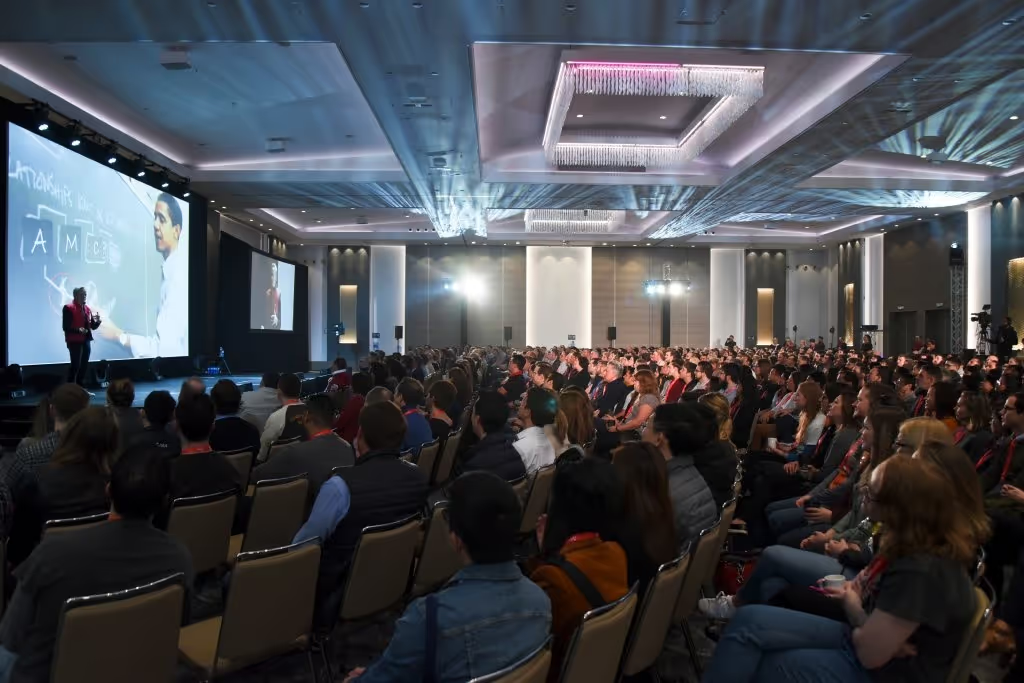
In a world where TikTok-length attention spans are the rule not the exception, executing a successful commercial kickoff, meeting, or summit is more challenging now than ever before.
People’s short attention spans mean that during a typical commercial kickoff, engagement levels plummet. Hours of back-to-back meetings with no actionable takeaways are not only boring for employees, but they also don’t make a difference for your business.
So – how do you make the most of your time together? Get creative. By injecting a little creativity into your meeting format, you’ll eliminate the monotony and give your team an experience that will accelerate results, foster innovation, and keep their TikTok brains engaged the whole time. Whether your next commercial kickoff is in-person, remote, or a hybrid, here are four moves to ensure it is a success.
- Be savvy with your investment. When organizing a commercial kickoff, it's tempting to prioritize hiring a high-profile speaker – but getting a big shot on stage isn’t what will really engage your people. Go beyond the surface-level and consider the core elements that make an event memorable: Are you investing in quality content and impactful messaging? Are you allocating resources to find a remarkable venue? Are you curating immersive experiences that will go beyond the event? These factors are all more important than booking a big name. By focusing on investments that drive value, you’ll ensure that you're maximizing the potential of your kickoff and providing attendees with an unforgettable experience.
- Don’t pack your agenda so tightly that there’s no space for reflection. We’ve all had the experience: bouncing between speeches and roundtables and workshops—taking voluminous notes—and then returning to our everyday work with no idea how to apply what we learned. When building your kickoff’s agenda, schedule ample time for thoughts and reflection. That’s important during in-person events. Even more so for virtual gatherings. A 90-minute presentation followed by a 15-minute break? That won’t cut it. Time breaks based on how much people can absorb before they get overwhelmed and tune out.
- Make it a two-way conversation. If you position your people as passive recipients of wisdom from the top, you’ll quickly lose their attention. Eventually, you’ll lose them. Build in opportunities for everyone to share their insights and ideas and help set the direction for the company. The benefit is twofold – people will get to share their ideas with leadership and leadership may be able to uncover some even better insights.
- Be conscious about building in networking opportunities. In-person, individuals left to mingle without a purpose tend to coalesce into clumps of co-workers they work with every day. In a virtual room, the conversation will be dominated by a few extroverts, leaving everyone else feeling unheard. This does not promote engagement or inclusivity. Instead, set intentional opportunities to connect. Build in time for “speed dating” where people meet each other for a rapid-fire five minutes of conversation or create small break out groups of intentionally diverse teams to spend 30 minutes together. Whether virtual or in person, connection is everything and it’s your job to be intentional about making it happen.
Hosting engaging commercial kickoffs in today’s TikTok world will never be easy. However, by being creative about how you craft the experience, you’ll run an engaging event that will inspire and equip your team to be successful. Whether you’re launching a new product, kicking off a new quarter, or setting sales goals that will help your organization reach its next billion-dollar target, leverage these tips to help your commercial team kick things off with the right foot forward.

Becoming change-ready requires the whole team, not just a select few leaders.
This column was originally published on Entrepreneur.com on MAR 3, 2023.
Heraclitus, an ancient Greek philosopher, said that change is natural and constant. Nowhere is this adage more alive than in the business world; the entrepreneur's origin story is built on change.
Recently, Frontier Airlines enacted a change by removing its customer service phone number. This leaves customers to find solutions through digital channels. With this change, the customer experience will transform entirely, creating a significant difference in the organization. This approach will allow Frontier Airlines to uncover insights that might inform, validate and challenge its strategy.
Making a bold choice such as this can be difficult, which is why many leaders and founders struggle with change.
Why is change so hard for a growing business?
Many businesses insist on leaving transformational leadership in the hands of a small group of senior leaders or change managers rather than making it part of their team's mission. Maybe because change is so crucial at the beginning of a venture — the scrappy entrepreneur needs to disrupt, innovate, sell their home and live in a basement. Then a company's relationship to change changes.
A familiar disappointment for company leaders is the feeling of getting slower as they grow. The profile of people who start and join a small company is vastly different from those who join as the company grows and becomes more stable. Stability becomes the preference and inertia the enemy.
The demands of a company's growth stage can reveal individuals' unproductive relationships to change. These relationships can be put into three categories. Receivers of change believe change is being done to them. Resistors to change believe they can wait out the change, and controllers of change ultimately believe they can plan and manage their way through it. Being big doesn't have to mean being slow or putting change on the back burner, and entrepreneurs can overcome these unproductive attitudes.
Organizations growing most sustainably continue to disrupt at all stages of growth. The ability to continue to adapt and outpace the changes of the external environment requires change-ready leaders at all levels.
What are the benefits of a change-ready organization?
Companies with change-ready teams can tackle and rise above the challenges of their environments more easily than teams that rely on top-down change management. Companies that insist on only entrusting change to a select few leaders are bound to find a lack of change, engagement, diversity and connection with customers. We've already established that change is constant, and leadership needs to reflect that in order to have a change-ready culture.Here's what sets change-ready leaders apart:
- They're more engaged. They understand that emotional agreement precedes strategic alignment, so they seek to bring everyone's voices to the table.
- They're more adaptable. They are open to their teams' conflicting views and assumptions and can adapt to the increasing rate of change in the environment.
- They lead with a mutuality mindset. They know that diverse teams generate even stronger ideas that consider key risks and ensure their teams think from customers' perspectives.
Perhaps the most important benefit of developing change-ready team members is that researchers believe that "employee attitudes to change are key predictors of organizational change success." People who see change as a constant and necessary source of opportunity are best positioned to turn change into positive forces for their organizations.
How can leaders nurture change readiness?
Instead of managing change from the top down, leaders could find that a more sustainable way of staying change-ready is to engage the whole team. How can leaders begin to cultivate a change-ready mindset among team members? Here is a playbook of initial strategies to try:
1. Accept that change isn't linear
Change is messy. It progresses one day and falls back the next. Many leaders operate under the notion that periods of change in their companies will be followed by periods of calm or that change will eventually end. This is a misconception; business is change, and creating conditions of change readiness will be more enduring than making temporary preparations to handle a specific change.
Therefore, leaders should adapt their mindset around change in their companies. At BTS, we know that change is no longer an individual sport but a team sport. Rather than a few elite surfers trying to conquer the waves, we see change more like white water rafting, where everyone must work together to make it through the waves.
2. Build awareness of your own relationship to change
Before you can successfully lead anyone through change, you need to heighten your own self-awareness of your productive and less productive responses. This starts with a biological reality: Although change is coming at us faster and more frequently than ever before in human history, biologically, we are wired to respond to change as a threat. In the past, threats to our existence were lions, tigers and bears; in the modern change-filled world, threats are things such as looking bad, being wrong or losing control.
The first step any organization can take to build more change readiness is to help every leader understand their beliefs around change and offer them new tools and approaches to be more effective. This is the approach we took with a Fortune 200 company that, in anticipation of significant structural shifts for the organization, equipped all 50,000 employees with new tools and techniques to build resilience and change readiness.
3. Engage your team to take ownership of change
Identify the pivotal moments your organization faces in leading change and align on what change-ready behaviors look like in each moment. Cultivating a team of change-ready leaders will mean engaging team members in what change means. Share the targets and outcomes of strategic direction meetings, allowing time to hear all perspectives and test different ideas on the front line. Invite people to tackle those challenges themselves in their roles so that they feel ownership over the pivotal moments where change occurs in a day.
To support this team-level ownership, shift behavior in the smaller moments that matter most. Back this up by creating the social networks and support structures that enable a wholescale mindset, giving each level and department a chance to own its change readiness.
Change is constant, and it is a team sport. No one leader or manager can author change by themselves and expect it to serve the whole organization and a whole world of customers. Sustainable, successful change comes from a collective of people who feel positively about change: a team of change-ready leaders.

It’s practically a tradition — leaders begin observations of their junior team members with, “When I was that age…” — stating, with some frustration, how different their
youngest team members are from their own or previous generations. The latest “problem child”? Gen Z.
Born between 1997 and 2012, Gen Zers are different from previous generations. Unafraid to speak up or break long-established taboos, a Gen Z team member might leave the office at 17.00 (five o’clock) sharp because they have football practice, even if there is more work to do. They might also question the company’s stance on a controversial social issue.
More broadly, headlines such as “Generation Disconnected: Data on Gen Z in the Workplace” [1] and “Gen Z: The Workers Who Want It All” [2] portray these young employees as entitled and uncommitted to their jobs. A problem to be, if not solved, at least managed.
But there’s another way to look at it. Every generation is different, their mindsets, habits, and perspectives shaped by a unique set of events. Instead of seeing these differences as a problem, organizations need to leverage each new generation’s unique perspective as a strategic advantage. In the case of Gen Z, it starts with understanding who these employees are and what they value, and then tapping into their native genius.
The “dialoguers”
Opinions come naturally to Gen Z employees, and most are not shy about expressing them. In fact, Gen Zers expect to have a voice. Keeping informed of what’s happening in the company and beyond is important to them. Also, more diverse than prior generations in the workforce, Gen Zers tend to reject labels, whether related to gender, sexuality, race, or culture. They are comfortable representing more than one identity.
- What to do: Create spaces for conversations about lived experiences. This can look like reverse mentoring, empathy workshops, panel discussions featuring Gen Z team members, and shadow boarding.
Prioritize mental health
In 2022, a McKinsey survey [3] of American 18-to-24-year-olds found 55 percent had received a diagnosis or treatment for a mental illness, and research from Deloitte [4] showed 46 percent of Gen Z employees said they were stressed all of most of the time. It may not be surprising, then, that a survey of UK Gen Z employees revealed 62 percent had taken a “mental health sick day.” [5] The same survey found only 24 percent of those who took a mental health day were honest about it, fearing retribution.
- What to do: Show your Gen Z employees that you care about their mental health. Make available company-sponsored counselling services and educational resources. Also, train managers to be empathic and build trust with their team members so that Gen Z employees feel they can ask for help.
Provide opportunities for growth
Many Gen Zers entered the workforce during the Great Resignation triggered by COVID-19. Today, Gen Z still has high rates of turnover, with 58 percent considering changing jobs in the year ahead. [6] While this is alarming for employers, research also shows 30 percent of Gen Z workers are looking for opportunities to advance within their current company. [7] Also, 76 percent of Gen Zers cited the desire to learn, practice new skills, or gain new expertise as motivation for seeking another job. [8]
- What to do: Invest in your people. Create learning and development opportunities for your youngest employees and give them a clear path for advancement. Think of all that Gen Z ambition as fuel to propel your company to the next level. Don’t blame young employees for wanting to leave; give them a reason to stay.
Leverage purpose as a motivator
Progressive and socially active, Gen Z workers expect their employers to be good corporate citizens. Research by New (Network of Executive Women) [9] showed that 77 percent of Gen Z respondents say the values of the organization they work for must match their values. As a diverse group themselves, Gen Zers prioritize diversity and inclusion. They are also deeply concerned about climate change.
- What to do: Put diversity, inclusion, and equity at the core of your company’s culture, not on the periphery as an initiative or one-time workshop. Similarly, embed sustainability throughout your organization’s processes. Finally, provide forums for employees of all generations to talk about their values and how the organization can align with them.
Gen Z has been called “the generation that wants it all”, for them financial security is important but not enough. As they ask for more from the employers, organizations are expected to change or be left behind. This new generation is changing how we work and how we think about work.
Navigating generational differences between employees will always be a challenge for organizations. But your organization’s success depends on it – attracting, retaining, and nurturing top talent requires addressing these challenges, not just within the Gen Z population, but among employees of all generations. Doing so requires a mindset shift from “us versus them” to “we all bring something to the table.” This will enable your organization to adapt to every new generation and ultimately win the talent war, ensuring your organization’s longevity.
References
[1] https://www.gallup.com/workplace/404693/generation-disconnected-data-gen-workplace.aspx
[2] https://www.bbc.com/worklife/article/20220613-gen-z-the-workers-who-want-it-all
[3] https://www.mckinsey.com/featured-insights/sustainable-inclusive-growth/future-of-america/how-does-gen-z-see-its-place-in-the-working-world-with-trepidation
[4] https://www.deloitte.com/content/dam/assets-shared/legacy/docs/about/2022/deloitte-2022-genz-millennial-survey.pdf
[5] https://www.milkround.com/recruiter-advice/mental-health-sick-days-report-by-milkround
[6] https://www.microsoft.com/en-us/worklab/work-trend-index/great-expectations-making-hybrid-work-work
[7] https://www.linkedin.com/pulse/gen-z-boldest-generation-its-job-hunt-priorities-off-charts-anders/?trackingId=pwWrCQQ1SiG9Yds3hH8gUg%3D%3D
[8] https://www.linkedin.com/pulse/gen-z-boldest-generation-its-job-hunt-priorities-off-charts-anders/?trackingId=pwWrCQQ1SiG9Yds3hH8gUg%3D%3D
[9] https://www2.deloitte.com/content/dam/Deloitte/us/Documents/consumer-business/welcome-to-gen-z.pdf

This blog is based on an article that was originally published in SUCCESS. It has been updated for 2025 and beyond
Large-scale events like sales kickoffs and leadership summits have long been a staple of business strategy. They’ve served as annual milestones—moments to align, inspire, and energize teams around the path forward.
But in today’s environment, their role has become even more vital. As organizations navigate dispersed teams, shifting strategies, and relentless change, these events are no longer just ceremonial—they’re one of the few chances to create clarity, connection, and culture at scale.
How you bring people together is now just as important as why.
Virtual fatigue, rising costs, evolving team structures, and hybrid expectations have transformed event planning from routine to strategic. The most effective companies are moving beyond default formats and asking: What does this moment demand—and how do we design for it?
There’s no one-size-fits-all anymore. The best events flex—tailored to your business, your people, and the outcomes that matter most.
So is there a gold standard? In-person still delivers unmatched energy and connection—but in 2025, the smartest strategies are context-driven.
- In-person builds energy you can feel. It’s unmatched for connection, culture, and rallying teams around big shifts.
- Hybrid expands reach. It connects distributed teams while maintaining presence and participation.
- Virtual is fast, inclusive, and cost-effective—perfect when timing or accessibility is the priority.
- Hyper-local brings people together in smaller, regional gatherings—minimizing travel while maximizing face time and relevance for specific markets or teams.
The question isn’t which format is best—it’s what does this moment call for?
This updated post explores how to design high-impact events—tailored to your context, your people, and your goals.
Let’s dive in.
Set the tone—and build something that lasts
It’s not just the format that’s shifting. Structure, length, content, and tone are evolving too—which creates a powerful opportunity for leaders to shape more meaningful, memorable experiences.
To make these moments count, it helps to pause and consider:
- What do you want this experience to be remembered for?
- How do you want people to connect with it—and with each other?
- What kind of follow-through do you want to inspire?
Approaching event planning through this lens turns it from a one-off activation into a long-term investment. As a leader, you don’t have to manage every detail—but you do need to set the tone. When your vision is clear, your team can build something truly intentional.
Here are four strategies to help you get there:
1. Empower teams to make the right decisions.
Many meetings are unproductive or a waste of time, and meetings involving event coordination may become nothing more than project updates. Though these aren’t without merit to gauge progress, it shouldn’t be the sole focus. For execution teams to act on the right decisions around every detail, the meeting agenda should also touch on the vision, benchmarks, next steps and any obstacles that might require additional support, among other topics. And it should do so at a cadence that makes sense for you, the team and the event itself.Perhaps all that’s necessary is to meet once a month until the event date closes in. Maybe every two weeks is a better option. Information is power, as they say, and you can empower your team to take initiative on their own. Research has shown that empowering team members may lead to innovative behavior and improved work performance, among other benefits. This potential boost to innovative, proactive and knowledge-sharing behaviors may be especially useful when it comes to the team developing innovative ideas and the wherewithal to put those ideas into action. Engage all team members early in the planning process. Provide them with the freedom necessary to make decisions on their own so that when things deviate from the plan, they can adjust accordingly instead of being left unsure of the next steps.
2. Find a balance between internal vision and external engagement.
You’re essentially building a legacy for how you want to be remembered. This can have a sizable impact on not only creating a memorable and lasting experience for your audience, but encouraging them to return year after year.Just look at the Consumer Technology Association’s CES® event, which claims to be “the most influential tech event in the world.” At this year’s event, CES welcomed nearly 120,000 attendees from around the world and offered massive visibility (print and social media) to its exhibitors and presenters. The planning and execution of this event, which showcases other companies’ solutions, requires months of vetting potential exhibits, working with venue and event teams and organizing high-profile keynotes.While staying true to your vision is critical, make sure that you don’t lose sight of the customer in the process. Get boots on the ground and make a habit out of listening, relaying what’s learned and even following up with customers. Then, it’s just a matter of striking a balance between your vision for the event and what the audience is saying. It’s important not to go too broad or too narrow when homing in on your audience and vision; it’s more about finding something in between that speaks to what’s really going on in the business and what attendees want in an event.
3. Create a purposeful, intentional atmosphere for meetings.
All discussions should be connected to the company strategy—“connected” being the operative word here. Think about the purpose and desired outcome. What conversations do you need to initiate? What is the red thread or throughline for everything you’re doing at the event?Without that connection, the focus can shift away from the strategy. Our company uses a pyramid diagram to divide ideas into sections and organize the meeting structure to ensure all discussions are intentional and purposeful.At a recent sales kickoff for a large client, we ensured the client’s new methodology and customers were at the core of every design element. Everything from the digital solution to the scenarios that participants engaged in to how facilitators led debrief conversations was designed to reinforce the new methodology and drive the effectiveness of a cross-functional team in service of customers. As a result of that intentionality, the client saw a 54% uplift in their pipeline coming out of the event and a 40% adoption growth of a newly introduced scorecard for account executives.
4. Reflect on operational successes and failures.
You may not think of reflection as a competency, but research shows that such a habit can be the differentiator between extraordinary and mediocre workplace performance and engagement, and it may serve to benefit your team as well. As such, make after-event discussions more than just debriefing sessions. Did the experience lead to the desired outcomes? Were there any unanticipated outcomes? More importantly, how do you plan to track results over the next few weeks or months?Our company worked with one client who was exceptional at this process. Naturally, the event’s theme fed into the experience from start to finish, and the outcomes were as expected. But instead of checking off that box and returning to business as usual, the client took reflected on the outcomes. They found ways to incorporate that specific experience into their organization so they didn’t lose any traction made with the target audience.
Thinking more strategically about how to execute an event and incorporating these event planning tips will put you a step ahead of the competition. It will also help you create an experience that’s both memorable and a critical part of establishing a legacy for you and your company.

Traditionally, a commercial kickoff is a milestone event — part of a company’s DNA, and the place to reignite and recharge the field by celebrating accomplishments, driving excitement among sales reps, and building alignment around the organization’s future.
It provides an excellent opportunity for organizations to advance their objectives and strategic imperatives. Unfortunately, through our experience, these events often miss the mark in expectations from leadership, the field, and overall return on investment. We find that critical elements to plan and execute a commercial kickoff successfully are overlooked at some point during the process, creating friction among those responsible for planning and managing the event.
These three critical elements are: (1) ensuring alignment across relevant, diverse stakeholder groups, (2) maintaining a focus on the target audience, and (3) recognizing the impact of changes on event design. Attending to these elements ensures a balance between executing a memorable event, making the event relevant to the target audience, and driving business outcomes for the future.
Designing, developing, and executing a sales event: does this happen to you?
Typically, a commercial kickoff starts when a sales leader sees a need to celebrate accomplishments, drive excitement among sellers, and build alignment around the organization’s future. A committee is quickly assembled with representation from stakeholder groups such as marketing, sales enablement, and operations; they then develop a budget and announce the commercial kickoff, and everyone involved in planning quickly shifts into execution mode.
The committee comes up with a plan and assigns responsibilities. Committee members then go off on their own along with their respective teams, conducting periodic check-ins as a full committee to gauge progress. It quickly becomes apparent that groups are working in siloes with different priorities. For example, one group focuses on event program management, including venue choice or platform identification, event objectives, agenda, speakers, and communications. Other members of the commercial kickoff team are focused on content development.
Inevitably, something always happens that leads to minor and, in some cases, significant changes to the event. For example, sales leaders who are sponsoring the event are not always involved until a few weeks before, when they begin to realize that minor changes are necessary. However, there are other instances when organizations need to make drastic changes to their commercial kickoff plans. Whether adjusting for minor or significant changes, these changes lead to re-work, stress, and late nights for the people putting the event together – all major contributors to friction between team members and others in the organization. More alarming, these challenges can ultimately impact the ability to achieve the desired outcomes from a commercial kickoff.
There are three common mistakes organizations and planning committees make that lead to unnecessary friction when launching a commercial kickoff. By avoiding these mistakes, you will experience better planning, coordination, and alignment between sales leaders, marketing, event planning, sales enablement, and operations, which will help you achieve the desired business outcomes for your commercial kickoff.
Mistake 1
Planning is not aligned across all event stakeholders
Too often, planning efforts fail to consider competing stakeholder interests and perspectives that influence members of the planning committee as they develop an overall event plan.
- The Event Team wants attendees to remember the experience. Therefore, their priorities are the location (if in-person), the platform (if virtual), registration, and communications.
- Sales Enablement wants attendees to walk away better equipped to engage customers. Therefore, their priorities are breakout sessions that focus on tools and skill development.
- Product Marketing wants attendees to understand product and solution features and benefits, use cases, and “what’s new.” Therefore, their priority is education.
- Sales Leaders want attendees to leave inspired and motivated to execute the strategy. Therefore, their priorities are the main stage messaging and the overall vibe of the experience.
Solution
Ensuring alignment to the business objectives early in the process and understanding the critical decision points the team needs to make will reduce unnecessary friction throughout event planning and execution. Experience tells us that organizations with the most successful commercial kickoffs do the following:
- Align all vital stakeholders on goals or desired outcomes for the event.
- Solicit input from all stakeholders to identify themes.
- Maintain clarity on the red thread throughout the event.
- Coordinate planning and execution efforts by working as one unit, rather than in silos.
Mistake 2
Losing sight of what the target audience needs from the event
When balancing multiple perspectives and priorities, it can be easy to lose sight of what the target audience needs to get out of the event. While everything that an organization does is in service of customers, it is critical to keep in mind that commercial kickoffs are intended to serve the salesforce to help them do their best work serving customers. Traditionally, organizations have over-rotated on celebration, inspiration, and information-sharing during commercial kickoffs. However, these do not address sales reps’ comprehensive needs in today’s environment.
In reality, today’s sales reps struggle to achieve work-life balance because they are working longer days, jumping from meeting to meeting, experiencing less separation between work and home, and struggling to disconnect from work outside of working hours. Sales reps have demonstrated the prevailing feeling of being disconnected or isolated from their colleagues and their organizations. They are spending more time with their immediate families and re-evaluating what is important to them. It’s essential to recognize that some sales reps will decide whether or not to continue working for organizations after a commercial kickoff.
Solution
A concept called “everboarding” describes the notion that onboarding or activating customers never stops because products and services are ever-evolving. “Everboarding” is also applicable to your existing salesforce. Everboarding is informed by learning science – the realization that one-shot approaches like having a single day to onboard a new employee or share something new with employees in a single session will not endure. An everboarding strategy is a shift from sharing information during a single event to ongoing reinforcement. The organization, marketplace, and sellers constantly evolve, but teams are left to make sense of these changes. Successful organizations, particularly now, are taking the “everboarding” approach with their teams to continually engage and activate their team in the go-to-market strategy. A commercial kickoff represents an opportunity to engage participants in meaningful dialogue, workshop ideas, problem-solving, reflect, and plan intentional experiments in the field.
Mistake 3
Failing to recognize the impact of significant changes on the design of the event
There are external and internal events that can lead the team to reassess a commercial kickoff. With limited time to pull off a commercial kickoff event after any significant change, the team, including vendors, is thrust into action. Unfortunately, sometimes the group takes action without having a clear line of sight on the overall impact of their decision or based on incorrect assumptions. In these situations, stress builds, and missteps or errors become widespread.
Solution
Significant changes may require redesigning the event rather than simply adjusting or modifying sessions. There is a subtle difference between the two, but one that will determine the impact and effectiveness of the event. Given any significant changes, redesigning the event entails taking a step back and considering how you can best accomplish the event’s objectives. We know what you’re thinking – that you don’t have time for that, because the event is only weeks away – and we understand your urgency in these situations. However, taking the necessary actions early on will save you time, re-work, and overall frustration. Here are a few steps you can take to make the redesign work to your advantage:
- Quickly convince stakeholders to align the event’s objectives given a need to redesign and explore what needs adjusting given proposed changes.
- Evaluate the limitations of the platforms (registration, learning delivery, virtual event, etc.) that can materially impact achieving the objectives of the event.
- Redesign the event by considering the impact of the changes on the scope of the event (national, regional, or global), length of sessions, the balance between main stage and breakout sessions, strategies for participant engagement, speaker selection, and also the impact of the red thread throughout the event.
Conclusion
A commercial kickoff represents an excellent opportunity for organizations to acknowledge their sales force’s contributions and advance organizational objectives and strategic imperatives. However, it is also essential to balance executing a memorable event, making the event relevant to the intended audience, and driving business outcomes. To successfully plan and execute a commercial kickoff, event planners must not overlook the three most essential aspects to execute a commercial kickoff successfully: (1) ensuring alignment across relevant stakeholder groups, (2) maintaining a focus on the target audience, and (3) recognizing the impact of changes on event design. Ensuring that these elements are top-of-mind considerations throughout the commercial kickoff development journey will allow for a memorable event that’s relevant to the target audience and drives business outcomes for the future.
References
- Miller, R.C. (undated article). Commercial kickoffs: The Mistake You’re Making, https://www.forcemanagement.com/blog/mistake-youre-making-when-planning-your-sko
- Spotio (February 4, 2020). Guide to the Perfect Commercial kickoff Meeting, https://spotio.com/blog/sales-kickoff-meeting/ Pipedrive (updated blog post). Commercial kickoff: How to Start the New Year with a Bang, https://spotio.com/blog/sales-kickoff-meeting/
- Robinson, R (updated blog post). 12 commercial kickoff meeting strategies and best practices for bringing your team together https://blog.close.com/sales-kickoff-meeting/
- Wang, E. (November 17, 2020). Everboarding is the next level of customer onboarding, https://medium.com/bento-app/everboarding-is-the-next-level-of-customer-onboarding-6aa52e2595d8

How many times have you and your colleagues on the leadership team grappled with a culture problem?
The answer may not be obvious at first. Here are a few ways we see companies taking on culture change, often under the guise of a different name:
- Adopting and socializing a new customer-first go-to-market strateg
- Shifting from working heads-down in silos to formal, cross-functional collaboration
- Turning the tide to incite more inclusive behaviors
When starting to make these shifts, the go-to answer is often: “Let’s talk to HR – maybe we can get some training so people will start doing things differently?” And HR responds with, “Great – let’s go!”
Then, months go by, and the needle hasn’t moved. This leaves you and your organization right back where you started. Despite the plethora of online courses, internal seminars, and team sessions available, you are frustrated by the lack of change. What gives?
Training individuals is not the answer. While training is critical for people to learn new things, it is not a comprehensive culture fix. Training alone is insufficient to change culture across the organization.
Research conducted by Kim Cameron and Robert Quinn from University of Michigan’s Ross Business School, and also by Edgar Schein from MIT’s Sloan School of Management has shown that effective culture change happens in groups because group norms, organizational mindsets, and team behaviors overpower individual desires. Just as strategic initiatives are born from a shared organizational vision, culture also cascades from collectively held mindsets, behaviors, and values.
When companies focus on individual development efforts to reinforce the culture they aspire to embody, they miss their biggest point of leverage. Changing your culture requires mobilizing both individuals and the collective behind a shared sense of urgency and responsibility.
Moving beyond the HR talent lens to deliver a culture shift
When making organizational changes, of course HR needs to be involved. However, to successfully enable culture shift, you need to go beyond training and address several other elements, such as: process engineering, information access, governance, and decision making, which can all be affected by culture change. If you are not thinking about these (and more), you are training your way to culture change.
To mobilize your organization and bring your culture shift to life, consider these three elements:
1. Cultural assessment and definition—creating the foundation for change
The first step in shifting your organizational culture is to ground yourself in the current one. If you don’t have a deep understanding of your existing culture, you may miss opportunities to identify and address major cultural roadblocks that will hinder your future state. You also might overlook key cultural strengths that you could leverage to propel the organization forward. (To learn more about cultural assessment, check out this white paper.)Assessing your current culture at the following four levels will enable you to uncover the nuances, behaviors, systems, and mindsets necessary to get you where you need to go:
- Individual – relationship to self and others
- Team – working in groups
- Organization – what drives action
- Business environment/context – view of change
When organizations lean on training as a band-aid, they miss the opportunity to toggle other systemic elements that profoundly impact culture, such as compensation alignment, process engineering, access to information, and feedback, among others.Here are a few game-changing questions that leaders can ask to define and build toward a strong culture:
- How can we build momentum towards the desired business results?
- What processes and systems are enabling or defeating the change?
- Are the current performance management systems getting us where we need to go?
- Am I assessing my team on the right capabilities?
2. Cultural scaling—creating alignment, processes, and systems
While shaping culture at the individual level is easier, people seldom produce their best work in siloes. To change culture, your organization must change the way people work in teams. This element, which can be done in concert with individual training, is about aligning team processes and embedding them in the organization.Changes in team effectiveness require supporting systems. To ensure your systems are aligned to your organization’s cultural vision, ask these two critical questions:
- Do the current talent lifecycle activities, organizational capabilities, and work processes across your business support the changes you hope to see?
- Which legacy systems and processes could derail the culture change you seek?
When leveraged correctly, processes and systems should create boundaries and provide guardrails that encourage culturally constructive behaviors, mindsets, and problem-solving methods.
3. Individual training—activating individuals to support the shift
The third element of shifting the culture is where training comes into play: activating individuals to do things differently. When asking HR to take the lead on training, consider these two aspects to ensure you are readying the whole organization for the culture shift you seek:
- Change-ready leadership to help address individual readiness. In addition to broader efforts to assess, define, and scale organizational systems and capabilities that enable alignment and foster culture, it is critical to evaluate and enable individual readiness. Shifting the culture is a burden shared by not only business leaders and CHROs, but also by those leading talent management and leadership development who are responsible for preparing individual leaders.
- Identify behavior shifts and lead accordingly. Change-ready leaders prioritize enduring behavioral shifts over “check-the-box” or surface level ones. When it comes to culture, quick fixes are often the enemy. Change-ready leaders also hold individuals accountable through feedback and by example. Leaders who model the behaviors they wish from their teams build trust and gain buy-in when it matters most. This might include challenging actions and decisions such as encouraging those who prefer not to shift their current behaviors to move on from the organization.
Organizational culture is a living, breathing, intangible thing. Just like a brand, we know it and feel it daily, despite its intangibility. Business leaders, you have the power to ignite the change you seek by leveraging assessment and definition, scaling, and individual training. Over time, these efforts will produce new behaviors and ways of working, ultimately creating the new organizational culture and a long-lasting legacy for your organization.
Sources
- Cameron, Kim S., and Robert E. Quinn (2011). Diagnosing and Changing Organizational Culture: Based on the Competing Values Framework. John Wiley & Sons, Hoboken.
- Schein, E.H. (2010) Organizational Culture and Leadership. Vol. 2, John Wiley & Sons, Hoboken.

Whether you love or hate the term, it represents an important quality for leaders – the ability to show up in a way that engages others, aligns and motivates them, and that ultimately can rally them to get things done. When working with leaders who are self-identified introverts, they often prickle at the assumption that they need to consciously “extrovert” themselves to demonstrate executive presence. Or be gregarious. Or just “get over” their introversion and become more outgoing.
Recently, a senior technology leader at a large insurance company taking on broader responsibility across his organization reached out. He knew that he wanted to step up his presence and visibility in order to mobilize and inspire the team. He struggled with the idea that he’d have to make a dramatic change from his more analytical, quiet, and introverted approach to better connect with people. “I’m just not an exuberant person,” he said. “Being overly energetic and bubbly doesn’t feel genuine to me. I don’t have it in me to be effusive or over-the-top. I just don’t have charisma.”
He's not alone in that sentiment: many introvert-identifying leaders feel the same way. However, there is another approach. Leaders CAN demonstrate charisma without having to compromise on personal style or authenticity. Step one is aligning on how we define charisma. In this instance, let’s use the traditional Merriam-Webster version: an individual that possesses “a special magnetic charm or appeal.” Something that draws you to another person.
With that in mind, here are seven actions you can take to heighten your “charisma” without feeling like you’re having an out-of-body experience:
- Make eye contact: This is the simplest way to clearly demonstrate that you’re paying attention and interested in what the other person is saying. A good rule of thumb is to maintain eye contact 50 percent of the time when speaking and 70 percent when listening. If that feels uncomfortable, try looking away for four to five seconds at a time and then refocusing.
- Smile more: There’s a great TED talk about the power of smiling. Here’s what you need to know: One smile can generate the same level of brain stimulation as 2,000 bars of chocolate. It reduces stress-inducing (cortisone) and increases mood-enhancing (endorphins) hormones. Also, try not to automatically smile back when someone smiles at you.
- Consider body language: More specifically, tilt forward slightly when in conversation, and keep your arms uncrossed. Use hand gestures to emphasize points. You don’t want to cross into someone’s personal space, but you can send a message that invites the other person to lean in – literally and figuratively.
- Talk about yourself: Talking about things that are important to us is scientifically proven to spark more neural activity in our brains. In other words, self-disclosure, or sharing something you’re passionate about, can create a sense of energy and excitement that can be contagious. In addition, any level of vulnerability in turn gives your audience permission to reciprocate, and they may be more likely to share with you.
- Talk about them: See point #3. Talking about yourself creates connection, which is true for the person you’re talking to as well. Ask them questions about their passions and interests, then listen. Really listen — without interrupting, checking your phone, or bringing the conversation back to you.
- Share stories: Imagine someone who is extremely charismatic. It’s likely you aren’t conjuring up someone who regularly spouts data and facts. A better way to emotionally connect with your audience is to use stories and analogies to make your point. It’s about sharing experiences that have shaped who you are and how you think. And stories are 22 times memorable than facts alone.
- Use real talk: The fastest way to lose someone in a conversation is by using technical jargon or formal, scripted language. Aim to be both conversational AND credible. Try slowing down your pace to be more intentional with your word choice. If you’re using words like “synergy” and “circle back” – you’re doing it wrong.
Bottom line – developing your executive presence and a sense of charisma doesn’t mean having to become someone you’re not, and it doesn’t require a dramatic change. Very small shifts in how you pay attention, convey information, and use body language can have a meaningful effect on how you connect with your audience.
SYDNEY, AUSTRALIA, July 2023 – BTS Group, a global human capital consulting business, operating in Australia for more than 20 years, has appointed Tracey Bunyard and Stephanie Peskett as joint Managing Directors of BTS Australia, succeeding Andrew Robertson. Together, Tracey and Stephanie will lead the end-to-end business and partnerships with clients.
Tracey Bunyard is a qualified Accountant and business leader with more than 20 years of experience in general management across industries spanning Financial Services, Manufacturing, Distribution and Technology. For the past eight years, Tracey has been the General Manager of BTS Australia. Tracey has deep expertise partnering with commercial leaders to create customer value, supporting customer and sales transformations, and delivering business strategy and assessment. Tracey is a proud Indigenous woman who lives in Sydney with her husband and two sons.
Stephanie Peskett is a HR practitioner, PCC accredited Coach, and business leader with more than 20 years of experience supporting people and strategy development in the world’s leading organisations. She partners with clients to transform their learning, culture, talent management, and top-to-bottom leadership development initiatives. Stephanie also works with Executives to support their end-to-end people and organisational change initiatives. Stephanie lives in Sydney with her partner and three children.As Managing Director of BTS Australia, Andrew Robertson spent 20 years developing BTS’ Australian business, serving many of region’s largest local and global organisations. Andrew will remain with BTS until November 2023, focusing on operations and consulting.
"Tracey and Steph have been integral to BTS Australia’s growth. They are exceptional with our people and our clients and have teamed well together for years. This is the natural next step in their careers and I have no doubt that they will continue to foster the BTS culture of being high performing and big-hearted. I am grateful for their pioneering spirit in this adventure,” says Jessica Skon, Global CEO of BTS Group.
"We’re very proud of the strength and proven sustainability of our business in Australia, and the way we have been able to impact businesses and leaders. Over the years, we have also seen Australian talent taking on global roles and helping us in the growth of the BTS business. I am confident that Stephanie and Tracey in their new roles will accelerate the business’ growth as well as continue to provide outstanding service for our loyal and valued clients across the country,” says Philios Andreou, Deputy CEO & Head of Other Markets.
For more information, please contact:
Kim Cooper
Marketing Manager
Kim.cooper@bts.com

STOCKHOLM, SWEDEN and SAN FRANCISCO, CALIFORNIA, June 2023 – BTS has signed the Human Rights Campaign and GLAAD’s “Count Us In” Pledge, which affirms leading businesses and employers’ support for LGBTQIA+ inclusion and equality in the workplace and beyond.
BTS is committed to creating a professional environment that is inclusive, safe, and supportive of people of all gender identities and sexual orientations.
“We stand with the LGBTQIA+ community in the fight for equality,”
says Kathryn Clubb, CEO of BTS North America.
“We loudly celebrate LGBTQIA+ diversity and resilience. As an organization and brand, we are committed to demonstrating this support in publicly visible ways. PRIDE month has given us the opportunity to celebrate, learn, appreciate, and understand the LGBTQIA+ community. We are emboldened to take action, speak up, and be better allies.”
In signing this pledge, BTS commits to taking a stand for its LGBTQIA+ employees and clients. Through advocacy, in partnership with lawmakers on the front lines, BTS is committed to supporting broader social change that will shape the world for the better. In tandem with this pledge, BTS has formed an internal taskforce to lead its ongoing discussion and commitment by identifying opportunities for additional advocacy efforts.
“I’m so proud of BTS and the ways in which we are taking a stand to create a better world for our clients, our communities, and our employees,”
said Kathryn Clubb.
“In the words of P. T. Barnum, ‘Comfort is the enemy of progress.’ May we never get too comfortable.”
BTS stands alongside more than 75 other leading businesses, including many clients, in taking this pledge. To learn more about the Pledge and what it stands for, click here.

In challenging times, organizations need their leaders to step up and drive results.
When it comes to making that happen, just about every leader gets feedback that they have valuable strengths, as well as areas of opportunity where they could improve.
For most leaders, your strengths come rather easily. However, addressing your areas of opportunity is usually more of a challenge! Even worse, when your manager, peers, and others tell you that you need to change, you may feel hurt, upset, or anxious about it.
Here’s an example: Introverted leaders are often appreciated because they generally come across as thoughtful and deliberate when it comes to making decisions. At the same time, these leaders may get feedback that they often leave their teams and peers wanting more – that they need to speak up and share what they think and feel more often.
While many high-performing leaders understand this feedback, they may also struggle with it. Some worry that if they change their behavior in response to the feedback, they won’t be their authentic self. At the same time, these leaders may also be concerned that if they don’t change, then they will limit their success. We call this the “Authenticity Paradox.”
So what can you do when faced with this seemingly lose-lose choice? Quite often, leaders are advised to “fake it ‘til you make it.” Let’s say an introverted leader takes this advice to heart. They vow to start blurting out whatever thoughts come to mind—throwing caution to the wind by speaking first and thinking later.
There are a few significant problems with the “fake it ‘til you make it” approach. The first one is that no one wants to be fake! Secondly, you run the risk of negatively impacting one of your greatest strengths – your reputation for being more thoughtful and less impulsive. Thirdly, most people just can’t do it. They may try to change, but it feels so out of character that they will simply stop trying to behave differently.
The great news is that you don’t have to “fake it ‘til you make it.” In fact, this approach is actually a very ill-advised path forward. Instead, the key is to figure out how you can respond to constructive criticism AND be true to your authentic self. To do so, think about how you can leverage your existing strengths to your advantage — maybe in a slightly different way than you do now.
For example, if you are an introvert, here are some ways you can be true to your authentic self AND be responsive to feedback calling for you to speak up and share more often:
- If you are a good listener who struggles to inspire others, go on a listening tour to learn more about what would inspire others.
- If you are humble person who doesn’t like the spotlight, tell more stories about peers and direct reports who deserve recognition. This may be a more comfortable way to inspire others and rally them around a vision.
- Rethink how you prepare for meetings and presentations in ways that honor your introvert’s preference for processing time. If you can anticipate and prepare for your audience’s tough questions on a given topic, you will show up much more ready to share and without feeling you have to “think out loud,” which may not feel natural for you.
The simple truth is that you don’t need to choose between being true to who you are and being successful in driving business results during turbulent times. Everything you need is within you: You don’t have to fake it ‘til you make it. You just need to be more thoughtful about how you can be responsive to feedback in ways that still feel authentic to you.

STOCKHOLM, SWEDEN and SAN FRANCISCO, CA — BTS GROUP AB (publ), a world-leading strategy implementation firm, was recently named to Selling Power’s Top Sales Training Companies in 2023 list.
“We are grateful to receive this recognition of our sales training capabilities for the third year in a row,” said René Groeneveld, Partner at BTS. “This past year, we augmented our hybrid-virtual solutions by leveraging artificial intelligence and language analytics. This enabled us to evaluate sellers’ abilities to engage with customers in situations such as discovery, value conversations, negotiations, and more. Thanks to our clients for their ongoing partnership and trust while co-creating leading-edge solutions.”
According to Selling Power publisher and founder Gerhard Gschwandtner, quality sales training is more important than ever. “As the economy continues to slow, accelerating sales becomes increasingly critical to a company’s success. The right sales training delivered at the right time can be the secret ingredient to a company not only surviving in this economy, but also thriving.”
All companies on the list submitted a comprehensive application that included a detailed listing of their offerings for both training and retention, innovative solutions, and their company’s unique contributions to the sales training marketplace.
The main criteria used when comparing applicants and selecting the companies to include on this year’s list were:
- Depth and breadth of training offered
- Innovative offerings (specific training courses, methodology, or delivery methods)
- Contributions to the sales training market
- Strength of client satisfaction and overall client feedback
To evaluate applicants for the list, the Selling Power team surveyed and considered feedback from nearly 400 clients of the applicants. Here is a brief selection of comments from their clients:
“They are helping us achieve a very high standard through their training sessions. Our implementation has already yielded some big positive outcomes.”
They are always available to help. They go above and beyond to provide the support and structures we need for our sales process. Their objection handles and reviews are the best I've seen.”
The level of professionalism, expertise, experience, and deep collaboration to best understand our sales channel challenges was excellent.”
Super-fast responses to customer requests, delivery time frames, high-quality facilitators, and very good rapport with all the team.”
The best methodology for accelerating the success of any sales team with minimal overhead and highest ROI.”
They make every effort to listen and fully understand client needs resulting in training programs that are shaped and focused to meet specific requirements and deliver results. Furthermore, they have the capability to deliver at scale globally in multiple languages.”
Selling Power magazine editors encourage CROs, sales VPs, and sales enablement leaders to leverage this list to find the right sales training partner and help salespeople succeed during social distancing and remote working. See the Selling Power Top Sales Training Companies 2023 list.

The negotiation quickly devolved into an intense battle: the client wouldn’t yield, while the salesperson was determined to close the deal no matter what.Many of us have experienced this scenario at least once. How can you emerge from a such a situation successfully and efficiently?The art of negotiation goes beyond closing a deal, and begins earlier in the sales process than you would think. Here’s how considering mindset, acumen, and capability at three critical stages of the sales process will help you and your sales teams refine your skills, identify the right deals, and strengthen customer relationships.
- Preparation.At this preliminary stage in the sales process, ask yourself: what do you need to know about your customer, their industry, and the financial circumstances of both organizations involved in the deal?Applying mindset at this stage means preparing yourself for a variety of possible reactions to your every statement by “climbing the logic tree” of a sales conversation and assuming a collaborative stance. As for acumen, develop familiarity with the industry and define the financial value of your offer for your client. A specific capability required at this stage is stakeholder management: be mindful of both your own and your customers’ positions and focus on the interplay of your interests.
- Negotiation.Throughout the course of the conversation, ask yourself: how can you present an offer optimally, address customers’ concerns constructively, and define a strategy compellingly? The correct mindset at this stage is a tactical one: having anticipated objections throughout the preparation phase, you’re now prepared assert yourself with confidence, no matter the direction your customer steers the conversation. Incorporating acumen into the negotiation process means clearly articulating the financial impacts of each option you’re presenting. Uncovering your customers’ interests through questioning allows you to handle objections capably.
- Going deeper.Throughout the final stages of a negotiation, ask yourself: What’s the best way to deal with procurement people, and what are their interests? How do you successfully negotiate a price increase?The right mindset remains one of confidence, especially when speaking with regards to procurement and negotiating price increases. Having acumen at this stage means understanding the greater procurement environment, as well as the effects of every possible change in pricing on said environment. Confidence and knowledge, of course, set up the conditions for you to form additional sales capabilities (such as trust-building), or the ability to pivot from negotiating pricing to other variables (such as volume or share achievements, specifications on certain products, warranties or guarantees, contract terms, delivery terms, and more).
By strengthening your own sales mindset, acumen, and capabilities in addition to the deal-closing skills you already possess, you can head into any negotiation knowing that the right response is always within reach.
So, how will you apply the above?

For CEOs and business leaders today, their role extends beyond the typical challenges of ensuring profitability and executing the business strategy. They are also responsible for managing tensions between customers who want climate-conscious products and business operations, employee physical and mental health care, and the transition to a hybrid work environment. Furthermore, CEOs need to consider exponential rates of change in technology (including AI and robotics), digital currency disruptions, the impacts of globalization and geopolitics (such as shifts in power), as well as social media.
Today, leaders, organizations, and societies face ever accelerating rates of change and disruption. However, the individual and collective capacity to keep up with change is not growing at the same rate. The rate of change is greater than peoples’ capacity to learn and adapt along with it.
Research by Lectica[1] shows a significant gap between leadership capability and the complexity leaders face, referred to as the “complexity crisis.” The type of development needed to prepare for this reality is not just for senior leaders, and it’s not just about learning new knowledge, skills, and information.
This new approach is called vertical development. Many leaders are now becoming aware that this type of development is important. However, we have yet to see an organization that has unlocked the full power of vertical development interventions.
What is vertical development?
We define vertical development as the development of a leader’s worldview — deepening, expanding, broadening, and transforming their mindsets. This impacts leaders’ behavior and, therefore, results. Put simply, horizontal development is more about competency, and vertical development is more about capacity. Think about expanding development as if it were a glass of water. Adding water to a glass is horizontal expansion, but increasing the size of the glass is vertical expansion. Or, take cell phone operating systems: horizontal growth is about adding more apps; vertical development is about upgrading the operating system. Vertical development means that you can add apps with the ability to do more complex tasks than the previous operating system could handle.
Einstein is known to have said, “We can't solve problems by using the same kind of thinking we used when we created them." You can’t solve the problems leaders face today by adding new apps – you need to upgrade your operating system. Leaders today face more and more complex challenges. Adding new competencies, skills, and knowledge is not enough. Leaders’ development also needs to include the vertical dimension of growth so that they can see from a different perspective, find new and creative solutions, act with greater wisdom and capacity, and have a transformative impact within and beyond your organization. This is the type of learning that leaders need in order to meet the exponential rate of change.
In Harvard Business Review, Torbert (2005) found that five out of ten CEOs from various companies were measured at the Strategist level (an advanced level of vertical development), while the other five were measured at lower stages of vertical development. Of the five Strategists, all had successfully implemented organizational transformations in a period of four years, which improved the company’s profitability, market share, and reputation. For the other CEOs, only two succeeded in doing the same.
How do you facilitate vertical development in your organization?
Leaders cannot be forced to grow vertically. It is not the same as horizontal development, where knowledge sharing, training, skill development, or practicing a new behavior are enough. Growth occurs differently in vertical development.Vertical development is about expanding your mindset — changing how you think and behave. Mindset refers to the mental models you engage when you are thinking, as well as your sense of identity.
Vertical development isn’t about training a leader in skills. It’s about transforming the ways a leader thinks, which will impact what they do and how they behave. In vertical development, you become more adaptable, self-aware, and collaborative, with the ability to span boundaries and networks.[2]
We know from research at the Centre for Creative Leadership (CCL 2020) that three aspects facilitate vertical development growth:
- Heat experiences – experiences where you face a complex situation that disrupts your habitual way of thinking.
- Colliding perspectives – when you are exposed to others who have different worldviews, opinions, and backgrounds, your own mental model of the world is challenged through these experiences.
- Elevated sense-making – as you reflect and make sense of the changes in worldview and experiences, you have the opportunity to enlarge your worldview.
By including all three of these aspects in your interventions, you will create prime conditions for vertical development.
Here is one example, which is designed in the context of executing a new business strategy through people:
- Heat experiences: Leveraging business simulations, participants (dozens or thousands) form groups with other leaders to practice running a modeled version of their business environment. This allows them to align and live the new business strategy or transformation. Leaders are removed from their comfort zones and placed into complex situations, which enables them to grow. Sometimes leaders’ behaviors are observed to offer insights and additional challenges, which turns up the “heat.”
- Colliding perspectives: Leaders meet others from different functions and levels to grapple with the simulated challenges in small groups to execute the new strategy. Here, leaders’ mental models are challenged through interactions with their peers. Each individual brings a different perspective or worldview and represents a different part of the business. Doing so reduces the polarity of views between groups, such as sales and operations, which can be a powerful tool in preparing leaders to execute a new strategy successfully. Without an intervention like this, these business siloes typically lead to stagnation or slow progress.
- Elevated sense-making: Through mindset coaching, leaders get the opportunity to step back, make sense of things, and apply their learnings and shifts in worldview. Using a coaching approach that specifically focuses on mindsets or changing worldview is critical to enable this change as it provides critical support for individuals to make the necessary shift.It is also important to note here: not everyone will develop vertically. Some leaders will be a driving force for integrating a vertical change, but others may not be ready for such a shift. It is important to facilitate both vertical and horizontal development, and given the current climate, ensure vertical development is included.
Heat experiences, colliding perspectives, and elevated sense-making should be integrated into all of your interventions, enabling you to build the vertical development foundation your leaders need to have the greatest possible impact. When leaders’ worldviews are narrow, their range of choice and creativity is also narrow. As they expand, they will see more, experience more and be able to lead with more. When your leadership development interventions deliberately invite leaders to shift their perspectives and worldview, while also providing new knowledge, skills, and competencies, you empower and unleash your leaders to lead in our complex, globally interconnected world.