Welcome to BTS Mexico
When people do the best work of their lives, they create better businesses and a better world.

BTS is the global leader in transforming strategy into action and results through people. We have more than 30 years of global experience and 15 years working in Mexico, with offices in Mexico City being the first office in Latin America, collaborating with leading companies in the market and with most of the companies within the FORTUNE 100 and expansion.
We believe that to successfully execute any strategic initiative, the key is people.Companies need their people to be aligned with the vision of success of the organization, generating the right mindset to address the necessary changes and developing their skills to adopt the new ways of doing and thus generate amazing business results.
Latest Content


Technology choices are often made under pressure - pressure to modernize, to respond to shifting client expectations, to demonstrate progress, or to keep pace with rapid advances in AI. In those moments, even experienced leadership teams can fall into familiar traps: over-estimating how differentiated a capability will remain, under-estimating the organizational cost of sustaining it, and committing earlier than the strategy or operating model can realistically support.
After decades of working with leaders through digital and technology-enabled transformations, I’ve seen these dynamics play out again and again. The issue is rarely the quality of the technology itself. It’s the timing of commitment, and how quickly an early decision hardens into something far harder to unwind than anyone intended.
What has changed in today’s AI-accelerated environment is not the nature of these traps, but the margin for error. It has narrowed dramatically.
For small and mid-sized organizations, the consequences are immediate. You don't have specialist teams running parallel experiments or long runways to course correct. A single bad platform decision can absorb scarce capital, distort operating models, and take years to unwind just as the market shifts again.
AI intensified this tension. It is wildly over-hyped as a silver bullet and quietly under-estimated as a structural disruptor. Both positions are dangerous. AI won’t magically fix broken processes or weak strategy, but it will change the economics of how work gets done and where value accrues.
When leaders ask how to approach digital platforms, AI adoption, or operating model design, four questions consistently matter more than the technology itself.
- What specific market problem does this solve, and what is it worth?
- Is this capability genuinely unique, or is it rapidly becoming commoditized?
- What is the true total cost - not just to build, but to run and evolve over time?
- What is the current pace of innovation for this niche?
For many leadership teams, answering these questions leads to the same strategic posture. Move quickly today while preserving options for tomorrow. Not as doctrine, but as a way of staying adaptive without mistaking early commitment for strategic clarity.
Why build versus buy is the wrong starting point
One of the most common traps organizations fall into is treating digital strategy as a series of isolated build-vs-buy decisions. That framing is too narrow, and it usually arrives too late.
A more powerful question is this. How do we preserve optionality as the landscape continues to evolve? Technology decisions often become a proxy for deeper organizational challenges. Following acquisitions or periods of rapid change, pressure frequently surfaces at the front line. Sales teams respond to client feedback. Delivery teams push for speed. Leaders look for visible progress.
In these moments, technology becomes the focal point for action. Not because it is the root problem, but because it is tangible.
The real risk emerges operationally. Poorly sequenced transitions, disruption to the core business, and value that proves smaller or shorter-lived than anticipated. Teams become locked into delivery paths that no longer make commercial sense, while underlying system assumptions remain unchanged.
The issue is rarely technical. It is temporal.
Optimizing for short-term optics, particularly client-facing signals of progress, often comes at the expense of longer-term adaptability. A cleaner interface over an ageing platform may buy temporary parity, but it can also delay the more important work of rethinking what is possible in the near and medium term.
Conservatism often shows up quietly here. Not as risk aversion, but as a preference for extending the familiar rather than exploring what could fundamentally change.
Licensing as a way to buy time and insight
In fast-moving areas such as AI orchestration, many organizations are choosing to license capability rather than build it internally. This is not because licensing is perfect. It rarely is. It introduces constraints and trade-offs. But it was fast. And more importantly, it acknowledged reality.
The pace of change in this space is such that what looks like a good architectural decision today may be actively unhelpful in twelve months. Licensing allowed us to operate right at the edge of what we actually understood at the time - without pretending we knew where the market would land six or twelve months later.
Licensing should not be seen as a lack of ambition. It is often a way of buying time, learning cheaply, and avoiding premature commitment. Building too early doesn’t make you visionary, often it just makes you rigid.
AI is neither a silver bullet nor a feature
Coaching is a useful microcosm of the broader AI debate.
Great AI coaching that is designed with intent and grounded in real coaching methodology can genuinely augment the experience and extend impact. The market is saturated with AI-enabled coaching tools and what is especially disappointing is that many are thin layers of prompts wrapped around a large language model. They are responsive, polite, and superficially impressive - and they largely miss the point.
Effective coaching isn’t about constant responsiveness. It’s about clarity. It’s about bringing experience, structure, credibility, and connection to moments where someone is stuck.
At the other extreme, coaches themselves are often deeply traditional. A heavy pen, a leather-bound notebook, and a Royal Copenhagen mug of coffee are far more likely to be sitting on the desk than the latest GPT or Gemini model.
That conservatism is understandable - coaching is built on trust, presence, and human connection - but it’s increasingly misaligned with how scale and impact are actually created.
The real opportunity for AI is not to replace human work with a chat interface. It is to codify what actually works. The decision points, frameworks, insights, and moments that drive behavior change. AI can then be used to augment and extend that value at scale.
A polished interface over generic capability is not enough. If AI does not strengthen the core value of the work, it is theatre, not transformation.
What this means for leaders
Across all of these examples, the same pattern shows up.
The hardest decisions are rarely about capability, they are about timing, alignment, and conviction.
Building from scratch only makes sense when you can clearly articulate:
- What you believe that the market does not
- Why that belief creates defensible value
- Why you’re willing to concentrate risk behind it
Clear vision scales extraordinarily well when it’s tightly held. The success of narrow, focused Silicon Valley start-ups is testament to that.
Larger organizations often carry a broader set of commitments. That complexity increases when depth of expertise is spread across functions, and even more so when sales teams have significant autonomy at the point of sale. Alignment becomes harder not because people are wrong, but because too many partial truths are competing at once.
In these environments, strategic clarity, not headcount or spend, creates advantage.
This is why many leadership teams choose to license early. Not because building is wrong, but because most organizations have not yet earned the right to build.

This article was originally publish on Rotman Management
IN OUR CONSULTING WORK with teams at all levels—especially senior leadership—my colleagues and I have noticed teams grappling with an insidious challenge: a lack of effective prioritization. When everything is labeled a priority, nothing truly is. Employees feel crushed under the weight of competing demands and the relentless urgency to deliver on multiple fronts. Requests for prioritization stem from both a lack of focused direction and the challenge of efficiently fulfilling an overwhelming volume of work. Over time, this creates a toxic cycle of burnout, inefficiency and dissatisfaction.
The instinctive response to this issue is to streamline, reduce the number of initiatives, and focus. While this is a step in the right direction, it doesn’t fully address the problem. Prioritization isn’t just about whittling down a to-do list or ranking activities by importance and urgency on an Eisenhower Decision Matrix; it also requires reshaping how we approach work more productively.
In our work, we have found that three critical factors lie at the heart of solving prioritization challenges: tasks, tracking and trust. Addressing these dimensions holistically can start to address the root causes of feeling overwhelmed and lay the foundation for sustainable productivity. Let’s take a closer look at each.

Across industries, leaders agree: critical roles, those with outsized impact on organizational success on business success, deserve focused attention. And yet, most organizations still struggle to define them clearly, identify the right talent, and build the readiness needed to execute when it matters most. Despite years of investment in succession planning and high-potential pipelines, most organizations still lack the clarity and consistency needed to execute critical role strategy with confidence.
What are critical roles, really?
We define critical roles as those that disproportionately impact business outcomes and are hard to fill, often cross-functional, and deeply tied to strategic execution. They aren’t always the most senior roles, but they’re the ones that, if left vacant or poorly filled, slow down growth, innovation, or transformation. These roles often require capabilities that go beyond technical expertise like influence across silos, decision-making without full control, and the ability to navigate ambiguity.
Many organizations assume they know their critical roles, but often these definitions are inherited, outdated, or driven by hierarchy, not business value. We encourage clients to pressure-test role criticality by asking: How does the law of supply and demand apply when the demand for this critical role is high, but the supply is limited due to how difficult it is to find, train, and develop ready leaders?
The maturity challenge: what the data shows
Despite prioritizing critical roles, most organizations are not where they want to be:
- Only 21% say successors for critical roles are truly ready1
- Just 25% have clear development plans for people in these roles2
- 50% are starting to expand beyond executive roles, but definitions are still narrow3
This results in a rise of business risk. Transitions stall. Significant business moments like product launches, market expansions, or leadership shifts get delayed or derailed. Even when roles are named and successors are listed, too often it’s the same few people rotating through stretch assignments without real role-level clarity or successor variety.
Three distinct talent needs we see
At BTS, we see three pivotal talent needs organizations must design for:
- The role has evolved, but the leader hasn’t. The strategy has shifted, but expectations haven’t been redefined.
- The pipeline is unclear. It hasn’t been clearly identified who belongs on the bench or whether the right people are even in it. Without visibility and targeted development, readiness remains more of a guess than a strategy.
- A decision needs to be made now, and it must be right. The risk of getting it wrong is high, and factual, objective evidence is needed.
Readiness isn’t a one-time conversation; instead, it’s a continuous discipline. The most advanced organizations are building systems, not just lists.
Seven enablers of a critical role strategy
In our work across industries, the most effective organizations are building discipline around critical roles, not just process. We’ve identified seven drivers that consistently separate high-performing strategies from reactive ones. These show up in different ways depending on where an organization is at on their journey:
- Strategic alignment: Roles are clearly tied to business goals and future priorities.
- Role definition: Roles are defined by impact, not hierarchy.
- Building profiles: The definition of success in role is based on the future, not the past.
- Wide-ranging talent pipelines: Bench strength reflects diversity of experience, geography, background, and perspective.
- Immersive development: Successors build real readiness through stretch roles, simulations, and job previews. Coaching enhances these experiences by helping leaders process feedback, build self-awareness, and apply learning to their context.
- Retention strategy: Incumbents are supported with personalized development and visible investment.
- Continuity planning: Institutional knowledge is captured and transitioned before it walks out the door.
What great looks like in practice
Most organizations rely on role titles, tenure, and intuition. But that’s not enough for roles that carry real risk. Organizations that are closing the readiness gap are doing more than refreshing succession charts. They’re investing in: custom success profiles, assessment-backed talent decisions, and development experiences that reflect the real demands of the role. Great organizations don’t just offer development; they also create role-specific experiences that build the judgment, fluency, and resilience required for the real pressures of the job. It’s not just about knowledge; it’s about role conditioning.
How future-ready is your approach? A quick checklist
Use this checklist to pressure-test the strength of your critical role strategy:
- Have you defined critical roles based on future business impact, not just titles?
- Are success profiles aligned with what the business will require tomorrow?
- Do you know who’s in your bench and how ready they are?
- Are your placement decisions based on structured assessment, not gut feel?
- Are your successors learning through stretch experiences and role previews?
- Are incumbents receiving targeted support that drives their retention and growth?
- Do you have a plan for knowledge transfer if someone in a critical role left today?
What you can do now
- Clarify what roles are truly critical by future impact, not just past precedent
- Be honest about readiness and measure it before placing someone in role
- Invest intentionally and build immersive, real-world development to match role demands
- Don’t confuse visibility with readiness; make decisions based on data, not familiarity
- Prepare leaders before they transition into a critical role so they’re ready to thrive from day one
Critical roles don’t just need names next to them. They need clarity, intention, and investment. Organizations that treat critical role strategy as a leadership capability, not just a process, are the ones driving growth and resilience in today’s market. This isn’t just about building a bench. It’s about building belief, from the front line to the C-suite, that the right people are leading in the moments that matter most.
1Gartner, 2023 report
2The Talent Strategy Group, Critical Roles Report, Apr 2025
3Korn Ferry, Revamping Succession Planning, Nov2023 report

Each business revolution has reshaped not only how businesses operate, but how they organize themselves and empower their people. From the industrial age to the information era, and now into the age of artificial intelligence, technology has always brought with it a reconfiguration of authority, capability, and judgment.
In the 19th century, industrialization centralized work and knowledge. The factory system required hierarchical structures where strategy, information, and decision-making were concentrated at the top. Managers at the apex made tradeoffs for the greater good of the enterprise because they were the only ones with access to the full picture.
Then came the information economy. With it came the distribution of information and a need for more agile, team-based structures. Cross-functional collaboration and customer proximity became competitive necessities. Organizations flattened, experimented with matrix models, and pushed decision-making closer to where problems were being solved. What had once been the purview of a select few, judgment, strategic tradeoffs, and insight became expected competencies for managers and team leads across the enterprise.
Now, AI is changing the game again. But this time, it’s not just about access to data. It’s about access to intelligence.
Generative AI democratizes access not only to information, but to intelligent output. That shifts the burden for humans from producing insights to evaluating them. Judgment, which was long the domain of a few executives, must now become a baseline competency for the many across the organization.
But here’s the paradox: while AI extends our capacity for intelligence, discernment, the human ability to weigh context, values, and consequence, is still best left in the hands of human leaders. As organizations begin to automate early-career work, they may inadvertently erase the very pathways and opportunities by which judgment was built.
Why judgment matters more than ever
Deloitte’s 2023 Human Capital Trends survey found that 85% of leaders believe independent decision-making is more important than ever, but only 26% say they’re ready to support it. That shortfall threatens to neutralize the very productivity gains AI promises.
If employees can’t question, challenge, or contextualize AI’s output, then intelligent tools become dangerous shortcuts. The organization stalls, not from a lack of answers, but from a lack of sense-making.
What organizations must do
To stay competitive, organizations must shift from simply adopting AI to designing AI-aware ways of working:
- Build new learning paths for judgment development. As AI replaces easily systematized tasks, companies must replace lost learning experiences with mentorship, simulations, and intentional development planning.
- Design workflows that require human input. Treat AI as a co-pilot, not an autopilot. Embed review checkpoints and tradeoff discussions. Just as innovation processes have stage gates, so should AI analyses.
- Make judgment measurable. Assess and develop decision-making under ambiguity from entry-level roles onward. Research shows the best learning strategy for this is high-fidelity simulations.
- Start earlier. Leadership development must begin far earlier in career paths, because judgment, not just knowledge, is the new differentiator.
What’s emerging is not just a flatter hierarchy, but a more distributed sense of judgment responsibility. To thrive, organizations must prepare their people not to outthink AI, but to out-judge it.

What makes us different
Context matters
We have more than 15 years of experience working with our clients, supporting them in the execution of their strategies and measuring results.
Our team makes the difference
We have a local multicultural team, with digital expertise, new technologies and methodologies oriented to create the best experiential solutions.
Market experience
We are a reference in cultural transformation advising leading companies in their sector, such as financial services, consumer goods, manufacturing, for a better management in their day to day.
Global and local
Strong consultative approach, focused on understanding the needs of each of our clients to support them based on our Expertise / global experience.
Empowering Your Organization with Strategy Execution, Leadership, Talent and Succession Solutions
In today’s fast-paced business environment, organizations face numerous challenges in executing strategies, ensuring continuity, preparing for future needs, and cultivating a culture of excellence. At BTS, we understand these challenges and have developed comprehensive solutions that bridge strategy with leadership and talent capabilities to deliver impactful results.

Leadership Development
Great leaders create inclusive communities, empower individuals and teams with higher levels of motivation, and lift organizational results.
Today’s leaders must adapt to the rapidly changing world while maintaining the compassion and humility needed to relate to teams on a human level. BTS has deep understanding and expertise in leadership coaching and development, leveraging diverse methods to equip leaders with the tools to succeed.
Sales & Marketing Strategy
Integrating marketing and sales is transformational.
In today’s market, your sales, marketing, product, and service teams face accelerating buying cycles, fragmented markets, and demanding buyers. BTS has spent years conducting extensive research and working with the world’s best sales and marketing organizations to gain a deep understanding of the critical moments in a buyer’s journey. Leveraging this understanding, we equip your customer-facing teams with the skills and mindsets needed to accelerate results, close sales quickly, and provide elevated service that will keep your clients coming back.


Strategy Execution & Business Transformation
Going from strategy to execution can be a challenging process. To effectively execute new business and culture strategies in today’s constantly changing business environment, leaders must inspire teams to shift their mindsets and behaviors as well as initiatives and ways of working. We also know that change has changed. Traditional change management approaches can’t keep up with today’s business evolution. BTS can help your team understand, adapt, and thrive in new competitive landscapes and cultures, providing you with the alignment and mindset necessary to execute your strategies at scale.


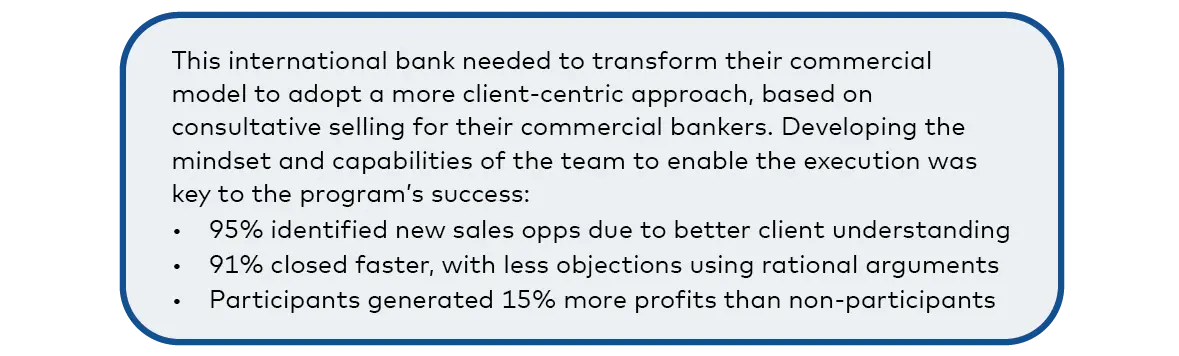
The transformation you need in your sales and marketing team
Tired of always repeating the same messages and not seeing change?
What we’ve learned (so far) by using AI in coaching
In this episode of the Fearless Thinkers podcast, Fredrik Schuller, Head of BTS Coach and Executive Vice President, shares how artificial intelligence can augment the leadership coaching process by increasing consistency, accessibility, and scalability.

Our Smart Learning Methodology
Weaving 4 distinct ways of learning that serves the 70-20-10 development model, creating community and momentum to deliver maximum learning impact.

Process that engages learners to effectively acquire, retain, and apply new mindsets, skillsets, and toolsets in their life and work.
6 targeted application boosters focusing on developing action (application) in real-world scenarios for impact.

Increasing agility for a healthcare organization's HR department
Learn how Netmind, a BTS company, partnered with a hospital's HR department to better develop and retain top medical talent.

A BTS innovation story
How BTS helped a Fortune 100 coffee giant utilize design thinking techniques to foster effective and impactful innovation across functions.


Working in Mexico
Working at BTS means working in an organization that puts people first. We want to be the coolest consulting firm to work for, and that is reflected in a work environment where you have opportunities to grow from day one.
At BTS Mexico you will work with diverse teams, in a meritocratic and fun environment where you will have a lot of exposure both internally and with our clients. You will work with reference organizations from different industries, which will allow you to accelerate your learning curve and never stop learning.
Are you up for it?

Locations & Contact Info


.avif)