Beyond skills: Enhancing leadership through vertical development

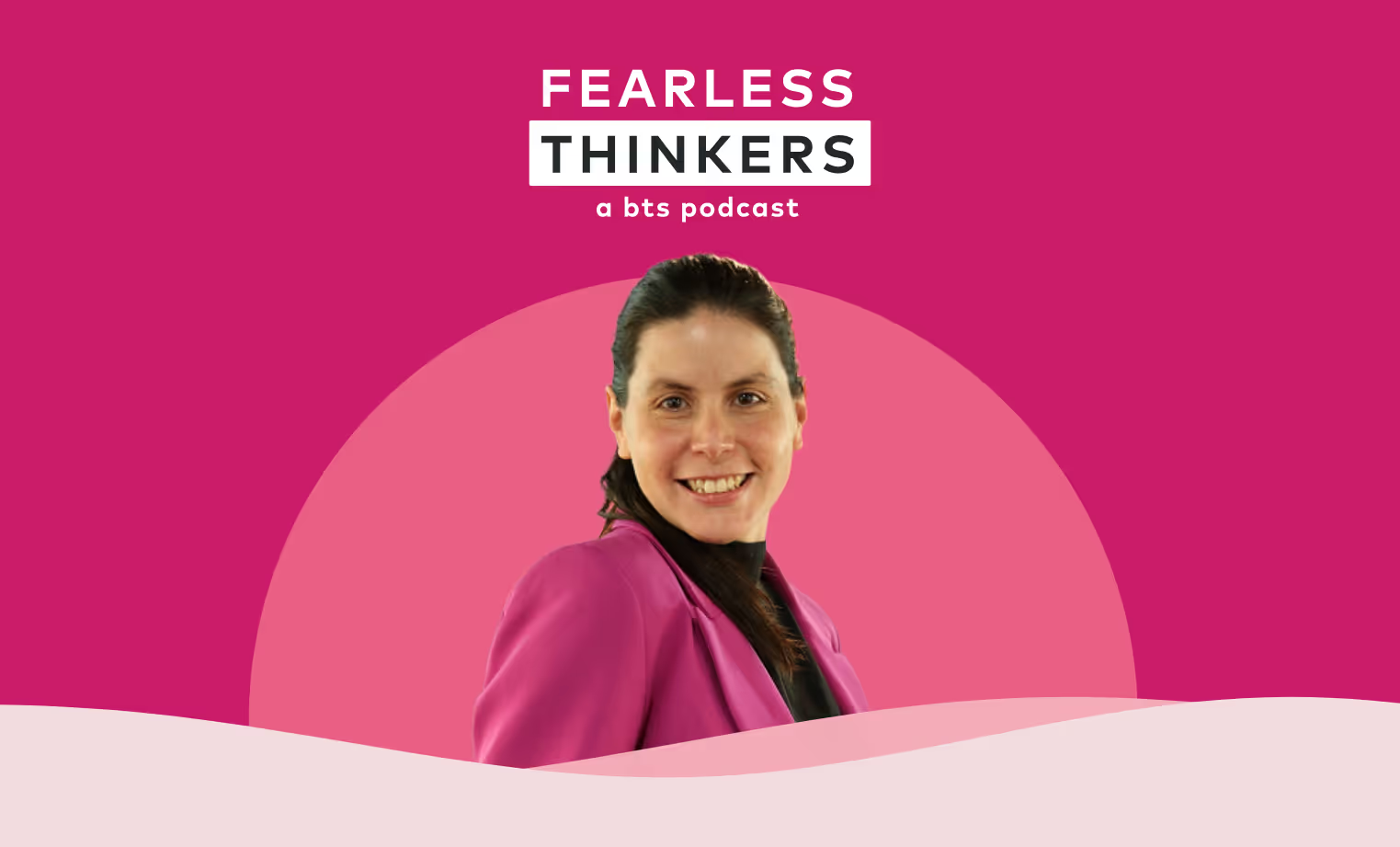
In this episode, Rick Cheatham is joined by Tara Castaneda, Senior Director at BTS, to discuss vertical development and leadership.
March 25, 2025
Guests
Subscribe to the BTS newsletter
Follow us on Linkedin
Follow BTS on Linkedin
Share

Beyond skills: Enhancing leadership through vertical development

Welcome to another episode of the Fearless Thinkers podcast! Host Rick Cheatham is joined by Tara Castaneda, Senior Director at BTS, to explore the concept of vertical development. Tara breaks down the stages of vertical development, from the diplomat stage to the strategist stage, and explains how these stages influence leadership styles and behaviors. She emphasizes the importance of self-awareness and continuous growth for effective leadership. Tune in for practical insights and tips on elevating your leadership approach.
About the host
No items found.
About the show

Most of us want to lead in a way that matters; to lift others up and build something people want to be part of.But too often, we’re socialized (explicitly or not) to lead a certain way: play it safe, stick to what’s proven, and avoid the questions that really need asking.

This podcast is about the people and ideas changing that story. We call them fearless thinkers.

Our guests are boundary-pushers, system challengers, and curious minds who look at today’s challenges and ask, “What if there is a better way?”If that’s the energy you’re looking for, you’ve come to the right place.

Read Transcript

Rick: Welcome to Fearless Thinkers, the BTS podcast. I'm your host, Rick Cheatham and today I've got an extra special treat because my dear friend Tara Castaneda is joining me for a conversation about vertical development. To be honest with you, I didn't even know what that was, but it really is an adventure into what are those things that, no matter where we go on our leadership journey, we need to carry with us. Tara's depth of experience, both as a practitioner and a consultant are truly unmatched, so let's get into it.

Rick: Hey, Tara. So happy to have you on the show.

Tara: Hey Rick, I'm so happy to be here with you today.

Rick: Well, thanks. What's been going on in your world?

Tara: You know, I'm really proud of myself. I passed my latest dentist visit with no cavities and good to go. So it's a good day.

Rick: Oh, that's so funny. I must confess that I am terrified of the dentist actually. I have made it now officially 53 years without a cavity. So, I don't know what I'll ever do if I have to have dental work done. But I'm proud of you for being brave. I would give you a sticker and a toothbrush if I had one.

Tara: Thank you. I appreciate that. I think that's a common human experience. I mean, there may be a relatively few humans on the planet that haven't had some sort of concerning experience with the dentist that doesn't make you terrified every time you go. But I haven't met too many of those folks.

Rick: It's that, it's the joy of having metal on bone that I think brings us all together in a shared human experience. That's awesome. So Tara, I'm so excited to have you here today to talk about vertical development. I have to admit that before I got to see you speak on it at the Brandon Hall conference, I didn't completely understand what it was. So for those that are probably wiser than me, but still have big questions, I'm wondering if you could give us a high level overview of what precisely is vertical development.

Tara: Sure, I'd be happy to. It's often a, a term that causes a bit of confusion and if we think about it by way of human development, in the past, we spent a lot of time studying how children develop. And in the 1960s people started asking, do we still develop as adults? And if so, what does that look like?So the best way I can describe it is that oftentimes we're really clear on what horizontal development is. That's adding new skills, learning new tools, things that we can use to do things better, faster, differently, etc. And vertical development is more about mindsets, values, wisdom, how we got to be who we are today.One of the easiest ways to explain it is to think about horizontal development being more like if we're adding apps to our phone: new functionality, things that our phone can do for us. And yet sometimes we hit a point where the phone's moving really slowly, maybe not doing the things that we want it to do. And so vertical development is a lot more like upgrading that operating system.

Rick: Cool. So if I'm tracking with you here, what you're really saying is that horizontal development is my ability to improve the way that I do different kinds of things. Vertical development is the way that I do things, no matter whatI'm doing.

Tara: Yeah. It's about interpreting and gaining insights about yourself, about others, and about the world at large. It's really about this ability to invite new perspectives, and really it's more of a maturity model, if we want to think about it that way.

Rick: Cool. So, I know you are well versed in the research on this topic. I'm wondering if you could break it down for us a little bit further.

Tara: Sure. So, this has been studied for quite some time. It has its roots in adult developmental psychology and there are a variety of models out there ranging from thinking about it in four stages of development, all the way up through nine stages of development. And the easiest way to think about it is just to focus maybe on these five key developmental stages.The first one, if you will, is something I think we're all familiar with. It's often referred to as the diplomat. In this stage, we're really trying to figure out what the lay of the land is. We are looking to fit in, we're looking to conform to some norms. Oftentimes you'll see this or can think about it in your own experience from when you might have started a new job or been introduced to a new group of people. So that’s the first stage.The second stage is moving more into this space of trying to perfect our knowledge, trying to stick with procedures, trying to use that as a way to exercise control on the world around us and really values like deep expertise. We call this stage, in fact, expert.

Rick: That's really interesting to me. And  as I think about that on the surface, it makes a lot of sense to me. But on the other hand, I'm curious as to how much those are kind of personality traits as opposed to development stages. So in other words, those who know me know that I've probably never been one to be the diplomat and to worry so much about how do I fit in and tend to more be the one that, that looks to be different. And so I'm curious about when I'm thinking about vertical development, how much of it is personality versus maturity.

Tara: Great question. This tends to lend itself back to your ways of viewing the world. So there are elements or opportunities for everyone's differences in personality to shine. This is really having to do with how your brain interprets things. And so, maybe not consciously, but at some point in your reality, chances are pretty high that even if you didn't act on it, you experienced some self talk in your brain about, hmm, what should I be doing in this situation, in this environment, with this particular set of people, etc.

Rick: Makes sense. From that expert level, I'm curious, what does that mean on the continuum of, I'm trying to be an expert and get it all right and do it all right, to I'm trying to have a broader understanding of how things work, whether I'm doing it or somebody else on the team is doing it.

Tara: So in the expert stage, the focus is on a personal deep commitment to excellence, to getting things right. And to the point of, oftentimes people in this stage are thinking things like, there's only one right way to do this. And I know how to do it, I’m the one that holds all of the knowledge and the wisdom.And so it really is maybe even an aversion to the idea of risk taking that I am going to build this sphere of influence, this expertise, etc. And that's what I'm using to define my place in the world.

Rick: So it is on some level, a function of risk avoidance.

Tara: Yeah, and if we look at it on the positives, it's this deep desire to be seen as the best at whatever it is that we're doing.So the next one is, again, one of the common terms coined is achiever. And this particular stage really focuses on results, effectiveness, success within whatever system that you're in. So very goal oriented. Probably has a little broader ability to include others. So maybe as a team, you're trying to achieve something and therefore effectiveness is seemingly prioritized over a lot of other things.

Rick: Makes sense to me.

Tara: What's interesting, Rick, is that if we look at these first three stages: diplomat, expert, and achiever, research specifically by Suzanne Cook Reuter suggests that 80 percent of adults sit in the diplomat, expert or achiever space. And specifically, most adults within the working world are in that expert or achiever stage.

Rick: And I’m curious, as I think about your analogy earlier with the iPhone and the iOS upgrade, as I reflect on this just a little bit, I would think I might show up differently depending on my comfort with the topic.So maybe I'm still stuck in a horizontal world, but I'm just kind of thinking about if something has to do with sales and marketing, I'm going to tend to be a little bit more of an expert and a little bit more of achiever in the way that I approach those kinds of situations. But if somebody wants to sit down and have a finance conversation with me, I'm going to be trying more to fit in and get along than I am going to be like, Oh no, it's over here and we're all going to go chase it.

Tara: Spot on Rick. This is not a linear progression. We might find ourselves in a variety of these spaces given the context of what's going on with us, for us, and how we're feeling about it. So absolutely, the example that you shared is 100 percent spot on. In certain contexts, I may be in a different stage or I might be exhibiting different behaviors or different ways of thinking based off of that particular situation.

Rick: Got it. What comes after that achiever level?

Tara: So the last two stages that I'll share with you really lean into this kind of post-conventional space. And the first of those or the fourth of our overall conversation here, is often referred to as the individualist. More popularly, it's a thing stage where we talk about redefining. And what that means is we're leaning into a space of being curious, reflective, there's a willingness to push back on maybe previous approaches or our current mindsets. And it's really focused on being and feeling more so than doing and achieving, thus being a pretty big break, between the achiever stage and this individual stage.And then finally, the last one we'll talk about is the strategist, which also is maybe a little bit easier to think about as the stage where we're spending time in a transforming state. It's “both/and thinking”, it's autonomous, it's being inclusive of others and not only inviting those different perspectives, but being willing to act on them, being really comfortable in complexity, recognizing that there may not be one right answer. There may be conflicting priorities. There may be differences that we need to sit with.

Rick: This is actually hitting me pretty hard as I think about some of the leaders that I've been around in my life might very much think of themselves as a strategist. However, their behavior, especially under pressure shows up so much more as an expert or an achiever. Is that a thing that happens?

Tara: So Rick, a lot of times, there can be a disconnect between where people see themselves and what the people around them are experiencing. And I think specifically because, if I'm looking at those first couple of levels, it's almost like we're a bit on autopilot because of our focus around either conforming to or succeeding in an external set of norms.And so, absolutely it could be possible that someone thinks they're in this space of being willing to invite others in, being willing to sit in this polarity, etc. And what others are experiencing of them is very different.And that leads us back to the idea of this type of development being rooted in awareness and effort. Getting curious about how we show up, what assumptions, beliefs, or values are driving our behavior and shaping our view of ourselves, others, and the world around us. And having a willingness to lean in with humility and vulnerability is key and is easier said than done.The opportunity often presents itself when our ways of being and doing that have always worked for us are no longer working or working the way they used to. So, if we're experiencing frustration, exhaustion, maybe a little bit of burnout, it offers us a chance to take a breath, look within and think, what am I noticing about myself and where I might want to shift?

Rick: Yeah, and I think that's gosh, that's one of the most unfortunate things right when I think I'm doing the right thing I've got the right aspirations, but I show up quite differently to the people who potentially need me the most.So Tara, let's say I am aware and I see these opportunities to potentially shift, but I don't necessarily, or I'm not currently in a position in my organization to drive the change myself to, to have the infrastructure I need. What do I do to potentially take on this concept and be a better leader

Tara: There are lots of options available. Top of my list would be hiring a coach. And if you wanted to dive deeper on your own, there are plenty of books out there, assessments available, even something like a free assessment to explore your values and raise some of that awareness. And since it is about raising awareness, another option would be – although it can be risky – to ask others for feedback.It might spark your curiosity or even reveal a blind spot. You can also start a practice of journaling in service of raising that awareness of what you're feeling and thinking and what's behind it. Even a few minutes a day and over time will help you notice some patterns, what are you noticing about how you act, and react with others. And that enables you to create the capacity to navigate the increasing complexity, ambiguity, and constant change that's our reality today, both as a human being and as a leader.

Rick: I know you've done great work with many of our clients at scale in this area, but when you present it like that, there's also a lot of I can do as an individual, which always makes me happy when we have these kinds of conversations, because at its core, what I'm really starting to get from you more is that vertical development very much is about my honest ability to see how I show up in the world.There's a lot to take in. We're going to have to have you back for another show and dig even deeper, cause I think that this is really important stuff that frankly we could all benefit from. So, thanks so much for joining me today.

Tara:  Very welcome, Rick. And thank you. You know how near and dear this topic is for me, and I'd be happy to join you again, and continue our conversation.

Rick: Thanks for joining me today. It’s always a pleasure to bring to you our Fearless Thinkers. If you’d like to stay up to date, please subscribe. Bios for our guest and links to relevant content are always listed in the show notes. If you’d like to get in touch, please visit us at BTS.com, and thanks so much for listening!

Related Content

Inisights
June 3, 2025
5
min read
Disconnect between talent priorities and executive expectations
Research reveals a disconnect between talent priorities and executive expectations and what it means for building leadership momentum today.

AI is reshaping how work gets done—automating tasks, accelerating decisions, and raising expectations for speed and precision. Strategy is shifting faster than structures can adapt, leaving many leaders operating in systems that weren’t built for what’s being asked of them now. Employees are asking more of their managers—while the business is asking more of them, too. And leaders are stuck navigating it all with development priorities, operating norms, and support systems that weren’t designed for this level of speed, ambiguity, or stretch.

As expectations rise, leadership capability is under scrutiny.

But are development efforts evolving fast enough to meet the moment?

Where priorities and expectations diverge

Most leadership development programs today emphasize foundational strengths:

  • Executive presence
  • Personal purpose
  • A growth mindset
  • Empowering others
  • Stretching others

In contrast, senior executives in the BTS study identified a different set of capabilities as most critical for leaders right now:

  • Accountability
  • Transparency
  • Enterprise thinking
  • Divergent thinking

The contrast reveals a disconnect between what development programs are building—and what executives believe their organizations need most from their leaders today.

How did we get here?

The expectations placed on leaders—especially at the middle—have always evolved alongside the business landscape.

In the 1990s, leadership development focused on emotional intelligence and team empowerment. The 2000s brought globalization and lean operating models, with a sharper focus on efficiency and agility. Then came digital transformation, agile ways of working, and flatter, more matrixed structures.

Each wave expanded the leadership mandate—asking leaders to become connectors, coaches, and change agents.

What’s different now is the pace and proximity of change. Strategy no longer shifts annually—it flexes monthly. And mid-level leaders are no longer simply executing someone else’s vision. They’re expected to interpret it, shape it, and deliver results through others—in real time.

At the same time, the psychological contract of work has changed. Employees want more meaning, flexibility, and support—and they often look to their managers to provide it. Add in the rise of AI and the frequency of disruption, and the expectations placed on leaders have outpaced what many development efforts were designed to support.

What’s driving the disconnect?

What we’re seeing isn’t disagreement—it’s a difference in vantage point, shaped by the distinct challenges each group is solving for. This isn’t about misaligned intent—it reflects different priorities and pressures.

Talent and learning teams often prioritize foundational capabilities because they’re proven, scalable, and critical to developing confident, human-centered leaders. These programs are designed to grow potential over time.

Executives, meanwhile, are focused on the immediacy of execution—strategy under strain, shifting priorities, and the need for alignment at speed. Their focus reflects where progress is stalling now.

Both perspectives matter. But when they remain disconnected, development risks falling out of sync with business reality—and the gap is most visible at the middle, where expectations are rising fastest.

What’s the takeaway for talent leaders now?

This moment offers more than a gap to close—it offers insight into how leadership needs are evolving.

What if the differences between these two capability lists aren’t in conflict, but in sequence? Foundational strengths help leaders show up with purpose and empathy. Enterprise capabilities help them lead across systems and ambiguity. The opportunity isn’t to choose between them—it’s to connect them more intentionally.

What’s uniquely now is the acceleration. The stretch. The pressure to reduce friction and support faster alignment. Talent leaders aren’t just being asked to build capability—they’re being asked to build momentum. That means designing development experiences that reflect complexity, enable cross-functional thinking, and help leaders decide and adapt in real time.

It also means listening more closely. The capabilities executives are calling for aren’t just wish lists—they’re signals. Signals of where transformation slows, and where leadership must evolve for strategy to move forward.

This isn’t about shifting away from what works—it’s about expanding it. To connect what leaders already do well with what the business needs next—and to do it in ways that are grounded, human, and built for today’s pace.

Shifting momentum

Leadership development isn’t just a pipeline priority. It’s a strategic lever for how your organization adapts, aligns, and accelerates through change.

This research doesn’t just reveal a skills gap—it surfaces a systems opportunity. The disconnect between talent priorities and executive expectations highlights where momentum gets lost, and how leadership development can close the space between vision and execution.

Talent leaders are uniquely positioned to reconnect the dots—between individual growth and enterprise outcomes, between what leaders learn and how they lead, between what the business says it needs and how that shows up in behavior.

So the next question isn’t just: What should we build?

It’s: How do we enable leaders to build it into the business—faster?

Every organization is navigating this differently. If you’re revisiting your development priorities or rethinking what leadership looks like in your context, let’s connect. We’re happy to share what we’re seeing—and learning—with others facing the same questions.

Inisights
April 23, 2025
5
min read
How future-back thinking turns uncertainty into strategy
Discover how future-back thinking turns uncertainty into actionable strategy, helping leaders prepare for evolving challenges by designing for the future, not just reacting.

In late 2023, we set out to answer a question we kept hearing from clients:

How do you prepare for what’s next—when “next” keeps changing?

That question has only become more urgent in 2025. Today’s leaders are navigating rapid shifts—from AI’s integration into nearly every role to volatile markets and a growing disconnect between employee expectations and organizational readiness. Planning feels harder than ever—because the future keeps accelerating while our tools and assumptions stay anchored in the past.

Too often, strategic planning is built on outdated logic: start with what’s already in motion, layer on incremental improvements, and forecast trends forward. But in today’s environment, that approach isn’t just ineffective—it’s risky. It reinforces legacy thinking. It prioritizes what’s easy over what’s essential. And it creates strategies built for a version of the world that no longer exists.

That’s why we took a different approach. We gathered a team of I/O psychologists, academics, and senior talent leaders—not to react to trends, but to reimagine what the future of talent, leadership, and learning might truly demand.

To guide the process, we used a method we often apply with clients: future-back thinking.

What is future-back thinking?

Future-back thinking flips traditional strategy. Rather than starting with today’s constraints, it begins with a bold vision of future success—and works backward to define what it will take to get there.

This approach helped us look past short-term pressures and surface deeper signals. It made the future feel more actionable—and more human.

It also reminded us why innovation is so rare: Most organizations are wired to protect what’s familiar. We prioritize feasibility, optimize what exists, and assume continuity. In uncertain times, we tweak around the edges instead of reimagining what’s possible.

Future-back thinking breaks that cycle. It turns ambiguity into alignment—and strategy into design.

It starts with a better question:

What will the future demand—and what will we wish we’d done sooner?

Because it’s not about being right. It’s about being ready.

Five bold predictions—and how they became reality

When we applied future-back thinking to the future of talent and learning, five provocative themes emerged. Each was grounded in signals we were already starting to see—but at the time, they felt ambitious.

We captured them in our original blog, Navigating the New Dawn of Talent Strategy—a look at what might shape how organizations attract, develop, and lead talent over the next 3–5 years.

Now, just two years later, those signals have become strategy. Here’s how the predictions stack up against today’s reality:

1. Skills × jobs (the remix)

Then: We predicted that rigid job architectures would give way to more fluid, capability-based models—ones that reflect how people actually grow and how business needs evolve.

Now: That shift is well underway. Many organizations have begun redesigning roles around transferable skills and capabilities, creating more dynamic paths for growth, mobility, and performance.

2. AI-powered learning

Then: We anticipated GenAI would unlock personalized, real-time learning at scale, integrated into the flow of work.

Now: GenAI is now embedded in many organizations’ learning ecosystems—powering smart coaching, adaptive learning paths, and knowledge retrieval in the flow of work.

3. Diversity as differentiation

Then: We forecasted a shift from DEI as a compliance mandate to DEI as a core driver of innovation, adaptability, and growth.

Now: High-performing organizations are building cognitive and cultural diversity into teams, treating it as a strategic advantage—not a checkbox.

4. AI as a leadership partner

Then: We imagined a future where AI would augment—not replace—leaders, supporting better decisions, planning, and communication.

Now: That’s exactly what’s happening. Leaders are using AI to model scenarios, synthesize insights, and communicate with more speed and clarity.

5. Decentralized, human-centric leadership

Then: We projected leadership would decentralize, moving closer to the front line and defined by mindset more than title.

Now: Leading organizations are scaling leadership behaviors across levels and embedding psychological safety, inclusion, and empowerment into day-to-day work.

These predictions weren’t about chasing trends. They were about imagining what the future might require—and preparing for it before it arrived.

That’s the power of future-back thinking: it doesn’t just forecast change. It helps leaders design for it.

Start thinking differently now

Most strategic plans start by looking around—at what exists, what’s already in motion, what feels feasible. But the brain doesn’t just collect data. It builds habits. It channels information into familiar paths. And it reinforces what it already knows.

That’s good for speed. But bad for imagination.

Future-back thinking challenges that. It deliberately disrupts those neural paths. Instead of adjusting today’s structures, it starts at the endpoint: a bold future state. Then it reverse-engineers the shifts required to get there.

This shift—from refining the familiar to reimagining what’s possible—is what organizations need now.

Here are three provocations to help you start:

  1. What assumptions are we treating as facts? The most dangerous limits are the ones we no longer see.
  2. What would someone from a completely different world do? (A customer, a child, Beyoncé?) Try role-storming to unlock new angles.
  3. What if we had no legacy systems to maintain—what would we build from scratch? Imagine a blank slate.

These questions aren’t just creative warm-ups. They help you unstick your strategy from old grooves—and build what’s essential.

Because in a world that’s constantly changing, the biggest risk isn’t getting it wrong. It’s staying stuck.

How BTS helps leaders and teams think beyond today

Our brains—even at their most capable—get stuck in “rivers of thinking,” defaulting to what feels safe instead of what the future demands.

At BTS, we help organizations break that cycle.

Future-back thinking is more than a framework—it’s a provocation. A way to disrupt habitual planning, reframe challenges, and design from a place of possibility.

We work with leaders and teams to:

  • Break from old patterns by surfacing the assumptions quietly guiding decisions
  • Align around vivid, future-state scenarios that challenge status-quo thinking
  • Role-storm bold ideas into strategic options that unlock creativity
  • Simulate future decisions to build confidence and agility
  • Build the mindsets and capabilities your strategy requires

Because the real risk isn’t change. It’s standing still.

Too often, organizations invest time and energy planning for a version of the world that no longer exists. They reinforce legacy mindsets, delay bold moves, and miss the moment.

Future-back thinking offers a way out. It gives leaders a structured way to reimagine what’s possible, align teams around the future, and start building toward it—now.

Let’s build what’s next—together. Learn how we help organizations prepare for the future.

Inisights
April 2, 2025
5
min read
Feedback that fuels: A framework to help leaders shift from critique to connection
Leaders can turn feedback into a powerful tool for connection and growth with this practical guide to building trust and sparking curiosity.

Feedback is one of the most powerful tools a leader has, shaping both individual and organizational culture. Yet, despite its value, it’s often met with apprehension—seen as judgment rather than an opportunity. Instead of fueling growth, it can create tension, leaving recipients feeling exposed and defensive.

This reaction is natural. Feedback touches on identity, competence, and self-worth. When framed as a verdict rather than an insight, it sparks defensiveness instead of openness. But what if feedback wasn’t about judgment? What if it was a tool for gathering better data—both for the recipient and the leader?

When leaders make feedback a habit, not a performance review, they gain sharper insights, model continuous improvement, and create a culture where learning thrives. The shift from evaluation to empowerment turns feedback into fuel for growth. And at the heart of this shift? Curiosity.

Leading in a MESSY world: Why feedback matters more than ever

Leaders today operate in constant disruption and complexity. They must move beyond assumptions and seek new perspectives. At BTS, we call this operating in a MESSY world:

  • M – Making sense of the broader ecosystem
  • E – Establishing emotional connections to build trust
  • S – Seizing momentum to stay ahead
  • S – Sensing the future amid uncertainty
  • Y – Yielding ego to create space for others to grow

Feedback is critical in helping leaders navigate these challenges. It’s not just a tool for correction but a catalyst for innovation and collaboration. But without structure, feedback can fall flat. That’s where the AFIRM Model comes in.

Reframing feedback: From evaluation to exploration

Great feedback moves beyond transaction into mutual discovery. When leaders model effective feedback, they foster deeper connections and unlock insights that drive performance.

Curiosity plays a crucial role in this transformation. When leaders approach feedback with genuine curiosity—asking open-ended questions and actively listening—they shift conversations from critique to shared learning. Curiosity also provides leaders with better data on how they show up, helping them refine their approach and model the kind of feedback culture they want to create.

Balancing feedback with efficiency is essential. The AFIRM Model provides a structured approach that makes feedback actionable and constructive while keeping curiosity at the center.

Structure feedback for impact with the AFIRM model

AFIRM enables structured yet flexible conversations—ensuring feedback drives results. It provides a roadmap for leaders to create meaningful, productive discussions that foster growth and accountability. Here’s how it works:

A – Agenda

Set clear intentions. Define the purpose and desired outcomes upfront. A prepared conversation leads to honest, productive dialogue and signals that feedback is a shared responsibility rather than a one-sided critique.

F – Facts, Observations, Evidence

Keep it objective. Base feedback on data and observations to minimize bias. Stay neutral and constructive. Providing fact-based feedback ensures conversations remain focused and prevents emotional reactions that derail progress.

Curiosity fosters deeper dialogue—ask questions, seek perspectives, and pave the way for growth. Instead of assuming why something happened, ask “What led to this?” or “What challenges were you facing?” to create space for honest reflection.

I – Impact

Clarify effects. Who was affected? What were the consequences? Centering feedback on impact builds trust and accountability. Highlighting the broader implications helps individuals understand why feedback matters and how their actions contribute to team success.

R – Request

Co-create a path forward. Define actionable, SMART next steps (Specific, Measurable, Achievable, Realistic, Time-bound). Encourage collaboration by asking “How do you think we can move forward?” or “What support do you need?” Keeping the dialogue open ensures accountability while fostering autonomy.

M – Mutuality

Feedback is a partnership. Success requires shared ownership and commitment to growth. A strong feedback culture thrives when both parties see feedback as a two-way street—leaders should also invite input on how they can better support and enable success. Take time to ask “What feedback do you have for me?” to reinforce that feedback is a mutual learning process.

Creating feedback-driven growth

Imagine an organization where feedback fuels engagement and connection. When framed as a tool for growth rather than judgment, conversations shift from evaluation to exploration. Everyone is on the same team, with the same goals.

Great leaders don’t just give feedback—they seek it, reflect on it, and use it to sharpen their approach. By modeling curiosity and making feedback a daily habit, they foster a culture where feedback is normal, constructive, and empowering.

Feedback isn’t about fixing. It’s about discovering what’s possible. By approaching it as a shared learning opportunity, we move from judgment to collaboration, growth, and transformation.

What’s one question you could ask today to spark a meaningful feedback conversation?

Client Stories
October 29, 2025
5
min read
Promoting safety in transportation through cultural transformation
BTS partnered with a Spanish railway embed safety into its culture through a leadership program reaching 1,500 people.

lorem ipsum

Client Stories
July 10, 2025
5
min read
Strengthening talent and leadership development in the aluminum industry
How a global engineering firm transformed leadership behaviors to drive culture change, strategy execution, and long-term success.

lorem ipsum

Client Stories
May 22, 2025
5
min read
How leadership transformation drives long-term success in engineering
How a global engineering firm transformed leadership behaviors to drive culture change, strategy execution, and long-term success.

lorem ipsum

Podcast
June 24, 2025
5
min read
Are you leaving employees better off or burned out?
In this episode, Steph Peskett and Abi Scott talk about the second major trend from their recent research: human sustainability.

lorem ipsum

Podcast
June 24, 2025
5
min read
This is why your best people are quietly disengaging
In part one of this two-part conversation, Steph Peskett and Abi Scott unpack one of the biggest trends reshaping talent development.

lorem ipsum

Podcast
March 31, 2025
5
min read
Thriving through change: How HR leaders can build a future-ready workforce
How can HR leaders can build a future-ready workforce in uncertain times? Rick Cheatham and CRF’s Richard Hargreaves share insights on agility, critical roles, and driving impact.

lorem ipsum

Whitepapers
March 20, 2025
5
min read
Safer workplaces, stronger bottom line: Unlocking the power of your frontline leaders
Learn how investing in frontline leadership development enhances workplace safety, boosts performance, and creates a resilient workforce, driving long-term business success.

lorem ipsum

Whitepapers
September 10, 2024
5
min read
Why even the best intended leadership development efforts often fail
Organizations invest heavily in leadership development programs, yet many remain dissatisfied with their return on investment.

lorem ipsum

Whitepapers
October 4, 2023
5
min read
TL&L community – Leveraging AI in learning and development
Peter Mulford, Global Partner and CIO, discusses how AI works, how organizations can integrate the tool for L&D professionals.

lorem ipsum

News
September 30, 2025
5
min read
Why Authentic Leaders Win Influence And Trust At Work

Resistance doesn’t end after kickoff—it evolves. To lead lasting transformation, CEOs must stop treating pushback as failure and start using it as fuel.

lorem ipsum

News
December 4, 2024
5
min read
4 strategic priorities to unlock HR leaders’ potential in 2025

In the rapidly evolving business landscape, the CHRO role continues to be indispensable for organizational success. According to a recent Accenture survey, 89% of CEOs believe CHROs should have a central role in driving long-term growth, highlighting the increasing recognition of HR’s impact on organizational performance and culture. However, only 45% of those CEOs are creating the conditions to allow CHROs to have an impact.

lorem ipsum

News
November 4, 2024
5
min read
BTS's Elizabeth Freedman on "The Soul of Business" podcast with Blaine Bartlett

In this conversation, Blaine Bartlett and Elizabeth Freedman, Vice President Executives and Team Performance at BTS, explore the multifaceted nature of leadership and emphasize the importance of understanding the soul of a business, the role of values, and the necessity of creating meaning in the workplace.

lorem ipsum