The economics of attention in an AI world

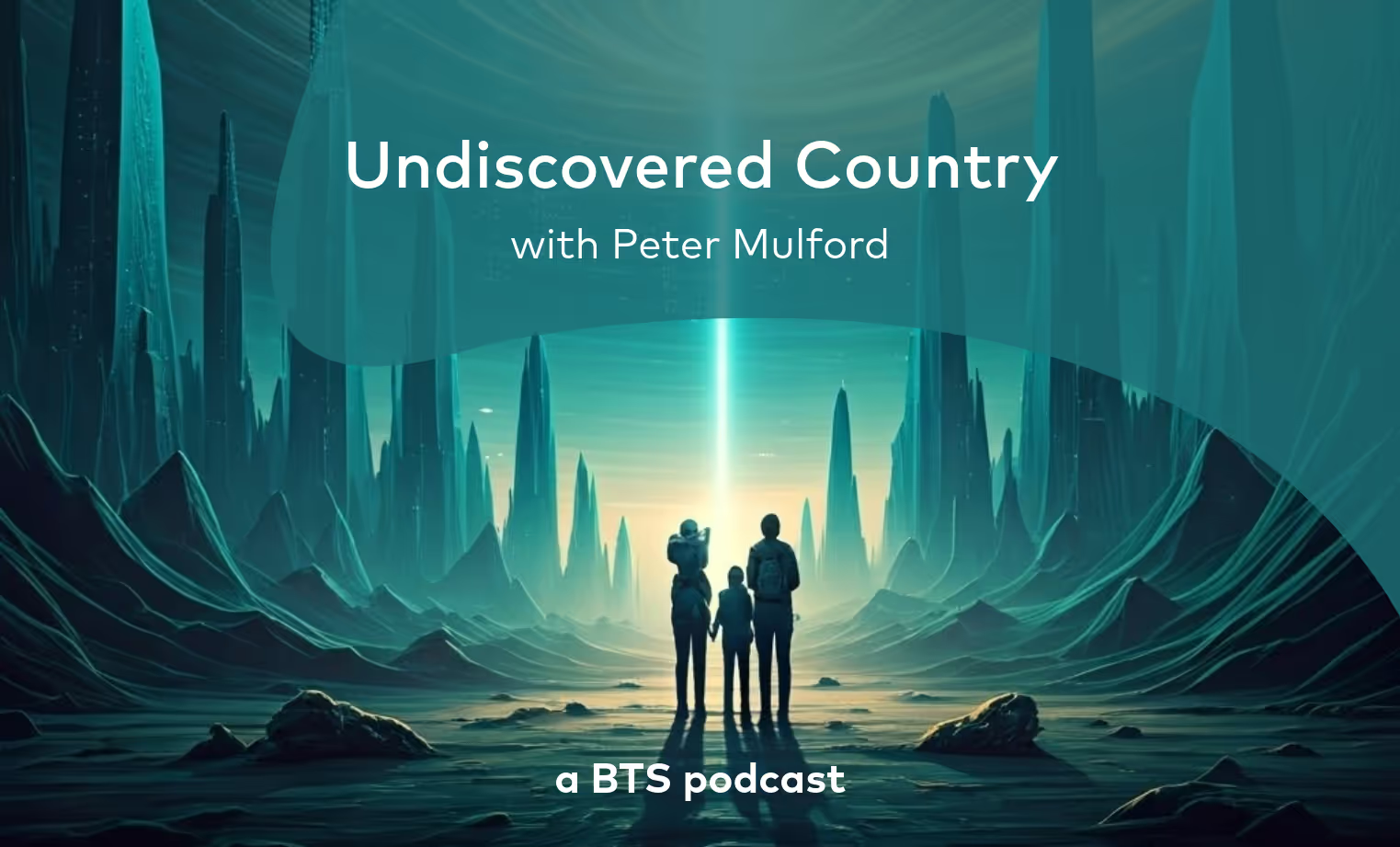
In this episode, Peter Mulford sits down with Doug Shapiro to explore the structural forces quietly reshaping every attention driven business, the real threat facing Hollywood from AI, and how the potential of infinite content creation is destroying the economics of the industries that pays for them.


Most of us want to lead in a way that matters; to lift others up and build something people want to be part of.But too often, we’re socialized (explicitly or not) to lead a certain way: play it safe, stick to what’s proven, and avoid the questions that really need asking.
This podcast is about the people and ideas changing that story. We call them fearless thinkers.
Our guests are boundary-pushers, system challengers, and curious minds who look at today’s challenges and ask, “What if there is a better way?”If that’s the energy you’re looking for, you’ve come to the right place.
Find this episode on:


.svg)
Peter: Hello and welcome to the latest edition of The Undiscovered Country, a BTS podcast about the future of work. In this episode, we sit down with Doug Shapiro. Doug is a man who has spent nearly three decades at the intersection of media money and strategy. First as a celebrated Wall Street analyst, then as a time water executive, and most recently as an independent advisor and writer.
Whose Substack the mediator has become a kind of required reading across the media industry. In this, uh, podcast, we get into the structural forces he believes are quietly and dramatically reshaping media. And, um, every attention driven business, we talk about why fragmentation and concentration aren't, uh, opposites, but accomplices.
Uh, why he believes the real threat of AI to Hollywood isn't robots replacing writers, but actually, uh, a world in which we have infinite content destroying the economics that pay for them, and a whole host of other ideas. I enjoyed the conversation and I hope you will too. And with that, I bring you Doug Shapiro.
I'm here today with Doug Shapiro. Hello, Doug.
Doug: Hello.
Uh, how do you pronounce it? Peter?
Peter: Mo Mulford. Yes. How long we known each other now, Doug? It's, it, I'm pretty sure it was 2008, 2009 that we met when you were SVP of investor relations.
Right? It was, was, um, in 2008, 2009.
Doug: That sound I was, I was trying to think about this morning, but it's a long time. Uh, I, I was. Uh, 15 years Sounds right, but it, 16, 17, I don't know. It's been a lot of years, so I do actually know how to pronounce Mulford.
Peter: That's good.
Doug: That was a joke.
Peter: And that's, um, you know, this, um, this is just an audio I think we mentioned, but, uh, amazing to me.
You still have all of your hair and I have none of mine. So maybe, uh, at the end of this podcast you can gimme some, some tips.
Doug: Yeah, it's zero sum. There's only so much hair to go around, so sorry.
Peter: It's, it's terrific. Well, um, I've really been looking forward to this, uh, call today for a couple of reasons and not the least of which, uh, there's a lot of stuff going on in the world of media and in, um, AI that I think you are uniquely qualified to talk about.
Um. So maybe to set the stage right. I will have introduced you properly during the housekeeping, but maybe we could start with, um, a potted history, uh, your intellectual history, how it is you, you came to be where you are now, and you, and you might even describe the, the interests and the incidents, uh, that pulled you along to this, uh, place where we are today.
Doug: Sure. Um. So I've been in and around the media business for over 30 years. Uh, I was an analyst on Wall Street for, uh, 14 years covering media up and down the value chain. Then I went to Time Warner. I was there for 12 years. And then since then I've been doing various consulting and speaking and advising and writing kinds of things.
Um, the through line of all that is that, um. I've always, uh, I've always done more or less the same thing or enjoyed doing more or less the same thing, which is, um, trying to recognize the big patterns and, uh, synthesize them and figure out what's important and then what to do about it. Um, and so I did that on the outside as an analyst.
I did that within Time Warner, and it's still what I'm doing now.
Peter: That's interesting. Is there, um, or what is, what is it you've noticed, uh, over the 30 years about moving back and forth between these perspectives that, uh, gives you an edge that maybe, um. Would be invisible to people who just stick in one lane.
Like I, I was reflecting, uh, wall, the Wall Street Journal, uh, let's see if I get this right. Uh, recognized you early in your career several times for being the best on the street, right? At an as an analyst, when you're scrutinizing what executives are doing, and then fast forward, suddenly you're the executive.
When you were, um, chief Strategy Officer at Turner. So was there anything surprising in how your perspective changed or, or the insights you could gain as you shifted from role to role?
Doug: Um, yeah. I, I, I think it has been very valuable to have all those different perspectives, um, when you are outside. You, uh, really don't understand how companies function, how they make decisions, uh, where the real leverage points are in the system.
You tend to kinda live in a bit of an ivory tower and lose sight of the. The practical day-to-day considerations. Um, when you're inside a company, you, um, a lot of time your thinking is, uh, well, for one thing, it's just narrow because it tends to be constrained by the, the company in which you work. Um. You know that, that those are the physical walls, that's the culture.
There's also that, uh, that Upton Sinclair quote about, you know, um. I forget exactly how it goes, but you know, one of the hardest things to do is to, uh, uh, convince a man of something when his salary depends on him not being convinced or something like that.
Peter: Yeah, yeah.
Doug: And, and so, uh, just I think when you're inside, it's very difficult to have a, a broader, uh, a broader perspective.
Um, so yeah, I think it's been very valuable to have, have seen it from both sides.
Peter: It's, um, I'm talking about perspective. Uh, so there's inside and there's outside. And then there's also this idea of, um, today forward versus future back. And I, I noticed, and I, if I put words in your mouth that don't belong there, spit 'em out.
But I thought, I read in one of your descriptions that you don't think of yourself as a, a futurist. In fact, I think you might have said, I'm not a futurist. That's a, that's an unusual thing to lead with in, um. Your self descriptions. So what, um, what are you pointing at there and, and why does that distinction matter to you?
Doug: Um, well it relates to the, the prior question, which I guess is why you just asked it, uh, in succession. But, um, yeah, I think a lot of times futurists, uh, fall prey to what I would call. Um, well to a couple things. One is just a disconnection from, uh, from reality to understanding, uh, again, how companies actually make decisions, how they function.
Um, you know, just as a digression on that point, when I was, uh, before I went into Time Warner, I had a pretty, uh, naive and romantic view of the way companies. Work. And I thought, oh, okay. I've been a Monday morning quarterback of strategy for the last 15 years. Now I'm just, you know, I'm gonna go inside.
I'm gonna be able to actually influence strategy and it's gonna be fun. We're gonna figure out to what to do, and then we're gonna do it. And then I got inside and I quickly realized that figuring out what to do is like 4% of the job and 96% of the job is convincing everybody else. That it should be done and then doing it.
So, um, so I think, I think if you're outside and you are a, uh, already, I think that's a, that's a problem. As we alluded to, I think with, with futurists, they tend to, to sometimes fall prey to what I call this sort of naive technological determinism, which thinking that just because something can happen technologically, it will therefore happen.
Um, but the biggest problem is. Uh, you know, they just don't have skin in the game, so it's very easy to just kind of say, oh, this thing might happen in this very long timeframe. Um, but there's really no accountability if they're wrong. Uh, and I think the lack of accountability, um, results in a lack of discipline around the thinking.
I think the thinking can get very lazy and hand wavy because there's no cost to that.
Peter: Interesting. Well, now you're, um, now you're in this unique position where you are doing a lot of advisory work. I mean, you're, you're pretty busy. You're traveling around the country, if not the globe advising, uh, academics and companies and executives.
So I'm wondering, uh, how, what's, what's the first thing you would say, uh, when you're talking to. Executives about the rate of change in the world that really draws from this perspective you have, which is on the one hand, um, it's important to pay attention to all the change that's happening from the outside in, but also because you have great empathy for, that's maybe 4% of it.
The, the 96% is bringing people along and doing the execution. How does that show up? Maybe differently from people who don't have your experience, um, in your first interactions with executives?
Doug: Um, yeah. I think that there's a, uh, I think I come in with a higher degree of empathy, having been in that position, um, and realizing that, um.
All that change is scary. Um, and, and you know, for people who have a mortgage and are worried about their career, um, these are not there, there's a human cost to all of this, which is, which is this change, which is quite real. Um, and I think it's sometimes easy to lose sight of that from the outside. Um.
You know, in particular on Wall Street, it can be very, uh, draconian and uh, and, and, um, you know, quantitative, uh, almost to a fault. Um, but the other thing, yeah, and this just occurred to me the other day, is I think this is an indication of the current rate of change. Um. When I entered Time Warner and had that view, okay.
You know, it's relatively easy to figure out what to do. I think it's because it was, I think there weren't that many options of, of what to do, and we kind of knew what we had to do. I think today no one even really knows what to do. Um, that it is that the, that the, the, the possible permutations, the, the rate of change is, um.
Is quite startling. The range of potential outcomes is broader. And, and so I think for a lot of, uh, companies, it's, it's hard enough to effectuate the change when you know what you're trying to achieve, right? And now you're compounding that with, well, wait, what are we supposed to even be doing here? And I, um, so.
So I think it's gotten a lot harder, and having been in that position, I, I think that I have a greater appreciation for it. I would say one thing though, which, uh, is sort of the flip side of the, of the current uncertainty is that I. Think that the degree of calcification inside big companies is also declining at the same time in a way because there's, I think there's a greater sense of urgency now than there has been historically because there's a recognition that a lot of these changes are raising existential threats and just kind of hanging out and not doing anything is not an option.
Peter: That's, um, that's a really nice on-ramp actually for, uh, what I'd like to talk to you about today. So let's, um, if we aim our direction at your, what I think is your real sweet spot, which is around, um, media. Uh, helping large media companies flourish in this environment. You've, um, you've written a lot. You have this, this framework.
It kind of started as a, I think it was, you originally wrote about about four tectonic forces, but it's since evolved is so for people who might have seen your earlier work, they may or may not know it's evolved from kind of these four tectonic forces to six key themes. That you share with executives to really get their head around what's happening.
Uh, tell us a little bit about, you know, the quick, the short version of the, the six themes. And as you do that, what would you say is the most misunderstood relationship between those themes? That, um, it really makes them, would make them leap off the slide into something, something particularly useful?
Doug: Yeah, so the, I mean, maybe to go back a step before that, what I talk about a lot is this idea that, um. The current state of media can be traced back to disruptions that really started around the 1980s, which were, uh, digitization in the internet. And prior to, uh, digitization, all media was analog. And, um, analog signals have no common language.
They don't talk to each other. And so a necessitated that every form of media needed to have its own purpose built. Medium and supply chain and form factor. You read the news in a newspaper, which had a very specific, um, kind of, uh, uh, paper stock and, and very specific supply chain. And, you know, you listen to the radio, on a radio and you watch TV and tv, all that sort of stuff.
And, and all of these regulatory structures and business processes and business malls formed around these silos. Then digitization comes in. And it creates a universal language for all media with only two letters, zero and one. So now all of a sudden you, and this is true of all information goods, now you can, uh, transmit process, store all information exactly the same way.
And so it broke down all of these historical silos between media and really changed the whole architecture of the media business. And so. And the biggest change, there's a lot of changes there. It went from, you know, these silos to one network, from one way to two way, uh, from local to global. Um, but the biggest one is that, um, it, it took the cost of distribution from, uh, very expensive to functionally free.
And so and so you can, that whole architectural shift and underlying shift in the economics. You can, uh, you can basically trace a straight line from there to what you alluded to these, these six tectonic themes. And what I mean by tectonic is, uh, trying to be faithful to tectonic. These are things that are very powerful and I think irreversible.
Not always noticeable day to day though. Um. So they are, uh, number one, the, um, stagnation of attention, um, that a attention is kind of tapped out in the media business. The average US adult is spending about 75% of their waking hours with media today. So it's really not a lot of room for attention to go off, which creates this sort of.
Uh, structural constraint on growth in the whole media business. The second one is disintermediation, which is the weakening of the middle, which is, um, this idea that, uh, most of the most powerful. Companies in the media value chain have historically been middlemen between who creates and who to consumes.
They do things that have really been very hard historically for the creatives to do themselves. Now, technology has democratize a lot of what they do, and it's made it possible for creatives to just circumvent the middle altogether and go direct to consumer. Right, and that's the whole rise of the creator economy and Mr.
Beast and all that sort of stuff. Right,
Peter: right.
Doug: The third one is the fragmentation of attention. Attention is being split off in, in, in a billion different directions, and we can maybe come back around to that. And that's something we all kind of feel intuitively. Um, then there's uh, deflation, which is really as simple as kind of supply demand.
More supply tends to put pressure on pricing, right? Uh, then globalization, which is, uh, kind of a euphemism for the waning power of the us. Exports, right. The US used to be by far the dominant provider of entertainment globally. And now you have the rise of, you know, K-pop and K dramas and Latin trap. And, you know, people, it was a very unusual for people to be watching foreign language shows in the United States.
Now you have, you know, Casa of Uphill and Dark and you know, uh, squid games,
Peter: qui games. I was afraid you were gonna bring that one up just
Doug: well, there. There you go.
Peter: Horrifying.
Doug: And then the last one is concentration. Um, and, uh, what that relates to is the concentration of, uh, both power and a handful of platforms and attention in a handful of hits.
So it's a very long answer. And, but I think what you're alluding to is that if you, you know, kind of step back and, and you look at those six themes, you might say, okay, well hold on. You just said that fragmentation. Was the third one you mentioned and concentration was the sixth one you mentioned. How can.
The media business be both fragmenting and concentrating at the same time. Aren't those antonyms? Um, and the the answer is, um, that, that both those things are happening at the same time. And the reason why fragmentation is happening is because there's, uh, a lot more stuff. Fixed attention means less attention per unit of stuff on average.
The reason concentration happens is because, um, now there's so much consumption on networks, and the most salient thing about networks is that networks are subject to very powerful positive feedback loops that each node affects. Every other node. And that tends to make things strong, things stronger. It tends to amplify signals.
That's what a positive feedback loop is. It's the amplification of a signal, right? And so what's happening now is, um, you, you basically, um. Popularity begets more popularity that people, because they're overwhelmed by choice, they need to turn to various filters to choose. One of those filters is popularity.
They say, well, okay, you know, they, they use popularity as a signal of quality, so things. Popularity begets more popularity. It's, it's sort of, it's called, uh, in network science. It's called, uh, um, preferential attachment, or it sometimes cumulative advantage. Then you hear the Matthew Effect. It's all the same ideas that, um, is that, uh, you know, strong things tend to get stronger and so.
You have. So that's how it happens, is that you, you know, so what, where we're going is that the distributions of popularity have become ever more skewed that, um. You now have, uh, uh, the distributions of popularity look a lot like, um, power loss, where you have a very, very skinny head of a couple of hits.
You know, you have, uh, Taylor Swift and you have Bed Bunny and you have Beyonce and Bruno Mars and Post Malone or whatever. And then you have this sort of skinny middle and this essentially infinitely long tail. Um, so the head gets higher. The biggest gets bigger and the tail gets longer, the smallest gets smaller, the mill gets kind of hollowed out a little bit.
Um, and so anyway, so that's how, uh, that's how you can have fragmentation and concentration coexisting and, and both resulting from the same phenomenon.
Peter: Okay. So there was, wow, there was a lot in there. I'm gonna have to re-listen to that, that bit. But, um. A quick playback. So you started by noting six things, stagnation, disintermediation, fragmentation, deflation, globalization and concentration.
You went from there and, uh, pointed out that you've got fragmentation and concentration happening at the same time, and for, for some really interesting reasons that I think are a little counterintuitive until you hear them, and then I'm sure anyone in the media business listening to this is thinking, wow, okay.
That, that makes sense. Um, let's dive, let's, let's talk a little bit more, let's shift over to something you said a moment ago. You, you talked about attention and, uh, I can't remember exactly what you said, but something to the effect of average adults spend, what was it, 13 hours? 14. Yeah.
Doug: So seven, it's like 75% of waking hours, something like
Peter: that.
So they spend a lot of time a day, uh, with media of some kind. Um. And you seem to be suggesting that we're at attend, we're hitting some kind of ceiling. Some attention ceiling, and people have talked about this before when they've talked about the attention economy. And of course you can't grow that until such time as we, you know, we put cybernetic implants in our brains.
Thank you Elon. But, um, so tell me what that means. If I'm an executive listening to this, I'm probably nodding and thinking I'm with you. Uh, what does that mean for me or frankly for any business? Competing for time and attention. You know, not just media companies, but also, you know, companies that depend on advertising, for example, to get to get their business.
Doug: Um, yeah. Well, I think, uh, there's a, there's a few ways to go with that. One thing I think is interesting is about the media business is to what degree, uh, the health of the business is correlated with time spent. Um, which I, when you think about it and that, and that is because so much of media is monetized through advertising.
Um. And, uh, that's actually not that common, right? Like, you know, you are not, the, the, your willingness to pay for your car is not Carly really with the length of your commute. You know, like, oh my, there's more traffic, therefore I value my car more. Or, you know, when you, when you buy into a steak, like how much you pay for it is not.
Correlated with how long it takes you to chew it, you know, so there's not, you know, there's not a lot of businesses where the value is so directly correlated with time. So you have this input, which is fixed, and other businesses have, you know, elements of demand that are fixed. So that, that's just one thing to be kind of mindful of is, um, is that, um.
The second thing I would say is that the media business is really about monetizing, um, attention and engagement. So attention you can think of as equivalent to time and is, and is finite. But engagement is not finite. Engagement is a measure of, um, of. Uh, someone's perception of the quality of the experience.
Um, and so I think that the real key for entertainment companies, many of which are really oriented around time, is that they have to think more about the. Quality and depth of the experience that they're providing and how that will translate into a higher willingness to pay. Um, and, and you know, I think where the media business has to go, and it's a, it's a longer conversation, but I think it has to go from being focused on reach to being focused on engagement and, and being.
I think the future of the business is, is less so about just reaching more people and more so about selling more stuff to fewer people, to, to really serving the super fans, um, because that, that is where you're going to be able to, um, to create and monetize the most engagement.
Peter: Well, let's, let's linger on that point a little bit.
So it sounds like you're saying, uh, I mean, I like the, I like the clarity, uh, what you said a moment ago where you said the goal is really to monetize attention and engagement and then you seem to be suggesting given the ceiling on attention, the future largely is gonna be about producing really high quality experiences that are engaging for a smaller.
Audience, how does that, uh, square with, um, the suits phenomena that you, you've written about this idea, um, that you had, um, you had a show that was kind of a middling success on cable for a while and then went from middling. Uh, an uninspiring to the most watched series, I think, in all of streaming or something like that.
Uh, largely because of the reach was, was, was broadened by Netflix. Could you, could you say a little bit more about that and how that maps onto, uh, this idea that you need to be more focused?
Doug: Well, um, look, great. Broad reach is great if you can get it. And, uh, today, um, and you're, you're, you're kind of coupling two ideas that I would not, uh.
Naturally couple, but let's try. Um, you know, today, uh, the choice friction that consumers face, I think is greater than ever. Uh, there's just so much stuff. It's so hard to choose. Um. So the companies that are in the catbird seat, uh, of controlling the moment of choice, um, have a huge competitive advantage.
So, you know, if you're Netflix and you're kind of the default viewing experience, people start with Netflix. If you're YouTube, which has a similar pheno, if you're TikTok, if your reels may be, if you're Spotify, you know, so there's a handful of these. Uh, platforms that have become kind of the default experience, consumption experience.
And, um, for them, that means that their, um. Their, the efficacy of their content spend will be, uh, or much, or, or marketing or what have you, will be much higher because they have a, an advantage getting that content in front of the audience. And that's what we saw with what you're referring to, the Suits phenomenon, which is this sort of, you know, middling show on a, the USA network goes, is finishes in 2019, four years later Netflix picks it up.
Puts all the, the seasons on, and then it goes on to be the most streamed show of that year. Has that happen? It happens because Netflix has preferred distribution. I think writ large though I would go back to what I said before, which is if we have finite demand and. We haven't talked about this, but we're headed toward infinite supply.
That's not a great combo. Um, it means that the, you know, the, the pricing and the value of content has to compress. Um, and, you know, if, if that occurs, then, um. Then value's gonna shift away from the content itself to something else. It's gonna shift away. Toward compliments. That's always what happens when something becomes very abundant and you can look at, you know, food when crop yields rose.
All the value really shifted away from the farmers to processing, distribution and brands. You know, or you think about like digital photography when it came in and it, it. It pushed the cost of photography to zero, basically, and the value shifted away from the film and the, and the camera manufacturers to things like storage or editing software or social networks, you know, so this always happens when there's, uh, that's why in, in, when you go to Silicon Valley, the, the idea of commoditized or compliments is something of like a religious mantra, right?
You want a, uh, you want a compliment that is, uh, abundant and cheap. And so if content becomes abundant and cheap, then uh, where does the value shift it's become, is going to become. Pretty much the most important question in the media business. And if you look what's happening already, you can already see indications of this that, um, uh, you know, if you look at the music business as an example, uh, the, the price of recorded music as plummeted with the advent of streaming, it's about, you know, you spend about one 10th.
Per hour to listen to music on Spotify is what you used to pay when you bought CDs, right? So when you hear artists complain that they don't make a lot of money per stream from Spotify, that's because Spotify does not make a lot of money per stream either, right? So it used to be that you would, um. Go on tour to promote your album.
Now you put out the album to promote the tour, the value has shifted from the recorded music into the live event. That's the compliment. If you think about, um, I. Gaming, right? Uh, console gaming, very expensive to develop those games. And they monetize the gameplay. You know, they sell a cartridge for 70 bucks or 80 bucks or 60 bucks, whatever it is.
Um, but in mobile gaming, the cost is compressed and, uh, you know, has moved toward functionally free to develop a mobile game. And so the games are now all free. The, the games have all gone free to play, but instead, so they're not monetizing gameplay. They monetize a compliment, and that might be. Emotes or skins or digital goods or marketplaces or communities or something, or power ups, whatever it is, right?
Um, you think about what's happening in the creator economy, also very cheap to create, and a lot of the biggest creators are increasingly making most of their money off platform. Um, Mr. Beast, biggest creator in the world. Some, by some measures, disclosed last year that he loses money on YouTube. He makes all his money selling chocolate bars, right?
So you have this phenomenon where, um, value has to shift kind of down the content will become top of funnel to other stuff. Um. And there's a lot of things that, that might be, it might be merch or, uh, in, uh, in real life event or a community or a marketplace or a, you know, rare digital collectible or whatever it is.
Um, the people who are gonna consume that stuff are the, gonna be the super fans, are gonna be the biggest fans. And so, um, I guess to put it a different way, you know, you can. Go back to 1957 and Walt Disney drew this famous diagram of how Disney was gonna work. And it's all these connecting lines between theatrical and theme parks and um, uh, I guess merchandise and all these things and, and.
In the media businesses has always been called ancillary revenue, right? You put out a movie or something and then the other, these other downstream things, you have the plush collectible, you have the, you know, shoes in Walmart with the little. Character on them. Those are called ancillary revenues. And then what's gonna change is that what had been ancillary is really gonna become more primary.
So all that points you in the same kind of direction, is that? Yes. If you are one of the few that is sitting in the catbird seat with, in terms of having distribution, that's great and you should exploit it all. You can, but I think again. Writ large. Where we're headed is that if there's this explosion of supply, the per unit pricing, the the, the content itself will lose value and has to migrate someplace else, which points you in the direction of monetizing deeper engagement, the of monetizing fandom, and not just monetizing reach.
Peter: So, wow. There was, there was a lot in there and I, uh, you gave us a nice on-ramp to the, the 800 billion parameter elephant in the room, which was, which was ai. So let me make sure I'm hearing you right. And then let me ask you a question, uh, make, make sure I'm getting you right. So you've, you've just inferred and you've also written that the biggest threat, generative AI poses to Hollywood.
Isn't, you know, replacing actors with ai. It's that AI floods the market with a lot of competitive content. And then you went further to say, why? Well, you kind of, you, you summoned microeconomics 1 0 1, this idea that it'll undermine the, the economic foundation of studio's businesses. Why? Because the value of one thing goes down the value of the complimentary goods.
Goes up. And in this case, it sounds like the complimentary good you're gesturing towards is in ary, uh, slip over that word revenues, which can come in the form of merchandising. It can. In the case of Mr. Beast, it can come in and around all the things he sells that have nothing to do with, uh, his, his YouTube videos.
Um, and then. You're, you're basically saying price deflation in media is just a persistent consequence of artificial intelligence, and for that reason, value is gonna shift. Someplace else, if that's a, if that, if that's a, a faithful playback or everything you just said there. Um, I have a question for you and the question is going back to something you also said earlier about, uh, Netflix or TikTok or whether whoever controlling content discovery at the moment of impulse, I think you said that it was a really wonderful description you had there.
Um, what happens when. AI becomes the coordination layer sitting above Netflix or sitting above TikTok or HBO Max or whatever else. Does that make, uh, the Netflix recommendation engine or that choke point go away or become obsolete? Like where, and is there anything a Netflix could do about it if that's true?
Doug: Yeah. Um, well that's, I think that's something I just wrote about yesterday, so I guess that's what you're referring to maybe. Um, I think that's a less explored idea, uh, a less explored implication of gen ai. I think that people mostly think about it as, um, they mostly think about the implications of, uh, the cost of content.
Plummeted a content creation plummeting and not so much this idea that AI becomes the new discovery layer. Um, what I wrote was that, um, that's actually quite likely because, um. Discovery today is really just, is completely broken around a lot of the media landscape. Um, and just to be clear on this, I don't think discovery is a problem everywhere.
It's only a problem where there's high friction. Um, so for instance, I don't think discovery is a big problem in music or TikTok or reels where. Um, the, the, the opportunity costs of choosing a bad reel. Or a bad song are really low. You know, you just, you can ascertain quality very quickly. In just a few seconds, you skip to the next thing.
It's not a big deal. Um, and being in those environments, the discovery is a lot of the fun, right? If you're in TikTok or, and you're just scrolling the, the, the variable reward loop, the kind of dopamine, you know, push button that you have on, oh, it. That's stupid. That's stupid. Oh, that's really cool. You know, whatever.
That, that uncertainty and, and uh, again, that variable reward system is a big, is maybe the entirety of the experience, right? So I don't, I don't think anyone's gonna have like, some Uber recommendation engine, them telling them what tiktoks to watch. I don't know if that's gonna be a thing. But then you go to other media like, um.
Everything else, you know, podcasts are a disaster. TV is a disaster. Uh, in, in terms of discovery, you know, it's really hard to find stuff. Um, LinkedIn posts, ex posts, uh. How do you possibly know what's important? And I think in, I think in those kinds of media, having a better recommendation engine, um, would be extraordinarily valuable to consumers.
I just think about myself, right? So, you know, and you think about what AI can do. And it can, it can do a lot of things that you can't do in most of the platform's current recommendation systems, right? It can understand, uh, your. Queries and intent semantically. Um, it can search across different platforms, across different media.
Um, it could, you know, a huge one is it could understand context, it could understand your goals, your circumstances. Um, you know, you can imagine an agent that has, uh, visibility into your. Emails and your web searches and your, you know, uh, uh, your chats and whatever your file system and knows so much about it, knows you have a long flight coming up the next day.
It knows the kind of things you're interested in. Um, and then the biggest one is you have, uh, no, not the biggest one, but another big one is that in principle, at least this. This recommendation layer would be much more aligned with your own interests because you know, for the platforms. Um, and think about Netflix.
You know, Netflix's recommendation engine wants to keep you on Netflix, right? That's the point is to, is to keep you, uh, consuming more. So, uh, what I've just laid out is the logic for why I can see your face and your, and, and your wrinkling, your brow, and. You're like, okay, where's this guy going? Questions?
Uh uh. Yeah, I'm just saying, so like the lo I think the logic, there's a lot of things that have to happen. This is kind of an early idea. You know, this is not, this is not a baked idea. This is more just applying logic to why a, some kind of Uber recommendation layer would be very valuable to people. Um, and so if you are one of those platforms that currently is in this catbird seat, um.
They would not like this, they would not like the idea of there being some, uh, you know, uh, uh, another recommendation layer, another intermediary between them and the consumer. I.
Peter: Well, so there was a lot in there. What I'm, the reason you see my, uh, my brow forwarding is because I was, I was in my mind mapping, um, what you were saying here, which is a new idea to something you wrote about previously, um, in a piece called Trust is the New Oil.
And unless I misunderstood that. The central gist I thought of that other piece was simply that as the ai, as AI floods the internet with low or lower quality synthetic content, trusted human curation becomes scarce or more valuable. So the idea is, um, over time, curated human voices. Will literally become the thing that you'll use perhaps more than anything, anything synthetic to figure out what you should be paying attention to.
So I'm wondering, is that, is that, do you genuinely think that that's where we will go, or is that just a kind of optimism you have that you know, maybe a small group of trusted voices will become more important in the synthetic age. What is that? Is that, um, do you feel like surely gonna happen or is it more an expression of optimism that it, it might happen?
Doug: I think it's very rude and inappropriate for you to expect me to be internally consistent about anything. Um, no,
Peter: sorry, Ms. Shapiro asked me to. Yeah. To pepper that question in there.
Doug: Yeah, yeah, yeah. No, um, well, I think it's, it's, I think tr I think trust will be more important than ever because of, um, uh, the, the, because of the lack of, um, uh, be, well, when anybody can make anything, I think people will, uh, will use trust as one of their filters or to kind of back up.
I think the, the, the critical question for is, or, or one interesting lens to use is how to, how are consumers gonna choose when they're confronted with so much stuff? And there's only probably a handful of things they're gonna rely on. Like one thing might be, um. What I mentioned before, you know, like what's popular, what, what, what gets surfaced by the network itself, right?
If you use popularity as a signal of quality, um, what's been marketed to me effectively, um, what is surfaced by an algorithm, what is. IP that, or a brand that I kind of know, like I recognize that brand, right? So, uh, in there, uh, uh, trust is, uh, kinda this meta thing that. Weaves through a lot of those different components, you have to, you're gonna have to trust the source.
That source could be a person. I mean, in a way you could say that a lot of influencers today are those trusted curators. What are they curating? You know, they're curating ideas. They might be curating products. You know, if you're a beauty influencer, you're a curator of. Of beauty products, right? Um, Mr.
Beast is kind of a curator of other influencers, right? 'cause he'll bring other people into his orbit and, and there's a. Good housekeeping, Mr. Beast Seal of approval when he brings those, when he brings Mr. Rober, Mr. He brings Mark Rober, Mr. Rob, Mr. Rober and Mark Beast. Now, when he brings Mark Rober into hi, uh, onto his, uh, into one of his videos, you know, he's a curating influencers, if you wanna think about it that way, right.
Um,
Peter: this is Mark Roper, the ex NASA guy.
Doug: Yeah, yeah, yeah. He's the na yeah. And yeah,
Peter: Mike loves him.
Doug: Yeah. Yeah. He's a cool guy. And I, I dunno if you ever seen the thing he did with like, squirrels in the backyard.
Peter: Squirrels, that's the thing. Yeah, yeah,
Doug: yeah, yeah, yeah. That was pretty cool. I'll
Peter: put it in the show notes.
That was amazing.
Doug: Yeah. But anyway, so, um, so, uh, you know, people will need trusted curation. That trust could be a person, but it could also be an agent. Um, if, if the agent, you know, you, again, we are early days and when the internet. Came out, no one knew that meant that we were gonna be getting into stranger's cars, you know, one day, right?
You know that there's like a lot of leaps between here and there, but it's conceivable that you could have an agent. That you deeply trust. And maybe we have a world where people have their own kind of in, uh, highly encrypted personal data rep repositories that they give the agent access to and nobody else can see, and they're not discoverable by the, you know, whatever.
But, um,
Peter: you know, you're speaking just like a futurist now, right?
Doug: I know that's a problem. But, uh, yeah, we're gonna try to avoid that. But, but anyway, um. But it's, it's, it's conceivable that you'll have an agent that you, that you, that you deeply trust where you think their interests are aligned with yours.
You know, let's say it's something you pay a, a subscription for. You know, you're not being pushed advertising, there's no affiliate links. They're not trying to get you to buy anything. Um, and, uh. If you really think this thing has your interest at heart, if you said to it, Hey, you know, I want to doom, scroll less, or I'm really interested in, um, I'm really trying to, uh, uh, you know, I'd like, I'd like a, um, uh, kind of intuitive understanding of, of behavioral economics.
How do I get that? And it says, oh, well. You know what you should do is read, uh, these books and actually these chapters of these books, and there's a couple of podcasts you should listen to and then read this article and then actually, here's four tweets you should read, or something like that. Right?
Peter: Yeah.
Doug: So, so anyway, I think the trust is the critical question. It could be a trusted person, it could be a trusted agent. I don't know if everyone loves that idea, but, um, but I would say the trust part is a critical part. Not necessarily is a human or not a human that is trusted.
Peter: You know, I will say, um, for, for what it's worth, I mean, you may not even need to, to buy an agent.
You could spin up your own. I don't mind telling you that. Um, I used anthropic. To help me navigate through the X-Files, right? You remember that, that show, which it's 10 seasons or whatever it is, and I said, Hey, just tell me about the shows that I need to watch in order to understand the core alien conspiracy theory, and it just saved me hours of my life.
That turns out of all the, all the episodes, you know, the 30, 60, whatever episodes is maybe. 15 I need to pay attention to.
Doug: Huh.
Peter: Um, so final, final question for you, uh, Doug, this has been fascinating. Thank you for your time and talking about the future. I know you don't want to, but we've got a, you've got a book coming out, uh, in the not very distant future, um, from, I believe it's MIT press, called Infinite Content, infinite Content, um, that title's doing a lot of work right there.
So for, uh, for our listeners who are curious. About what they're in for. Uh, what's your, what's the core provocation in, in that title? Is that, is that meant to be a good thing, a bad thing? Or what is it about that title that you would wanna alert us all to? Uh.
Doug: I, I try to stay away from value judgements. I think it kind of is what it is.
You know, technology is, uh, all these social systems and markets and technology are all complex adaptive systems that we can't, no one is controlling and they, uh, march at in their own emergent way. And so I think this is happening whether you think it's good or not. So, uh, so that's one thing is I, I try to stay away from value judgements, but.
I think it's, um, uh, I, that we've alluded to it over the course of the conversation that, um, the, the last 15 to 20 years of the media business were defined by the plummeting cost of, of distribution. And I think the next decade plus is gonna be defined by the plummeting costs of creation. That's the central premise.
And um, and. So I spend the first half of the book, um, basically walking through the logic of, um, uh, that we talked about, about how digitization and the internet change, the architecture of media and how that's tied to the current state of media. And then I draw the parallel, um. With Gen AI and what happens when the cost of creation also falls and where are we headed?
And so the first half of the book is mostly, uh, a, a framing of history. And the second half of the book, uh, is uh, you know, by necessity. More speculative. It's really the second half of the book is really more about raising questions and trying to understand the, the trying to bound the outcomes and, and not, um, not be overly, you know, prescriptive about where, where things, where things are going.
Peter: That's terrific. And when, uh, when can we expect to see, uh, the book at the shelves, the digital shelves?
Doug: Uh, gosh, I don't know. Uh, I, this is my first book and once, uh, e even after you submit this manuscript, I think it still takes months. I'm, I'm thinking it's gonna be, uh. Uh, closer to the end of the year than, than now.
I think it is gonna think it's be a bit, a bit of time,
Peter: just, just in time for our robot overlords to arrive. Uh, Doug, thank you very much for your time. I hope this won't be our, our last, uh, conversation. And, um, I'll put links to your materials in the show notes. But for anyone, uh, listening, you can find Doug Shapiro over at Substack at the mediator or just follow him.
On LinkedIn where he posts, uh, quite prolifically. Thanks a lot Doug, and uh, thanks Peter talking to you again.
Doug: Yeah, it's a lot of fun. Thank you.
Related Content





.png)