

BTS Resources
Empowering decision makers: Hands-on strategy training for tomorrow’s leaders
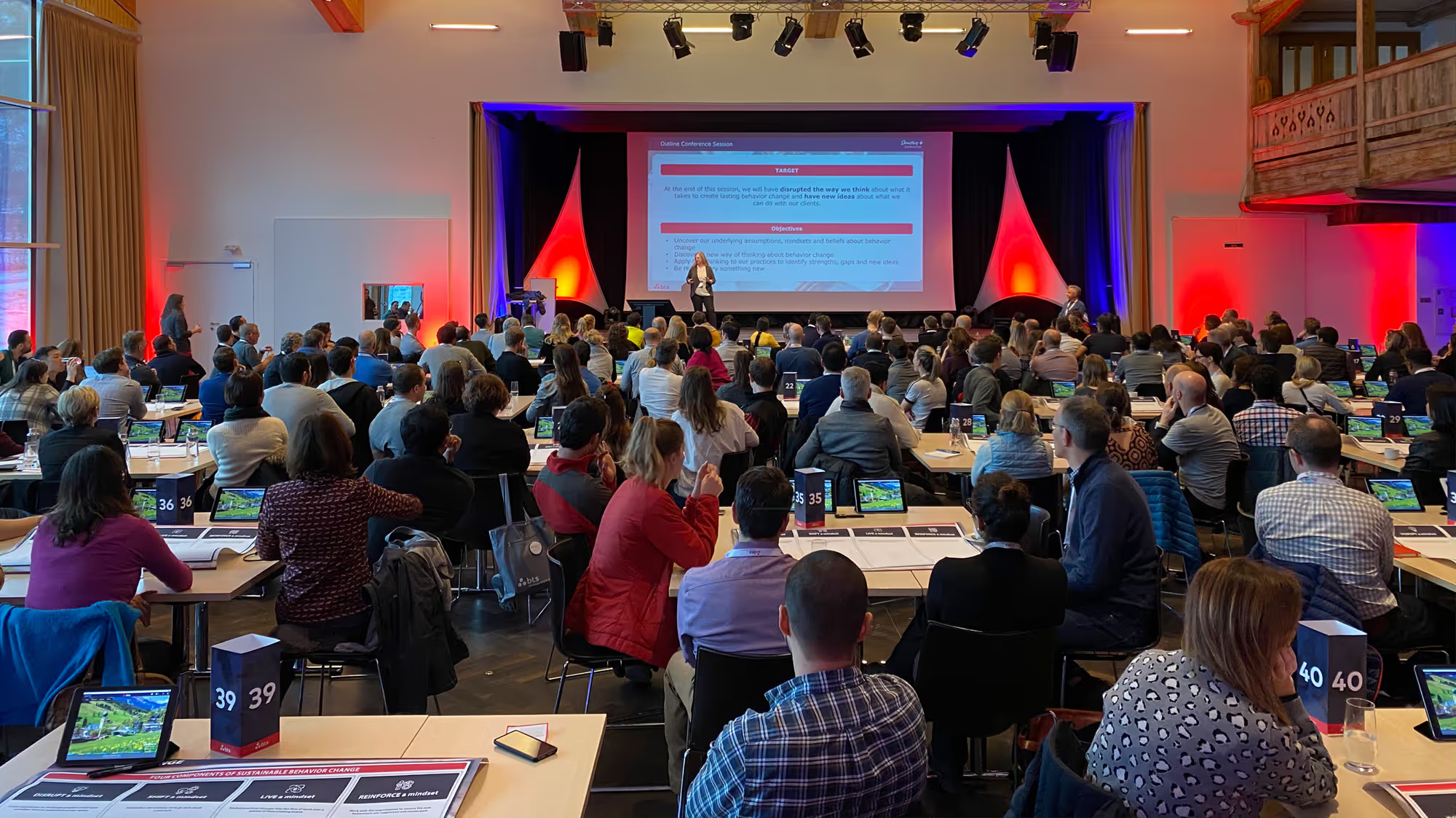
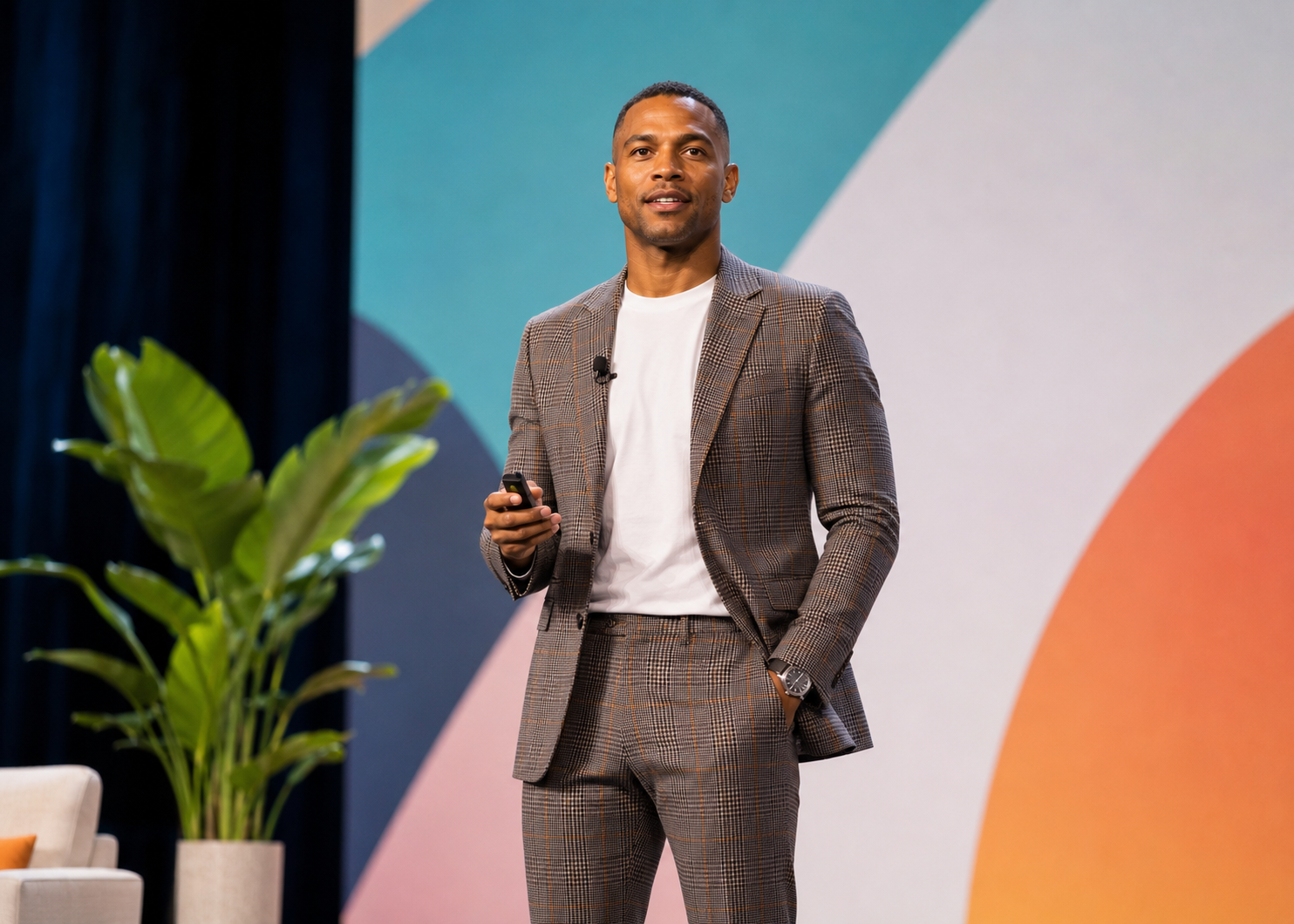
In 2012, 74% of SaaS account executives hit quota. Today, it's just 48%.
It's tempting to chalk that up to a software problem. But the pattern is broader. Alexander Group found that just 49% of core sellers across nine industries hit or exceeded quota in 2023.
But here's the kicker: the average seller in that study still reached 89% of target.
Across industries and benchmarks, attainment has been drifting down, but this isn't a story about a handful of great sellers carrying the number while everyone else is falling dramatically behind. The typical seller is getting close to quota.
Sellers aren't suddenly incapable of selling, the context around selling has changed.
Buyers still need sellers… they just need them differently
1. Seller's aren't guiding a single buyer anymore
B2B deals now involve six to 10 stakeholders, and enterprise purchases can involve 17 or more. About 77% of buyers describe their last purchase as complex or difficult.
The seller's job is increasingly to help a group reach a decision, not simply help one person make one.
2. The seller's information advantage is shrinking
The seller's information advantage is shrinking
Buyers now use about 10 interaction channels during a purchase, roughly twice as many as in 2016. AI is accelerating that shift, giving buyers more ways to research, compare and pressure-test options before they ever engage a seller.
The value of simply knowing more than the buyer is disappearing.
3. Buyers can avoid seller friction for longer
About two-thirds of B2B buyers prefer a rep-free buying experience. It's easier than ever to research a category, build a shortlist and develop a point of view without talking to sales.
That means sellers have to earn their way into the conversation by adding value, not just showing up.
4. Sellers are becoming sense-makers
Buyers aren't necessarily struggling to find information. They're struggling to determine what to trust, what matters and what to do with it. In fact, 69% say they turn to sales reps to validate AI-generated insights.
Which brings us to the kickoff
All of this has big implications for the one moment each year when we bring the entire commercial organization together to prepare for the year ahead.
The good news? You don't need to scrap the kickoff, you just need to redesign it.
That's work we do with clients all the time, across sales kickoffs and other high-stakes moments where strategy needs to become action.
And, in the spirit of not gatekeeping the good stuff, here are three things every kickoff designed to change behavior needs:
Before
Start with the change, not the agenda
This is where many sales kickoffs go wrong. They start with the event: strategy update, product roadmap, messaging, breakouts, keynote. The agenda becomes the organizing principle.
Flip it.
Start with the behavior you need to change, then design the kickoff around it.
That means thinking beyond the room itself. What needs to happen before people arrive? What do they need to experience and practice during the event? And what needs to happen after they get back to work?
Find the real constraint
Most revenue leaders have a hypothesis about what's holding their teams back. Few have enough data to know.
We ran a readiness diagnostic for a financial services client preparing for an AI leadership event. The leadership team came in expecting the biggest barrier to be skepticism: Would sellers actually believe AI could help them sell differently?
They were wrong.
Sellers and leaders already believed in the value of AI. The real gap was much more practical: confidence and ability. People understood the promise but weren't yet sure how to use it in their day-to-day work or bring it into a client conversation.
That changed the intervention completely. Instead of spending the event convincing people that AI mattered, we could spend the time helping them actually use it.
That's what a good diagnostic buys you: permission to change the plan.
A useful diagnostic doesn't need to be complicated. Ours can take 15 to 20 minutes per person and, when deployed across the full population, give leaders a ranked view of the constraints by region, function or level.
It also gives you a baseline for the behavior you're trying to change. Without a clear starting point, there's no way to know whether the kickoff actually moved the needle.
Get leaders ready before the room
Leader preparation shouldn't be a briefing the night before. If leaders aren't aligned on the change, the room won't be either.
Before the wider team arrives, leaders need to understand the data, the capability gap and, most importantly, what they need to do differently to close it.
The strongest version we've run gives leaders a dedicated session ahead of the main event. They arrive aligned on what needs to change, why it matters and how they'll reinforce it with their teams.
The test: Can every leader explain what their team needs to change, how kickoff will help and what they'll do differently afterward?
If not, you're asking the organization to change before its leaders are ready to lead the change.
During
Get people working, not watching
Most events fail for a pretty unglamorous reason: People sit and watch.
If you want behavior change, the room needs to feel more like the work and less like a conference.
A simple experiential architecture works:
- Start with the real work. Put people into a live or simulated situation before explaining the framework.
- Let them see the gap. Pause and reflect before introducing the solution. Let the insight come from the room.
- Give them something to try. Introduce the model, tool or methodology when people have a reason to use it.
- Practice before they leave. Don't assume understanding will translate into behavior. Let people try the new behavior while they're still in the room.
Skip the practice and you have awareness. Practice it and you have a shot at behavior change.
Put your leaders to work too
Leaders should facilitate, participate, join teams at the tables and model the behaviors they're asking others to adopt.
If executives are on stage for 20 minutes and gone by lunch, you've designed a broadcast.
People notice the gap between what leaders say matters and what they actually spend their time doing.
The test: Did leaders do the same work they're asking their teams to do?
After
Build reinforcement into the work
This is where a lot of the investment quietly disappears.
Managers today are carrying more people and more work than ever before. Gallup reports that average team size rose from 10.9 direct reports in 2024 to 12.1 in 2025. Yet managers remain one of the biggest variables in whether new behaviors stick, with Gallup estimating they account for 70% of the variance in team engagement.
So don't give managers another program to administer.
Make the first 90 days part of the design
- Weeks 1–2: Translate the kickoff into 90-day commitments with clear owners and dates. Give leaders an executive synthesis they can use with their teams.
- Days 30–60: Bring managers together in peer groups of six to eight to compare what's working. Give them simple guides they can use in 1:1s and pipeline reviews.
- Day 90 and beyond: Connect the new behaviors to business-led check-ins and actual performance.
Make leaders accountable for what happens next
Leaders set the expectation, managers coach it, executives model it, and the organization measures it.
No platform substitutes for a manager asking about the behavior in a 1:1.
The test: 90 days out, can a participant remember the last time their manager asked about the behavior?
If they can't, kickoff probably didn't stick.
The opportunity is bigger
The best kickoffs don't just get everyone aligned on the year ahead. They create a shared understanding of what selling requires now, give people a chance to practice it, and make it easier to carry that behavior back into the work.
If you remember nothing else from this blog, I'll leave you with a simple but powerful question to take into the planning process for your next event:
When your sellers walk back into the field on Monday, what will they be able to do that they couldn't do before?
If you have a good answer, you're probably on the right track.

There’s a specific kind of strategy meeting getting scheduled right now, in nice hotels with bad coffee: the AI reset off-site.
And for good reason. In a 2026 WRITER survey, 48% of leaders described their AI rollout as, in their own words, a "massive disappointment." That's nearly half the room.
What that number really measures is the distance between what these tools can do and what people are doing with them. In our experience, that distance is almost entirely human.
Which is why the off-site is the right instinct. Making the most of that time is the harder part.
What separates an AI reset that actually changes the game from an expensive two-day conversation? In our experience, it comes down to avoiding four common design mistakes.
Mistake 1
Blaming the bots
The gap between AI investment and real adoption is almost always about people, not technology. And when adoption stalls, we usually find it's one of four things.
- They don't think it will help them
- Nobody around them is using it
- They don't feel capable
- Or they don't have real access to the tools they were promised
Four different problems, and four completely different fixes.
That's why diagnosis comes first. If you don't know which barrier you're dealing with, every intervention becomes an educated guess. And you cannot tell which one you have by staring at a dashboard. A belief gap and a skill gap look identical in a status report and need opposite interventions. Show up guessing, and you'll spend real money teaching people to use a tool they simply don't trust yet. Congratulations - you've just catered the wrong conversation.
Mistake 2
Letting leaders off the hook
One of the biggest predictors of whether change sticks is also one of the most overlooked: leadership.
If your executives show up as observers, nodding along and quietly answering email under the table, your people clock it in about four minutes.
That doesn't mean your CEO has to emcee the thing. It means they use the tools in front of everyone, participate in the conversation, and make it clear this isn't someone else's initiative.
Recently we’ve been working with a Fortune 200 global professional services firm who’s top 120 leaders were at very different points with AI. Some were redesigning entire processes. Others were using it to summarize emails, or not at all. Rather than focus on the technology, the four-hour session focused on what leaders could do with AI, applying it to a live strategic challenge and ending with a personal commitment to lead differently. The response was strong enough that the organization is now cascading the experience globally.
The lesson is simple: when leaders experience AI as a strategic capability, they're better equipped to model the behavior that makes adoption stick. Nothing you build during those two days survives without that entire chain of leadership doing its part.

Mistake 3
Chasing the wrong outcome
Without a behavioral baseline, you have no way to prove anything actually moved. No baseline, no ROI. You're just hoping the energy in the room was good, which is a wonderful feeling and a terrible metric to bring to your CFO.
But the baseline isn't just about proving the off-site worked. It's about understanding where you're starting in the first place. And you'll want that clarity, because the quiet resistance is real. In that same 2026 research, nearly a third of employees admitted to actively working around their company's AI strategy. If you don't win their belief in the room, some of them will keep politely ignoring the whole thing from their desks. You can't measure your way out of that. You have to earn your way out of it.
Which brings us to the biggest reframe of all.
Mistake 4
Leaving follow-through to chance
We've been working with a Fortune 100 medical device company on their AI strategy for three years. It started with their leadership team, a three-hour session built around what those leaders would do differently, and it landed. What became clear afterward was that the same experience needed to happen everywhere else. So, it expanded: 90-minute activations for 15,000 people, and this year intact teams redesigning their own workflows.
Three years in, that first session is the smallest part of the story.
Your event is where momentum gets created. What happens at 30, 60, and 90 days is where results get made.
If you're planning one of these and want to change what happens on Monday, not just how everyone feels on Friday, that the work we do.
We'd be glad to help you design it.

Candidates now arrive at interviews pre-coached by AI, with their resumes optimized to pass every checkpoint. Polish has stopped being a signal. The traditional hiring process was built to read exactly the cues that AI is now best at producing, and the signals hiring managers once relied on have weakened as a result. And for roles where the wrong hire carries real business consequences, losing the ability to tell who will actually perform is not a minor inconvenience. It is a material risk, and it exposes the business to unnecessary turnover, reduced performance, and heavier investment for talent growth and development.
So how do you observe the behaviors that matter most, before someone is in the role?
Not by asking better questions, but rather by putting candidates in situations designed to elicit that behavior.
The limits of predicting from paper
Credentials tell you what someone has done. Structured interviews tell you what someone says they would do. Neither lets you observe what they actually do in the moments that count.
This distinction matters most in client-facing, relationship-driven roles, where the performance gap between a strong hire and a weak one plays out in real business outcomes (revenue, retention, client growth). Organizations that hire at scale in these roles carry that gap across hundreds of decisions at a time.
The better approach is to watch candidates do the work before you hire them. Put them in simulated, role-relevant scenarios, and pair the simulation with a second, different kind of measure so no single method carries the whole decision. That combination is what lets you evaluate real performance before anyone is in the role. Organization-specific simulations provide a clear read on who is ready and capable of performing on day one. In a world of AI-supported candidate signals, the use of simulations makes the process harder to prep for. It is harder to fake. And, when designed well, it is substantially more predictive than other hiring methods.
What counts as evidence
Claims about predictive power are easy to make. Evidence for them is rarer than you would expect.
A predictive validity study, the kind that links pre-hire assessment scores to how someone actually performs once hired, is some of the hardest evidence to produce and the rarest to see. Many assessments are validated against proxies: another test, or a theoretical model of the role, rather than real results on the job. Connecting scores to concrete business outcomes and doing the statistical work to show the link holds, takes years of shared data and a level of commitment from both the assessment provider and the client that most partnerships never reach. That is precisely why it is worth asking for. A provider who can show how assessment scores track to training completion, retention, and first-year output is offering something categorically different from one who can only show a correlation with another test.
Why simulation holds up where other methods do not
When a candidate sits across from a trained assessor (someone playing the client or prospect on the other side of the conversation) and has to work through a real situation, they cannot rely on a rehearsed answer. The scenario is specific. The stakes feel real. What you see is close to what you would get on the job.
That is the value of simulation-based assessment: it does not test what candidates know about the role.
It shows how they use what they know when a real person is on the other side of the conversation, before the stakes are real.
For roles that carry significant business responsibility, this distinction is the whole game. The cost of the wrong hire in a high-stakes client-facing role is not just a missed quota for a quarter - It plays out in relationships that do not develop, clients who leave, and productivity losses that compound over time. Getting those hiring decisions right, at scale, with consistency, requires methods that are built for predictive accuracy, not just candidate experience or hiring speed.
What this means for how organizations think about hiring
Most organizations are still optimizing the wrong things in their hiring process. They invest heavily in employer branding, application flow, and interview structure, all of which matter, but less in the core question: does our hiring process actually predict who will succeed in this role?
AI has sharpened the stakes here. If every candidate can present as polished and prepared, screening based on presentation becomes less useful. What holds up is direct observation of the behaviors that the job requires.
A few principles worth building from:
- Measure what the job requires, not what is easy to measure. Cognitive tests and personality questionnaires have their place, but they do not look much like the job. The closer the assessment is to the actual work, the better it predicts performance in it.
- Ask what your assessment predicts. Training completion? Retention? First-year output? Most organizations cannot answer that question today, largely because providers have rarely been asked to prove it. It is a fair thing to ask for.
- Take the human element seriously. In a simulation, a candidate is having a real conversation, responding in real time, navigating a situation that requires judgment. Even with the help of AI, that is hard to game. And it remains one of the strongest predictors of on-the-job performance available.
The data exists to make hiring decisions more accurate, fairer, and more directly tied to business outcomes. For organizations operating in high-stakes roles at scale, there is too much on the line to rely on methods that cannot hold up to that standard.
You may be interested in BTS’ thought leadership in the five talent shifts AI is forcing now.

Leadership is the work of creating shared understanding, and language is the primary tool for doing it. Yet we spend remarkably little time examining our words. Every decision, expectation, priority, and piece of feedback reaches another person through words. If those words aren't doing the job, neither is the leadership.
The lighthouse
Some years ago, a large company hired a strategy consulting firm to rethink its leadership model. The firm came back with a beautifully produced framework built around a central metaphor: the lighthouse.
Leaders, the model declared, should be lighthouses.
The metaphor quickly found its way into playbooks, performance reviews, onboarding decks, and town halls. People repeated it with the confidence of those who had paid a lot of money for it.
There was just one problem: nobody could agree on what a lighthouse was supposed to do.
Was it warning people away from danger? Guiding them toward a destination? Standing firm while everything else changed?
Eventually, the company hired another team to translate the metaphor into specific, observable leadership behaviors.
It was an expensive way to discover that a word everyone confidently repeated wasn't creating nearly as much shared understanding asthey thought.
Why jargon prevails
- Parking lot that
- Double-click
- Close the loop
Business jargon survives because it’s largely designed to manage social risk. Using it signals, I know how this world works. It demonstrates membership, competence, and credibility.
Business is messy, and leaders don't always have complete information. Abstract language lets us project confidence while preserving flexibility.
Altitude without traction
Specific language creates accountability. The more specific you are, the easier it is for people to disagree, question your thinking, orhold you accountable. That's part of the appeal of jargon. It creates distance between the speaker and the detail. The more abstract and elevated your language, the more strategic you sound.
A 2020 study by Harvard Business School professors Laura Huang and Andy Wu, published in the Academy ofManagement Journal, analyzed over 1,000 early-stage startup pitches and found that founders who spoke in abstract, visionary terms were significantly more likely to advance in the funding process.
A separate study, published in Applied Cognitive Psychology in 2025, found the other side: jargon raises how credible a speaker appears and lowers how much the audience retains.
The very language that helps people see you as a leader can make you less effective once you're leading.
The most trusted leaders tend to be the ones who resist impressive-sounding language and say the plainest version of what they mean.
In fact, four words probably do more for a leader's standing than any carefully crafted message: I made a mistake. Not "we encountered some headwinds," not "there were learnings from this experience," but the plain version.
The cost of comfort
When a conversation gets uncomfortable at work, it almost always feels easier to soften your message than to say exactly what you mean. You hedge, add qualifiers, cushion the point with extra reassurance, or leave the hardest part unsaid. Most of the time, you mean well. You don't want to discourage someone, damage the relationship, or create unnecessary conflict. The conversation becomes less uncomfortable for a moment, but the work often becomes harder afterward.
Amy Edmondson, Novartis Professor of Leadership and Management at Harvard Business School and author of The Fearless Organization, found that the fear of making a negative impression pushes people to stay silent exactly when clarity is most needed. According to her research, silence is one of the most consistent predictors of teams that miss problems early and never learn from them. The friction avoided in the meeting resurfaces later, at greater cost.
KimScott, former executive at Google and Apple and author of Radical Candor, calls this ruinous empathy: softening your message to protect someone's short-term feelings comes at the cost of the clarity they need. Her argument is simple and uncomfortable: clear, direct communication, even when it is hard, is an act of care.
The quiet power of saying what you mean
None of this is an argument for bland, colorless language.Vivid, precise writing does the opposite of jargon: it sharpens meaning instead of hiding it. Before reaching for a word, pause on two questions:
- What do I mean by it?
- What will my audience hear?
A surprising amount of corporate language wouldn't survive those two questions.
Leaders have more influence over language than they often realize. Whatever tone, vocabulary, and level of directness they model becomes the standard everyone else copies. Word choice is one of the quietest ways leaders shape culture.
This matters even more as we hand our language to AI. These tools can already learn to write in our voice. The question now is whether we've been deliberate enough about that voice in the first place to like what we see.

You can't predict the future. You can be disciplined about how you face it.
That's where Future Storming comes in. Future Storming is a process for looking at the trends and signals already visible in the market, understanding how those forces connect, and thinking more clearly about where they may lead.
Recently, we've been applying that lens to talent strategy, running Future Storming sessions with talent leaders across industries to understand which forces are already reshaping how organizations find, develop, and retain the people they need. When you look across those conversations, one thing is hard to miss: AI runs through almost all of the most significant trends, and not as a future scenario. It's already reworking the talent systems most organizations have leaned on for years, often quietly, and often faster than leadership teams have had time to respond.
From these sessions, five high-likelihood, high-impact shifts have emerged as the ones every talent leader needs to be watching right now. What follows is what each of them may mean for your organization.
1. The frameworks most organizations use to define great leadership were built for a different era
Skills and competency models describe work that no longer exists in many roles or that AI now performs alongside, or instead of, humans. The gap between what organizations say they're selecting and developing for, and what the work actually requires, is widening quietly.
This creates a real problem. Organizations that don't redefine what great looks like now will be developing the wrong people for the wrong future optimizing for capabilities that are becoming less predictive while under-investing in the ones that matter most.
- Rebuild leadership profiles from a future-back perspective, starting with where the business is heading, not where it has been.
- Focus on the distinctly human capabilities AI cannot replicate judgment in ambiguous conditions, relational intelligence, ethical reasoning, the ability to set direction when there is no precedent.
- Increase the use of behavioral observation in selection and development. It's the only methodology that shows how someone actually thinks and decides under real pressure.
The signal worth chasing isn't on a resume, it's in the room in how someone handles a real situation, under genuine pressure. It's the only place where someone can't prepare their way out of being themselves.
2. Human differentiators are the last mile AI cannot close
Judgment. Empathy. Creativity. The ability to navigate genuine ambiguity. These are increasingly what separates human contribution from AI output and they're precisely the things most talent systems have always found hardest to measure.
For a long time, organizations could afford to treat these as qualities that would emerge naturally with experience. That's no longer an option. The human differentiators are becoming the job. And most organizations still aren't measuring them well.
The methods exist behavioral assessment, simulation, structured observation. And AI is now making them accessible at scale in ways that simply weren't possible before. The question isn't whether to use them. It's how to deploy them thoughtfully, with the governance and transparency that -stakes talent decisions require.
- AI-powered behavioral observation that surfaces how people actually perform in the flow of work, (i.e. judgement, decision-making, adaptability) not self-report
- Assessment that evaluated how people work with AI, not just without it because that's increasingly what the role looks like
- Simulation-based approaches that reveal thinking in action - the kind of evidence no credential or output can provide
3. The talent pipeline is broken
AI is displacing the early-career work that has traditionally served as the on-ramp into organizational life. Those tasks once gave emerging employees something more valuable than work product. They gave them foundational experiences, relationships, and judgment. The kind of judgment that eventually grows into leadership.
The impact won't show up immediately. That's exactly what makes it worth paying attention to now. Within three to six years, benches will thin and succession pipelines will require far more intentional investment. Organizations will find themselves asking why their internal talent isn't developing the way it used to.
The organizations that get ahead of this have a real opportunity to build something more deliberate, more equitable, and better suited to the capabilities the future actually requires.
- Invest in real, simulation-based experiences, putting emerging leaders into the decisions and pressures that build genuine organizational judgment, not just task exposure.
- Redefine what early-career development is, building toward the capabilities the future requires, not the ones the old job description described.
- Build feedback into the flow of work. AI behavioral observation and practice AI role plays make continuous development possible at scale. The experience that used to happen informally has to be designed now.
4. People need to re-skill faster than any development model was built to support
People need to reskill faster than any development model was built to support. Most organizational development infrastructure was built around a longer, more stable arc of skill acquisition. AI is compressing that arc significantly.
The implication isn't just that training needs to be faster. It's that the whole architecture of how organizations identify, develop, and deploy talent needs to be built for continuous recalibration not periodic refresh.
- Prioritize adaptability and learning agility over static expertise. The ability to acquire new capabilities quickly matters more than the specific capabilities someone holds today.
- Treat reskilling as a continuous organizational process, not an episodic program.
5. AI is absorbing leadership work and culture is losing it's anchor
This is the shift that's easiest to underestimate, and hardest to recover from once it arrives.
Culture is what people see leaders do. The behaviors leaders model how they make decisions, how they show up in hard moments, what they choose to reward and what they let go are how organizational culture gets transmitted. It doesn't travel through stated values. It travels through visible human behavior.
AI is absorbing the work that used to make leaders visible as humans making choices. Performance reviews written by AI. Communications drafted by AI. Coaching conversations mediated by AI. When the distinctly human work disappears, so does the signal. People don't know what to watch anymore. And culture which depends on that watching starts to fray.
The organizations that navigate this well won't be the ones that use less AI, they'll be the ones most intentional about which leadership behaviors remain visibly human, and why.
The behaviors that held culture together need to be rebuilt around what humans uniquely contribute now and that starts with getting the success profile right. That's exactly what the Future Ready Profile is built for.
Strengthen empathy-centered leadership capabilities. The human dimensions of leadership matter more, not less, as AI takes on more of the technical work.
- Strengthen empathy-centered leadership capabilities. The human dimensions of leadership matter more, not less, as AI takes on more of the technical work.
- Reinforce organizational purpose and human-centered culture as anchors.
- Treat culture as something you design, not something you inherit.
What this means
The organizations that navigate this well won't be the ones that adopted AI fastest, they'll be the ones that invested just as deliberately in the human systems around it.
These five shifts aren't warnings. They're design problems, and design problems have answers. The talent systems that come out of this moment can be more intentional, more equitable, and more fit for purpose than anything we've built before.
At BTS, this is the work we're doing every day. If you'd like to think through what any of it means for your organization, we’d love to talk.
The thinking in this article was shapped by Future Storming sessions, including a SIOP 2026 workshop, and by ongoing conversations with talent leaders navigating these shifts in real time.

In Part 1, I told you about the three decisions we made two years ago and the simulation flywheel that produced our first Applied AI diamond.
Here’s the field-notes version.
Over 80% of our global business have now adopted a new Applied AI approach for doing simulations in the first eight weeks, across 24 countries and every practice.
The flywheel didn’t stop with simulations. It moved into finance, sales enablement, legal, operations, and client delivery. Teams started building agents and bringing them onto their own org charts. We didn’t plan for any of that. We built the conditions for people to find their own breakthroughs.
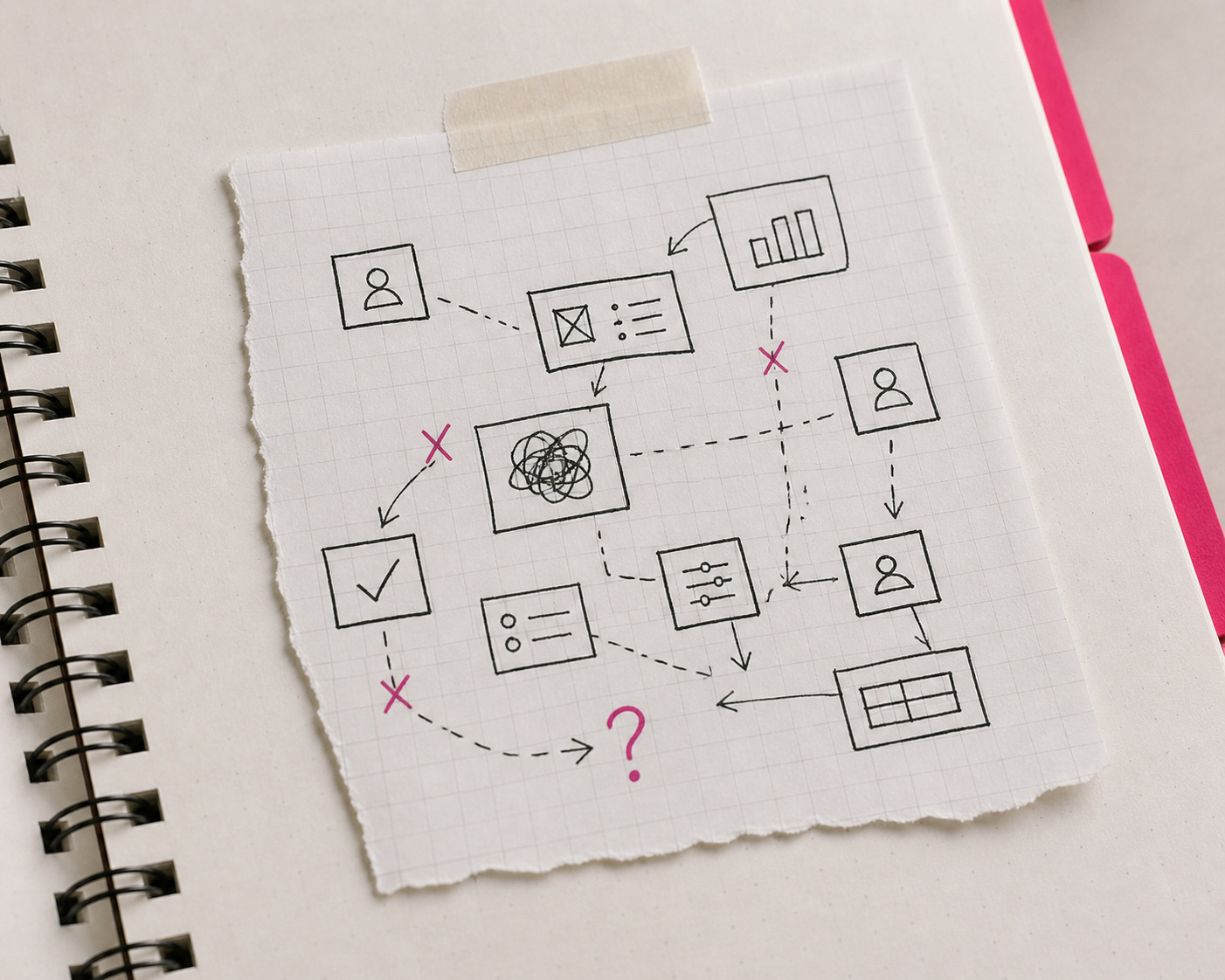
What it felt like inside the flywheel.
When the simulation team went live with their first clients on the new way of working, the lead person hit a wall. Their words:
“You’re asking too much. You’re making me be a full-stack developer. Up until this point I did a small part, and I sent it to the team, and they built off the back end, and they brought it back. And now I have to end-to-end soup to nuts, basically alone.”
There was graphic UI work nobody had been trained for, the fear of delivering quality below what BTS expects of itself, and the weight of not having a playbook. This was not the joyful adoption story most consultancies tell.
Then something shifted. Six members showed up for product testing, where the usual was two or three. The work created teamwork I hadn’t seen at BTS in years. The breakthrough was not an instantaneous change from skepticism to celebration. It was a breakdown in confidence, then rally, then bonding. If we didn’t make room for the breakdown, we would have lost the rally.
The other breakthrough was global teamwork; not yet a BTS core strength. Our culture is beautiful: high-freedom and entrepreneurial. But people’s first identities are to their countries. Almost every prior attempt we’ve made at a global initiative has failed. The one exception was Covid. So, when I say what happened next surprised me, I mean it.
I asked to join the simulation team’s Slack channel rather than pulling them into status meetings. What I got to watch in the mornings was someone in South Africa waking up, posting “I tried this and got stuck,” then London adding on, then San Francisco weighing in, then a surprise breakthrough overnight from Tokyo. We didn’t engineer that. Curious and determined BTS’ers did. The problem was interesting enough that the org chart didn’t matter. It was amazing to see and a glimpse into the next evolution of the BTS culture.

The pattern: Explore, expand, institutionalize, renew.
What we’ve now seen play out, both inside BTS and with clients, follows the same four-step pattern. Each step asks a specific decision of the leader.
Explore.
Stay stubborn on the aspiration and fluid on the path. Our breakthrough wasn’t the path we originally took. We changed tools and approaches. Nobody could have foreseen that. And if the team had taken the first six months of learnings from AI as their definitive “this is the detailed path we will follow,” we never would have gotten the disruption. Five different tool combinations were tried before we found the one that worked. Companies that lock into a single path or tool too early are betting against compounding capability that doubles roughly every seven months. That is not a bet I’d take.
Expand.
Run the old way and the new way side by side. When the simulation team’s breakthroughs got real, the instinct was to retreat into more internal testing. We did the opposite. They ran old way and new way in parallel on 6 or 8 live client projects across all three geographies. Every single one ended up going live the new way. The backup was always there. They didn’t need it.
Institutionalize.
Burn the boats. The simulation team committed that no new client work would be done the old way after January 1. The other practice leads then committed to dates within Q1, even though most of them had not yet experienced the new way themselves. They had to trust their colleagues. If you can do it for the most complex thing, you could probably do it for the less complex ones. By February 15, we had approaching 90% global adoption across 24 countries, across all practices. I was shocked and proud. We had spent years failing at exactly this kind of global rollout.
Renew.
Treat your agents as contractors. People on our diamond teams are now managing 30+ agents they built themselves. Our teams give agents performance feedback. We terminate their contracts when they don’t deliver. We expand the responsibility of agents when they outperform. The frontier question we’re wrestling with now is token budgeting. Two friends of mine running engineering-heavy companies believe that within 6 - 9 months, their token cost per engineer will exceed the cost of the engineer. Whether that’s the right framing is open. The question is real, and every CEO will be asked some version of it within the year.
What had to be true for this to scale.
Once we achieved this amazing global innovation, the leadership sat down to figure out what made it work. We named five things. None of them were about the technology.
Real pain points as the starting point. We had so many people frustrated from those ways of working, all the back and forth and all the wasted time, that this was gold for them. The old way was already painful. The new way wasn’t a forced disruption; it was relief. Find the workflow where the pain is loudest and start there.
The diamond unlocked creativity, it didn’t constrain it. This was the most differentiated insight, and the one most leaders miss. It wasn't "here's the new tasks and rules." It was, "once you learn how to do this, the sky's the limit. You can be even more creative." If your rollout feels like a new set of rules constraining your people, you’ve built the wrong thing.
Pair deep expertise with fresh eyes. The disproportionate share of our breakthroughs came from a tenured tinkerer with total command of the work, paired with someone new to the role who hadn’t yet built the muscle memory of how it had always been done. Without that pairing, you get incremental improvements to the work you already know how to do, instead of a reinvention.
Refuse the “people are too busy” reflex. When I brought the rollout to the global leadership team, the excuses came fast. “Our people are too busy. They’re burnt out. Q1 is going to be busy. No one’s going to have time.” My response: “This is a chance to eliminate the tasks you dread and expand what you love. I know it is a short push of extra work, and I think after the fact you and your team will feel joy and pride and say it was the best time we ever spent.” This is the moment most AI rollouts die.
Senior leaders must lead by example and do the work themselves. This is not middle manager’s job. This is not something you delegate. Even though you don’t build simulations anymore, you must know what this is. One of our partners proactively put time on senior leaders’ calendars and forced them to do the work. Once they started building, the excitement grew, and they could advocate for the rollout because they understood it. If your executives haven’t put their hands on the keyboard, you don’t have a rollout. You have a memo.
What we’re seeing across clients.
We’re now running this play with client organizations across industries and geographies. The companies whose flywheels are accelerating paired their A-players with their early-career talent, pulled IT and legal into the working sessions, refused the “too busy” reflex, and put their senior leaders’ hands on the keyboard. The companies whose flywheels are stuck almost always have a leadership pattern at the center of the stall. Not a tooling pattern. Not a governance pattern. A leadership pattern.
If this resonates, let’s talk.
If you read Part 1 and asked yourself whether your flywheel was turning, the question I’d add now is sharper: do you have the conditions in place for a diamond to appear? If yes, you’re already moving. If no, the technology will not save you.
Here's where we're starting with clients: a working session, half day to a full day, with a small group that owns one of your highest-friction processes. Together we map where your first diamond is most likely to land, how to set up the side-by-side trial, and what your version of "burn the boats" should look like.
The destination, if we do this right, is a self-reliant culture of applied AI inside your company. 5, 10, 15 diamonds compounding into a fundamentally different way of operating. From what I have experienced this is a once in a career opportunity for dramatic shareholder value creation if you get that muscle going. I say that because I'm watching it happen, in real time, inside our own company and across our client base.
If you want to get your flywheels spinning and map your first diamond, start here. Bring your hardest workflow. We'll bring the playbook.
Three decisions that changed everything.
Two years ago, we made three deliberate decisions about how BTS would move with Applied AI.
We would become our own Customer Zero.
While others were building strategies, defining governance, and waiting for clarity, we made a different call: we decided not to wait. Not because the stakes were low, but because they were high. And because in a space evolving this quickly, clarity wouldn’t come from planning. It would come from movement.
So instead of starting with a roadmap, we started with three principles:
- No top-down mandate. The people closest to the work figure it out.
- IT must evolve from gatekeeper to enabler - leading AI trials and fast experimentation.
- Don’t wait for certainty.
We set the organization in motion, and once we did, things started to move quickly.
What if we started this company today?
Waiting for certainty is itself a choice, and it’s costing companies more than they realize.
We started where we knew the work best: our simulations. No perfect plan, just teams moving, trying, and iterating.
Simulations are core to who we are at BTS. Companies that simulate don’t just make better decisions; they execute faster and build more engaged cultures.
The team asked a simple question:
"What if we were to start our company today?”
That question started the flywheel.
They asked IT for a few licenses and started building - vibe-coding, writing agents, and testing tools - moving at a pace that would make any VC-backed start-up smile.

The messy middle.
At first, the team was underwhelmed.
The early reports were blunt:
“Not good with math.”
“Poor graph capabilities.”
The team wasn't discouraged. They kept tinkering - jumping between tools, staying on top of new releases, experimenting constantly.
This was a small team, across 24 countries, building off each other’s ideas. Laughing at crazy creations. Breaking things. Iterating in a sandbox alongside real clientwork.
Each cycle produced something:
- A sharper scenario
- A faster build
- A more powerful simulation
The flywheel was turning, and it was generating something real.

When the diamond appeared.
Then something shifted.
The team moved into client trials across five countries. They figured out ISO compliance and built the architecture to handle the complexity, the “spaghetti.”
And what emerged wasn’t incremental:
- What used to take weeks started happening in days.
- Limited creativity started to feel like unlimited innovation.
- Clients became self-serving.
- Agentic simulations were built directly into client systems for real-time updates and preparation.
This was our first AI diamond - a high-impact outcome created by many cycles of experimentation compounding into real value.
It only appeared because we kept the flywheel turning, each cycle increasing the odds that something would break through.
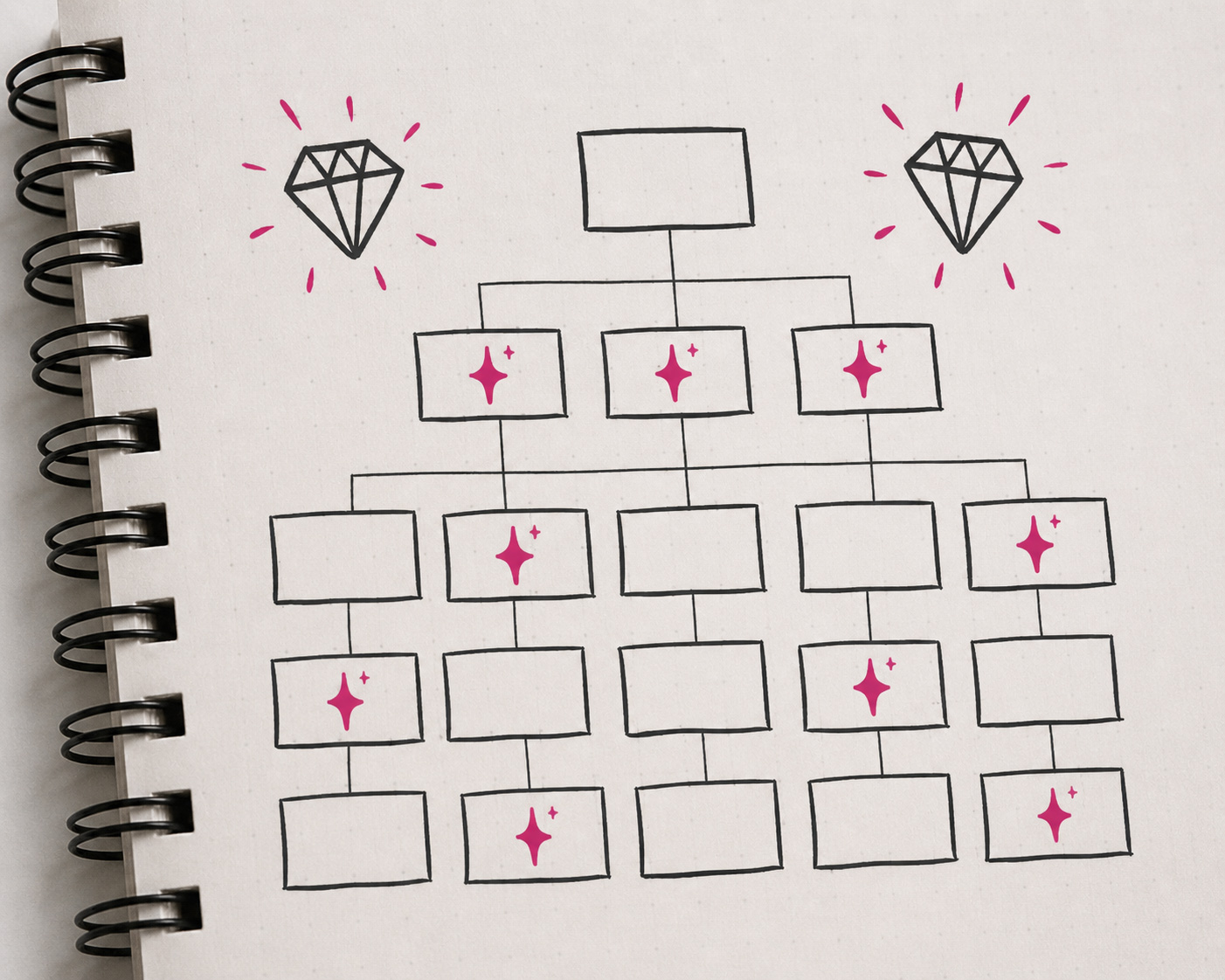
95% adoption in eight weeks.
Then it was time to take the AI diamond global.
BTS is decentralized and highly entrepreneurial. We operate across 24 countries and 38 offices, where local teams have real autonomy.
And historically? That’s meant a low appetite for adopting something built somewhere else and pushed from the center.
So we expected resistance.
Instead, something surprising happened.
In the first eight weeks, we saw 95% adoption across our global footprint.
It felt completely different from our own digital initiatives, ERP implementations, top-down rollouts of the past.
This moved on its own. Why?
We realized it didn’t start with a framework or a model, it started with a feeling.
The feeling of being at the leading edge of one’s craft and profession.
- Joy
- Excitement
- Pride
As we watched this play out across teams it stopped feeling like isolated wins.
There was a pattern to it. A repeatable, organic, innovation motion.
And the flywheel didn’t stop with simulations.
It spread across finance, sales enablement, legal, operations, and client delivery. Some cycles led to small improvements, and others revealed new diamonds.
Not becausewe planned for them, but because we built the conditions for people to find them.
The question I'd ask any CEO right now: Is your flywheel turning, or are you still waiting for the perfect plan?
In part 2, I’ll share the key success factors behind the breakthrough, and what we’re now seeing across more than 120 global clients.

Organizations have long wanted to scale coaching, but have been limited by cost and capacity. With AI, that's beginning to change as new platforms make coaching more accessible, flexible, and available on demand, extending support beyond a select group of leaders to entire populations.
For talent leaders, this shift creates both opportunity and complexity. With greater reach comes a new set of trade-offs: how to balance access with depth, flexibility with accountability, and efficiency with meaningful development.
The limits of unlimited (coaching).
Unlimited coaching sounds like the obvious answer. Remove the barriers, give everyone access, let people engage on their own terms. What's not to like?
In practice, quite a bit.
When coaching has no defined structure or cadence, engagement tends to become episodic - people show up when something feels urgent and step back when it doesn't. The coaching relationship never quite deepens. Conversations cover ground but don't build on it. And the development that was supposed to happen keeps getting pushed to the next session, and the next.
Three patterns emerge:
- Sporadic engagement over sustained development. Without a rhythm to anchor the work, coaching becomes reactive. Clients bring whatever is most pressing that week rather than working toward something larger. Progress happens in bursts, if at all.
- Insights that don't compound. Great coaching reveals patterns over time - things a client can't see in one session but can't unsee after several. Without continuity, and without a consistent coaching relationship to hold the thread, each conversation starts close to zero.
- Outcomes that are hard to measure. No milestones. No defined endpoint. No clear way for the organization, or the client, to know whether it's working. Activity fills the gap where impact should be.
The result is a model that's easy to scale and hard to defend. Which is exactly the problem talent leaders are navigating right now.
The relationship is the lever.
Decades of research into what makes coaching work keeps arriving at the same answer: it's the relationship. Not the platform, not the methodology. The relationship.
When a coach and client build trust over time, developing shared language, and returning to the same themes with increasing depth, something shifts. Conversations get more honest. Insights stick. The client starts doing the work between sessions, not just during them. That's when coaching becomes genuinely transformative, and it can't be rushed or replicated in a one-off session.
The ICF and EMCC are clear on this: continuity is what dives outcomes. The coaching engagements that produce lasting change are the ones where each session builds on the last, not the ones that simply offer more access.
Three principles make that possible: Consistency, Continuity, and Completion.
1. Consistency
The foundation everything else is built on.
The temptation when designing a coaching program is to treat flexibility as a feature - let people book when they want, swap coaches freely, engage on their own schedule. But frequent coach changes reset the clock. Every new coach has to earn trust, learn context, and find their footing with the client. That's time spent getting started, not getting somewhere.
A stable coaching relationship works differently:
- The coach starts to see around corners, uncovering patterns the client can't see on their own
- The client stops performing and starts being honest
- The relationship itself becomes a source of accountability, not just the sessions
Consistency doesn't constrain the work. It's what makes the deeper work possible.
2. Continuity
What turns a series of sessions into genuine development.
Without continuity, coaching tends to be additive at best- each session offers something useful, but nothing compounds. With it, the work builds on itself in ways that can't happen in isolated conversations.
What continuity makes possible:
- A limiting belief surfaced in session three becomes a thread that runs through the rest of the engagement
- A behavioral pattern the client couldn't see at the start becomes impossible to ignore by the end
- Space opens up for the harder work - the kind that requires sitting with discomfort across multiple sessions, not resolving it quickly and moving on
That slower, deeper work is where lasting change actually happens. It doesn't come from more sessions. It comes from the right sessions, in the right order, with the same person.
3. Completion
The most underrated principle of the three.
In a world of unlimited access, there's no finish line, and without one, it's surprisingly hard to know what you're working toward, or whether you've gotten there. A defined endpoint changes the entire shape of an engagement.
A clear endpoint creates urgency and focuses every session on what matters most.
- Shifts the question from "what should we talk about this week?" to "what do we need to accomplish before we're done?"
- Gives both coach and client a body of work to look back on, not just a log of conversations
For talent leaders, this is also what makes coaching legible as an investment. Sessions logged is an activity metric. A cohort of leaders who completed a structured engagement and can articulate what changed, that's a result.
Don't just scale it, design it (here’s how)
The opportunity in front of talent leaders right now is significant. The organizations that will get the most from this moment are the ones that treat coaching design as seriously as coaching delivery.
Practical design decisions:
- Define the arc before you launch: set the number of sessions, the cadence, and the goals upfront, not after people have already started booking
- Protect the coaching relationship: Make coach switching the exception, not the default, and design your program to discourage unnecessary re-matches
- Build in milestones: create structured check-ins at the midpoint and end of each engagement so progress is visible to both the coach and the organization
- Separate on-demand support from developmental coaching: Use AI-enabled tools for in-the-moment guidance, and reserve structured engagements for the deeper work
- Measure completion, not just activation: Track how many people finish an engagement, not just how many start one
Questions to pressure-test your design:
- Does every participant know what they're working toward before their first session?
- Can your coaches see enough context about a client's journey to pick up where they left off?
- Would you be able to show, at the end of a cohort, what changed, and for whom?
Access opened the door. Intention is what makes it worth walking through.

Across industries, safety is undergoing a structural shift. What was once managed primarily as a compliance function or performance metrics increasingly understood as a reflection of how organizations are designed, led and continuously improved.
In complex and high-risk environments, safety is not achieved through stronger enforcement or additional programs alone. It emerges from the interaction between leadership behavior, operational design, decision environments and the organization’s capacity to learn and adapt.
Drawing on global safety science, Human & Organizational Performance (HOP), research on psychological safety, and our cross-industry transformation experience, eight key shifts are shaping the next evolution of safety culture.
1. Safety as a Core Organizational Value
Safety is moving beyond being treated as a shifting priority. Priorities compete. Values guide.
When safety becomes a core organizational value, it shapes decision-making, trade-offs under pressure, operational planning and resource allocation. Safety becomes the natural consequence of how the system operates,rather than a campaign layered on top of production.
This shift also redefines the role of safety functions, from compliance policing to enabling safe and sustainable performance.
2. Learning as an Operating Discipline
Organizations are embedding continuous learning into everyday operations. Rather than focusing only on what failed, they exploreweak signals, near misses, operational friction and successful adaptations.
Learning becomes a core capability, accelerating insight, strengthening resilience and improving decision quality.
3. Leadership Ownership at All Levels
Safety culture is increasingly recognized as a leadership capability, not solely an HSE responsibility.
Executives define direction and tone.
Middle managers translate expectations into operational decisions.
Supervisors shape the daily decision environment.
Successful organizations translate safety expectations into concrete leadership behaviors and daily routines, creating clarity and alignment across levels.
4. Psychological Safety as Infrastructure
A strong safety culture depends on speaking-up environments.
When employees feel psychologically safe, weak signals surface earlier, risk trade-offs are openly discussed and learning accelerates.
Psychological safety is operational infrastructure , not a soft topic.
5. Amplifying What Works
There is growing recognition that most work is completed safely, often under variable conditions.
Studying success reveals adaptive capacity and strengthens resilience. This complements traditional incident analysis by reinforcing expertise and confidence.
6. Aligning Work-as-Imagined and Work-as-Done
Procedures and plans rarely capture operational complexity perfectly.
Leading organizations reduce the gap between policies and operational reality by inviting front line input and empowering stop-work authority.
The goal is better alignment between design and execution.
7. Designing for Human Decision-Making
Incidents often stem from predictable cognitive biases such as normalization of deviance, production bias, overconfidence and hindsight bias.
Recognizing these decision traps shifts focus from blaming individuals to strengthening decision environments.
8. Cultural Evolution as a Long-Term Capability
Sustainable safety culture requires integration rather than reinvention, structured capability journeys rather than one-off programs, and measurable behavioral impact rather than activity metrics.
Organizations that succeed:
- Integrate safety into existing leadership and operational systems
- Design earning journeys that support day-to-day application
- Measure behavioral change and operational outcomes
- Reinforce progress consistently over time
Cultural evolution is a sustained commitment to system alignment and capability building.
Conclusion
The evolution of safety culture is less about adding controls and more about strengthening systems.
Safety is something organizations produce — through leadership clarity, operational design, psychological safety and continuous learning.
Those who embed these capabilities consistently will not only reduce risk. They will build more resilient, sustainable and high-performing organizations.
Sources & references:
- WorldSteel Association. Safety Culture & Leadership Fundamentals.
- Norsk Industri (2025). Safety Leadership and Learning: A Practical Guide to HOP.
- D. Parker et al. / Safety Science 44 (2006). Development of Organisational Safety Culture
- Hollnagel, E. (2014). Safety-I and Safety-II: The Past and Future of Safety Management.
- Hollnagel, E. (2018). Safety-II in Practice: Developing the Resilience Potentials.
- Conklin, T. (2012). Pre-Accident Investigations: An Introduction to Organizational Safety.
- Edmondson, A. (2018). The Fearless Organizations
- Reason, J. (1997). Managing the Risks of Organizational Accidents.
- Resilience Engineering research (Hollnagel,Woods, Leveson and others).

Client need
A leading global wholesale bank needed to increase its market competitiveness by re-defining and implementing a differentiated growth strategy. This required significant leadership alignment, increased collaboration across regions, products, and functions, and faster execution. To increase competitiveness, leadership needed to rewire old mindsets, lack of clarity and siloed ways of working that were limiting their edge in the market, and build a performance culture grounded in enterprise value, feedback, and accountability.
Solution
BTS partnered with the head of the bank and the leadership team to design and deliver a structured engagement through a series of leadership off-sites, strategy definition sessions, and high-performance team experiences across EMEA, APAC, and the Americas to rapidly align, commit to, and execute the new strategy.
The work focused on:
- Co-creating the wholesale bank’s must-win battles and driving their activation and translation to the country, product, and function level.
- Resetting performance culture through a growth mindset, "brave spaces," and a sharper competitive edge.
- Creating a blueprint for high-performing teaming, with a consistent approach and language across the organization.
- Systematically removing key silos by tangibly strengthening collaboration and co-creation across the organization.
Through a series of assessments, practical tools, and focused application, leaders created joint ownership and commitment to the organization’s strategy, a culture of constructive conflict, stronger stakeholder engagement, and enterprise thinking, while defining new operating principles, ways of working, and must-win battles to accelerate execution.
Results
The partnership engaged more than 320 senior leaders globally and helped align teams around shared priorities, new ways of working, and enterprise-wide collaboration.
Key outcomes included:
- Joint ownership of defined regional strategies and cross-functional workstreams across EMEA, APAC, and the Americas.
- Year-on-year improvement in the EMEA Leadership Team's High-Performing Team Assessment (HPTA) scores across every facet .
- Increased alignment between country, product, and functional leaders .
- Leadership team meetings were redesigned for greater focus on collaboration, co-creation, and feedback; "corridors of cooperation" were established to share best practice across WB regions .
- A shift from "safe spaces" to "brave spaces" that encouraged constructive challenge and accountability, driving breakthrough client solutions and competitive wins
Testimonial
"This group has never come together in one room to align on an EMEA set of priorities, tradeoffs, or commitments."

Client need
A global fintech organization was navigating rapid growth amid increasing business and talent market volatility. As the company scaled, senior leadership recognized the need to strengthen leadership effectiveness and cultural alignment at the top of the organization.
The goals were to:
- Accelerate the effectiveness of critical C‑1/C‑2 leaders.
- Rebuild confidence and alignment around the company’s values.
- Gain deeper, actionable insights into the culture and leadership realities.
- Inform future senior‑talent decisions (selection, fit, succession).
The organization partnered with BTS to design a scalable approach that would both develop senior leaders in role while simultaneously generating insight to shape the future of the enterprise culture.
Solution
The result was a multi-year, integrated leadership partnership combining executive advisory and cohort-based simulations.
Together, BTS and the organization built a multi-year leadership partnership designed to accelerate senior leader performance while generating enterprise-wide insight.
The solution combined two core components:
- Executive advisory - targeted 1:1 engagements to shift behavior in real time
- Leadership simulations - cohort-based experiences to align leaders around operating principles and surface patterns at scale
By strengthening leaders in role while creating visibility into cross-organizational themes, the partnership supported both immediate performance and longer-term talent strategy.
Executive advisory
The work began with a six-month engagement for the top 7–8 senior leaders and expanded globally toC1/C2 roles critical to future success.
Each engagement:
- Followed a structured BTS advisory protocol
- Anchored development in the company’s values
- Focused on live enterprise challenges, stakeholder alignment, and decision-making
Because the work was grounded in real business priorities, impact was immediate. Themes across engagements provided leadership and HR with clear insight into strengths and friction points across the senior population.
Leadership simulations
Annual simulations reinforced enterprise priorities at scale.
These immersive experiences:
- Translated leadership expectations into applied decision-making
- Built a shared language across regions and functions
- Generated cultural and behavioral insight
Findings from both workstreams informed decisions related to selection, succession, and senior talent planning.
Results
During a period of growth and market pressure, the partnership strengthened critical leaders and clarified the future of the leadership bench.
Leader impact
Senior executives demonstrated stronger enterprise decision-making, clearer stakeholder alignment, and greater confidence navigating complexity. Leaders described the experience as one of the most valuable investments of their careers.
100% of participating leaders:
- Would recommend working with BTS
- Left with a clear development plan
- Valued their advisor as a thought partner on live business challenges
Cultural insight and talent strategy
As the work progressed, patterns emerged across leaders, revealing cultural strengths and previously unnamed friction points. HR and executive stakeholders gained across-organizational view of how leadership behaviors were shaping performance.
Expanding the work together
What began with a small senior cohort grew into
- Ongoing annual simulations
- Expanded advisory across global C1/C2 roles
- A pilot to scale coaching capacity and flexibility
Today, the work is embedded in how the organization strengthens and advances its senior leaders, a core component of its leadership strategy.
Testimonials
“My coach was instrumental in helping me to align with my manager on where and how to create more focus in my role. They held me accountable for results and follow-through. They helped me think through how to work the system with all of its’ big personalities and ever-changing dynamics.”
“My coach helped me to learn and claim my superpowers and stay focused on spending my time and energy in that space and to let others do that same thing.”

Client need
A leading global life sciences company was operating at the forefront of scientific innovation, delivering therapies to millions of patients around the world.
The organization's strategy called for Medical to play an increasingly visible and influential role across the enterprise, not as a scientific function operating in parallel with the business, but as a core contributor to strategic decisions spanning pipeline priorities, governance forums, and commercial direction. The ability of medical leaders to operate at that level had become a strategic imperative.
These leaders were not generalists. Many had built careers in academic and research settings, developing deep expertise in science and medicine. In their roles, they operated at the intersection of R&D and commercial, translating scientific insights into strategy, influencing governance forums, and shaping both pipeline and brand decisions. These were among the most complex and high-stakes leadership roles in the organization.
As these leaders took on broader, enterprise-facing responsibilities, the nature of their work shifted. They were expected to work across functions, influence diverse stakeholders, and contribute to decisions that balanced patient, scientific, and commercial priorities in increasingly complex, cross-functional environments.
While highly capable, many had not yet had the opportunity to develop these enterprise leadership skills. With strong competition for talent, the organization recognized the need to accelerate development from within and ensure its leaders could operate as true enterprise contributors.
Solution
BTS partnered with the organization to design and deliver a four-month immersive leadership journey focused on building enterprise leadership capability in some of its most critical roles.
The program engaged 165 leaders across six cohorts, primarily senior leaders in medical affairs, market access, and health economics. Designing an experience that would genuinely resonate with this audience required more than adapting a traditional leadership curriculum. These leaders operated in highly specialized roles, navigating governance forums, balancing scientific and commercial trade-offs, and influencing cross-functional stakeholders without formal authority.
To reflect that complexity, BTS co-created the experience with senior stakeholders across the business, grounding the journey in the actual decisions, stakeholder dynamics, and enterprise challenges participants faced in their day-to-day work. That specificity was essential to making the experience credible, relevant, and immediately applicable.
The program focused on strengthening three capabilities critical to enterprise leadership:
- Enterprise mindset
- Influencing across the organization
- Communication and storytelling
To build these capabilities, the journey combined assessment, practice, and application through a set of integrated experiences:
Enterprise simulation and assessment (in-person)
The journey began with a simulation based on real governance forums and asset-level decisions. Leaders worked through role-based scenarios with assessor-coaches, navigating trade-offs and stakeholder dynamics in a realistic enterprise setting.
Each session included immediate feedback supported by:
- Simulation observations
- 360 executive presence assessment
- Personality insights assessment
This established clear, evidence-based development priorities tied directly to each leader's role and business context.
Experiential workshops (2 x 1.5 days)
Leaders then participated in two immersive workshops focused on decision-making and influence in cross-functional environments.
Using real business scenarios, participants practiced aligning stakeholders, navigating ambiguity, and communicating complex scientific insights with clarity and impact. The workshops emphasized active practice and real-time feedback.
Individual coaching (throughout the journey)
Each participant worked with a dedicated assessor-coach to translate insight into action.
Coaching centered on upcoming business decisions and stakeholder interactions, with manager involvement helping reinforce alignment with enterprise priorities and day-to-day application.
Peer learning and application (ongoing)
Leaders participated in small peer groups that met throughout the journey to reinforce learning and accountability.
These sessions created space to reflect, share experiences, and apply new approaches in real time, helping build consistency across the organization.
Across every element of the journey, the work remained grounded in real business challenges. Leaders built capability by practicing the same decisions, conversations, and trade-offs they faced every day.
Results
The program's success led to continued investment, with new cohorts of more than 200 critical role leaders now underway. Overall, the program strengthened how leaders think, decide, and influence, improving both decision quality and cross-functional execution.
Impact was assessed through:
- Post-program surveys
- End-of-journey evaluations
- 49 structured interviews with participants and their managers
Every manager interviewed reported sustained positive behavior change. The most significant shift was in how leaders approached decision-making. Participants engaged stakeholders earlier, clarified trade-offs more effectively, and showed up with greater confidence in governance discussions. As a result, decisions moved faster and with less friction.
The impact extended beyond the Medical function itself. Colleagues across commercial, R&D, and other functions began noticing a tangible difference. Medical leaders showed up differently in joint forums, communicating complex scientific trade-offs more clearly and building alignment more effectively across competing priorities. Conversations that once required multiple rounds of clarification increasingly moved to alignment more quickly.
Leaders consistently improved in several key areas:
- Earlier alignment before formal decision forums
- Greater confidence navigating ambiguity and enterprise trade-offs
- Stronger influence across cross-functional groups
- Clearer, more concise communication of complex scientific insights
Collectively, these shifts improved cross-functional decision-making and execution across the organization. Leaders were better able to prioritize enterprise value, align diverse perspectives, and ensure medical insights were clearly understood and acted upon.
The impact extended beyond individual participants. Leaders applied these approaches within their own teams, reinforcing more consistent ways of working across the organization and helping position Medical as a strategic enterprise partner rather than solely a scientific function.

Client challenge
Wellstar Health System, one of Georgia’s largest healthcare systems, had already invested heavily in leadership development for senior leaders. But as the organization navigated rapid growth, a major acquisition, and the demands of a shifting healthcare landscape, it became clear that the greatest leadership challenges were happening at the front and midline.
“Some of the greatest leader challenges are really at the front and midline levels… we’ve invested heavily in leadership development, putting more emphasis on our front line and mid-level leadership in terms of outcomes, said Laura Dannels, Chief Talent Officer at the time.
We’re not an organization who believes in just investing in high performers… you’ve got to invest in your entire workforce.”
Wellstar partnered with Sounding Board to bring a more scalable, flexible coaching solution to leaders across the organization.
The solution
Partnering with Sounding Board, Wellstar designed a scalable, personalized coaching program to extend leadership development across the organization while maintaining the quality of one-on-one coaching.
A proprietary 360 assessment, aligned to Wellstar’s leadership behaviors, served as the foundation for each coaching engagement. This ensured development was directly tied to how leaders show up and lead in practice.
“We really wanted to ground the coaching to a framework that matters to our organization,” said Garry Gross, Executive Director of Leadership Development.
“Helping our leaders create an environment where our mission, vision, and values come to life was paramount.”
Program goals:
- Develop leadership capabilities aligned to Wellstar’s mission, vision, and values
- Deliver personalized, relevant development for leaders at all levels
- Strengthen the leadership bench and support succession planning
- Foster a culture of innovation, learning, and engagement
Program overview:
- Personalized, one-on-one coaching for leaders at all levels
- Capability development aligned to Wellstar’s values
- Serve with Compassion → Builds relationships
- Pursue Excellence → Drives results, leads teams, and plans strategically
- Honor Every Voice → Fosters inclusion and respect for differences
- Scalable delivery across frontline, mid-level, and clinical leaders
- Digital tools to track goals, capture insights, and measure progress
This approach made it possible to deliver consistent, high-quality coaching across roles and locations while keeping development relevant to each leader’s day-to-day work.
Results
As the program unfolded, Wellstar began to see a shift in how frontline and mid-level leaders showed up across the organization. Leaders in these critical roles had more consistent support navigating day-to-day challenges, and managers gained better visibility into how their teams were developing. Coaching became a more practical, embedded part of how Wellstar supports leaders in a complex healthcare environment.
Higher engagement and satisfaction
- 96% of participants said the coaching experience was worth the investment
- 99% said they could immediately apply what they learned to their day-to-day work
Measurable leadership growth
Participants reported double-digit growth across leadership capabilities including:
- Executive presence (+16%)
- Organizational collaboration (+14%)
- Strategic thinking (+13%)
- Time management and prioritization (+13%)
- Communication (+11%)
Stronger retention and mobility
- Coached leaders achieved a 90% one-year retention rate
- Retention for coached leaders was 31% higher than non-coached peers
- 3% of participants were promoted into new roles, exceeding organizational goals and industry benchmarks
Learn more about Wellstar’s leadership coaching journey with Sounding Board in this feature in Becker’s Hospital Review.
.jpg)
Client need
For a 175-year-old technology company, competitive advantage isn’t just built on technical innovation: it’s built on leaders who know how to get the best thinking from every person around them. That culture of drawing out ideas, developing people, and driving innovation through engaged teams had been a defining feature of the organization for generations. And it depended on having the right infrastructure to keep developing frontline leaders at scale.
In 2020, that infrastructure was disrupted. The COVID-19 pandemic forced the organization to pivot its in-person development to virtual almost overnight, risking the erosion of frontline leadership capability while simultaneously needing to navigate the broader shocks of the pandemic: supply chain volatility, shifting materials costs, and a workforce managing profound uncertainty.
Stalling frontline leadership development meant risking productivity, employee engagement, talent retention, job performance, and downstream impacts on quality and operating margin, at a moment when the organization could least afford it.
The question now was how to reimagine frontline leader development to equip thousands of global leaders to continue supporting their teams through disruption, and to ensure the next generation of managers could help their people do their best work under any conditions.
Solution
The client partnered with BTS to reimagine frontline leader development from the ground up, equipping leaders globally with the practical skills, tools, and mindset shifts needed to support their teams in doing great, innovative work.
The partnership began in 2019, and over five years has reached over 1,600 frontline leaders capturing 700+ documented behavior change actions. In 2022, BTS collaborated with the organization to refresh the program to reflect their evolving strategy and develop a sharper focus on supporting a culture of continuous improvement and innovation with coaching and feedback.
The blended program experience combined the following elements:
- Immersive leadership simulations: Scenario-based experiences placing leaders in realistic situations, surfacing Multiplier and Diminisher tendencies in real time and making the learning immediately personal and actionable
- Multipliers and Diminishers framework: A structured exploration of how leaders either amplify or diminish the intelligence of those around them, including specific “experiments” leaders could use to better understand their own leadership approaches
- Custom leadership frameworks: Including a structured, step-by-step process for having significant feedback conversations, a tool to understand and flex to communication preferences, and a coaching approach designed to help leaders guide team members toward their own solutions, building capability and long-term ownership.
- Structured application sessions — on-the-job practice components designed to bridge the gap between the program experience and day-to-day behavior, giving participants specific frameworks to apply immediately with their teams
- Peer networking and breakout groups — cohort-based learning that participants identified as a standout feature, both for deepening the learning and for building cross-functional relationships that extended beyond the program
- A commitment-capture platform integrated into the program to log participant actions and reinforce behavior change after the program ended; over 670 participant actions were captured across the program’s delivery
Throughout the program, leaders examined the impact of their own behaviors, recognizing where they were unintentionally diminishing their teams, and built new habits around challenging, creating space for mistakes and learning, listening, questioning, giving developmental feedback, and creating ownership. The feedback model gave participants a practical process for the positive and constructive conversations that actually change performance.
Results
More than 1,600 frontline leaders and individual contributors have participated in the program—the population closest to daily execution, quality, and operations. A recent impact study told a clear story about the effects of the program across participants:
100% of participants reported actively applying what they learned. 59% reported producing significant, measurable business impact, with concrete evidence to describe it.
The results weren’t theoretical. One engineering leader restructured how his team developed project plans, creating space for debate and ownership instead of coming in with the answer. His team exceeded their quality target by 10 percentage points and accelerated the project timeline by +4 months.
One production leader used the feedback model to coach a struggling supervisor and cascade the process across his entire leadership layer. His unit reached #1 performance in its division, improving a key quality KPI by more than 18% year-over-year. A department head with over a decade in leadership set new production records after learning to flex his communication style and draw out quieter team members. And a development lab supervisor used the program to clarify her leadership identity, earn a promotion, and coach her direct report to one as well.
The study also confirmed that when managers actively supported participants post-program, the likelihood of significant business impact increased substantially, shaping the organization’s next phase of reinforcement and cohort follow-up.
For an organization whose competitive advantage rests on the innovation and intelligence of its people, the program gave its leaders something technical training rarely delivers: the confidence, the tools, and the self-awareness to make everyone around them better.
Testimonials
“The program gave me greater confidence to try new things as a leader. It helped me realize what I do and what I don’t do.” - HR Leader
“The skills I learned in the training helped me be more efficient. It helped me do the right thing, right away.” - Production Manager
“Feedback is very important to create a positive environment; and how to [give] feedback is a specific skill I learned from this training and how to share constructive feedback.” - Production Leader

Client need
A large U.S.-based health insurance organization operating at the center of a complex national ecosystem had already made a serious investment in enterprise AI. Leadership was not experimenting at the edges. They were leaning in.
Capability and commitment existed across the organization, but unevenly. Some teams were already pushing boundaries. Others hadn't yet found their footing. Most of the gains had come in personal productivity. Valuable, but the core work itself had not yet fundamentally changed. The opportunity was to go deeper, to move from AI-assisted individuals to AI-reinvented workflows.
Across the health insurance landscape, pressure was intensifying. Medicaid and government program contracts were becoming more competitive. Decision cycles were faster and more analytics-driven. Clinical evidence was evolving rapidly. Regulatory scrutiny was high. Security risks were constant. AI was no longer a future conversation. It was a present expectation.
Inside the organization, world-class experts were still constrained by manual processes.
Specialized teams were synthesizing large volumes of complex, fast-moving information, working to keep pace with an environment where the inputs never stopped changing. The work required deep expertise and judgment, and it also demanded repetitive processing that consumed days when it needed to take hours.
Other teams faced pressure where speed and precision directly influenced competitive outcomes. Manual approaches were creating lag at exactly the moments when faster insight mattered most.
Across functions, the pattern was consistent. Highly trained professionals were spending valuable time on low-leverage tasks, stitching together data, transforming files, and correlating inputs that AI could handle.
Leadership understood that AI licenses alone would not create advantage. To compete in an increasingly analytics-driven insurance environment, expertise had to scale. Insight had to move faster. Teams needed to reinvent how core work happened.
Solution
BTS partnered with the organization to move from AI access to AI application.
Through a series of focused design sprints, intact teams worked on their highest-value workflows using our GROUNDING → EXPERIMENT → BUILD → AMPLIFY methodology. The structure was simple and disciplined. Set context. Experiment quickly. Build against real work. Create a path to scale.
Participants brought their actual work into the room. Analytical frameworks. Competitive and operational documents. Risk and intelligence inputs. Data pipelines.
No generic demos. No abstract hypotheticals.
The turning point came when AI began working on their actual content.
Research syntheses that previously took days began structuring themselves in minutes. Competitive analysis that once required manual review surfaced patterns instantly. Data transformation workflows streamlined in real time.
Skepticism shifted to possibility.
We positioned AI as augmentation, not replacement. In a sector defined by professional expertise and accountability, that framing was critical. The goal was to elevate expert judgment, not automate it away.
Some teams left with working prototypes. Others left with detailed blueprints aligned to enterprise privacy and security requirements. Another team took away a re-prioritized set of additional tools to incorporate into a HIPAA-compliant environment. Every team left with a redesigned workflow.
Results
In five days, more than 100 leaders advanced 30 priority use cases tied directly to operational performance and competitive growth.
Early outcomes included:
- Significant reduction in manual research synthesis and data preparation
- Faster, more structured competitive intelligence to support high-stakes decisions
- Clear implementation pathways aligned to security and regulatory constraints
- A scalable model for continued AI-enabled workflow reinvention
Just as important was the mindset shift.
Participants stopped viewing AI as a tool sitting outside their work and began treating it as embedded infrastructure for how work gets done.
“This showed immediate relevance to our work.”
“Now I understand what’s actually possible for my team.”
“We just accomplished in two hours what used to take us two months.”
In a U.S. health insurance market where insight, speed, and precision directly influence who wins and who grows, the organization moved decisively from AI access to AI advantage.

Client need
Safety in the transportation industry has often been treated as a set of rules to follow and boxes to check. But one Spanish railway organization saw an opportunity to redefine safety as something far greater, a core value embedded into the culture of their company at every level.
This bold vision demanded more than compliance. It required a cultural transformation to challenge outdated behaviors, inspire teams, and empower leaders to embrace and model a safety-first mindset. For years, the organization had been working to foster a culture that prioritized protection over profit, setting new behavioral standards across the industry.
To accelerate this shift, the organization partnered with BTS to design a leadership development program that dismantled old practices and equipped leaders with the tools, insights, and behaviors needed to bring their vision to life.
- Deconstruct existing mindsets to enable cohesive change.
- Identify barriers preventing progress.
- Equip leaders with practical behavioral knowledge and tools.
Solution
BTS partnered with the organization to design a leadership journey that would reshape not just processes but perspectives, fostering a workplace where physical and psychological safety were paramount. Over eight months, the project team conducted interviews with leaders and focus groups to uncover critical behavioral insights and tailor the program to the organization’s unique needs.
Participants explored essential themes, including:
- Embedding safety into daily decision-making.
- Cultivating greater awareness of safety risks.
- Understanding the influence of their leadership on safety outcomes.
- Leading by example to set a cultural standard.
- Building trust, commitment, and open communication within their teams.
The program unfolded in three distinct phases to drive lasting behavioral change:
- Workshop preparation
Participants began with a self-assessment to uncover personal “safety blind spots” and mind traps. This phase, delivered through a custom online platform, helped leaders reflect on their current practices and prepare for the transformational journey ahead.
- Safety workshop
The one-day, immersive workshop was designed to spark deep conversations about safety culture, challenge ingrained mindsets, and equip participants with actionable strategies for change. Leaders engaged in real-world scenarios to explore the implications of their decisions and practice new behaviors. The day concluded with collaborative debrief sessions, leaving participants with practical tools to implement their insights immediately. - Implementation in action
To sustain momentum, the post-workshop phase extended over six months, offering six targeted activities. These activities reinforced key lessons, encouraged team collaboration, and provided ongoing support for integrating safety-first behaviors into daily routines.
The leadership program was delivered to 1500 participants over 66 workshops in seven locations across Spain.
Results
To measure results, the project team created a resource map evaluating progress.
Average completion rate of Activities One–Three: 57 percent. (One: 78.21%; Two: 53. 01%; Three: 40.57%)
A post-workshop survey was sent to participants, reporting on the following metrics:
- Average satisfaction — 4.7/5.
- Trainer’s evaluation — 4.9/5.
- NPS — 82 percent.
- “Saw improvement in safety alignment” — 93 percent.
- “Integrated safety tools in daily roles” — 82 percent.
- “Identified new initiatives for improving safety” — 77 percent.
- “Mitigated team/peer mind traps” — 93 percent.
- “More aware of risk in daily roles” — 98 percent.
- “Identified a normalized risk to work on” — 92 percent.
Testimonials
- “Many of the methodologies and tools not only help to improve safety but can also be used to improve operational or organizational processes.”
- “It has put us in front of the mirror of how we are today in terms of safety culture, opening our eyes to our development areas. Very participative and practical.”

Over the years, BTS has expanded its global footprint through thoughtful acquisitions and collaborations, bringing new creative capabilities and local expertise into the fold. From digital design studios to leadership consultancies across Europe, Asia, and the Americas, we’ve built a community that blends shared values with local perspective. That diversity has become one of our greatest strengths, shaping how we design and deliver learning that feels deeply personal everywhere we work.
Whether someone is in a leadership journey in Singapore, a coaching program in São Paulo, or a strategy workshop in Stockholm, the goal is always the same: to make the experience feel like it was made just for them.
Many of those experiences live on Momenta, BTS’s digital experience platform, powering journeys like Coaching, Multipliers, and other core programs.
As those experiences grew, so did the need for nuance. Every journey had to feel local, not just sound translated. Tone, humor, and cultural context have always been central to the BTS approach, and as demand expanded across formats and regions, our translation model was ready for its next evolution.
In early 2024, the team began exploring how AI could help. Rather than treating technology as the destination, we saw it as a catalyst, a way to rethink translation and deliver richer, more customized client experiences at scale. That curiosity sparked one of BTS’s most ambitious AI-first experiments, led by our Global Product Enablement Function team in partnership with our global network of linguists and translators.
Shifting to AI-first
The next step was finding the right place to experiment. Enter Phrase, a cloud-based translation management platform that quickly became our test lab. Phrase brings every part of the translation process into one place, from machine translation engines to human review, terminology management, and workflow tracking. It gives our linguists, designers, and project teams a shared space to collaborate, test ideas, and learn.
Over the next few months, two key discoveries reshaped how we think about translation, and ultimately, how we work.
Key discovery 1: Making AI a teammate
We began with a clear goal: make translation faster and more consistent. Using Phrase, AI handled the first drafts while our linguists refined them. Quickly, we realized there was potential for AI-value that went far beyond speed.
With AI completing the first 80% of the work in a fraction of the time, our linguists could focus on what matters most: nuance, tone, and cultural resonance. The relationship evolved from oversight to collaboration, AI structured and scaled, humans shaped and elevated.
The result was more than efficiency. It was better work, created by people and technology learning to amplify each other.
Key discovery 2: Turning a roadblock into a redesign
Next came a design challenge. Phrase, like most translation tools, struggled with text embedded in graphics, a hallmark of many BTS learning experiences. Instead of forcing the tool to adapt, we changed how we created.
We began designing with translation in mind: simplifying visuals, reducing text, and using modular components that could flex across languages. The constraint sparked better design, easier to scale, more consistent, and more inclusive for every audience.
Key discovery 3: Integrating systems for scale
With people, AI, and design in sync, the last barrier was process. Managing translations between Phrase and Momenta still required manual effort.
To fix that, we built an API integration linking the two platforms. Now, files move automatically, progress is tracked in real time, and everything stays connected.
That integration turned our workflow into a unified ecosystem, fast, transparent, and ready to scale globally.
Business impact
Just 18 months ago, our translation reviews lived in double-column Word docs. Today, we work in a fully connected, AI-first ecosystem. Each project feeds the next, refining prompts, tone profiles, and design patterns, so our translation process keeps getting faster, smarter, and more aligned with BTS’s voice.
Speed and quality. Translation cycles that once took months now wrap up in weeks, cutting turnaround times by over 40%. Phrase’s tools and AI-powered workflows accelerate production while maintaining quality through expert-approved reuse, glossaries, and automated quality checks. Even complex formats like videos and animations are localized faster, with AI supporting linguists at every step.
Smarter workflows. The integration between Momenta and Phrase automates project transfers and tracking, saving an estimated 2.5 hours per project. Teams across language, digital, and project management now collaborate in one streamlined environment.
Human focus. Our linguists remain the engine of quality and innovation. With AI managing repetitive tasks, they focus on nuance and meaning, and go further by creating specialized GPTs, training databases, and testing translation engines to continually raise the bar.

When BTS invented business simulations in the 1980s, leadership development was mostly theoretical – case studies, lectures, and frameworks about what good decisions looked like. Simulations changed that. They let leaders learn by doing, stepping into a realistic version of their business to test strategy, make decisions, and see the impact before the stakes were real.
Since then, simulations have evolved from spreadsheets to digital platforms to immersive virtual experiences that capture the complexity of leading in today’s world. Now, large language models and agentic AI are opening a new frontier, one where simulations evolve as fast as the world they reflect and experiential learning scales with the pace of change.
Creating space for exploration
Test quickly, abandon what doesn’t work, and share what you learn.
– Jessica Skon, CEO, BTS
A handful of simulation experts were pulled out of their day-to-day work and given the freedom to set their own direction. They had the authority to shape the roadmap and the protection to explore bold ideas without fear of critique. The brief was simple: go figure out what’s possible.
They had cover to fail fast, freedom to explore, and permission to get a little messy. Early wins were interesting but small. AI could draft faster, automate a few things – helpful, sure. Transformative? Not yet.
The breakthrough came when we stopped trying to bolt AI on to what we already did. We rebuilt our simulation platforms, our processes, and tools from the ground up around AI. Suddenly it wasn’t just about micro-gains & efficiencies, the canvas of possibility was much larger.
From experimentation to acceleration
So, we tested. Some tools showed promise, others, not so much. Every experiment taught us something. Each “failure” made us sharper about where AI could actually help, and where it would just get in the way.
What began as small experiments turned into a new way of working, a process and platform working as one.
AI now accelerates the first 80% of the work, the structure, synthesis, and early drafts, freeing BTS consultants to focus on the high-impact moments that drive behavior change: dilemmas, trade-offs, and conversations that build conviction.
Our new AI simulation platform and AI-First development process operationalizes that process:
- Enabling live co-creation and branching edits with clients
- Applying light guardrails for quality and security
- Integrating with enterprise systems for compliance and control
AI accelerates, people transform. That combination is what makes BTS… BTS.
Clients feel the impact in four ways
- Fast spin-ups for focused needs
For targeted challenges like coaching a customer conversation, debriefing a safety incident, aligning a sales team, we can now stand up bespoke simulations in days, not weeks. Teams co-create live; scenarios adjust in the room; relevance is immediate. - Enterprise simulations for strategy alignment
For multi-round, high-fidelity simulations, AI accelerates the structure without compromising quality. BTS experts still craft the dilemmas and trade-offs that drive conviction. - A broader platform portfolio
Beyond enterprise simulations, we now support conversational practice, skill drills, workflow redesign, and company or market modeling, helping clients choose the right tool for each need. - On-demand, without the risk
Clients can use our AI platform for self-authored micro-sims, where speed and iteration matter most. Our toolchain scaffolds the flow, enforces guardrails, and keeps quality high.
The best model is flexible: enable where DIY shines, co-build for complex challenges, and experts lead end-to-end when outcomes matter most.
What clients are already seeing
- Weeks to hours: Work that once took six weeks was delivered as a high-fidelity experience in just 13 hours, specific enough to engage a CEO on first pass.
- Lean, agile teams: Projects that required seven consultants now take two, with no loss in quality or impact.
- Live collaboration: Simulations are built with clients, not for them, adjusted in real time during design and delivery.
The result: faster delivery, deeper relevance, and experiences that scale across an enterprise without losing the human touch.
The bigger picture
BTS simulations have always given leaders a safe place to wrestle with real dilemmas. AI hasn’t changed that, it’s expanded the canvas. By rebuilding how we design and deliver simulations, we’ve removed the trade-off between speed and substance.
Focused needs can now be met in days. Complex transformations can move at the pace of business. Clients can engage however they choose, DIY, co-create, or end-to-end, with BTS expertise guiding every step.
We’re still early in this chapter, just like our clients. But the direction is clear: faster, smarter, more scalable experiential learning, anchored in human judgment, strategic alignment, and the craft that defines BTS.
The hardest parts of leadership in the age of AI

The economics of attention in an AI world
AI - Del hype a la acción - los retos de ejecución
The science of great conversations

Scaling the learning culture (EMEA)

Culture - the missing ingredient
Scaling the learning culture
Accelerating the talent system (EMEA)
Accelerating the talent system
Making bold investments in leadership
Making bold investments in leadership

Jessica Skon delivers acceptance speech as one of Consulting Magazine's 2022 Women Leaders in Consulting

2023 Leadership trends

Tomorrow's Best Leaders May Not Be Today's Best Performers, Here's What Companies Should Look For In The AI Era
Organizations need a future-back approach to identifying potential, including simulations and key assessment methods, that goes beyond standard performance reviews.

How the Best Leaders Shape Conversations
The highest-performing teams steward conversation through three elements: goals, roles, and soul. Use this framework for greater clarity, stronger trust, and better decisions.

Preparing Leaders for the Moments That Matter
How moments-based simulations and AI role-play help leaders practice high-stakes conversations, build real behavior change, and give L&D predictive insight into performance.

Emprendedores | Liderar en el desorden: la competencia que nadie enseñó y decidirá el futuro de la empresa
Cinco capacidades para tomar mejores decisiones, conectar personas y tecnología y actuar con criterio en contextos de alta incertidumbre y cambio.
BTS and Clients Win 72 Brandon Hall Group Excellence Awards
BTS and its clients won 72 Brandon Hall Group Excellence Awards in 2026, the company's highest total in recent years.

Il Giornale delle PMI | L’AI Act entra nel vivo la compliance nei processi HR: cinque red flag critiche nell’uso dell’IA per valutare le competenze
Le aziende devono ripensare l’uso dell’intelligenza artificiale nelle Risorse Umane, garantendo trasparenza, supervisione umana ed equità nelle decisioni.

People are People | AI Act, cinque “red flag” dell’IA da evitare nella selezione e valutazione dei talenti
Come utilizzare l’intelligenza artificiale in modo responsabile nelle Risorse Umane, riducendo rischi e bias e garantendo la conformità all’AI Act europeo.

The Officer | El 95% de las empresas no rentabiliza su inversión en IA
La adopción de inteligencia artificial crece entre las compañías, pero convertir esta tecnología en resultados tangibles sigue siendo uno de los grandes retos empresariales.
%20(2).png)
The Officer | Marta Zaragoza: «El líder que espera tener todas las respuestas llega tarde»
Liderar con impacto implica mucho más que definir un plan. Conoce la visión de Marta Zaragoza sobre cómo las organizaciones transforman la estrategia en resultados.
lorem ipsum

lorem ipsum
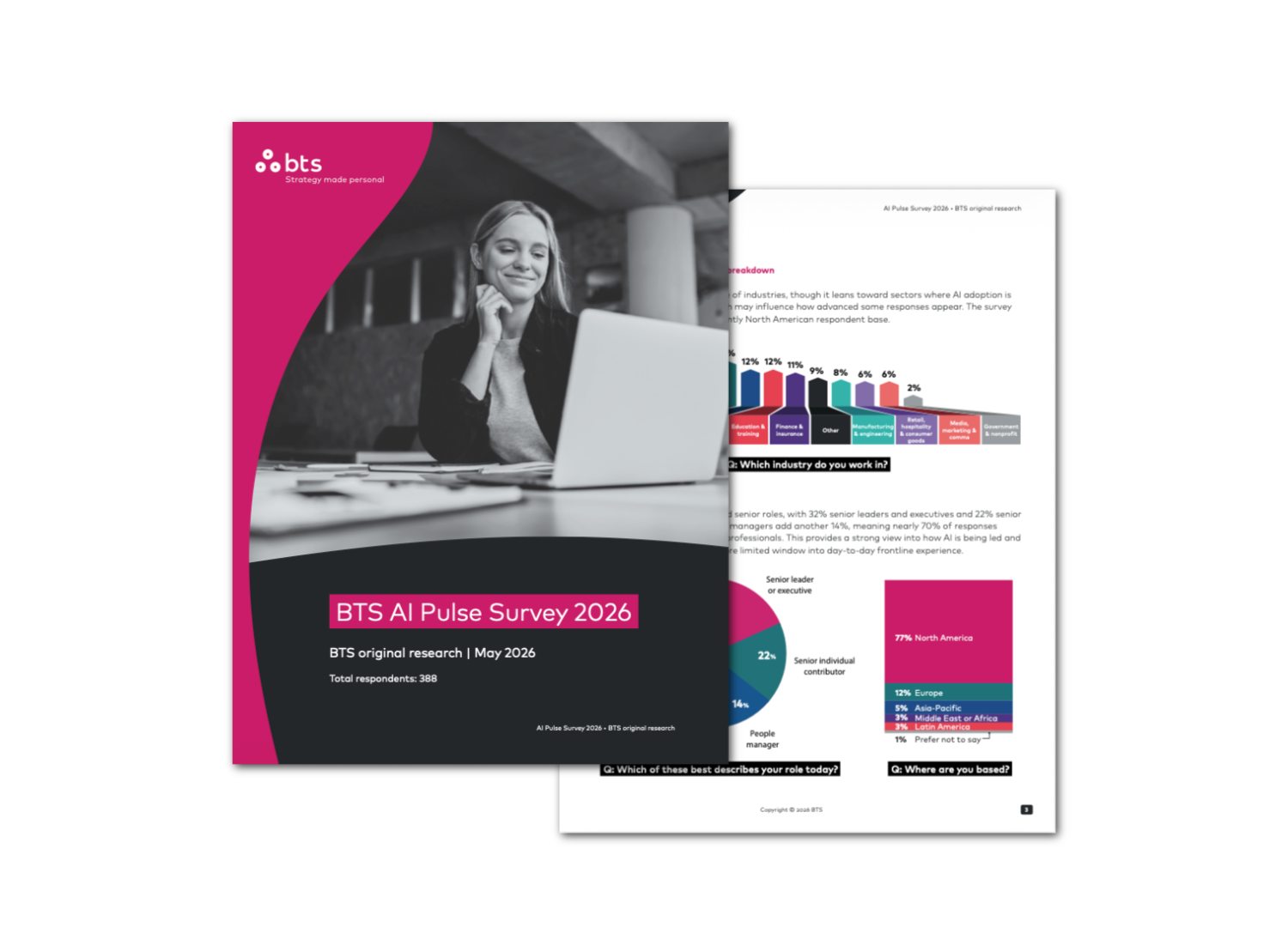
lorem ipsum

lorem ipsum

lorem ipsum
lorem ipsum

lorem ipsum
.avif)
lorem ipsum
.avif)
lorem ipsum