Talent insights & assessment

We help you evaluate, select, and develop leaders based on how they perform in real business situations.
Clients we partner with

Measuring leadership capability, potential, and readiness

Generic assessments give you generic data. Every BTS assessment is shaped around the realities of your business, reflecting your strategy, culture, and the challenges your leaders actually face.

Backed by 40+ I-O psychologists and 100+ expert assessors, we go beyond the traditional client-vendor model to act as your strategic talent partner, integrating assessment insights with leadership development, coaching, and transformation initiatives to drive measurable business impact.

How we help

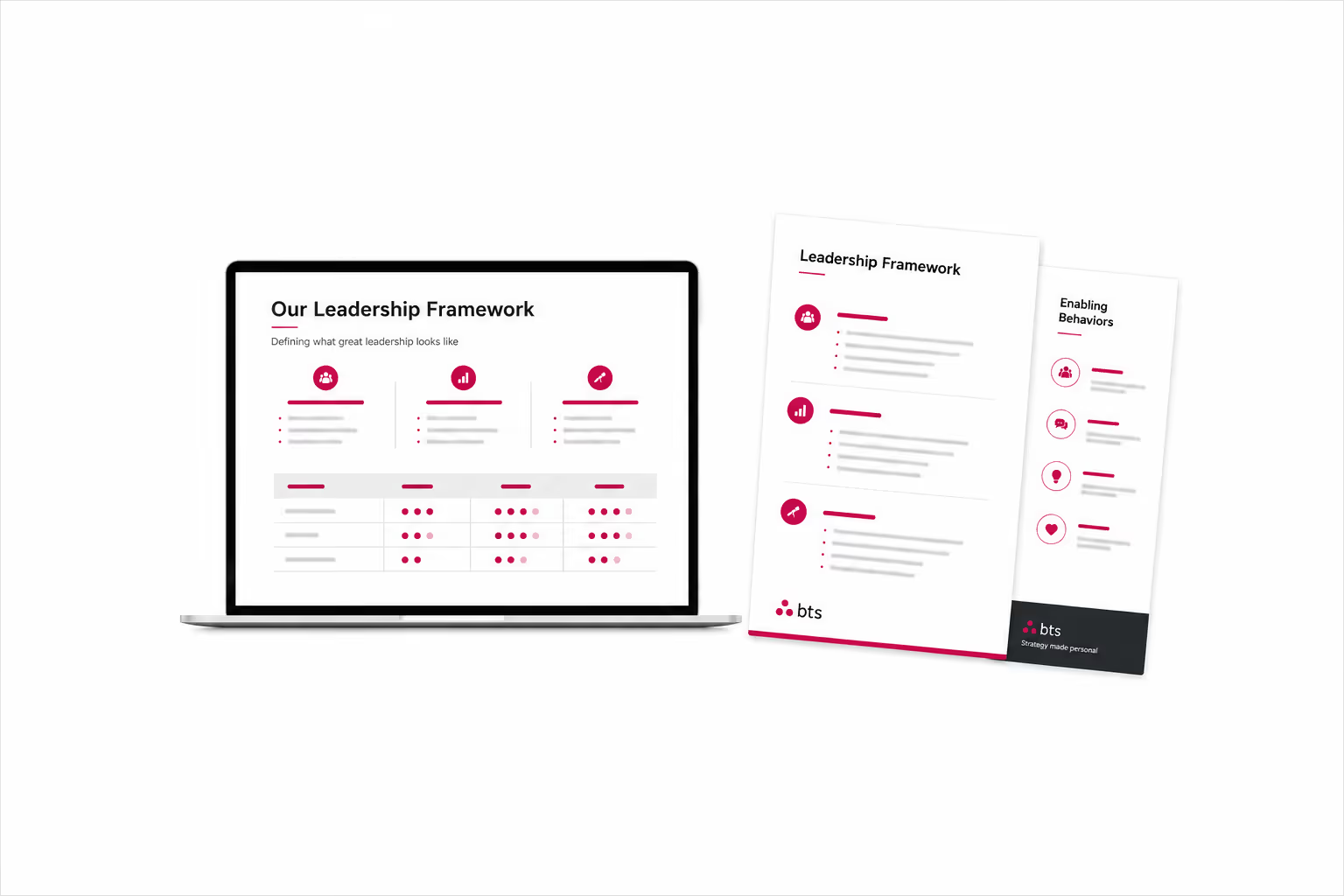
Talent frameworks

BTS talent frameworks translate your strategy into a clear set of leadership capabilities and behaviors, that define what "great" looks like. We use these frameworks to design assessments and evaluate leaders in action, so you can see how they perform against what actually matters.
How we help

Talent acquisition

BTS supports talent acquisition by providing role-specific, simulation-based assessments that evaluate how candidates think, decide, and lead in real business scenarios.

How we help

Talent and leadership development

By linking real-world assessment data to immersive development experiences, coaching, and business-driven learning, we help leaders grow in ways that translate directly to performance.

How we help

High potential identification

HiPo identification isn’t one-size-fits-all. BTS works with organizations to define what “potential” actually means based on their strategy, leadership model, and future role requirements.

Smiling businesswoman discussing documents with two colleagues at a desk in a bright office.
How we help

Succession planning

Create a leadership bench for strategically important roles

How we help

Talent analytics

BTS talent insights and analytics turn individual assessment results into a connected view of your talent, showing where you have strength, where you have gaps, and who is ready for what’s next. Through calibrated data, visual reporting, and expert interpretation, we help you pinpoint risk, prioritize development, and take action with confidence.

Whitepaper

Future-proofing succession: Insights from top talent leaders

Discover the six themes reshaping succession planning, with insights from top talent leaders and BTS research.

Client stories

AstraZeneca’s Liz Moran talks about their need for global succession processes.
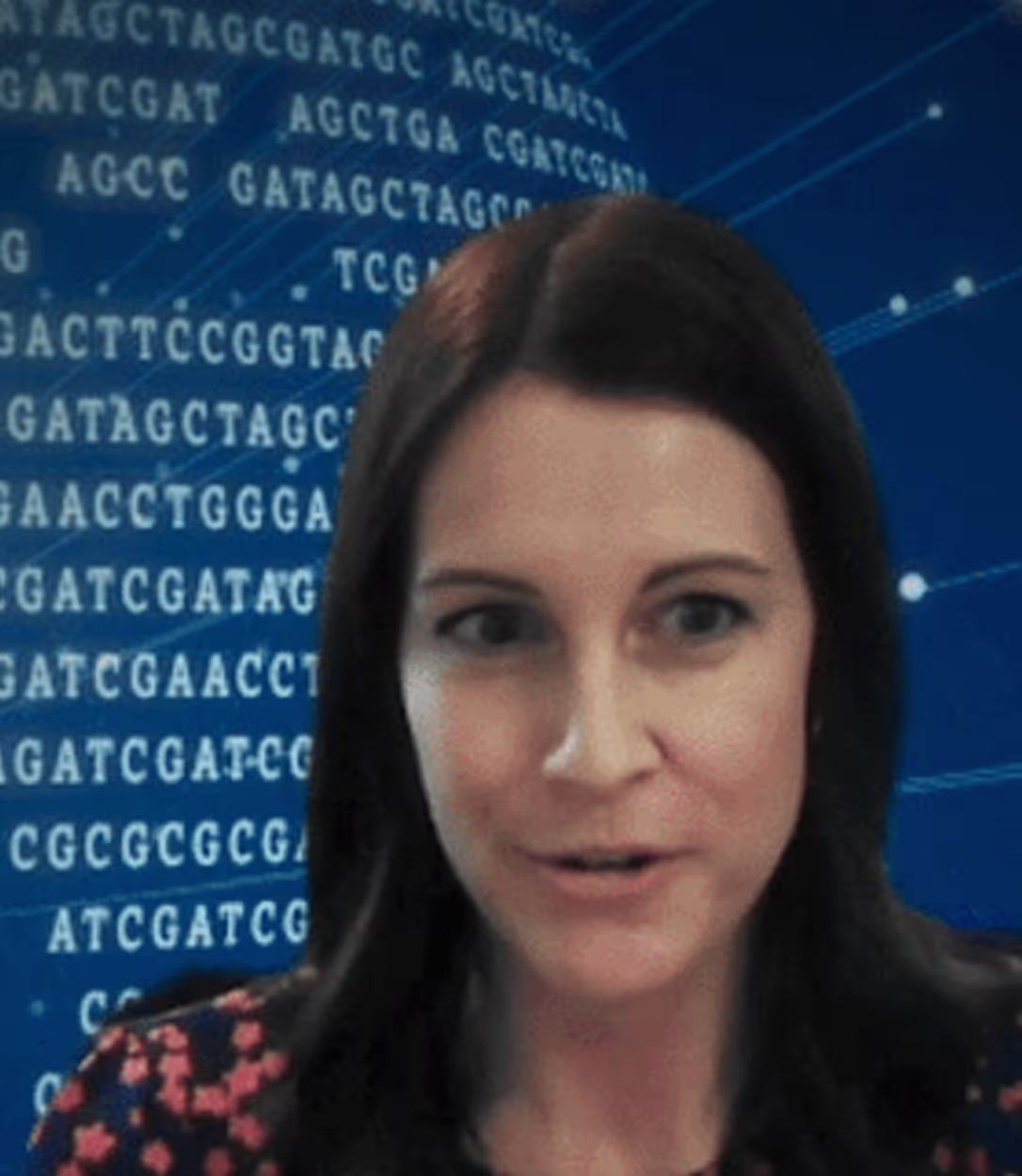

Woman with dark hair speaking in front of a blue background displaying DNA sequence letters.
Client Stories

Pfizer’s Connie Bustamonte talks about their need to level up their leadership

Learn more
Smiling middle-aged man with gray curly hair wearing a white lab coat and blue shirt.
Client Stories

A new strategy needs different talent

A global utility company with diverse, internationally distributed business units in a variety of functional areas, was experiencing a shift in strategy following a major change in leadership. The organization partnered with BTS to identify the right people who had the potential to develop into the next generation of C-suite leaders.

Learn more
Smiling electrician in orange safety gear holding a laptop at an electrical substation.
Client stories

Talent selection in Financial Services

Two businesspeople reviewing and signing documents at a wooden table with colorful pencils and a coffee cup in the background.

Latest Content

Blog
August 19, 2026
5
min read
Everybody's planning an AI reset off-site. Four mistakes will sink most of them.
Planning an AI reset off-site? The agenda decides everything. Four common design mistakes, and how to build two days that change what your company is capable of.

There’s a specific kind of strategy meeting getting scheduled right now, in nice hotels with bad coffee: the AI reset off-site.

And for good reason. In a 2026 WRITER survey, 48% of leaders described their AI rollout as, in their own words, a "massive disappointment." That's nearly half the room.

What that number really measures is the distance between what these tools can do and what people are doing with them. In our experience, that distance is almost entirely human.

Which is why the off-site is the right instinct. Making the most of that time is the harder part.

What separates an AI reset that actually changes the game from an expensive two-day conversation? In our experience, it comes down to avoiding four common design mistakes.

Mistake 1

Blaming the bots

The gap between AI investment and real adoption is almost always about people, not technology. And when adoption stalls, we usually find it's one of four things.

  1. They don't think it will help them
  2. Nobody around them is using it
  3. They don't feel capable
  4. Or they don't have real access to the tools they were promised

Four different problems, and four completely different fixes.

That's why diagnosis comes first. If you don't know which barrier you're dealing with, every intervention becomes an educated guess. And you cannot tell which one you have by staring at a dashboard. A belief gap and a skill gap look identical in a status report and need opposite interventions. Show up guessing, and you'll spend real money teaching people to use a tool they simply don't trust yet. Congratulations - you've just catered the wrong conversation.

Mistake 2

Letting leaders off the hook

One of the biggest predictors of whether change sticks is also one of the most overlooked: leadership.

If your executives show up as observers, nodding along and quietly answering email under the table, your people clock it in about four minutes.

That doesn't mean your CEO has to emcee the thing. It means they use the tools in front of everyone, participate in the conversation, and make it clear this isn't someone else's initiative.

Recently we’ve been working with a Fortune 200 global professional services firm who’s top 120 leaders were at very different points with AI. Some were redesigning entire processes. Others were using it to summarize emails, or not at all. Rather than focus on the technology, the four-hour session focused on what leaders could do with AI, applying it to a live strategic challenge and ending with a personal commitment to lead differently. The response was strong enough that the organization is now cascading the experience globally.

The lesson is simple: when leaders experience AI as a strategic capability, they're better equipped to model the behavior that makes adoption stick. Nothing you build during those two days survives without that entire chain of leadership doing its part.

Mistake 3

Chasing the wrong outcome

Without a behavioral baseline, you have no way to prove anything actually moved. No baseline, no ROI. You're just hoping the energy in the room was good, which is a wonderful feeling and a terrible metric to bring to your CFO.

But the baseline isn't just about proving the off-site worked. It's about understanding where you're starting in the first place. And you'll want that clarity, because the quiet resistance is real. In that same 2026 research, nearly a third of employees admitted to actively working around their company's AI strategy. If you don't win their belief in the room, some of them will keep politely ignoring the whole thing from their desks. You can't measure your way out of that. You have to earn your way out of it.

Which brings us to the biggest reframe of all.

Mistake 4

Leaving follow-through to chance

We've been working with a Fortune 100 medical device company on their AI strategy for three years. It started with their leadership team, a three-hour session built around what those leaders would do differently, and it landed. What became clear afterward was that the same experience needed to happen everywhere else. So, it expanded: 90-minute activations for 15,000 people, and this year intact teams redesigning their own workflows.

Three years in, that first session is the smallest part of the story.

Your event is where momentum gets created. What happens at 30, 60, and 90 days is where results get made.

If you're planning one of these and want to change what happens on Monday, not just how everyone feels on Friday, that the work we do.
We'd be glad to help you design it.
Blog
August 14, 2026
5
min read
Every candidate looks like a great hire now. AI made sure of it.
Polish is no longer a hiring signal. See how organizations use role-relevant simulations and predictive validity data to hire for high-stakes roles.

Candidates now arrive at interviews pre-coached by AI, with their resumes optimized to pass every checkpoint. Polish has stopped being a signal. The traditional hiring process was built to read exactly the cues that AI is now best at producing, and the signals hiring managers once relied on have weakened as a result. And for roles where the wrong hire carries real business consequences, losing the ability to tell who will actually perform is not a minor inconvenience. It is a material risk, and it exposes the business to unnecessary turnover, reduced performance, and heavier investment for talent growth and development.

So how do you observe the behaviors that matter most, before someone is in the role?

Not by asking better questions, but rather by putting candidates in situations designed to elicit that behavior.

The limits of predicting from paper

Credentials tell you what someone has done. Structured interviews tell you what someone says they would do. Neither lets you observe what they actually do in the moments that count.

This distinction matters most in client-facing, relationship-driven roles, where the performance gap between a strong hire and a weak one plays out in real business outcomes (revenue, retention, client growth). Organizations that hire at scale in these roles carry that gap across hundreds of decisions at a time.

The better approach is to watch candidates do the work before you hire them. Put them in simulated, role-relevant scenarios, and pair the simulation with a second, different kind of measure so no single method carries the whole decision. That combination is what lets you evaluate real performance before anyone is in the role. Organization-specific simulations provide a clear read on who is ready and capable of performing on day one. In a world of AI-supported candidate signals, the use of simulations makes the process harder to prep for. It is harder to fake. And, when designed well, it is substantially more predictive than other hiring methods.  

What counts as evidence

Claims about predictive power are easy to make. Evidence for them is rarer than you would expect.

A predictive validity study, the kind that links pre-hire assessment scores to how someone actually performs once hired, is some of the hardest evidence to produce and the rarest to see. Many assessments are validated against proxies: another test, or a theoretical model of the role, rather than real results on the job. Connecting scores to concrete business outcomes and doing the statistical work to show the link holds, takes years of shared data and a level of commitment from both the assessment provider and the client that most partnerships never reach. That is precisely why it is worth asking for. A provider who can show how assessment scores track to training completion, retention, and first-year output is offering something categorically different from one who can only show a correlation with another test.

Why simulation holds up where other methods do not

When a candidate sits across from a trained assessor (someone playing the client or prospect on the other side of the conversation) and has to work through a real situation, they cannot rely on a rehearsed answer. The scenario is specific. The stakes feel real. What you see is close to what you would get on the job.

That is the value of simulation-based assessment: it does not test what candidates know about the role.

It shows how they use what they know when a real person is on the other side of the conversation, before the stakes are real.

For roles that carry significant business responsibility, this distinction is the whole game. The cost of the wrong hire in a high-stakes client-facing role is not just a missed quota for a quarter - It plays out in relationships that do not develop, clients who leave, and productivity losses that compound over time. Getting those hiring decisions right, at scale, with consistency, requires methods that are built for predictive accuracy, not just candidate experience or hiring speed.

What this means for how organizations think about hiring

Most organizations are still optimizing the wrong things in their hiring process. They invest heavily in employer branding, application flow, and interview structure, all of which matter, but less in the core question: does our hiring process actually predict who will succeed in this role?

AI has sharpened the stakes here. If every candidate can present as polished and prepared, screening based on presentation becomes less useful. What holds up is direct observation of the behaviors that the job requires.

A few principles worth building from:

  • Measure what the job requires, not what is easy to measure. Cognitive tests and personality questionnaires have their place, but they do not look much like the job. The closer the assessment is to the actual work, the better it predicts performance in it.
  • Ask what your assessment predicts. Training completion? Retention? First-year output? Most organizations cannot answer that question today, largely because providers have rarely been asked to prove it. It is a fair thing to ask for.
  • Take the human element seriously. In a simulation, a candidate is having a real conversation, responding in real time, navigating a situation that requires judgment. Even with the help of AI, that is hard to game. And it remains one of the strongest predictors of on-the-job performance available.

The data exists to make hiring decisions more accurate, fairer, and more directly tied to business outcomes. For organizations operating in high-stakes roles at scale, there is too much on the line to rely on methods that cannot hold up to that standard.

You may be interested in BTS’ thought leadership in the five talent shifts AI is forcing now.  

Blog
July 15, 2026
5
min read
Why leadership needs less jargon
Why do leaders rely on business jargon? The answer may surprise you. This article explores the hidden ways leadership language shapes how others understand, trust, and respond to leaders.

Leadership is the work of creating shared understanding, and language is the primary tool for doing it. Yet we spend remarkably little time examining our words. Every decision, expectation, priority, and piece of feedback reaches another person through words. If those words aren't doing the job, neither is the leadership.

The lighthouse

Some years ago, a large company hired a strategy consulting firm to rethink its leadership model. The firm came back with a beautifully produced framework built around a central metaphor: the lighthouse.

Leaders, the model declared, should be lighthouses.

The metaphor quickly found its way into playbooks, performance reviews, onboarding decks, and town halls. People repeated it with the confidence of those who had paid a lot of money for it.

There was just one problem: nobody could agree on what a lighthouse was supposed to do.

Was it warning people away from danger? Guiding them toward a destination? Standing firm while everything else changed?

Eventually, the company hired another team to translate the metaphor into specific, observable leadership behaviors.

It was an expensive way to discover that a word everyone confidently repeated wasn't creating nearly as much shared understanding asthey thought.

Why jargon prevails

  • Parking lot that
  • Double-click
  • Close the loop

Business jargon survives because it’s largely designed to manage social risk. Using it signals, I know how this world works. It demonstrates membership, competence, and credibility.

Business is messy, and leaders don't always have complete information. Abstract language lets us project confidence while preserving flexibility.

Altitude without traction

Specific language creates accountability. The more specific you are, the easier it is for people to disagree, question your thinking, orhold you accountable. That's part of the appeal of jargon. It creates distance between the speaker and the detail. The more abstract and elevated your language, the more strategic you sound.

A 2020 study by Harvard Business School professors Laura Huang and Andy Wu, published in the Academy ofManagement Journal, analyzed over 1,000 early-stage startup pitches and found that founders who spoke in abstract, visionary terms were significantly more likely to advance in the funding process.

A separate study, published in Applied Cognitive Psychology in 2025, found the other side: jargon raises how credible a speaker appears and lowers how much the audience retains.

The very language that helps people see you as a leader can make you less effective once you're leading.

The most trusted leaders tend to be the ones who resist impressive-sounding language and say the plainest version of what they mean.

In fact, four words probably do more for a leader's standing than any carefully crafted message: I made a mistake. Not "we encountered some headwinds," not "there were learnings from this experience," but the plain version.

The cost of comfort

When a conversation gets uncomfortable at work, it almost always feels easier to soften your message than to say exactly what you mean. You hedge, add qualifiers, cushion the point with extra reassurance, or leave the hardest part unsaid. Most of the time, you mean well. You don't want to discourage someone, damage the relationship, or create unnecessary conflict. The conversation becomes less uncomfortable for a moment, but the work often becomes harder afterward.

Amy Edmondson, Novartis Professor of Leadership and Management at Harvard Business School and author of The Fearless Organization, found that the fear of making a negative impression pushes people to stay silent exactly when clarity is most needed. According to her research, silence is one of the most consistent predictors of teams that miss problems early and never learn from them. The friction avoided in the meeting resurfaces later, at greater cost.

KimScott, former executive at Google and Apple and author of Radical Candor, calls this ruinous empathy: softening your message to protect someone's short-term feelings comes at the cost of the clarity they need. Her argument is simple and uncomfortable: clear, direct communication, even when it is hard, is an act of care.

The quiet power of saying what you mean

None of this is an argument for bland, colorless language.Vivid, precise writing does the opposite of jargon: it sharpens meaning instead of hiding it. Before reaching for a word, pause on two questions:

  • What do I mean by it? 
  • What will my audience hear? 

A surprising amount of corporate language wouldn't survive those two questions.

Leaders have more influence over language than they often realize. Whatever tone, vocabulary, and level of directness they model becomes the standard everyone else copies. Word choice is one of the quietest ways leaders shape culture.

This matters even more as we hand our language to AI. These tools can already learn to write in our voice. The question now is whether we've been deliberate enough about that voice in the first place to like what we see.

Client Stories
July 16, 2026
5
min read
Wholesale bank strategy re-alignment for growth
See how BTS helped a global wholesale bank align 320+ leaders, break down silos, and execute a differentiated growth strategy across regions.

lorem ipsum

Client Stories
May 27, 2026
5
min read
Building a future-ready leadership bench in global fintech
A global fintech company partnered with BTS to strengthen senior leadership effectiveness and cultural alignment during rapid growth.

lorem ipsum

Client Stories
May 14, 2026
5
min read
Building enterprise leadership in medical affairs
Learn how BTS helped a global life sciences company strengthen enterprise leadership in critical medical affairs roles through simulations, leadership assessment, coaching, and cross-functional leader development.

lorem ipsum

BTS whitepaper cover: The Leadership Shift — mindset coaching research
Whitepapers
July 24, 2026
5
min read
The leadership shift: what two years of coaching data are telling us.
Two years of anonymized coaching data reveal the mindset patterns holding leaders back.

lorem ipsum

Whitepapers
July 24, 2026
5
min read
Applied AI field guides
Four practical guides for building AI capability, mobilizing leaders, and navigating the moments when AI innovation gets difficult.

lorem ipsum

Whitepapers
June 25, 2026
5
min read
BTS 2026 AI pulse survey
Read the original BTS research from nearly 400 leaders on AI adoption, workforce readiness, training gaps, and governance.

lorem ipsum

Neon sign with pink circular symbols and white text 'bts' mounted on a wall covered in rows of vintage cassette tape images.

Contact us.

Have a question or want to explore how we can help? Get in touch - we’d love to hear from you.